Candidate tracking software is most valuable when hiring confidence is improving but risk tolerance is still low. In this market pattern, teams need an application tracking system that records every candidate touchpoint, shortens response time, and protects decision quality. September labour data in Canada showed better headline numbers with continued executive caution, which is exactly the environment where online employment application software plus AI-driven outreach can outperform manual recruiting. This article explains the data context, the hiring behavior behind it, and a practical framework to combine ATS discipline with StrategyBrain AI Recruiter for faster screening and clearer pipeline control.
Key Takeaways
- Labour momentum was real but uneven: unemployment fell by 1.2 percentage points to 9.0%, while employment rose by 378,200 jobs, which was a 2.1% increase.
- Employer caution stayed high: many teams kept searching for highly specific profiles instead of broad hiring, which increases pipeline complexity.
- Candidate behavior split: active job seekers stayed engaged, but many employed candidates remained risk averse and less willing to switch roles.
- Candidate tracking software becomes a control system: structured stage tracking helps reduce missed follow-up and improves recruiter throughput.
- AI assisted outreach can reduce repetitive effort: StrategyBrain AI Recruiter is designed to automate early LinkedIn conversation and résumé collection while recruiters keep final qualification decisions.
- Global hiring requires language coverage: multilingual communication and 24/7 response are now operational needs, not optional enhancements.
What the Labour Signal Actually Said
The September labour update published on 9 October 2020 pointed to improving macro indicators. Unemployment declined to 9.0%, and total employment reached 18,470,000 after a monthly gain of 378,200. Relative to pre-pandemic baselines cited at the time, employment levels remained below prior peaks, but momentum was directionally positive.
At the same time, hiring sentiment stayed selective. Henry Goldbeck described an employer pattern where teams searched for highly precise fits rather than hiring broadly. That is a classic cautious expansion posture. Companies are willing to hire, but they are not willing to absorb quality risk from a weak match.
We also saw role specific divergence. Manufacturing added 68,000 positions in the same period, while hospitality faced greater downside uncertainty moving into fall operations. Therefore, recruiting leaders could not rely on one national number. They needed segment level visibility and faster pipeline adaptation by function and sector.
Why Candidate Tracking Software Matters More in Cautious Cycles
When leaders are selective, hiring friction increases across every stage. Recruiters run more outreach attempts, hiring managers request more evidence, and candidate drop off rises if response latency is high. A modern application tracking system acts as workflow infrastructure, not just a résumé database.
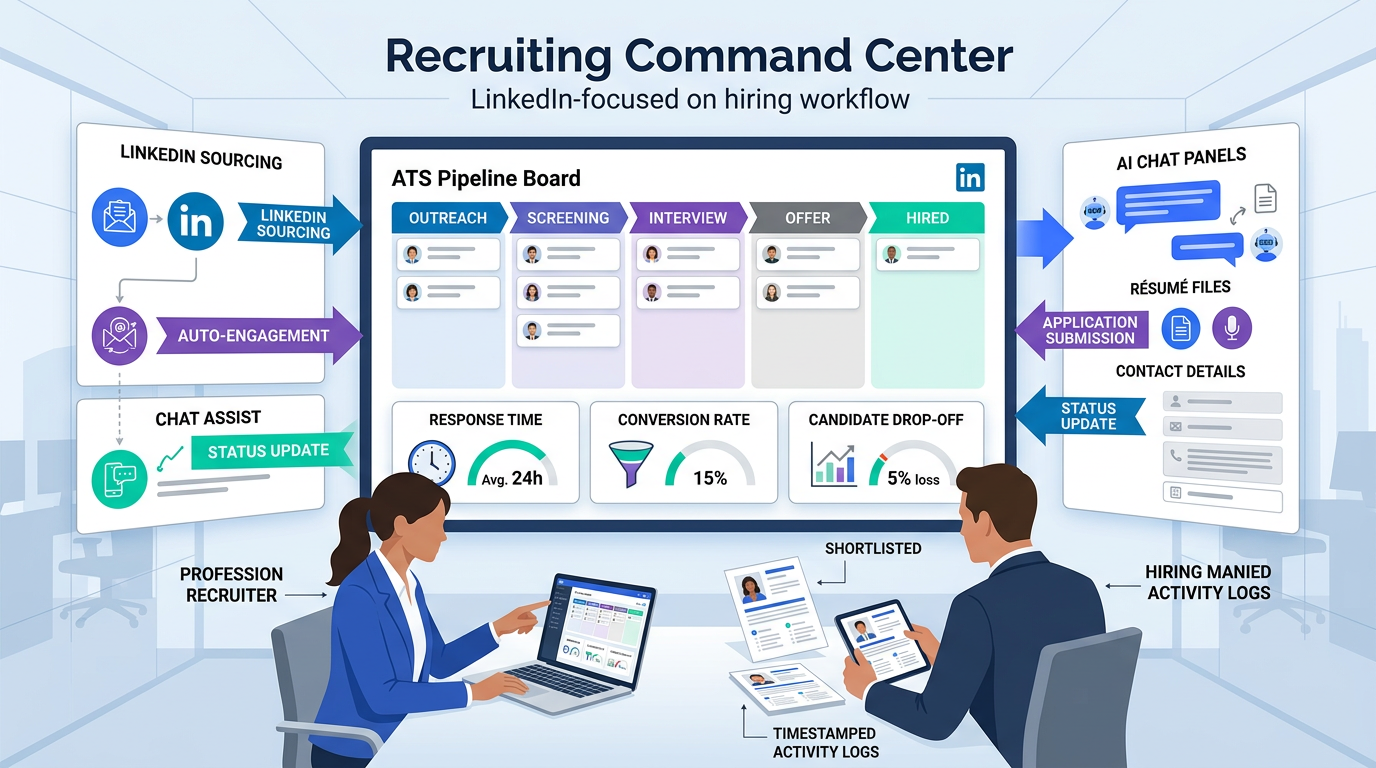
In practical terms, candidate tracking software should handle three core jobs. First, it must preserve stage level traceability from first contact to interview decision. Second, it should make recruiter activity measurable, including response time and conversion by step. Third, it should reduce manual admin so recruiters can spend more time on judgment, alignment, and candidate experience.
Online employment application software also improves governance. In a cautious market, documentation quality matters because hiring managers need confidence that choices are evidence based. Structured notes, standardized scoring rubrics, and status histories reduce avoidable disagreement and shorten decision cycles.
Where manual teams lose time
- Repeated candidate introductions and follow-up messaging
- Inconsistent collection of contact details and résumé files
- Slow handoff from sourcing to screening to interview scheduling
- Poor visibility into inactive candidates who may reengage later
A Practical Operating Model with StrategyBrain AI Recruiter
Based on our recruiting operations review, the most effective setup is an ATS centered process with AI support on repetitive front end communication. StrategyBrain AI Recruiter is built for LinkedIn focused automation and can initiate candidate contact, introduce openings, answer role level questions, and request résumé plus contact details from interested people.
This matters because candidate tracking software performs best when input quality is consistent. If early messaging and data capture are fragmented, the application tracking system becomes a storage layer rather than a decision layer. AI Recruiter can standardize first touch and information capture, then recruiters can apply professional judgment to final qualification and interview selection.
The platform is also positioned for cross border hiring operations through multilingual communication and continuous response windows. For teams hiring across time zones, this helps preserve momentum and improves candidate experience consistency.
What stays human in this model
- Final résumé fit assessment against role requirements
- Hiring manager calibration and interview design
- Compensation negotiation and closing conversations
- Risk review for culture and team fit
What can be automated safely
- Initial candidate connection and role introduction
- Early intent checks and interest confirmation
- Basic role Q and A based on approved job information
- Collection of résumé files and contact details for ATS ingestion
Step by Step Implementation Plan
- Audit current pipeline metrics: measure time to first response, stage conversion rates, and interview to offer ratio over the previous 30 days.
- Define ATS stage architecture: normalize stages across teams so candidate tracking software reflects one hiring language and one set of status rules.
- Deploy AI assisted front end outreach: configure StrategyBrain AI Recruiter with approved job details, candidate criteria, and response boundaries.
- Standardize data capture fields: ensure online employment application software receives consistent records for résumé status, contact details, and source channel.
- Set exception handling: route edge cases such as compensation disputes, legal questions, or nuanced role clarifications to human recruiters.
- Review quality weekly: monitor response quality, candidate satisfaction signals, and shortlist relevance, then refine prompts and stage rules.
Operational checklist
- Use a single definition for “qualified candidate” across recruiters and hiring managers
- Track every candidate message outcome with timestamp fields
- Require explicit disqualification reasons for closed profiles
- Maintain a reactivation list for candidates who were interested but not selected
- Document multilingual conversation policy for global consistency
Limitations and Risk Controls
No candidate tracking software can remove the need for recruiter judgment. AI Recruiter can identify willingness to continue discussions, but final fit against job requirements still requires human review of the résumé and context from hiring managers.
Second, teams should avoid over automating candidate communication. High volume messaging without role clarity can damage employer brand. The control is simple. Keep approved role facts current, define escalation thresholds, and review conversation samples regularly.
Third, data security and compliance must be non negotiable. StrategyBrain states that customer data is encrypted, isolated, and not used to train external models. Even with that design, each company should validate regional privacy requirements and internal governance standards before full rollout.
FAQ
Is candidate tracking software the same as an application tracking system?
In most hiring teams, the terms are used interchangeably. Candidate tracking software and an application tracking system both describe software that manages applicant records, hiring stages, and communication history.
Can online employment application software improve hiring speed without lowering quality?
Yes, if process design is disciplined. Speed improves when stage definitions, disqualification rules, and follow-up timing are standardized, while quality is protected through structured screening criteria and recruiter review checkpoints.
Does StrategyBrain AI Recruiter replace recruiter jobs?
It is designed to automate repetitive outreach and early conversation steps, not final hiring decisions. Recruiters still own qualification, shortlist quality, interview evaluation, and offer decisions.
How does this model support LinkedIn heavy recruiting teams?
AI Recruiter is built around LinkedIn workflow automation, including candidate connection, role introduction, and interest confirmation. That helps teams feed cleaner, more complete data into their ATS.
What KPI targets should we monitor first?
Start with time to first response in hours, screening to interview conversion in percentage points, and candidate drop off by stage. These indicators quickly show whether your candidate tracking software setup is improving real pipeline performance.
Can this approach work for global hiring?
Yes, especially when multilingual communication and around the clock candidate response are required. The key is to pair language coverage with consistent hiring policy and recruiter oversight.
Conclusion
The labour signal from September showed improvement with continued caution, and that combination is exactly where candidate tracking software delivers strategic value. A strong application tracking system gives process control, while AI assisted front end workflows can reduce repetitive work and preserve candidate momentum. If your team is managing selective hiring conditions, the next step is clear. Standardize your ATS stages, automate early outreach responsibly, and keep final qualification decisions in recruiter hands. That structure supports faster hiring without compromising decision quality.