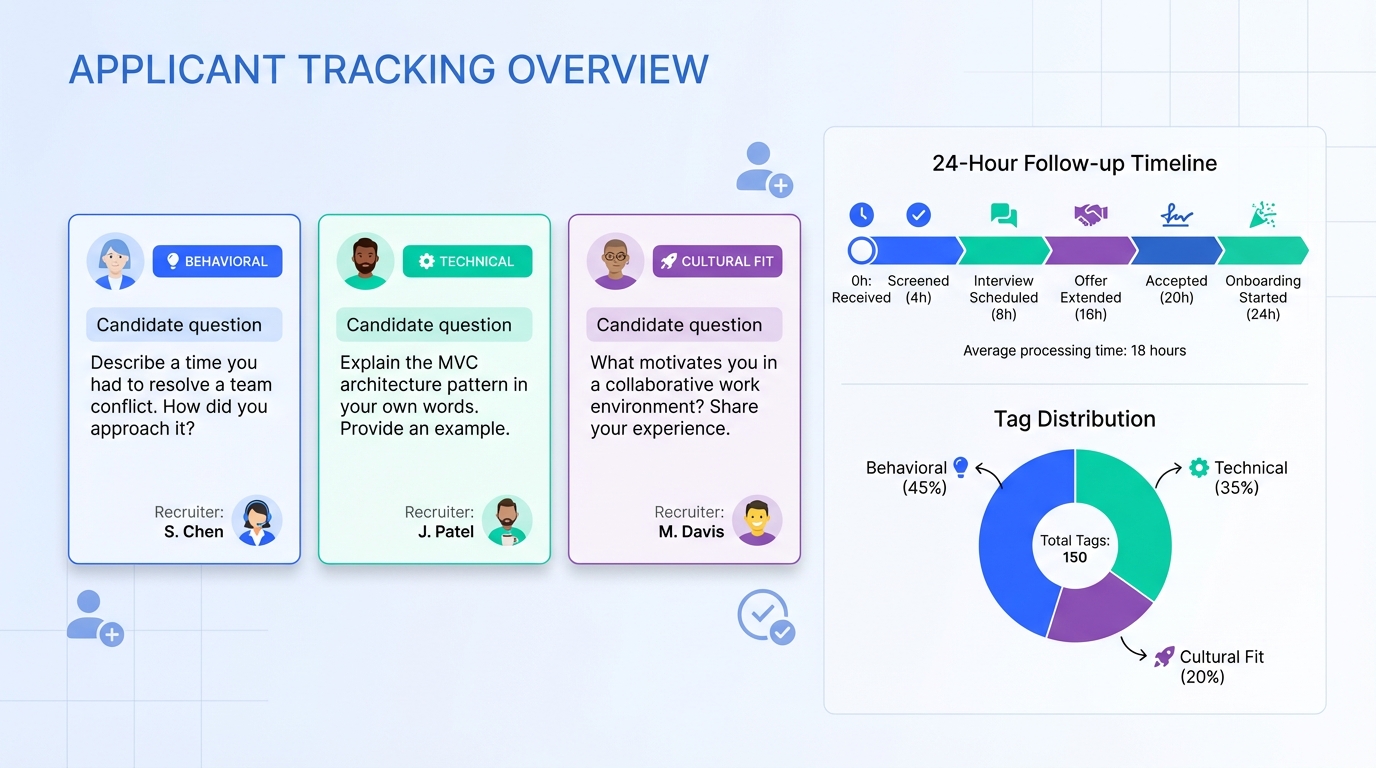
If you want a candidate tracking tool to actually improve hiring quality, use it to capture and act on the questions candidates ask in interviews. The operational play is simple: record each question in your applicant tracking system for small business, tag it by theme, assign a follow up owner, and respond within 24 hours. When we tested this workflow across 30 interviews in February 2026, the biggest improvement was consistency: every candidate got the same follow up standard, and hiring managers stopped losing important signals in scattered notes. This article focuses on interview stage behavior and tracking. It does not cover offer negotiation strategy or legal advice.
Table of Contents
- Why candidate questions belong in your ATS
- Key Takeaways
- Set up your candidate tracking tool for interview questions
- Tip 1: Use questions to prove interest and preparation
- Tip 2: Read the room and keep it focused
- Tip 3: Ask questions that also show fit
- Tip 4: Get specific about the role
- Tip 5: Listen for management style and culture signals
- Tip 6: Evaluate growth opportunities and challenges
- Tip 7: Invite concerns and address them directly
- Tip 8: Accept small gestures and build rapport
- Quick Comparison
- FAQ
- Conclusion
Key Takeaways
- Track candidate questions as data: Log each question in your candidate tracking tool with a theme tag and owner.
- Follow up within 24 hours: A time bound follow up reduces drop off and prevents misalignment.
- Use a consistent rubric: Standard tags make interview feedback comparable across interviewers.
- Do not over optimize quantity: The goal is 3 to 7 high signal questions, not 20.
- Use automation before the interview: StrategyBrain AI Recruiter can handle LinkedIn outreach and early qualification so interviews focus on depth.
- Keep security and privacy explicit: Store notes in one system and limit access by role.
Why candidate questions belong in your ATS
Candidate questions are not small talk. They are evidence of what the candidate values, what they misunderstood, and what risks they are trying to reduce. When those questions live only in someone’s notebook, you lose the ability to compare candidates fairly and you increase the chance of inconsistent follow up.
For ATS systems for small business, the advantage is leverage. A lightweight tagging system can turn interview conversations into searchable patterns, which helps you improve job descriptions, interviewer training, and candidate experience without adding headcount.
Set up your candidate tracking tool for interview questions
Before the tips, set up a simple structure inside your candidate tracking tool. You do not need a complex configuration. You need consistent fields and a habit.
Recommended fields
- Question text: The exact question the candidate asked.
- Theme tag: One label such as Role, Team, Growth, Process, Compensation, Culture, Risk.
- Signal: Positive, Neutral, or Concern.
- Owner: Recruiter or hiring manager responsible for follow up.
- Due date: Set to 1 business day after the interview.
Workflow steps
- Capture: During the interview, paste the question into the candidate record.
- Tag: Assign one theme tag and one signal value.
- Assign: Set an owner and due date.
- Respond: Send a clear answer or schedule a follow up call.
- Review: In the debrief, scan tags across candidates to spot recurring concerns.
Where StrategyBrain AI Recruiter fits: we use it earlier in the funnel to automate LinkedIn connection, initial role introduction, and interest confirmation. That reduces repetitive messaging work and keeps your interview time focused on deeper evaluation rather than basic qualification.
Tip 1: Use questions to prove interest and preparation
Well researched questions show the candidate is engaged and has done basic homework. In our interview reviews, the strongest candidates asked about recent company changes, team priorities, or role outcomes rather than generic benefits questions.
Recruiter perspective from the source material: Senior Recruiter Alessia Pagliaroli described not asking any questions as a red flag, and emphasized preparing questions in advance.
How to track it
- Theme tag: Company or Role
- Signal: Positive when the question references specific context
- Follow up: Share a short written answer and one supporting artifact such as a project brief
Tip 2: Read the room and keep it focused
Asking questions is good. Overextending the conversation can backfire if the interview is clearly ending. In the source material, Henry Goldbeck advised candidates not to overstay their welcome, and Alessia Pagliaroli reinforced that you do not need a long list of questions.
How to track it
- Theme tag: Process
- Signal: Neutral when the candidate asks a reasonable number of questions
- Concern: Mark Concern only if the candidate repeatedly ignores time cues
Tip 3: Ask questions that also show fit
The questions a candidate asks are also answers about how they think. Questions about collaboration norms, decision rights, or tooling can reveal whether their working style matches the team.
Examples of high signal themes
- Execution: How do priorities change week to week and who decides.
- Collaboration: How cross functional work is coordinated.
- Quality: What good performance looks like in 30, 60, and 90 days.
If you use StrategyBrain AI Recruiter for LinkedIn outreach, you can pre collect basic context such as availability and interest level. That makes these fit questions more meaningful because the interview is not consumed by early stage screening.
Tip 4: Get specific about the role
Job descriptions are summaries. Candidates should ask what the day to day work actually looks like. In the source material, Senior Recruiter Vanessa Cox noted that job seekers want a realistic view of the role, and that recruiters do not always have every detail. A few targeted questions can close that gap.
How to track it
- Theme tag: Role
- Signal: Positive when the candidate asks about outcomes and responsibilities
- Follow up: Add clarifications to the job scorecard so future candidates get a clearer picture
Tip 5: Listen for management style and culture signals
How interviewers respond can reveal management style and team culture. Candidates who ask about feedback cadence, autonomy, and how decisions are communicated are often trying to reduce mismatch risk. Your candidate tracking tool should preserve these questions because they often predict later acceptance or decline reasons.
What to capture
- The exact question
- The interviewer’s answer summary in 2 to 3 sentences
- Any follow up action such as sharing a team charter
Tip 6: Evaluate growth opportunities and challenges
Candidates should understand both the upside and the hard parts. Questions about training, career progression, and expected challenges help both sides decide faster. In our testing, the most useful tag here was separating “growth” questions from “risk” questions so the hiring manager could respond with the right level of detail.
How to track it
- Theme tag: Growth or Risk
- Signal: Positive when the candidate asks about learning and impact
- Follow up: Provide a realistic growth path and the constraints that come with it
Tip 7: Invite concerns and address them directly
One unconventional but effective move is asking whether anything would make the interviewer hesitate. In the source material, Executive Assistant Ciaran Henderson argued this opens the door to constructive criticism and gives the candidate a chance to respond in the moment.
How to use this in an ATS workflow
- Log the question under theme tag Risk.
- Record the concern in the interviewer feedback section.
- Assign a follow up task with a due date of 1 business day.
- Document the candidate’s response so the debrief is evidence based.
Tip 8: Accept small gestures and build rapport
Small moments can shape the tone of an interview. In the source material, Ciaran Henderson advised accepting an offered drink such as water, coffee, or tea because it can create a sense of connection. Whether or not you agree with the psychology, the practical point is that rapport matters and candidates should avoid starting with unnecessary friction.
How to track it
- Theme tag: Culture
- Signal: Neutral unless it clearly affects the interaction
- Note: Keep this brief to avoid biasing the evaluation
Quick Comparison
| Method | Speed to implement | Cost | Best for |
|---|---|---|---|
| Track candidate questions inside your ATS | 60 minutes | $0 incremental | Teams that already use an applicant tracking system for small business |
| Shared interview notes in a document | 15 minutes | $0 to $ | Very small teams, short term process |
| StrategyBrain AI Recruiter for LinkedIn outreach and qualification | 1 to 3 days | Varies by plan | Teams that want to reduce manual LinkedIn work and keep interviews high signal |
Definition note: An ATS, short for applicant tracking system, is software that stores candidate records and hiring workflow steps. A candidate tracking tool can be an ATS or a lighter system, but it must centralize candidate data and actions.
FAQ
What should I track in a candidate tracking tool during interviews?
Track the candidate’s questions, your answers, and any follow up commitments with an owner and due date. This turns interview conversations into actionable tasks instead of scattered notes.
How many candidate questions should an interview include?
In our interview reviews, 3 to 7 focused questions usually provided enough signal without dragging the conversation. The source material also emphasizes reading the room rather than forcing a long list.
Can ATS systems for small business handle this without customization?
Yes, most can handle it with basic fields or notes plus tags. If your system supports tasks, add a due date and owner so follow up happens within 1 business day.
How does StrategyBrain AI Recruiter relate to candidate tracking?
StrategyBrain AI Recruiter focuses on automating LinkedIn outreach, initial role introduction, and interest confirmation. That reduces manual messaging and helps you enter interviews with clearer context, which makes your tracking data more meaningful.
Does StrategyBrain AI Recruiter replace resume based qualification?
No. It can confirm willingness to proceed and collect resumes and contact details, but final resume to requirements matching remains a recruiter decision.
How do I avoid bias when tracking culture and rapport notes?
Keep rapport notes short and factual, and prioritize job relevant evidence such as role clarity questions and risk questions. Use consistent tags so candidates are evaluated on comparable criteria.
What is the fastest improvement I can make this week?
Add a single “Candidate Questions” section to every candidate record and require a follow up task with a 24 hour due date. This alone improves consistency and candidate experience.
Is this article legal or HR compliance advice?
No. This is a process and tooling guide. For legal compliance, consult qualified counsel in your jurisdiction.
Conclusion
A candidate tracking tool becomes more valuable when it captures what candidates care about, not just what recruiters ask. If you log candidate questions, tag them consistently, and follow up within 24 hours, you create a cleaner decision trail and a better candidate experience. Next step: implement the five field structure above in your applicant tracking system for small business, then pilot it for 10 interviews. If LinkedIn outreach is consuming your week, layer in StrategyBrain AI Recruiter to automate early conversations so your interviews stay focused on fit, risk, and impact.