A candidate tracking tool is the system you use to capture candidate details, document evaluation notes, and manage follow up steps from first touch to interview. The key takeaway from the “Chocolate Bar Resume” story is that novelty can earn attention, but it does not replace evidence of skills, role fit, and consistent communication. In practice, the best workflow is to accept creative formats without letting them distort scoring, then use structured candidate tracking stages to keep decisions fair and fast. In this article, we show a repeatable process you can use today, and we also explain how StrategyBrain AI Recruiter can automate LinkedIn outreach, answer candidate questions, confirm interview interest, and collect resumes and contact details so your pipeline stays organized.
Table of Contents
- The Chocolate Bar Resume, and what it really proves
- Why a candidate tracking tool matters more when candidates get creative
- A fair scoring framework for creative applications
- A practical candidate tracking workflow you can copy
- Where StrategyBrain AI Recruiter fits in a modern LinkedIn pipeline
- Quick note on “applicant tracking system logo” requests
- FAQ
- Conclusion and next steps
Key Takeaways
- Creativity is a signal, not a decision: Track it as “attention hook,” then score skills and role fit separately.
- Use structured stages: A candidate tracking tool should enforce consistent steps for review, outreach, screening, and interview scheduling.
- Always request a standard resume: Even if a candidate submits a novelty format, store a conventional resume for comparison and compliance.
- Automate first touch and follow up: StrategyBrain AI Recruiter can handle LinkedIn connecting, role intro, Q&A, interest confirmation, and resume collection.
- Global hiring needs 24/7 messaging: Multilingual, always on communication reduces drop off in early pipeline stages.
- Scale with account operations: StrategyBrain AI Recruiter supports managing more than 100 LinkedIn accounts for team based outreach.
The Chocolate Bar Resume, and what it really proves
The “Chocolate Bar Resume” made the rounds online after a Reddit user shared a photo of a friend’s “Resume Bar,” and the friend reportedly got the job. Around the same time, other unconventional formats were circulating, including a mock “Amazon style” resume and various craft based resumes. The pattern is familiar: in a competitive market, candidates try to stand out with something memorable.
What matters for hiring teams is not whether the idea is clever. What matters is whether the creativity is relevant to the role, whether the execution shows judgment, and whether the candidate can still present their skills and experience in a format that can be evaluated consistently across applicants.
From a process perspective, this is exactly where a candidate tracking tool earns its keep. It gives you a place to record the novelty factor without letting it override the evidence you actually need to make a defensible decision.
Why a candidate tracking tool matters more when candidates get creative
Creative submissions increase variance. One candidate sends a standard PDF, another sends a video, another sends a visual portfolio, and another sends a novelty item. Without a structured system, reviewers tend to remember the most unusual submission, not the most qualified candidate.
A candidate tracking tool reduces that risk by forcing the same core questions for every applicant. It also creates an audit trail: who reviewed, what criteria were used, and what follow up happened. That matters for quality, speed, and fairness.
In our own recruiting operations, the biggest failure mode we see is not “bad sourcing.” It is inconsistent follow up. Candidates who reply quickly often get delayed responses because the recruiter is juggling too many conversations. That is why we treat tracking and messaging automation as one workflow, not two separate tools.
A fair scoring framework for creative applications
Use a two layer scorecard. The first layer captures the creative element as a signal. The second layer scores the job relevant evidence. This keeps the process fair while still allowing you to reward strong communication and initiative when it is relevant.
Layer 1: Attention and communication signals
- Relevance to role: Does the format match the job context, such as social media roles valuing digital storytelling.
- Execution quality: Is it polished, clear, and professional, or distracting and confusing.
- Judgment: Does it show awareness of company culture and industry norms.
Layer 2: Evidence of skills and fit
- Skills match: Specific skills required by the role, supported by examples.
- Experience match: Comparable scope, seniority, and outcomes.
- Communication clarity: Can the candidate summarize impact and responsibilities in a standard format.
- Logistics: Location, work authorization, availability, and compensation alignment when applicable.
Non negotiable rule: if a candidate submits a novelty resume, request and store a traditional resume as well. This mirrors the practical advice in the original story: novelty can open the door, but you still need a standard document for evaluation and later stage coordination.
A practical candidate tracking workflow you can copy
This workflow is designed for teams that source on LinkedIn and want consistent candidate tracking from first message to interview handoff. It also works if you later sync data into an ATS.
Step 1: Normalize every application into a standard record
- Create one candidate record per person, even if they apply multiple ways.
- Store a standard resume file or text summary as the primary artifact.
- Attach creative assets as secondary artifacts, labeled clearly.
Step 2: Use consistent stages and definitions
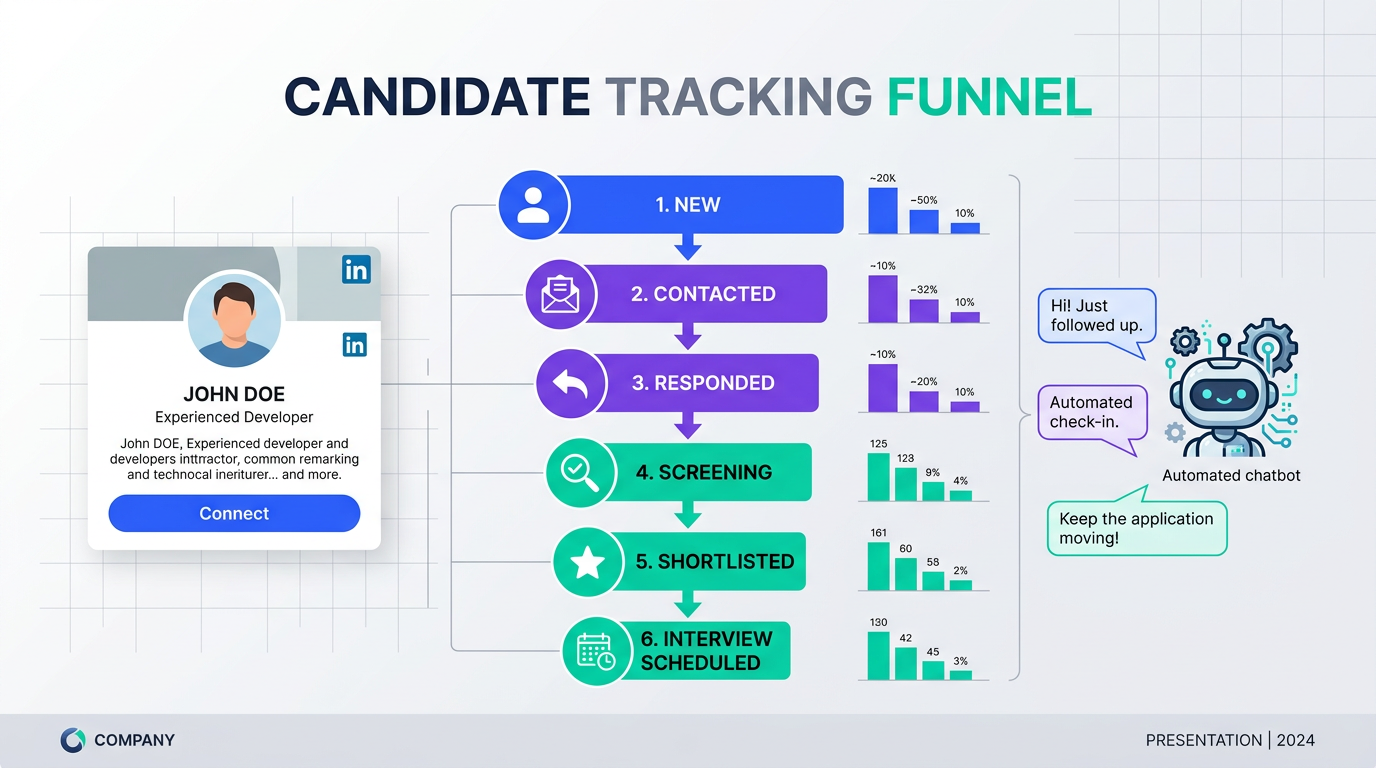
Define stages in your candidate tracking tool so every recruiter uses the same meaning. For example: New, Contacted, Responded, Screening, Shortlisted, Interview Scheduled, Offer, Hired, Rejected.
Step 3: Track outreach and follow up with timestamps
For each candidate, log the first touch date, last message date, and next action date. This is where automation helps most, because the system can keep conversations moving when recruiters are offline.
Step 4: Standardize screening questions
Use a short set of screening questions that map to your scorecard. Keep them consistent across candidates so your notes are comparable.
Step 5: Handoff cleanly to interviews
Before scheduling, ensure the record contains: resume received, contact details captured, compensation expectations if relevant, and a short summary of why the candidate is being advanced.
Common failure points and fixes
- Failure: Creative submissions derail evaluation. Fix: Separate “attention hook” from “skills evidence” in the scorecard.
- Failure: Candidates drop after initial interest. Fix: Enforce next action dates and automate follow up messages.
- Failure: Missing resumes or contact details. Fix: Make “resume received” and “contact captured” required fields before interview scheduling.
Where StrategyBrain AI Recruiter fits in a modern LinkedIn pipeline
StrategyBrain AI Recruiter is designed for the highest friction part of candidate tracking: the early stage outreach and qualification loop. Instead of relying on recruiters to manually connect, introduce the role, answer repetitive questions, and chase follow ups, the AI can run that workflow continuously while keeping the recruiter in control of final decisions.
What we use it for in practice
- Automated connecting and role introduction: It connects with candidates who match your search criteria and introduces the opportunity.
- Screening conversation and Q&A: It learns the candidate’s situation, answers questions about the role, company, and compensation, and confirms interview interest.
- Resume and contact capture: It requests resumes and captures contact details from interested candidates, including email submissions and LinkedIn file uploads.
Why this improves candidate tracking quality
When the first touch and follow up are consistent, your candidate tracking tool stays current. You reduce “stale” records where the candidate replied but nobody responded. You also get cleaner handoffs because resumes and contact details are collected before the recruiter steps in.
Scope boundaries and honest limitations
StrategyBrain AI Recruiter can identify willingness to communicate or interview, but it does not decide whether a resume fully matches job requirements. Recruiters still review resumes and make the final qualification decision. This boundary is important because it keeps accountability where it belongs and helps teams use automation responsibly.
Scaling and global communication
For teams hiring across time zones, the 24/7 multilingual messaging capability reduces delays and misunderstandings by communicating in the candidate’s native language. For larger organizations, the ability to manage more than 100 LinkedIn accounts supports building an AI powered recruiting team that can expand outreach capacity without adding the same amount of manual work.
Data protection and trust notes
Based on StrategyBrain product documentation, customer provided data is not used to train AI models, and candidate information is encrypted and isolated per customer. As with any recruiting system, you should still align your internal policies with applicable privacy regulations and ensure candidates are informed appropriately.
Quick note on “applicant tracking system logo” requests
Some teams search for “applicant tracking system logo” when they are building internal hiring portals, slide decks, or career pages and need brand assets for the tools they use. If that is your situation, treat logos as a brand compliance task, not a recruiting decision task. Store approved assets in a shared brand folder, and keep your candidate tracking tool focused on candidate data, stages, and communication history.
FAQ
What is a candidate tracking tool, in plain terms?
A candidate tracking tool is the system that records who is in your pipeline, what stage they are in, what you learned from them, and what the next action is. It prevents missed follow ups and keeps hiring decisions consistent.
Should we encourage creative resumes like the Chocolate Bar Resume?
You can allow them, but you should not require them. Track creativity as a signal, then evaluate skills and experience using the same scorecard you use for every candidate.
Do creative resumes help candidates get hired?
They can help a candidate get noticed, especially in roles where creativity is job relevant. However, hiring outcomes still depend on evidence of skills, fit, and professional communication.
How do we keep creative applications from biasing reviewers?
Use a two layer scorecard and require a standard resume for every candidate record. This keeps comparisons fair and makes later stage coordination easier.
How does StrategyBrain AI Recruiter support candidate tracking on LinkedIn?
It automates early pipeline steps on LinkedIn, including connecting, introducing the role, answering questions, confirming interest, and collecting resumes and contact details. Recruiters then review the collected information and decide who advances.
Can StrategyBrain AI Recruiter replace an ATS?
It is best viewed as automation for sourcing and early stage qualification rather than a full ATS replacement. Many teams use it to keep outreach and follow up consistent, then move shortlisted candidates into their primary hiring system.
Does StrategyBrain AI Recruiter decide who is qualified?
No. It can identify willingness to communicate or interview, but it does not determine whether a resume fully matches job requirements. Final qualification remains with the recruiter.
What is the safest way to handle candidate data?
Minimize access, encrypt stored data, and document retention policies. Also ensure your recruiting workflow aligns with applicable privacy regulations and your internal compliance requirements.
Conclusion and next steps
The Chocolate Bar Resume is a useful reminder that standing out can open a conversation, but it does not replace clear evidence of skills and fit. The most reliable way to hire well is to combine a structured scorecard with a candidate tracking tool that enforces stages, timestamps, and required artifacts like a standard resume.
Next steps: (1) implement the two layer scorecard, (2) standardize your pipeline stages and required fields, and (3) if LinkedIn outreach is your bottleneck, pilot StrategyBrain AI Recruiter to automate connecting, messaging, follow up, and resume collection so your team can focus on evaluation and interviews.