When recruiter hours and candidate trust are at risk, this article helps hiring teams judge which interview scheduling app fits real workflows and avoids generic-calendar mistakes.
That matters because scheduling failure is rarely just a calendar problem. In a small search firm, it burns recruiter hours that should go to outreach and qualification. For an independent recruiter, it weakens response speed and can make promising candidates feel handled carelessly. For an internal talent team, it creates friction with hiring managers, delays first interviews, and leaves the employer brand carrying the cost of avoidable confusion.
In my own workflow, I have found that scheduling gets easier when repetitive candidate communication is handled upstream instead of waiting until interview coordination breaks down. Using AI Recruiter to keep candidate conversations moving, answer routine role questions after hours, and collect resumes and contact details earlier helped reduce the scramble that usually lands on the coordinator or recruiter later. It does not replace recruiter judgment; I still review resumes, decide who moves forward, and own the final interview plan.
The same pattern shows up in remote work. Before anyone joins a call, they need a setup that actually supports the meeting: a usable desk, reliable internet, clear audio, and tools that make digital collaboration possible. In hiring, candidates and interviewers are not so different. A recruiter can send invites all day, but if calendars are messy, availability is unclear, and the meeting setup is fragile, the process starts with avoidable discomfort instead of momentum.
Once a team shifts into distributed interviewing, the weaknesses become visible fast. People try to treat hiring like business as usual, yet the routine depends on connected tools, clear communication, and protected focus. That is why automated interview scheduling is not just about booking speed. It is about choosing an interview scheduling app that supports real recruiting work better than generic online calendar programs or a simple book calendar app ever could.
Table of Contents
- Key takeaways
- Why scheduling setup matters before automation
- What automated interview scheduling actually does
- Where generic calendar tools fall short
- Features that matter in real recruiting operations
- What remote and distributed hiring changes
- How I combine outreach automation with scheduling
- How to evaluate the right solution
- Common mistakes to avoid
- FAQ
Key takeaways
- A strong interview scheduling app does more than share open slots; it applies rules that fit recruiting workflows.
- Remote and distributed hiring make scheduling setup more important, not less.
- Generic online calendar programs often work for simple meetings but struggle with panels, stages, and recruiter control.
- A lightweight book calendar app may help with basic appointments, but hiring teams usually need more governance and better visibility.
- Upstream candidate communication and downstream interview coordination should support each other, even when different tools handle each part.
Why scheduling setup matters before automation
One useful lesson from remote work is that productivity starts with preparation. People do better work when the basics are in place: the right workspace, dependable equipment, working communication tools, and a routine that makes collaboration easier. Interview coordination follows the same logic. If your hiring team has poor calendar hygiene, unclear ownership, weak candidate communication, or inconsistent meeting setup, automation will expose those issues rather than hide them.
That is why experienced recruiters do not evaluate scheduling software as if it were just another convenience feature. We look at whether the tool can support the actual environment people are working in. Can interviewers maintain focus without double booking? Can candidates self-schedule without creating confusion? Can coordinators recover cleanly when someone needs to move a meeting?
Practical takeaway: In recruiting, the quality of your interview setup often determines whether automation saves time or simply accelerates mistakes.
What automated interview scheduling actually does
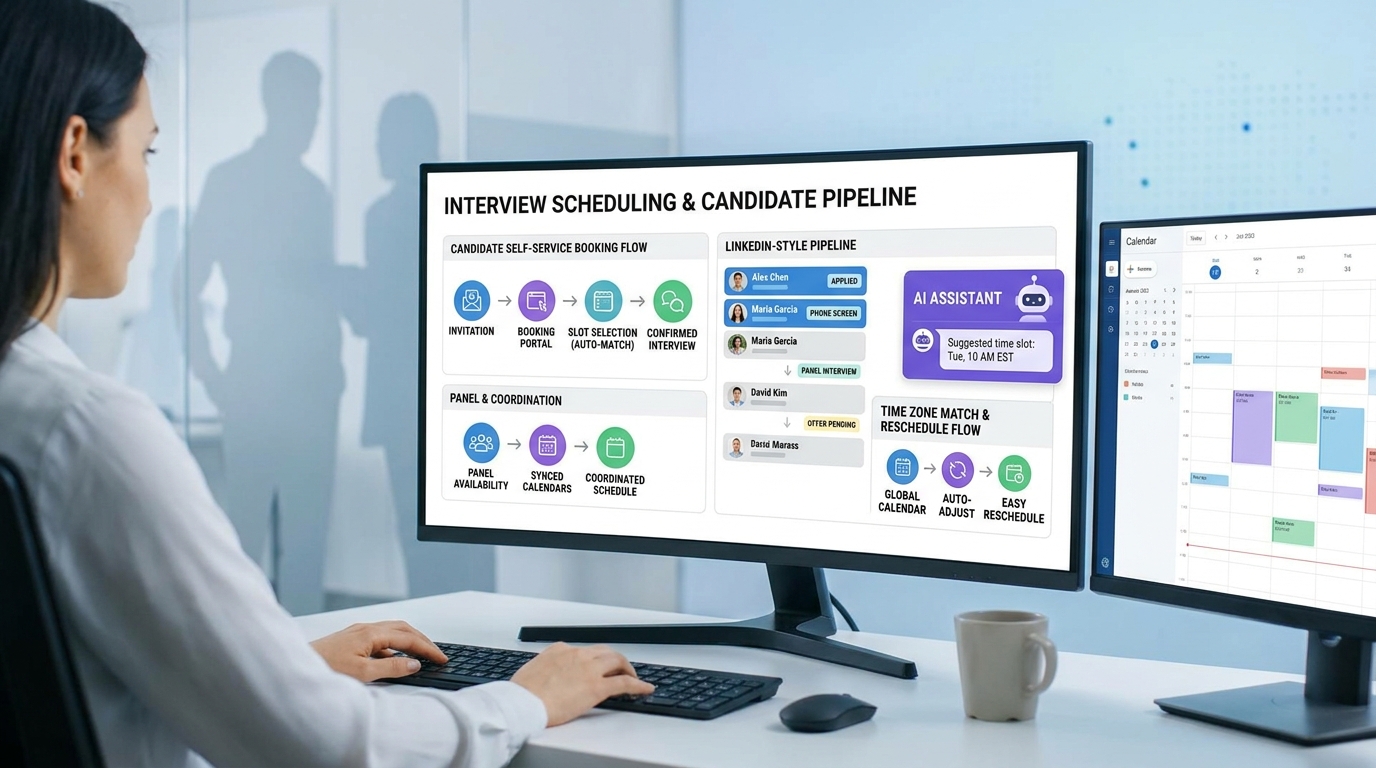
Automated interview scheduling is the process of matching candidate availability, interviewer calendars, working hours, time zones, interview stages, and meeting rules so valid time slots can be booked with far less manual coordination. The right interview scheduling app functions like a matching engine, not just a digital sign-up page.
In practice, that means the system should be able to:
- Read interviewer availability from connected calendars
- Respect working hours and time-zone differences
- Support different interview types, including one-on-one, panel, and multi-stage loops
- Offer candidate self-service scheduling only for valid slots
- Handle reschedules and cancellations without forcing recruiters back into email chains
When this works well, recruiters spend less time chasing confirmations and more time doing the work that still requires judgment: screening, calibration, candidate management, and stakeholder alignment.
Where generic calendar tools fall short
Most teams begin with tools they already know. That is understandable. Plenty of online calendar programs can send invites, expose availability, and create meeting links. For simple internal meetings, that may be enough. Recruiting is different because availability is only one part of the decision.
A hiring workflow usually includes stage logic, interviewer combinations, buffers, reschedule policies, candidate messaging, and accountability across several people. That is where a generic tool starts to feel thin. A basic book calendar app may let one person book time with another, but it often does not handle recruiter-level complexity very gracefully.
Common failure points include:
- Panel interviews that require overlapping interviewer availability
- Multi-stage plans where each round needs different participants and rules
- Reschedules that break links between interview stages
- Overloaded interviewers who keep appearing as available because no load balancing exists
- Candidate communication that feels detached from the rest of the hiring process
That gap is why recruiting teams should compare category fit, not just calendar polish.
Features that matter in real recruiting operations
When I assess an interview scheduling app, I care less about glossy booking pages and more about how the system behaves when the process gets messy. These are the features that usually matter most.
1. Candidate self-service that stays within real constraints
Self-service scheduling is valuable only when the presented options are genuinely workable. Candidates should not be exposed to slots that create hidden conflicts for the hiring team.
2. Reliable calendar sync
This is table stakes. If calendars are not reliable, automation becomes risky. The tool should reflect true availability and respect working hours, buffers, and existing commitments.
3. Panel and multi-stage support
Many tools perform well in a demo built around one interviewer and one candidate. Real recruiting often involves hiring managers, peers, cross-functional interviewers, and multiple stages. Test those scenarios first.
4. Rescheduling controls
Interview plans change. Good scheduling software should make changes manageable instead of creating a fresh coordination project every time someone moves a meeting.
5. Clear ownership and templates
Recruiting teams benefit from repeatable workflows. Templates for interview type, duration, participant group, and communication pattern reduce manual error and make the process more consistent.
6. Candidate-facing communication quality
Even the best workflow feels weak if the confirmation, reminder, and update messages are unclear. Scheduling is part of candidate experience, not separate from it.
| Feature | Why it matters | Who feels the impact |
|---|---|---|
| Self-service scheduling | Reduces back-and-forth and speeds booking | Candidates and recruiters |
| Calendar sync | Prevents double booking and bad slot offers | Interviewers and coordinators |
| Panel support | Handles complex hiring loops | Hiring managers and recruiting ops |
| Rescheduling flow | Limits disruption when plans change | Candidates and recruiters |
| Templates | Improves consistency and setup speed | Talent teams |
| Load balancing | Avoids overusing the same interviewers | Hiring teams |
What remote and distributed hiring changes
Remote work did not invent scheduling complexity, but it made teams more dependent on systems that support digital collaboration. In the old office model, some coordination problems could be solved by walking over to a desk, catching someone in a hallway, or making a quick manual adjustment. Distributed hiring removes those informal fixes.
That shifts more weight onto the scheduling layer. Teams need tools that can preserve a business-as-usual rhythm even when candidates and interviewers are spread across locations and time zones. The same habits that improve remote productivity also improve interview operations:
- Prepare the setup: working calendars, meeting links, and communication templates should be ready before interview volume rises.
- Use remote-friendly tools: the scheduling stack should support digital handoffs cleanly.
- Maintain routine: interviewers need clear expectations and protected time blocks.
- Stay connected: recruiters, coordinators, and hiring managers need a dependable communication loop when changes happen.
In other words, the recruiting version of a good home office is a well-structured scheduling environment.
How I combine outreach automation with scheduling
Although scheduling and sourcing are different parts of the funnel, they affect each other more than many teams expect. If candidate communication is slow, patchy, or trapped inside after-hours inboxes, scheduling pressure builds later because recruiters are trying to qualify, answer questions, collect details, and coordinate interviews all at once.
That is one reason I have used AI Recruiter as an upstream support layer in LinkedIn-heavy workflows. Its practical value for me has been simple: it can keep candidate conversations moving around the clock, communicate in the candidate's language when needed, and collect resumes or contact information from people who are interested before I step in for final review. When I come into the conversation, I am not starting from a cold thread.
I would not confuse that with automated qualification. The final fit assessment is still mine. I decide whether the resume supports the brief, whether the candidate is worth screening, and whether it is time to move into an interview plan. But by the time I open scheduling, I am dealing with a cleaner set of live candidates and fewer avoidable delays. For recruiters who rely heavily on LinkedIn outreach, that can reduce the pileup that eventually overwhelms interview coordination. More details are available on the AI Recruiter page and related conversation examples.
Operational insight: Scheduling tools work best when recruiters are not asking them to compensate for poor candidate follow-up upstream.
How to evaluate the right solution
If you are comparing options, use your real hiring loop as the test case. Do not rely on a polished one-on-one booking demo. The better evaluation method is to recreate the moments where recruiting actually gets difficult.
- Start with your environment. Review calendar systems, time-zone patterns, interview volume, and who owns coordination.
- Test your hardest workflow early. Use panel interviews, reschedules, or multi-stage loops instead of basic meetings.
- Inspect candidate experience. Confirm that booking, confirmation, reminders, and rescheduling all feel clear.
- Check operational controls. Look for templates, buffers, routing logic, and interviewer protections.
- Look beyond the booking page. Evaluate how the tool supports the full rhythm of distributed hiring, not just the initial slot selection.
This is also where title-and-opening evaluation matters from an SEO standpoint. The strongest pages in this topic usually win clicks because they signal practical judgment, not generic software hype. A good title should combine the problem, the tool category, and the decision angle. A strong opening sentence should quickly tell recruiters whether the article understands the tradeoffs they deal with in real scheduling work.
For that reason, I would assess article positioning with a simple framework:
- Intent match: does the title clearly promise help with selecting or using an interview scheduling app?
- Specificity: does the opener reflect recruiter-level pain such as candidate trust, panel complexity, or workflow fit?
- Differentiation: does the article distinguish recruiting software from generic online calendar programs?
- Credibility: does the copy sound like it comes from operating experience instead of abstract feature listing?
Common mistakes to avoid
- Treating scheduling as a standalone fix: if upstream communication is weak, calendar automation will not solve everything.
- Testing only easy scenarios: one-on-one booking rarely reveals the real limitations.
- Ignoring remote-work realities: distributed teams need stronger digital coordination, not lighter process.
- Assuming every book calendar app is interchangeable: recruiting usually needs more control than standard appointment software provides.
- Underestimating reschedules: a tool that books well but fails under change still creates manual work.
FAQ
What is an interview scheduling app?
An interview scheduling app is software that helps recruiters coordinate interviews by matching candidate availability, interviewer calendars, meeting rules, and interview formats. Better tools support self-service booking, rescheduling, and complex hiring workflows.
How is automated interview scheduling different from online calendar programs?
Many online calendar programs are built for general meetings. Automated interview scheduling is more recruiting-specific because it needs to account for interview stages, multiple interviewers, candidate communication, and workflow controls.
Is a book calendar app enough for hiring?
A simple book calendar app may work for basic screening calls or solo appointments. It is usually less effective for panel interviews, structured hiring loops, or teams that need stronger coordination rules.
Why does remote hiring make scheduling more important?
Remote and distributed hiring remove many informal ways teams used to solve coordination problems. As a result, the scheduling process needs stronger systems, clearer communication, and more reliable calendar visibility.
Can candidate messaging tools help interview scheduling?
Yes. Faster candidate communication upstream can reduce scheduling friction later. In LinkedIn-based workflows, tools such as AI Recruiter can help maintain candidate conversations, answer common questions, and collect resumes before recruiters take over final evaluation and interview decisions.
Conclusion
The best way to choose an interview scheduling app is to treat scheduling as part of a larger recruiting operating system. If the process depends on remote collaboration, multi-stage interviews, and candidate responsiveness, you need more than generic booking software. You need a tool that supports the way hiring actually happens.
That is the real lesson behind automated interview scheduling. Good coordination begins with preparation, strong digital routines, and tools that fit the job. When you test options, use the workflows that usually break, compare them against ordinary online calendar programs, and be honest about whether a simple book calendar app can really carry the recruiting load your team has.