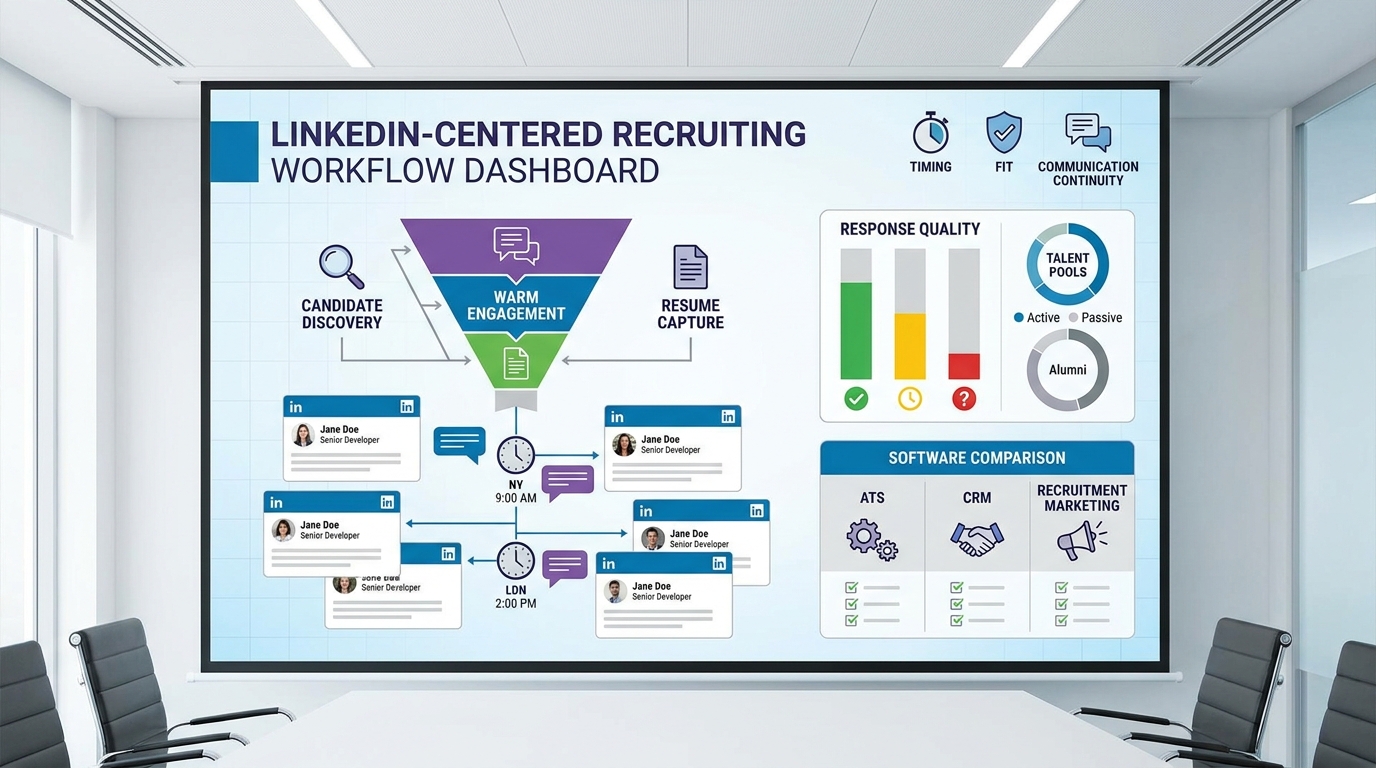
When pipeline quality keeps slipping before candidates apply, this article helps headhunters judge recruitment marketing software by timing, fit, and response quality.
That standard matters because most recruiting pain starts before a candidate ever applies. A recruiter may have the right search brief, a hiring manager may want progress by the end of the week, and the market may already be active, yet outreach stalls because nobody is consistently nurturing interest, answering questions, or keeping warm talent engaged. For a solo recruiter, that means lost evenings and weak follow-up. For a small search firm owner, it means more labor without more placements. For an in-house TA lead, it means slower hiring, thinner pipelines, and a candidate experience that feels reactive instead of prepared.
In that gap, I have found StrategyBrain AI Recruiter useful as a support layer rather than a replacement for recruiter judgment. It can automate initial LinkedIn outreach, keep conversations moving across time zones, and collect resumes or contact details from interested people while the recruiter still handles final fit assessment, resume review, and the next decision. That kind of support is especially helpful when the real bottleneck is not sourcing names, but sustaining relevant communication at scale.
The same logic shows up in another familiar scenario: a specialist candidate is weighing whether to accept a consulting interview. The discussion will likely center on expertise, stakeholder management, availability, and one difficult question beneath all of it: can this person actually deliver the mandate within the employer's timeline? Before the meeting, the candidate reviews past project wins, thinks through examples from real client work, and prepares to explain how trust was built with teams under pressure. On the employer side, the recruiter is doing parallel work, gathering proof points, confirming interest, answering practical questions, and making sure the conversation starts with enough context to be useful.
If that early coordination is weak, both sides lose. The candidate enters the discussion half-briefed, the recruiter scrambles through old notes and scattered messages, and the employer learns too late that interest was shallow or availability was misunderstood. That is exactly where recruitment marketing automation and stronger recruitment marketing platforms matter: not because every hire is a marketing campaign, but because high-quality recruiting depends on timely communication, better pre-conversation context, and a system that can build readiness before a formal hiring workflow begins.
- Why recruitment marketing software starts with context
- How it differs from an ATS and CRM
- The decision criteria that actually matter
- Where recruitment marketing automation helps most
- How to compare recruitment marketing platforms
- How it fits into your hiring stack
- Common mistakes in selection and rollout
- FAQ
Why recruitment marketing software starts with context, not just automation
The most useful lesson from candidate-facing consulting interview prep is simple: good outcomes depend on preparation before the high-stakes conversation begins. Candidates think about expertise, examples, stakeholder handling, and availability because they know those are the topics that determine whether a project can move forward. Recruiting teams should evaluate recruitment marketing software in the same way. The question is not merely whether a tool can send messages. It is whether it helps recruiters create enough context, continuity, and timing discipline that the right conversation happens at the right moment.
That is why recruitment marketing software has become a core category within recruitment automation tools. It is built to attract talent, capture early interest, segment audiences, nurture relationships, and re-engage people before urgency forces everyone into rushed outreach. In practice, it often combines career site content, landing pages, talent community capture, email and SMS campaigns, social distribution, analytics, and CRM-like audience management.
Key insight: The best recruitment marketing automation does not just increase activity; it improves readiness on both sides of the hiring conversation.
That distinction matters to experienced recruiters. An applicant tracking system is valuable once someone is inside an active process. But if your team repeatedly opens a role with little warm pipeline, inconsistent employer messaging, and no practical way to re-engage prior talent, then your problem sits upstream.
In my own workflow, that upstream gap is where tools like AI Recruiter can help. I have used AI-supported outreach most effectively when I already knew the target profile and needed coverage across after-hours replies, multilingual communication, and early interest confirmation. What I still would not delegate is the final qualification step. The automation can move conversations forward and gather resumes, but recruiter judgment remains central when evaluating project relevance, communication quality, and whether a candidate can actually succeed in the role.
How recruitment marketing software differs from an ATS and CRM
One of the biggest buying mistakes is expecting a single system to solve every recruiting problem. The overlap between an ATS, a talent CRM, and recruitment marketing platforms is real, but the operating purpose is different.
| System | Primary focus | Best use | Main limitation alone |
|---|---|---|---|
| Applicant tracking system | Application and hiring workflow control | Managing active candidates, interviews, and offers | Limited support for pre-apply nurturing and always-on engagement |
| Talent CRM | Contact and relationship organization | Pooling talent, tracking history, segmenting prospects | May lack campaign execution, branded content experiences, or robust automation |
| Recruitment marketing software | Attraction, engagement, and conversion before and around apply | Building pipeline with campaigns, talent communities, outreach, and analytics | Needs connection to ATS and downstream hiring workflows |
A good working rule is this: an ATS manages process, a CRM manages records, and recruitment marketing software manages momentum. That momentum is what prevents every hiring need from feeling like a cold start.
The consulting interview example is helpful here. A strong interview is not made by scheduling alone. It depends on whether the candidate understands the assignment, whether the employer has a view on relevant expertise, and whether both sides enter the discussion with enough clarity to test real fit. Recruitment marketing platforms contribute to that pre-conversation clarity through outreach history, content, reminders, nurture sequences, and audience segmentation.
The decision criteria that actually matter
When buyers compare recruitment automation tools, feature lists can hide the real question: can the platform help recruiters create informed, timely, trust-building interactions at scale? I find it more useful to evaluate around the same kinds of criteria that matter in a consulting conversation.
1. Subject-matter fit
In recruiting terms, this means whether the platform supports the audiences you actually hire for. Can it handle distinct role families, geographies, seniority bands, and campaign types? Can you tailor messaging and landing pages for engineers, consultants, operations staff, or volume hiring pools without recreating everything manually?
Strong recruitment marketing software should let you build audience-specific journeys, not just generic sends.
2. Stakeholder management support
The reference scenario puts stakeholder management at the center for a reason. Hiring rarely breaks because one recruiter forgot to message someone; it breaks because recruiters, hiring managers, and candidates operate with different assumptions. Look for tools that make coordination easier through shared campaign visibility, engagement history, response tracking, and cleaner handoff into the ATS.
This is also where reporting matters. If a hiring manager asks why a search is thin, recruiters need more than anecdotal answers. They need to show what was sent, who engaged, what talent pools existed, and where interest dropped.
3. Availability and responsiveness
Availability was one of the core decision topics in the reference material, and it maps directly to recruiting operations. Candidates often respond outside business hours, across time zones, or in a different language than the recruiter expects. If your process depends on someone being online at the perfect moment, you will lose conversations.
That is one reason I see practical value in AI Recruiter. In LinkedIn-heavy workflows, I have found that always-on responses and multilingual communication can preserve momentum when human coverage would otherwise drop. The gain is not magical matching; it is continuity. The recruiter still reviews the resume and decides whether to move forward, but the conversation no longer goes cold just because the reply arrived after hours.
4. Proof of prior engagement, not just contact volume
Candidates in consulting interviews are expected to demonstrate prior success in similar projects. Recruiting teams need the equivalent: visible evidence that a contact is not just in the database, but has engaged with content, opened messages, visited a landing page, joined a talent community, or responded to outreach.
This is the difference between a static list and a working pipeline. Recruitment marketing automation should help you understand who is warm, who is drifting, and who is ready for a recruiter conversation now.
5. Ease of launch for recruiters
If every campaign requires technical support, adoption will lag. Recruiters need to be able to launch a page, send a nurture flow, segment an audience, and monitor replies without waiting on a specialist for routine work.
That does not mean governance is unimportant. It means the system should make repeatable campaigns simple enough that good process happens consistently.
Where recruitment marketing automation helps most
Not every organization needs the same stack depth, but several use cases consistently justify investment.
Hard-to-fill and expert-led hiring
When the hiring conversation depends on demonstrated expertise, relationship-building starts early. You are not only selling a role. You are helping a skilled person assess whether the opportunity is worth serious discussion. Recruitment marketing automation supports that by keeping content, reminders, proof points, and follow-up consistent before formal interviews begin.
LinkedIn-centered outbound recruiting
For many headhunters and agency recruiters, LinkedIn remains the practical front door for first contact. In that environment, repetitive tasks stack quickly: connection requests, introduction messages, interest checks, follow-ups, after-hours replies, and resume collection. This is the scenario where I would most directly pair recruitment marketing software strategy with StrategyBrain AI Recruiter. It can keep early-stage outreach moving, while the broader recruitment marketing system handles segmentation, nurture logic, and reporting. The recruiter remains responsible for the actual quality call.
High-volume or distributed hiring
If roles open repeatedly across locations, teams need more than job posting volume. They need talent communities, campaign landing pages, automated reminders, and re-engagement paths for prior applicants or silver medalists. Recruitment marketing platforms help maintain that rhythm.
Event, campus, and community hiring
Event recruiting is a strong example of the value of pre-conversation preparation. Invitations, registrations, reminders, follow-up messages, and post-event nurture are all parts of the same relationship. Without automation, these touchpoints often become fragmented and hard to scale.
How to compare recruitment marketing platforms
If you are evaluating options, skip the generic scorecard first and start with realistic scenarios. I usually recommend testing each platform against the kinds of judgment calls recruiters actually face.
| Evaluation area | What to test | Why it matters |
|---|---|---|
| Pre-apply pipeline creation | Can you attract and capture interest before a requisition opens? | Shows whether the platform truly supports proactive recruiting |
| Message continuity | Can outreach continue across time zones, channels, and reply delays? | Reduces dropped conversations and stale leads |
| Audience intelligence | Can you segment by skill, location, intent, and engagement history? | Improves relevance and prioritization |
| Recruiter usability | Can recruiters build campaigns without technical bottlenecks? | Determines real adoption |
| Downstream handoff | Does data move cleanly into ATS workflows? | Prevents silos and duplicate work |
| Candidate readiness signals | Can you identify who is informed, interested, and worth immediate follow-up? | Improves recruiter efficiency and conversation quality |
A practical exercise is to run one specialist search scenario and one volume hiring scenario. For example, test how the platform would support a consulting hire where expertise, stakeholder fit, and availability must be established before interview, then test a repeatable frontline hiring campaign where speed and consistency matter more. The stronger platform is usually the one that makes both workflows easier without turning recruiters into campaign operators full-time.
How it fits into your hiring stack
The most effective setup is usually layered. Recruitment marketing software sits upstream of the ATS, often alongside a CRM or sourcing function, and supports the part of recruiting that happens before application and between hiring cycles.
Recruitment marketing plus ATS
This is the most common model. Recruitment marketing automation generates awareness, captures leads, and nurtures talent. The ATS then manages the application, interview sequence, approvals, and offer process. Used together, they create better continuity from first touch to active candidate management.
Recruitment marketing plus LinkedIn automation support
Where LinkedIn sourcing is central, there is a separate operational need: keeping one-to-one outreach active without burning recruiter time. That is where I would use AI Recruiter in a supporting role. It helps handle repetitive first-contact work and resume capture, while the recruitment marketing layer manages broader audience nurture and the recruiter owns final screening and relationship decisions.
Recruitment marketing plus analytics
TA leaders increasingly need to explain not just hires, but how interest was built. When reporting is connected, you can trace early engagement, nurture performance, talent community activity, and downstream conversion into interviews or offers. That matters when budget scrutiny increases and teams need to justify where recruiting effort should go.
Common mistakes when buying recruitment automation tools
Buying for activity instead of decision quality
A platform that sends more messages is not necessarily helping recruiters make better calls. Look for systems that improve timing, context, and candidate readiness.
Expecting an ATS to solve pre-apply problems
An ATS is essential, but it is usually not enough to attract passive talent, nurture long-consideration candidates, or maintain awareness between openings.
Ignoring the candidate's evaluation process
The reference consulting scenario is useful because it reminds us that talented people are evaluating you too. They care about whether the role matches their expertise, whether stakeholders seem aligned, and whether timelines are realistic. Recruitment marketing software should support those signals, not bury them under impersonal automation.
Over-automating final qualification
Automation is strongest in outreach continuity, segmentation, reminders, and information capture. Final fit judgment still belongs with recruiters and hiring teams. That includes resume review, deeper qualification, and deciding whether a conversation should progress.
Failing to define success before rollout
Decide early what good looks like for your team: stronger talent community growth, more recruiter time recovered, cleaner handoffs, better engagement rates, more useful hiring-manager reporting, or more consistent re-engagement of prior candidates.
FAQ
What is recruitment marketing software?
Recruitment marketing software helps employers attract, engage, and nurture candidates before and around the application stage. Typical capabilities include talent communities, landing pages, campaign automation, outreach, segmentation, and analytics.
How is recruitment marketing software different from an ATS?
An ATS manages active applicants and hiring workflows. Recruitment marketing software focuses on generating interest, capturing leads, and nurturing talent before someone formally applies. Most mature teams use both.
Who benefits most from recruitment marketing automation?
Agency recruiters, headhunters, and in-house TA teams benefit most when they hire repeatedly, rely on passive candidates, or need better communication consistency across many prospects.
Are recruitment marketing platforms useful for LinkedIn-heavy recruiting?
Yes, especially when LinkedIn is a major source of first contact. Recruitment marketing platforms help organize campaigns and nurture flows, while tools such as AI Recruiter can support repetitive outreach, multilingual messaging, and early resume capture. Recruiters should still own final qualification.
What features matter most?
Focus on segmentation, landing pages, talent community capture, email and SMS workflows, analytics, ATS integration, and practical recruiter usability. If LinkedIn outreach is central, assess whether your process also needs dedicated automation support for first-touch messaging and follow-up continuity.
How should teams measure results?
Use measures tied to pipeline quality and workflow efficiency: warm lead growth, engagement by segment, re-engagement rates, recruiter follow-up speed, conversion into apply or interview, and visibility into where candidate interest is won or lost.
Conclusion
The strongest recruitment automation tools are not the ones that simply do more; they are the ones that help recruiters prepare better conversations before urgency takes over. That is the thread connecting consulting interview preparation to recruitment marketing software. In both cases, expertise, stakeholder alignment, availability, and evidence of fit all need attention before the decisive meeting happens.
If your team keeps starting searches from zero, the issue is probably not only workflow control. It is that your stack may be handling applicants better than it builds readiness. Evaluating recruitment marketing platforms through that lens will lead to better decisions than a feature checklist ever will.