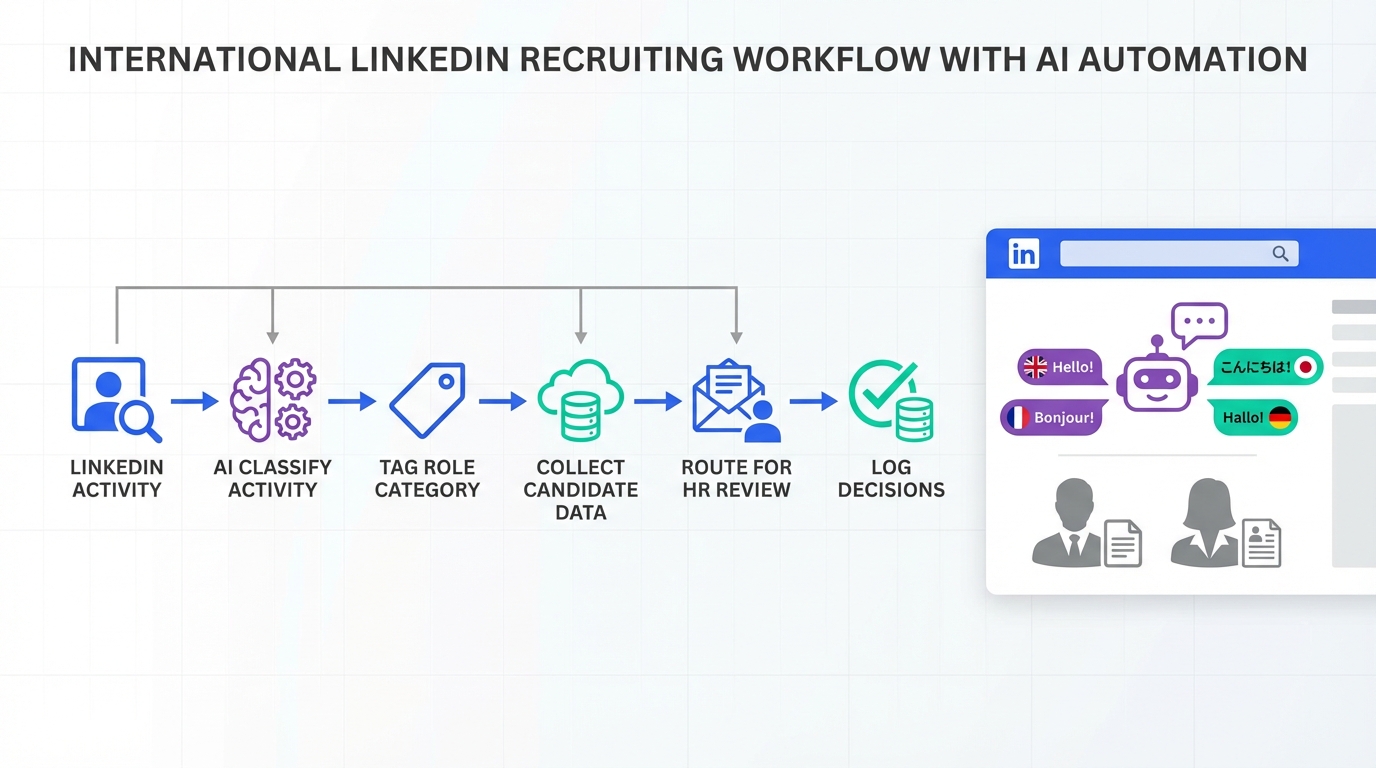
If your hire platform touches international hiring, cross border sales, or short term assignments, the practical question is simple: can your employees and candidates legally enter another country to do business, and in some cases work, without getting stuck in avoidable process. Based on the original 2016 discussion of NAFTA and the Trans Pacific Partnership, the key takeaway is that trade agreements can expand temporary entry options for Business Visitors and certain professional categories, while still requiring careful HR and legal coordination. In our recruiting operations, we treat this as a workflow problem as much as a policy problem: you need consistent intake, documentation, and follow up. That is also where StrategyBrain AI Recruiter fits naturally, because it can automate LinkedIn outreach, handle multilingual candidate messaging 24/7, and collect résumés and contact details so your team can focus on eligibility and final qualification.
Key Takeaways
- Scope boundary: This article focuses on temporary entry concepts for business travel and certain work categories, not on giving legal advice or replacing immigration counsel.
- NAFTA signal: The original piece frames NAFTA as making Canada to United States business travel comparatively straightforward for many business needs.
- TPP signal: The original piece describes broader temporary entry allowances across multiple signatory countries, including Business Visitors, some professional and trades categories, and inter company transferees.
- Operational reality: Even when entry is easier, HR still needs consistent documentation, role classification, and audit ready records inside the platform hire process.
- Recruiting impact: Cross border mobility changes candidate pools and hiring speed, especially for roles that can be deployed internationally.
- AI leverage: StrategyBrain AI Recruiter can automate LinkedIn outreach and follow up, communicate in candidates native languages, and collect résumés and contact details so recruiters spend time on eligibility and interviews.
What the 2016 context was really saying
The original post was published on April 1, 2016 and attributed to Kael Campbell. It opens with a business reality that still shows up in hiring and workforce planning: currency conditions and economic demand can push Canadian companies to expand into the United States, which increases employee travel and cross border coordination.
It then narrows the scope to one specific lens: Business Visitors. A business visitor is a person entering a country for business activities that typically do not involve joining the local labor market. The post also references categories that can allow actual work authorization under certain conditions, such as NAFTA Professionals and Inter Company Transferees.
What NAFTA meant for business travel
In the original narrative, NAFTA is presented as a practical enabler for cross border business activity, using examples of British Columbia companies operating in the United States while maintaining headquarters in Vancouver. The point for HR is not the brand names, it is the pattern: when expansion is easier, employee travel becomes routine, and your hiring and mobility processes must keep up.
The post also mentions a NAFTA Professionals category that allows over 30 professions to work in Canada or the United States, explicitly naming nurses and college instructors as examples. For a modern hire platform, this is a data modeling requirement: you need a structured way to tag roles and candidates by mobility relevant category, not just by job title.
What the TPP claimed to expand
The original post describes the Trans Pacific Partnership as potentially enabling Canadian companies to do business more easily in a list of countries, including Australia, Brunei Darussalam, Chile, Japan, Malaysia, Mexico, New Zealand, Peru, Singapore, and Vietnam. It also notes that the United States was described as a signatory in that discussion, while acknowledging political uncertainty at the time and the need for parliamentary debate in Canada before ratification.
From an HR operations perspective, the post highlights three mobility ideas that matter when you design a platform hire workflow.
1) Business Visitors have strong access
The post states that an examination of agreements suggests business visitors have excellent access to visit and begin exploring business in these markets. In practice, this means your travel request and assignment initiation process should start with a clear question: is this business visitor activity, or is it work that triggers a different category.
2) Professional and trades categories may be broader in some countries
The post calls out that some countries were described as having broad categories for professionals and trades people, while Brunei is described as only allowing the exchange of petroleum engineers. Whether or not a specific category applies to your case, the operational lesson is consistent: your hire platform should not treat international mobility as a one size fits all rule.
3) Inter Company Transferees can support multi year moves
The post states that inter company transferees allow management to move between TPP countries and stay and live for up to 3 years. If your organization uses internal transfers as a growth lever, your platform hire process should capture transfer rationale, reporting lines, and assignment duration in a way that can be reviewed by counsel and audited later.
Why this matters inside a hire platform
Most teams treat trade agreement mobility as a legal memo. In our experience, it becomes a recruiting throughput issue the moment you scale. When you expand internationally, you create more roles that require travel, more candidates who ask mobility questions, and more coordination between recruiting, HR, and immigration counsel.
A hire platform that supports international operations should therefore do three things reliably.
- Standardize intake: capture destination country, purpose of travel, role category, and expected duration.
- Centralize evidence: store documents and decision notes in one place so you can reproduce why a decision was made.
- Reduce manual follow up: automate candidate communication and information collection so recruiters do not become a bottleneck.
This is also where video recruiting can help. When candidates are in different time zones, asynchronous video screening can reduce scheduling friction. It is not a legal solution, but it is a practical way to keep the pipeline moving while mobility eligibility is being confirmed.
A practical workflow you can copy
Below is a copyable workflow we use as a baseline when international travel or cross border work might be involved. It is designed to fit inside a platform hire process without turning recruiters into immigration specialists.
Step by step
- Classify the activity: Business visitor activity versus work activity. Record the purpose in 1 sentence.
- Tag the role category: For example, professional category, trades category, or internal transfer. Use consistent tags so reporting is possible.
- Collect candidate facts: Citizenship, current location, intended destination, and expected duration. Store as structured fields.
- Route to review: Send the case to HR and immigration counsel with the structured summary and supporting documents.
- Communicate timelines: Tell the candidate what you can confirm now and what is pending review. Avoid promises.
- Finalize and log: Record the decision, the reviewer, and the date. Attach the final guidance used.
Quick checklist for recruiters
- Destination country is recorded
- Purpose of travel is recorded
- Expected duration is recorded in days
- Role category tag is applied
- Candidate has been told what is confirmed versus pending
- Review owner and review date are logged
Where StrategyBrain AI Recruiter helps
When mobility questions increase, recruiters lose time to repetitive messaging, follow ups, and document chasing. StrategyBrain AI Recruiter is designed to remove that drag specifically in LinkedIn hiring workflows.
LinkedIn outreach and qualification automation
StrategyBrain AI Recruiter can automatically connect with candidates that match your search criteria, introduce the opportunity, answer common questions about the role, company, and compensation, and confirm interview interest. In our day to day use, this matters because it keeps the top of funnel moving while HR and counsel handle mobility review.
24/7 multilingual candidate communication
International hiring creates time zone gaps and language friction. StrategyBrain AI Recruiter supports always on messaging and can communicate in the candidates native language. That reduces misunderstandings and prevents promising candidates from going cold while your team sleeps.
Résumé and contact detail collection
Once a candidate is interested, StrategyBrain AI Recruiter can request a résumé and capture contact details shared in conversation. It supports both email submission and LinkedIn file upload flows. Recruiters then review the collected résumés and proceed with interviews and final qualification.
Scaling with multiple LinkedIn accounts
For teams that need volume, StrategyBrain AI Recruiter supports managing more than 100 LinkedIn accounts so organizations can build an AI powered recruiting team. This is especially useful when you are hiring across multiple countries and business units and need consistent outreach quality.
Limitations and risk notes
- Not legal advice: Trade agreement categories and temporary entry rules are complex and change over time. Use qualified immigration counsel for decisions.
- Final fit is still human: StrategyBrain AI Recruiter can identify willingness to communicate or interview, but it does not determine whether a résumé fully matches job requirements. Recruiters must do final qualification.
- Country specific requirements vary: The original post notes that provinces may have different requirements even when federal entry is described as easier. Treat local licensing and credential recognition as separate workstreams.
FAQ
Is this hire platform guide legal advice?
No. It is an operational interpretation of the original 2016 discussion and a workflow template. For any real case, confirm requirements with qualified immigration counsel.
What does Business Visitor mean in this context?
Business visitor refers to entering a country for business activities without joining the local labor market. The exact permitted activities depend on the country and the agreement category.
What is the difference between Business Visitor and NAFTA Professionals?
Business visitor is typically about short term business activity. NAFTA Professionals, as referenced in the original post, is a category that can allow certain listed professions to work in Canada or the United States under specific conditions.
How long can an inter company transferee stay, according to the original post?
The original post states that inter company transferees can allow management to move between countries and stay and live for up to 3 years.
How does StrategyBrain AI Recruiter fit into a platform hire workflow?
It automates LinkedIn outreach and follow up, answers candidate questions, and collects résumés and contact details. That reduces recruiter time spent on repetitive messaging while HR and counsel handle mobility review.
Does StrategyBrain AI Recruiter replace recruiters?
No. It replaces repetitive outreach and early qualification steps. Recruiters still review résumés, assess fit, and run interviews.
Can StrategyBrain AI Recruiter communicate with candidates in different languages?
Yes. It supports multilingual communication and can respond around the clock, which is useful for international hiring and cross time zone pipelines.
What should we store in the hire platform for audit readiness?
Store destination, purpose, duration, role category tags, reviewer identity, review date, and the final decision notes. Keep supporting documents attached to the case record.
Conclusion
Trade agreement mobility is not just policy trivia. It changes how fast teams can deploy people, how wide the candidate pool can be, and how much coordination recruiting must do. The most reliable approach is to treat it as a repeatable workflow inside your hire platform: classify the activity, tag the role category, collect structured facts, route to review, and log decisions. If you also want to reduce recruiter workload while keeping the pipeline warm, StrategyBrain AI Recruiter can automate LinkedIn outreach, run 24/7 multilingual conversations, and collect résumés and contact details so your team spends time on eligibility review and interviews rather than chasing messages.