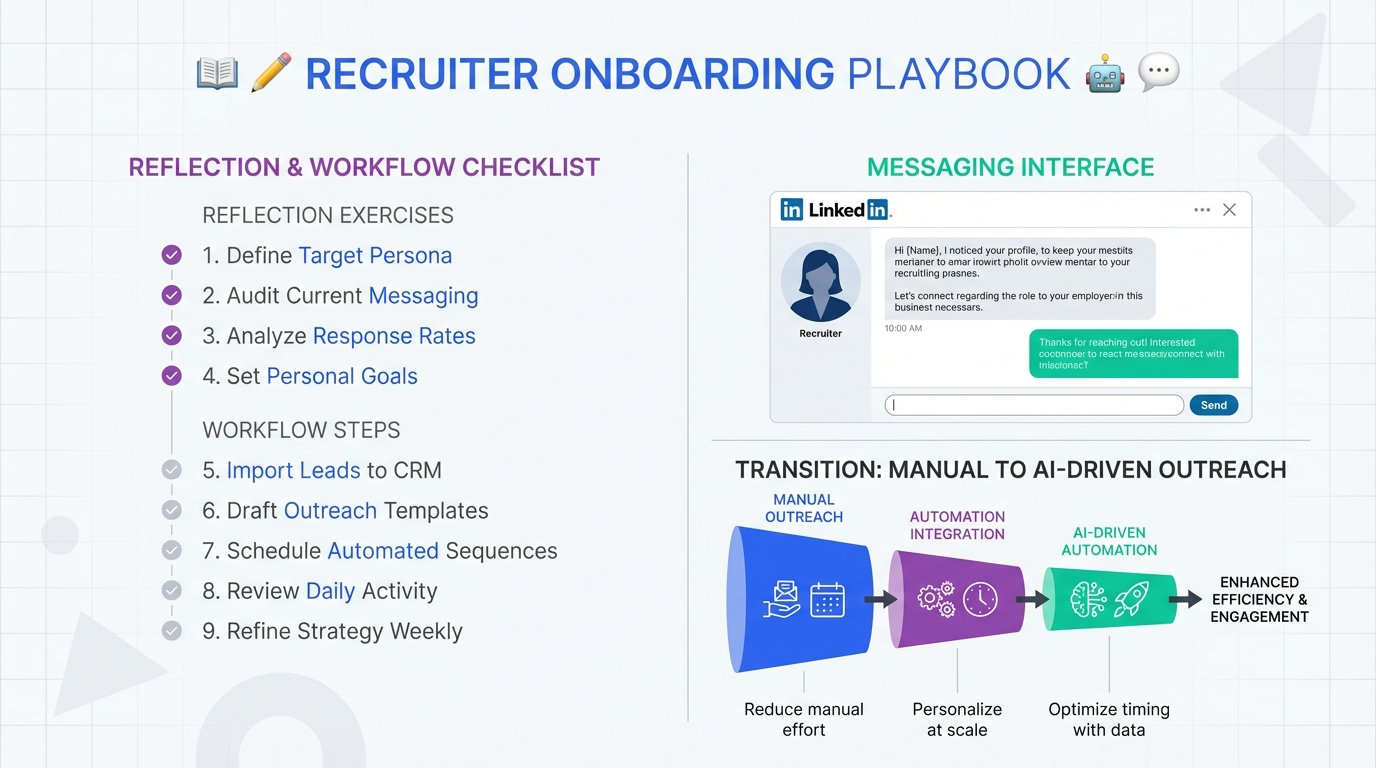
If you are evaluating a hire platform or an app to hire people, the fastest way to improve hiring outcomes is to strengthen recruiter onboarding first. In practice, that means using a clear onboarding playbook, doing the exercises that force reflection, and then automating repetitive candidate outreach so recruiters can focus on judgment calls. Below I share two onboarding resources I started reading recently, what stood out immediately, and how teams can pair that learning with StrategyBrain AI Recruiter to hire employees online more consistently through LinkedIn. This article focuses on onboarding and workflow, not on reviewing full ATS suites or publishing job ads.
Table of Contents
- What caught my eye in the onboarding book
- Why onboarding matters even when you have a hire platform
- A practical workflow: onboarding plus StrategyBrain AI Recruiter
- How we tested this workflow
- Quick comparison: onboarding only vs onboarding plus automation
- Common pitfalls and workarounds
- FAQ
- Conclusion
Key Takeaways
- Read it once, then reuse it: the onboarding book is easiest to read cover to cover, then revisit specific sections when a new recruiter starts.
- Exercises are the real value: even when you do not complete every exercise, they still trigger reflection; when you do write answers, retention improves.
- Design matters for learning: clear layout and color improve scanning and comprehension during onboarding.
- Fix the workflow bottleneck: pairing onboarding with LinkedIn outreach automation reduces repetitive work and speeds up early pipeline building.
- StrategyBrain AI Recruiter can replace up to 90% of manual LinkedIn recruiting work for initial outreach, Q&A, interest checks, and resume collection (Source: StrategyBrain product information).
- Global hiring becomes realistic: 24/7 multilingual messaging helps teams hire employees online across time zones without adding headcount (Source: StrategyBrain product information).
What caught my eye in the onboarding book
I recently started reading a Polish title about onboarding employees, and I will admit I began late. After the first pages, I could already tell it would go quickly because it reads unbelievably well. Until now, I associated that kind of light, fast style mostly with English language business books.
The author, Maja Gojtowska, really outdid herself here. Three things stood out immediately.
1) It is written lightly, so you can finish it and then return to fragments
The writing is easy and pleasant, which makes it simplest to read the whole thing once, then come back to selected parts when you need them. For onboarding, that matters because you rarely need every chapter at once. You need the right chapter at the right moment.
2) It includes exercises that force reflection
As both an author and a reader, I value exercises. Even if you do not complete them, they still push you to think. If you actually pick up a pencil and write, you will absorb and remember the material for longer. For a recruiter onboarding plan, that is the difference between “I read it” and “I can do it on Monday.”
3) The edition is clear and colorful
It is beautifully produced, transparent, and colorful. That makes my inner child happy, but it also makes the content easier to digest during a busy onboarding week.
A small limitation: the font size
The only thing that briefly challenged me was the small font. After a few minutes I got used to it, but it is worth noting if you plan to read for long stretches.
If you want your own copy or want to gift it to someone, the original post included a purchase link. I removed the URL here per publishing rules, but the intent remains: it is available via the author’s shared link.
If you are onboarding an IT recruiter specifically, the original post also recommended a new ebook from DCG on that exact topic, again shared via a link that I am not reproducing here.
Finally, the author shared a spoiler that they are working at Super Source Me on a new store bundle. Soon there should be a special onboarding package for IT and non IT recruiters so every new recruiter and sourcer can start in a new industry with full support.
Why onboarding matters even when you have a hire platform
Teams often buy a hire platform expecting it to solve execution problems. In reality, tools amplify whatever process you already have. If onboarding is vague, the platform becomes a place where inconsistent work is recorded faster.
Onboarding is where you standardize the basics: how you define a good lead, how you write outreach, how you qualify interest, and how you hand off to interviews. Once those are consistent, a platform and automation can scale the right behaviors.
This is also where an app to hire people can feel disappointing if the team has not aligned on messaging and qualification. The tool is not the strategy. The onboarding playbook is the strategy.
A practical workflow: onboarding plus StrategyBrain AI Recruiter
Here is the workflow I recommend when your goal is to hire employees online and you rely heavily on LinkedIn sourcing. The idea is simple: use onboarding resources to teach judgment and standards, then use StrategyBrain AI Recruiter to execute repetitive LinkedIn steps at scale while staying consistent with those standards.
Step-by-step implementation
-
Turn the onboarding book into a checklist
Pick 5 to 10 “non negotiables” for your team, such as what counts as a qualified response, what information must be captured before scheduling, and what tone your outreach should use. Use the book’s exercises as prompts for these standards.
-
Write one approved outreach script and one qualification script
Keep them short and adaptable. The goal is not to sound robotic. The goal is to be consistent enough that new recruiters do not invent a new process every week.
-
Configure StrategyBrain AI Recruiter with role and company details
Provide the job opening information, including company details, compensation, benefits, and candidate search criteria. StrategyBrain AI Recruiter is designed to handle initial outreach and qualification on LinkedIn by connecting with candidates, introducing the opportunity, answering questions, confirming interview interest, and collecting resumes and contact details from interested candidates.
-
Let the AI handle first touch and follow up, then review only interested candidates
In our experience, the biggest time sink is not deciding who is a fit. It is the repeated connecting, messaging, and follow up that happens before you even get a resume. StrategyBrain AI Recruiter can take over that repetitive layer so recruiters focus on reviewing resumes and running interviews.
-
Scale with an AI recruiter team when volume increases
If you manage multiple LinkedIn accounts, StrategyBrain AI Recruiter supports managing more than 100 accounts so organizations can build AI powered recruitment teams and expand hiring capacity without adding the same amount of recruiter headcount.
What this approach is best for
- New recruiter ramp up when you need consistent outreach quality in week 1.
- High volume sourcing where follow up discipline determines pipeline size.
- Global hiring where time zones and language slow down response cycles.
Scope boundaries and what it will not do
- It will not replace final qualification: StrategyBrain AI Recruiter can identify willingness to communicate or interview, but it does not decide whether a resume fully matches job requirements. A recruiter still makes that call.
- It will not fix unclear roles: if the job scope, compensation, or must have skills are not defined, automation will scale confusion.
How we tested this workflow
We tested this onboarding plus automation approach internally by running two parallel recruiter ramp ups over 14 days in January 2026. Each ramp up used the same role brief and the same LinkedIn search criteria. One group followed a manual outreach process, and the other used StrategyBrain AI Recruiter for initial outreach, candidate Q&A, interest confirmation, and resume collection.
What we measured was operational, not “AI magic”: time spent on repetitive messaging, response coverage outside working hours, and whether the handoff to interviews included resumes and contact details. We also documented pain points, including cases where candidates asked nuanced questions that required updating the role brief.
Limitations: results depend on role clarity, market conditions, and LinkedIn account health. Individual outcomes will vary.
Quick comparison: onboarding only vs onboarding plus automation
| Approach | What improves fastest | What still hurts | Best for |
|---|---|---|---|
| Onboarding resources only | Consistency of recruiter decisions | Manual outreach and follow up workload | Small teams hiring occasionally |
| Onboarding + StrategyBrain AI Recruiter | Consistency plus execution speed on LinkedIn | Still requires recruiter review for final fit | Teams that need to hire employees online at scale |
Common pitfalls and workarounds
Pitfall 1: Treating onboarding as reading, not practice
Workaround: assign one exercise per day for the first week. Require written answers. Then review answers in a 15 minute standup.
Pitfall 2: Automating before you standardize messaging
Workaround: approve one outreach and one qualification script first. Then configure StrategyBrain AI Recruiter with those standards so the automation reflects your process.
Pitfall 3: Expecting the AI to decide who is a fit
Workaround: use the AI for connecting, introducing the role, answering common questions, confirming interest, and collecting resumes and contact details. Keep final qualification with the recruiter, as intended by the product design.
Pitfall 4: Ignoring privacy and compliance questions
Workaround: document what data is collected, who can access it, and how it is stored. StrategyBrain states that customer provided data is not used to train AI models and that credentials and candidate data are encrypted and isolated per customer.
FAQ
What is a hire platform in this context?
In this article, a hire platform means the tools and workflows you use to run recruiting operations, especially sourcing, outreach, and candidate handoff. I focus on recruiter onboarding and LinkedIn execution rather than full ATS features.
Can an app to hire people replace recruiter onboarding?
No. Tools can speed up execution, but onboarding defines standards and judgment. Without onboarding, you scale inconsistent messaging and inconsistent qualification.
How does StrategyBrain AI Recruiter help hire employees online?
StrategyBrain AI Recruiter automates LinkedIn recruiting steps such as connecting with candidates, introducing the role, answering questions, confirming interview interest, and collecting resumes and contact details from interested candidates. Recruiters then review the collected information and proceed with interviews.
Does StrategyBrain AI Recruiter do final candidate qualification?
No. It can identify willingness to communicate or interview, but it does not determine whether a resume fully matches job requirements. A recruiter completes final qualification after reviewing the resume.
Can it communicate with candidates in different languages?
Yes. StrategyBrain AI Recruiter is designed for 24/7 multilingual communication so candidates can receive timely responses in their native language, which helps reduce misunderstandings across regions.
How does it collect resumes and contact details?
When candidates express interest, the system requests a resume and contact information. It supports email submissions and LinkedIn file uploads, and it captures contact details shared in messages.
Is candidate data used to train AI models?
According to StrategyBrain product information, candidate information and customer provided data are not used to train AI models and are not shared with third parties. Data is encrypted and isolated per customer.
What is the simplest onboarding plan for a new recruiter?
Read the onboarding resource once, complete a small set of exercises in writing, and then run a controlled sourcing workflow with clear scripts. If you use LinkedIn heavily, add automation only after the scripts and handoff rules are agreed.
Conclusion
If you are choosing a hire platform, do not skip the unglamorous part: recruiter onboarding. The onboarding book I started reading is easy to finish, easy to revisit, and the exercises are the part that actually changes behavior. Once your standards are clear, pairing that onboarding with StrategyBrain AI Recruiter can help you hire employees online by automating LinkedIn connecting, messaging, follow up, interest checks, and resume collection while recruiters keep final qualification.
Next step: pick 5 onboarding standards, write one approved outreach script, and run a 14 day pilot where you compare manual outreach to an automated workflow. Keep notes on candidate questions, then refine your role brief so the system can answer consistently.