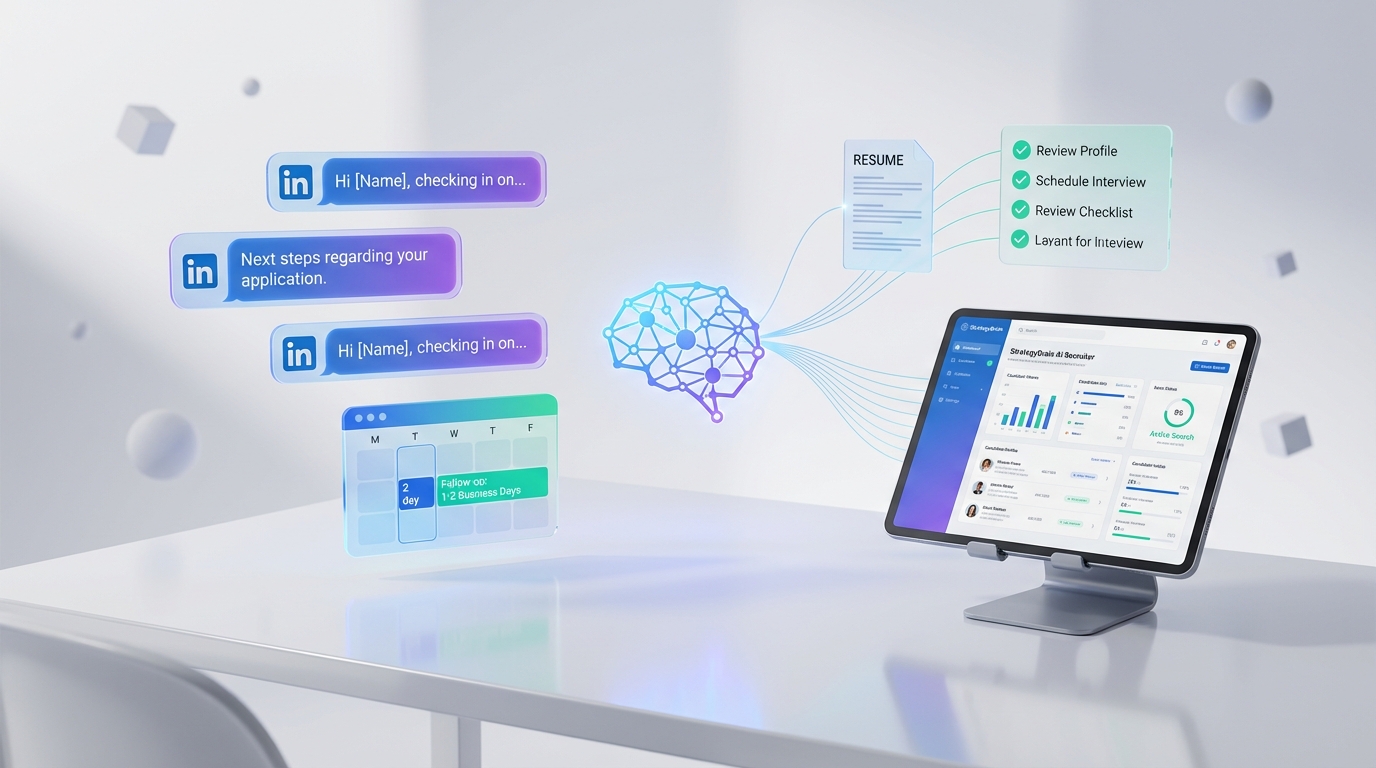
If you are using a hire platform and an interviewer misses their promised update date, the best next step is a polite follow up within 1 to 2 business days. Reconfirm your interest, ask for the updated timeline, and keep the message short. In our recruiting operations, this approach protects candidate experience without sounding pushy, because hiring teams often underestimate how long interviews, debriefs, and approvals take. This guide gives exact follow up scripts, timing rules for interviews versus applications, and a simple decision checklist. It also explains how StrategyBrain AI Recruiter can reduce missed follow ups by handling candidate messaging and qualification on LinkedIn around the clock, including multilingual communication and re9sume9 collection.
Key Takeaways
- After an interview: Follow up after 1 to 2 business days past the promised date, using a short, polite message.
- Do not over interpret silence: In practice, a hiring managere2809cs day or twoe2809d can stretch to 7 calendar days due to scheduling and approvals.
- Phone or email both work: Choose the channel you used most during scheduling, and keep it to 1 follow up unless invited to check back.
- After applying without an interview: Wait at least 7 calendar days, then make one brief follow up.
- Hire platform hygiene: Track promised dates, your follow up date, and the next step in one place to avoid duplicate outreach.
- Where StrategyBrain AI Recruiter fits: It can automate LinkedIn outreach, answer candidate questions 24/7 in any language, and collect re9sume9s and contact details so fewer candidates fall through the cracks.
What to do when the deadline passes
The scenario is common: you interview on a Wednesday, the conversation runs around 50 minutes, rapport feels strong, and the interviewer says you will hear back on Friday. Friday passes with no update. In most cases, the correct move is simple: follow up, politely.
From the employer side, delays usually come from scheduling conflicts, additional interviews, internal debriefs, or approval steps. Those are operational issues, not necessarily a signal about your performance or the companye2809cs quality.
Action steps
- Wait 1 business day after the promised date so you are not following up the same afternoon.
- Send one short follow up that restates interest and asks for the updated timeline.
- Stop after one attempt unless they reply with a specific invitation to check back again.
What not to do
- Do not send multiple messages across channels in the same day.
- Do not ask for feedback in the first follow up. Ask for timeline first.
- Do not assume silence means rejection until you receive a decision.
Timing rules: interview vs application
Good follow up timing depends on where you are in the process. A hire platform often mixes interview scheduling, messaging, and status updates, so it helps to separate two cases.
Case 1: You already interviewed
- Follow up window: 1 to 2 business days after the promised update date.
- Reason: You have invested time, they gave a specific expectation, and a gentle nudge is normal.
Case 2: You applied but have not interviewed
- Follow up window: after at least 7 calendar days.
- Reason: Many teams batch review applications, and early follow ups can look like noise rather than signal.
Reality check on timelines
We regularly see hiring teams say e2809ca day or twoe2809d and then take up to 7 calendar days to respond, especially when multiple interviewers must align. That is why the follow up should be calm and timeline focused.
Follow up scripts you can copy
These templates are designed to work whether you are communicating through email, a hire platform message center, or a recruitere2809cs inbox. Keep the tone confident, brief, and professional.
Script 1: After an interview, promised date passed
Subject: Checking in on next steps
Message: Hello [Name], thank you again for meeting with me on [Day]. I remain very interested in the [Role] opportunity. I wanted to check whether there is an updated timeline for next steps. Thank you, [Your Name].
Script 2: After applying, one week later
Subject: Application follow up for [Role]
Message: Hello [Name], I applied for the [Role] position on [Date] and wanted to confirm my continued interest. If interviews are being scheduled, I would welcome the chance to speak. Thank you for your time, [Your Name].
Script 3: Phone follow up outline
- State your name and the role you interviewed for.
- Reconfirm interest in one sentence.
- Ask for an updated process timeline.
- Thank them and end the call promptly.
Mini checklist before you hit send
- Did you wait 1 to 2 business days after the promised date for interview follow up?
- Is the message under 90 words?
- Did you avoid emotional language and assumptions?
- Did you ask for timeline, not feedback?
How a hire platform should support follow ups
A modern hire platform should reduce ambiguity for both candidates and recruiters. If you are evaluating systems, or fixing your process, look for these operational capabilities.
Core workflow features
- Status clarity: clear stages such as applied, screening, interview, decision.
- Timeline tracking: a field for promised update date and next action owner.
- Message logging: every candidate touchpoint stored in one thread.
- Reminders: nudges when a promised date passes.
Where video fits
Some teams add recruiting video software or video interview tools to speed up early screening. That can help, but it also increases the number of candidate touchpoints. Without strong follow up discipline, more steps can create more silence. The best setup is a hire platform that keeps messaging and next steps consistent, regardless of whether the interview was live, asynchronous, or video based.
Where StrategyBrain AI Recruiter helps
In our experience, missed follow ups are rarely caused by bad intent. They are caused by volume and context switching. StrategyBrain AI Recruiter is designed to remove that bottleneck in LinkedIn hiring by automating the repetitive front end of recruiting while keeping recruiters in control of final qualification.
Practical ways it reduces follow up gaps
- Automated LinkedIn outreach and conversation: It connects with candidates that match your search criteria, introduces the role, and keeps the thread moving.
- 24/7 multilingual responses: It replies in the candidatee2809cs native language and follows up across time zones, which reduces stalled conversations.
- Re9sume9 and contact capture: When a candidate is interested, it requests a re9sume9 and captures contact details shared in the conversation.
- Scale via account teams: It supports managing more than 100 LinkedIn accounts so organizations can run an AI powered recruiting team without adding headcount.
Scope boundary
StrategyBrain AI Recruiter can identify willingness to communicate or interview, but it does not decide whether a re9sume9 fully matches job requirements. Recruiters still make the final qualification decision after reviewing the collected re9sume9s.
Compliance and data handling notes
- Customer provided data is not used to train AI models.
- LinkedIn credentials are encrypted and used only with explicit authorization.
- Candidate information is encrypted and not shared with third parties.
Quick Comparison
| Approach | Speed to respond | Best for | Risk if unmanaged |
|---|---|---|---|
| Manual follow up by recruiter | Business hours only | Low volume roles, senior searches | Delays when recruiters context switch |
| Hire platform reminders and message center | Depends on team usage | Standardizing process and logging | Still relies on humans to reply |
| StrategyBrain AI Recruiter for LinkedIn outreach and qualification | 24/7 | High volume LinkedIn hiring, global pipelines | Requires clear role info and search criteria |
| Recruiting video software and video interview tools | Varies by workflow | Early screening and structured evaluation | More steps can increase drop off without follow up discipline |
FAQ
Should I follow up if they said they would call Friday and did not?
Yes. Wait 1 business day, then send a short message that restates interest and asks for the updated timeline.
Does a missed deadline mean I did not move forward?
Not necessarily. Hiring teams often underestimate how long interviews and approvals take, so silence alone is not a reliable signal.
Is it better to call or email?
Either can work. Use the channel you used most during scheduling, and keep it to one follow up unless they ask you to check back again.
How long should my follow up message be?
Aim for under 90 words. Include three elements only: appreciation, continued interest, and a request for timeline.
When should I follow up after submitting a job application?
Wait at least 7 calendar days, then make one brief follow up. Repeated outreach can backfire if the team is still in early review.
How can a hire platform reduce candidate drop off?
It should track promised dates, log all messages, and trigger reminders when updates are overdue. The goal is consistent communication, not more steps.
How does StrategyBrain AI Recruiter help with LinkedIn recruiting follow ups?
It automates initial outreach and ongoing messaging on LinkedIn, responds 24/7 in any language, and collects re9sume9s and contact details from interested candidates so recruiters can focus on interviews.
Does StrategyBrain AI Recruiter decide who is qualified?
No. It identifies willingness to communicate or interview and gathers information, but recruiters still review re9sume9s and make the final qualification decision.
Conclusion
When a promised update date passes, the most effective move is a calm follow up within 1 to 2 business days. Keep it short, ask for the updated timeline, and avoid reading too much into silence. If you are building a process inside a hire platform, make timeline tracking and message logging non negotiable so candidates do not get lost.
Next step: copy one of the scripts above and send a single follow up. If you are hiring at scale on LinkedIn, consider how StrategyBrain AI Recruiter can handle outreach, multilingual candidate communication, and re9sume9 collection so your team spends more time interviewing and less time chasing threads.