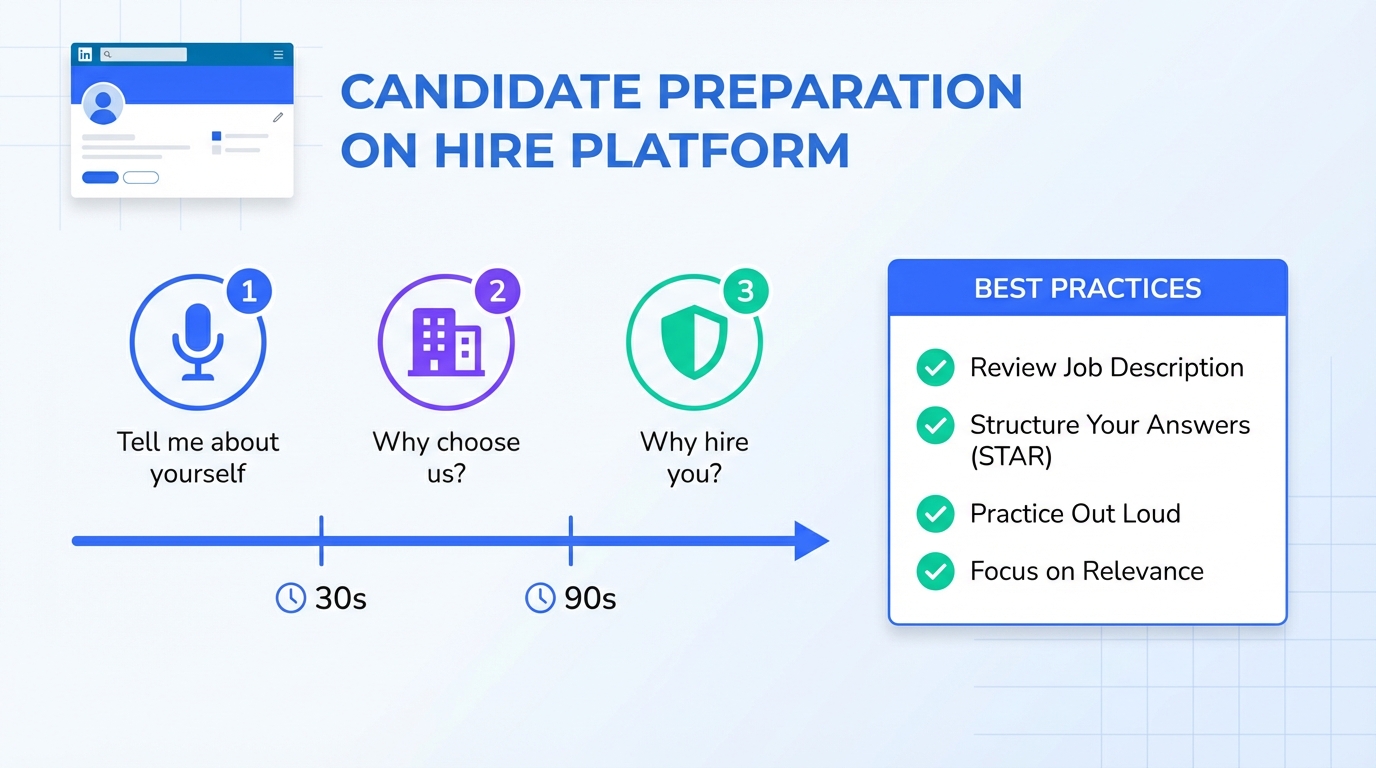
If you are preparing for interviews through a hire platform, focus on three questions that employers consistently use to test fit and communication: Tell me about yourself, Why did you choose our organization, and Why should we hire you. The best approach is to prepare a 30 to 60 second professional summary, research the company so your motivation is specific, and prove your strengths with short examples tied to the role. In our recruiting workflows, we see most rejections come from answers that are generic, too personal, or not tailored to the job. This guide gives ready to use structures, timing targets, and a quick checklist you can apply in any candidate experience platform or app to hire help.
Table of Contents
- Why these questions show up everywhere
- Question 1: Tell me about yourself
- Question 2: Why did you choose our organization
- Question 3: Why should we hire you
- Quick comparison: what good answers sound like
- How to practice inside a hire platform workflow
- Where StrategyBrain AI Recruiter fits in
- FAQ
- Conclusion
Key Takeaways
- Keep “Tell me about yourself” professional: deliver a 30 to 60 second summary focused on role relevant highlights.
- Make “Why this organization” specific: reference what you learned and connect it to your values and skills.
- Answer “Why should we hire you” with proof: name strengths and back each with a concrete example.
- Employers screen for 4 traits: communication, problem solving, teamwork, and a can do attitude.
- Tailoring beats volume: generic answers are the most common failure pattern we see in interview prep.
- Use a repeatable practice loop: script, time, record, revise, then rehearse again.
Why these questions show up everywhere
Across interviews scheduled through a hire platform or coordinated by a recruiter, these questions appear because they quickly reveal how you think and communicate. They also help the interviewer test whether you understand the role, whether you can connect your experience to the job, and whether you will fit the team’s working style.
In the source scenario that inspired this guide, a job seeker noticed repeated rejections and asked whether there are common questions people answer badly. The recruiter’s core point was simple: candidates often fail because they do not prepare and tailor their responses to the specific job.
Scope note: This article focuses on three high frequency questions and how to structure answers. It does not cover salary negotiation, technical assessments, or case interviews.
Question 1: Tell me about yourself
This is not an invitation to share your life story. Treat it as a professional introduction that helps the interviewer place you in context quickly. The goal is clarity and relevance, not completeness.
What employers are evaluating
- Communication flow: can you summarize without rambling.
- Role relevance: do you highlight experience that matches the job.
- Professional judgment: do you avoid oversharing personal topics.
Answer structure (30 to 60 seconds)
- Present: your current role and scope in 1 sentence.
- Past: 1 to 2 highlights from recent experience that match the job.
- Proof: 1 accomplishment with a measurable outcome if you have it.
- Personal, lightly: 1 neutral line about interests, only if appropriate.
- Future: why this role is the next logical step.
Common mistakes we see
- Too personal: topics that distract from your professional story.
- Too long: answers that exceed 60 seconds and lose the listener.
- Not tailored: repeating a generic summary that does not match the job.
Best for
- First round screens inside a candidate experience platform.
- Recruiter calls where time is limited.
- Hiring manager interviews where you need a crisp opening.
Question 2: Why did you choose our organization
This question is a preparation test. Employers want to see that you did your homework and that your motivation is specific to them, not just to “getting a new job.”
What to research before you answer
- What the company does: products, customers, and market.
- How the team works: values, operating style, and collaboration norms.
- Why the role exists: what problem the hire is meant to solve.
Answer structure (45 to 75 seconds)
- Specific hook: one concrete reason the organization stands out to you.
- Fit statement: how your strengths match what they need.
- Culture alignment: one reason you believe you will thrive there.
- Close positively: confirm enthusiasm for the role you applied to.
What to avoid saying
- “I am always looking for new opportunities”: it signals low intent.
- “I applied to many jobs like this”: it makes your choice look random.
- Empty praise: “great company” without a specific reason.
Best for
- Any interview stage where the interviewer is testing motivation.
- Roles where culture fit is a major hiring criterion.
Question 3: Why should we hire you
This is your chance to connect the dots for the employer. You are not listing skills. You are making a short business case for why you are the safest and strongest choice for the role.
What employers are listening for
Beyond the hard skills on your resume, employers often look for four traits:
- Communication skills
- Problem solving ability
- Team player mindset
- Can do attitude
Answer structure (60 to 90 seconds)
- Match: name 2 to 3 strengths that map directly to the job requirements.
- Prove: give 1 short example per strength using a situation and outcome.
- Differentiate: add one working style advantage, such as how you collaborate or prioritize.
- Close: restate how you will help the team succeed in the first 30 to 90 days.
Limitations and an honest workaround
No answer is perfect, and overconfidence can backfire. If you are missing one requirement, acknowledge it briefly and pivot to how you learn fast and how your adjacent experience reduces risk. Keep this to 1 to 2 sentences so you do not turn your answer into a weakness speech.
Best for
- Final rounds where the employer is choosing between similar candidates.
- Roles where you need to show impact, not just competence.
Quick comparison: what good answers sound like
| Question | Strong answer focus | Time target | Most common failure |
|---|---|---|---|
| Tell me about yourself | Role relevant summary plus 1 proof point | 30 to 60 seconds | Too personal or too long |
| Why did you choose our organization | Specific motivation plus fit and culture alignment | 45 to 75 seconds | Generic praise with no research |
| Why should we hire you | 2 to 3 strengths backed by examples | 60 to 90 seconds | Claims without evidence |
How to practice inside a hire platform workflow
Many teams now run scheduling, messaging, and screening through a candidate experience platform. That changes how you should practice because your first impression may be asynchronous, timed, or text based.
Step by step practice loop
- Draft: write your first version for each question in 6 to 10 sentences.
- Time it: read out loud and cut until you hit the time target.
- Record: capture audio or video and listen for filler words and unclear phrasing.
- Tailor: swap in role specific details for each application.
- Rehearse: repeat until you can deliver calmly without memorizing word for word.
Copy and paste checklist
- My opening summary is under 60 seconds.
- I referenced one specific reason I chose this organization.
- I used at least 2 examples to prove my strengths.
- I avoided personal topics that could distract from the role.
- I can explain how I will add value in the first 30 to 90 days.
When an app to hire help changes the interview dynamic
If the process includes automated prompts or chat based screening, clarity matters even more. Short sentences, direct answers, and role specific keywords help your message land correctly with both humans and systems.
Where StrategyBrain AI Recruiter fits in
On the employer side, many organizations use automation to handle early outreach and qualification, especially on LinkedIn. StrategyBrain AI Recruiter is designed for that stage: it can automatically connect with candidates who match defined criteria, introduce the role, answer questions about the job, company, and compensation, confirm interview interest, and collect resumes and contact details from interested candidates.
From a candidate perspective, this means your first interaction may look like a structured conversation that happens quickly and at any hour. StrategyBrain AI Recruiter supports 24/7 multilingual communication, so you may be asked the same core questions in a more conversational format. The preparation frameworks above still apply, but you should be ready to deliver concise, role relevant answers in writing as well as in live interviews.
Important boundary: StrategyBrain AI Recruiter can help employers identify willingness to communicate or interview, but final qualification for job fit is completed by a recruiter after reviewing the resume.
FAQ
What is a hire platform in the interview process
A hire platform is software that helps employers manage recruiting steps such as sourcing, messaging, scheduling, and screening. For candidates, it often means faster communication and more structured interview stages.
How long should my “Tell me about yourself” answer be
Keep it to 30 to 60 seconds. Aim for a professional summary with one proof point and a clear link to the role.
What if I do not know much about the company yet
Do basic research before the interview and prepare one specific reason you are interested. If you are missing details, ask a thoughtful question that shows you understand the role’s purpose.
How do I answer “Why should we hire you” without sounding arrogant
Use evidence instead of hype. State 2 to 3 strengths and support each with a short example and outcome, then connect it back to what the team needs.
What are the four traits employers often look for beyond hard skills
Communication skills, problem solving ability, teamwork, and a can do attitude. You can demonstrate these through examples rather than listing them.
How do I tailor answers quickly when applying to many roles
Keep one base script for each question, then swap in role specific details: the team’s goals, the job’s top requirements, and one relevant accomplishment. This usually takes 10 to 15 minutes per application once your base scripts are solid.
Will AI messaging change how I should prepare
Yes, because you may need to answer in writing first. Practice concise written versions of your three answers that fit in 3 to 6 sentences without losing specificity.
Does StrategyBrain AI Recruiter decide if I am qualified for the job
No. It can help employers automate early outreach and confirm interview interest, but the recruiter makes the final qualification decision after reviewing your resume.
Conclusion
The fastest way to improve interview results on any hire platform is to master three questions with tight timing and role specific proof: Tell me about yourself, Why did you choose our organization, and Why should we hire you. Use the practice loop in this guide to script, time, record, and tailor your answers so they sound natural and specific.
Next step: pick one active application, tailor all three answers to that role today, and rehearse until you can deliver each within the time target. If your process includes automated LinkedIn outreach, be ready to answer the same questions clearly in chat as well as live interviews.