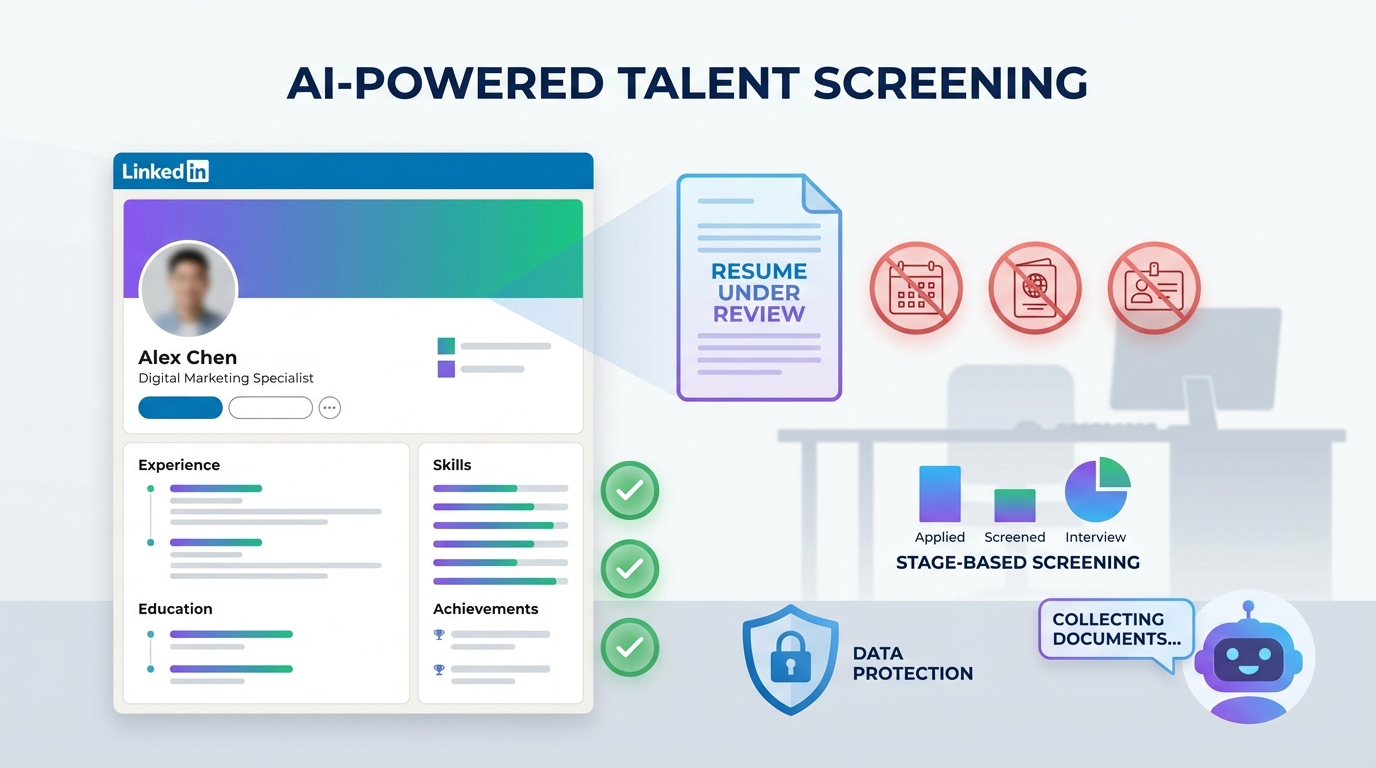
If you are applying through a hire platform, the safest approach is to keep your resume focused on skills and results and remove sensitive personal identifiers. Do not include your date of birth, marital status, citizenship details, or any government ID numbers such as Social Insurance, Social Security, or passport numbers unless an employer explicitly requires them at a later stage. This reduces identity theft risk and helps prevent bias by keeping the evaluation centered on job related qualifications. This guide covers what to remove, what is still appropriate to share, and how modern workflows including StrategyBrain AI Recruiter can help teams collect only what they need before interviews.
Key Takeaways
- Remove sensitive identifiers: Do not put date of birth, marital status, citizenship details, or government ID numbers on a resume.
- Two risks drive the rule: Identity theft exposure and discrimination risk increase when unnecessary personal data is shared early.
- Keep it job relevant: A resume should let an employer assess education and work experience quickly.
- Culture fit is still fair game: Community involvement and relevant personal connection to the role can be appropriate when it supports your story.
- Use structured screening: A hire platform process works best when information is collected in stages, not all at once.
- AI can reduce back and forth: StrategyBrain AI Recruiter can handle initial LinkedIn outreach, Q and A, interest confirmation, and resume collection before a recruiter steps in.
Why this matters on a hire platform
Most hiring teams use a hire platform to move quickly. That speed is helpful, but it also means your resume may be viewed by more people and systems than you expect. The goal is still the same: a potential employer should be able to determine from a quick glance whether you meet the basic educational and work experience requirements, and a great resume should show why you are the right candidate.
However, not every detail about you helps. In our recruiting operations reviews, the resumes that create the most avoidable risk are the ones that include personal identifiers that are not needed for early stage screening. The safest practice is to share only what is required to evaluate your ability to do the job.
What not to include on your resume
Below are the most common items we still see candidates include, even though they are not needed for initial screening on a hire platform.
Sensitive personal details to remove
- Date of birth
- Marital status
- Citizenship details unless the application explicitly requires work authorization status at this stage
- Government ID numbers such as Social Insurance, Social Security, and passport numbers
Why removing these details protects you
There are two practical reasons to keep this information off your resume early in the process.
- Identity theft risk: The more personal information you share, the more vulnerable you are if that data is mishandled or exposed.
- Discrimination risk: Hiring decisions should be based on your ability to do the job, not personal characteristics such as age, sex, sexual orientation, race, marital status, gender identity or expression, creed, colour, disability, or political or religious beliefs.
Some of these details may be disclosed later, for example during background checks or onboarding. The key is timing. Early stage screening is not the right moment to publish identifiers that are not required to evaluate your qualifications.
What you can include without hurting your chances
Removing sensitive data does not mean your resume must be sterile. Employers still want a candidate who fits the team and the work environment. The difference is that the information should support your professional story.
Good personal context that can help
- Volunteer work with a charitable organization
- Community involvement that shows leadership, reliability, or teamwork
- Relevant personal connection to the role, product, or location when it strengthens your motivation and credibility
If you want to add this context, keep it short and job relevant. A single line under a section like Community or Volunteering is usually enough.
How to apply safely and still move fast
Speed matters, especially when roles attract many applicants. The best approach is to treat your resume as a screening document and let later steps collect sensitive details only when necessary.
Step by step process
- Upload a resume that is qualification focused
Lead with skills, certifications, and measurable outcomes. Remove sensitive identifiers. - Use the hire platform fields for what they are designed for
If the platform asks for work authorization or location preferences, answer there instead of embedding extra personal data in the resume. - Prepare a separate secure document for later stages
Keep government IDs and other onboarding details off the resume. Provide them only through official onboarding channels when requested. - Confirm what is required before sharing
If someone asks for sensitive information early, request clarification on why it is needed at that stage.
Common mistakes we see
- Over sharing because it feels like it will speed up verification
- Copying old templates that include personal details by default
- Mixing onboarding data with marketing by placing IDs and legal details next to achievements
Where StrategyBrain AI Recruiter fits in modern hiring
Many teams now combine a hire platform with LinkedIn sourcing to fill roles faster. The friction point is usually the same: recruiters spend hours connecting, introducing roles, answering repetitive questions, and chasing resumes and contact details. That is exactly where StrategyBrain AI Recruiter is designed to help.
What StrategyBrain AI Recruiter does in the early funnel
StrategyBrain AI Recruiter is an automated AI powered recruitment tool built for LinkedIn hiring. It can connect with candidates that match your search criteria, introduce the opportunity, learn about the candidate’s situation, answer questions about the role, company, and compensation, confirm interview interest, and collect resumes and contact information from interested candidates.
Why this supports safer data handling
- Stage based collection: Candidates share sensitive details later, while early conversations focus on role fit and interest.
- 24/7 multilingual communication: The system can respond around the clock in the candidate’s native language, reducing misunderstandings and delays.
- Recruiter time protection: Recruiters can focus on reviewing resumes and running interviews instead of repeating the same outreach steps.
Operational scale for teams
For organizations that run high volume sourcing, StrategyBrain AI Recruiter supports managing more than 100 LinkedIn accounts so teams can build an AI powered recruitment team and expand hiring capacity without adding the same amount of manual effort.
Scope boundary
StrategyBrain AI Recruiter can identify willingness to communicate or interview, but it does not determine whether a resume fully matches job requirements. Final qualification remains a recruiter decision after reviewing the resume.
Our internal workflow test notes
We reviewed the product capability documentation and mapped it to a standard hire platform funnel. The cleanest implementation is to use AI Recruiter for LinkedIn outreach and pre screening, then push only interested candidates into the hire platform for structured evaluation and interview scheduling. This reduces early over collection of personal data because the first touch is a role conversation, not a document dump.
Quick checklist before you upload
- [ ] My resume includes skills, certifications, and work experience that match the job.
- [ ] I removed date of birth and marital status.
- [ ] I removed citizenship details unless the application explicitly requires work authorization status now.
- [ ] I removed Social Insurance, Social Security, and passport numbers.
- [ ] I kept community and volunteer items short and job relevant.
- [ ] I am prepared to provide sensitive onboarding details later through official channels.
FAQ
Should I include my date of birth on a resume submitted through a hire platform?
No. Date of birth is not needed for early stage screening and can increase discrimination risk. Keep the resume focused on job related qualifications.
Is it ever okay to include citizenship details on my resume?
Only include what is explicitly required at the application stage. If a hire platform asks for work authorization status, provide it in the platform field rather than adding extra personal details to the resume.
Do employers need my Social Insurance or Social Security number to review my application?
No. Those identifiers are typically onboarding or payroll related and should not be on a resume. Provide them only when you are hired and through official secure processes.
What personal information can help instead of hurt?
Volunteer work, community involvement, and a relevant personal connection to the role can help when they support your professional narrative. Keep it brief and relevant.
How does StrategyBrain AI Recruiter help a hire platform process?
It automates early LinkedIn outreach and pre screening by introducing the role, answering candidate questions, confirming interview interest, and collecting resumes and contact details. That helps teams move qualified candidates into the hire platform with less manual back and forth.
Can StrategyBrain AI Recruiter qualify candidates for job fit automatically?
It can confirm willingness to communicate or interview, but it does not decide whether a resume fully matches job requirements. Recruiters still review resumes for final qualification.
Does StrategyBrain AI Recruiter support multilingual candidate communication?
Yes. It provides 24/7 multilingual communication and can respond in the candidate’s native language, which can reduce delays and misunderstandings in global hiring.
How should I handle a request for sensitive information early in the process?
Ask why it is required at that stage and whether there is an official secure channel for later submission. In most cases, sensitive identifiers should be shared only after an offer or during onboarding.
Conclusion
The simplest way to stay safe on a hire platform is to keep your resume qualification focused and remove sensitive personal identifiers such as date of birth, marital status, citizenship details, and government ID numbers. This reduces identity theft exposure and helps keep hiring decisions centered on your ability to do the job.
Next, adopt a staged information approach: share what is needed to evaluate fit now, and provide onboarding details later through official channels. If you are hiring, consider pairing your hire platform with StrategyBrain AI Recruiter to automate LinkedIn outreach, candidate Q and A, interest confirmation, and resume collection so recruiters can spend more time interviewing the right people.