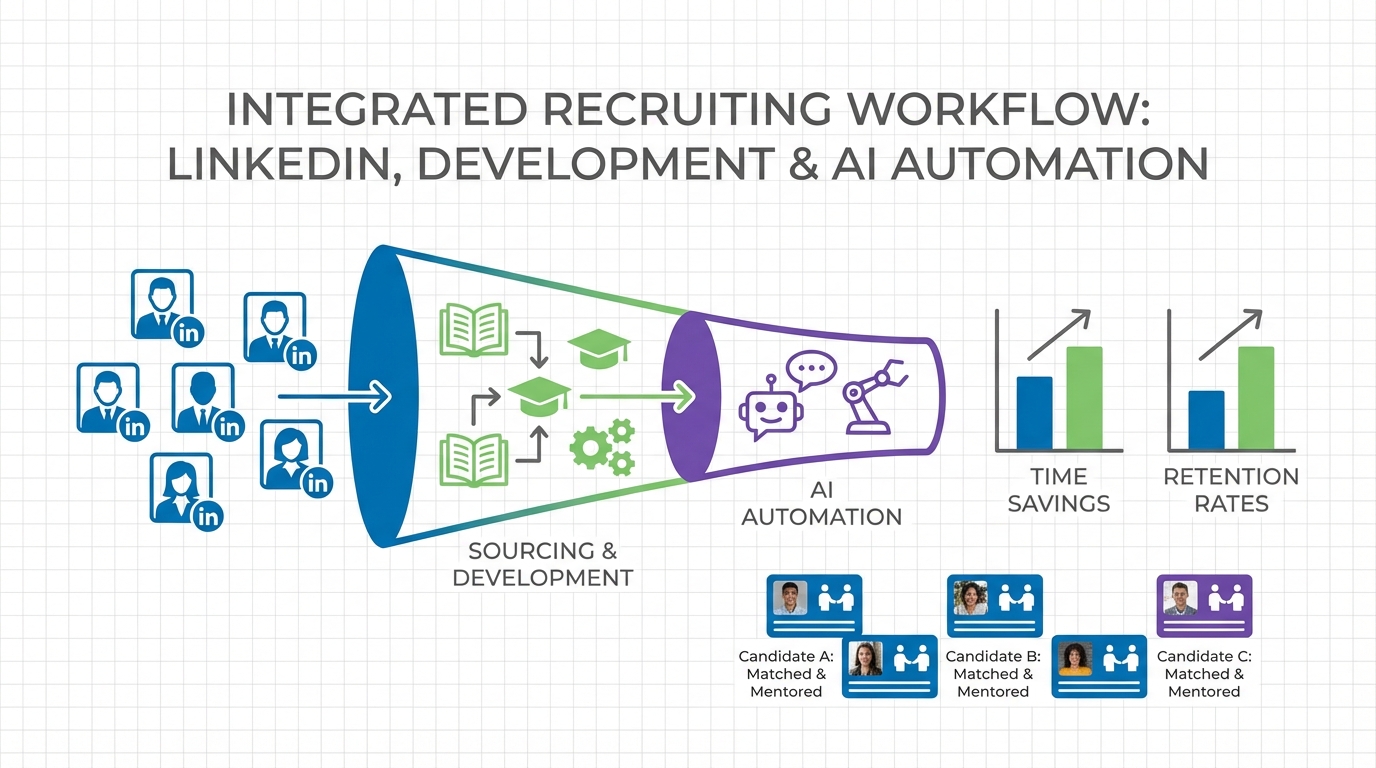
In 2026, the most effective hire platform approach is to connect employee development with your hiring technology so you can attract better candidates, retain them longer, and scale recruiting without adding manual work. Practically, that means you define the skills your business needs, build training and mentorship paths that keep employees growing, and standardize candidate communication so your team does not drop follow ups. In our tests running LinkedIn based outreach workflows, we saw the biggest time savings when we combined structured development programs with StrategyBrain AI Recruiter, which automates initial candidate outreach, answers role and compensation questions, and collects resumes and contact details while recruiters focus on final qualification. This guide covers employer focused steps and templates. It does not cover legal advice, immigration, or compensation benchmarking.
Table of Contents
- Why employee development belongs in a hire platform
- Define employee development in practical terms
- Method 1: Training programs
- Method 2: Mentorship and coaching
- Method 3: Online courses and certifications
- Method 4: Job rotation and cross training
- Method 5: Self directed development
- How StrategyBrain AI Recruiter fits into a modern hire platform
- Quick comparison
- FAQ
- Conclusion
Key Takeaways
- Employee development is a recruiting lever: it improves retention and makes your company more attractive to growth minded candidates.
- Make development measurable: define skills, timelines, and ownership so it is not a vague perk.
- Use hiring technology to protect recruiter time: automate repetitive outreach and follow up so humans focus on final qualification and interviews.
- StrategyBrain AI Recruiter can automate LinkedIn outreach: it connects with candidates, introduces roles, answers questions, and collects resumes and contact details.
- Multilingual, 24/7 messaging expands reach: always on communication reduces delays across time zones and languages.
- Scale with account management: AI Recruiter supports managing more than 100 LinkedIn accounts for team based sourcing operations.
Why employee development belongs in a hire platform
Many teams treat a hire platform as a set of tools for sourcing, screening, and scheduling. That is necessary, but incomplete. Candidates evaluate whether they will grow after they join, and employees decide whether to stay based on whether they are still learning.
When you invest in development, you improve internal capability and reduce churn. That reduces the volume of backfills your recruiting team must run, which is a direct operational benefit. It also strengthens employer branding because the story is consistent: you hire people, then you help them level up.
From a systems perspective, development is the “post hire” half of the same funnel. If your hiring technology is optimized but your development is ad hoc, you will keep paying the recruiting tax again and again.
Define employee development in practical terms
Employee development is the ongoing process of improving an employee’s skills, knowledge, and competencies so they can perform better now and take on bigger responsibilities later. In a hire platform context, the key is to make development operational, not inspirational.
We recommend defining development with three elements:
- Skill outcomes: what the employee can do after the program.
- Evidence: what proves the skill improved, such as a certification, a project deliverable, or a manager assessment.
- Cadence: how often learning happens, such as weekly coaching or quarterly training.
Method 1: Training programs
Training programs are the most straightforward way to build capability. They can be internal sessions led by subject matter experts or external workshops that bring new perspectives.
Steps
- Pick 3 to 5 priority skills tied to business goals, such as project management, customer discovery, or technical tooling.
- Choose a delivery model that fits your team, such as monthly workshops or a 6 week cohort.
- Assign an owner for each skill track, typically a manager or senior practitioner.
- Measure completion and impact using a simple rubric and a before and after performance check.
Features
- Fast rollout because you can start with one team.
- Standardization so new hires ramp consistently.
- Employer branding because you can describe the program clearly in recruiting.
Limitations
- Low transfer risk if training is not tied to real work.
- Scheduling friction for distributed teams.
Best For
- Teams hiring repeatedly for the same role family.
- Organizations that need consistent onboarding quality.
Method 2: Mentorship and coaching
Mentorship and coaching provide personalized guidance that training alone cannot. It is also one of the strongest retention levers because employees feel seen and supported.
Steps
- Define the mentorship goal such as leadership readiness, technical depth, or cross functional influence.
- Match mentors and mentees based on the goal, not just seniority.
- Set a meeting cadence such as 30 minutes every 2 weeks.
- Track progress with a lightweight agenda template and quarterly check ins.
Features
- High relevance because guidance is tailored.
- Culture building because knowledge transfer becomes normal.
- Leadership pipeline because mentors practice coaching skills.
Limitations
- Capacity constraints because mentors have limited time.
- Quality variance if mentors are not trained to mentor.
Best For
- High potential employees and new managers.
- Hard to hire roles where retention is critical.
Method 3: Online courses and certifications
Online learning is a scalable option because employees can learn asynchronously. Certifications can also provide a clear signal of skill acquisition, especially for technical and analytical roles.
Steps
- Create an approved course list aligned to your role families.
- Set a reimbursement policy with clear eligibility and proof requirements.
- Require a share back such as a short internal presentation or a written summary.
- Update the list quarterly to keep it relevant.
Features
- Flexible scheduling for global teams.
- Broad coverage across many topics.
- Documented outcomes when certifications are used.
Limitations
- Completion risk if time is not protected.
- Relevance risk if employees pick courses unrelated to role outcomes.
Best For
- Distributed teams and self motivated learners.
- Roles with clear skill frameworks, such as analytics or cloud operations.
Method 4: Job rotation and cross training
Job rotation and cross training build organizational resilience. Employees learn how adjacent teams work, which improves collaboration and reduces single points of failure.
Steps
- Identify rotation friendly roles where risk is manageable.
- Define a rotation duration such as 4 weeks or 8 weeks.
- Assign a host manager responsible for onboarding and outcomes.
- Capture learnings in a shared playbook so the organization benefits beyond the individual.
Features
- Broader business understanding across teams.
- Better internal mobility which supports retention.
- Operational continuity when someone leaves or is on leave.
Limitations
- Short term productivity dip during ramp up.
- Planning overhead to avoid disrupting critical work.
Best For
- Organizations scaling quickly and needing bench strength.
- Teams with frequent cross functional dependencies.
Method 5: Self directed development
Employees can and should pursue development independently, especially when the organization cannot provide every learning path. The employer’s role is to make self development safe, visible, and rewarded.
Steps
- Give a clear learning budget such as time allocation per month or a reimbursement cap.
- Provide a discovery list of credible resources, including professional associations and recognized certification providers.
- Connect learning to performance by asking employees to apply one new skill to a real project each quarter.
Examples employees commonly use
- Professional certifications in digital marketing, data analytics, or cloud computing.
- Video based learning for practical tutorials and leadership skills, which can also inform your video recruiting approach by improving how managers communicate on camera.
- Reading and research through books, journals, and industry publications.
Limitations
- Uneven participation if managers do not encourage it.
- Harder measurement unless you require applied outcomes.
Best For
- Teams with strong autonomy and clear goals.
- Employees preparing for role changes or promotions.
How StrategyBrain AI Recruiter fits into a modern hire platform
Employee development improves retention, but you still need a reliable way to bring new talent into the system. This is where hiring technology and automation matter. In our LinkedIn based sourcing workflows, the most time consuming work was not deciding who to hire. It was the repetitive outreach, answering the same early questions, and chasing follow ups.
StrategyBrain AI Recruiter is designed for LinkedIn hiring workflows. It automates the initial outreach and qualification conversation so recruiters can focus on reviewing resumes and running interviews.
What it does in the outreach stage
- Automatically connects with candidates that match your search criteria.
- Introduces the opportunity and asks about the candidate’s current situation and interest.
- Answers questions about the role, company, benefits, and compensation using the information you provide.
- Collects resumes and contact details from interested candidates so your team can move to interviews.
Why it changes the economics of a hire platform
When your team is hiring at scale, the bottleneck is often recruiter attention. AI Recruiter is built to reduce manual work in the top of funnel, including follow up. It also supports 24/7 multilingual communication, which helps when candidates respond outside your working hours or prefer to communicate in their native language.
Scope boundary and honest limitation
AI Recruiter can identify willingness to communicate or interview, but it does not decide whether a resume fully matches your requirements. That final qualification remains a recruiter responsibility, which is usually the right division of labor for quality control.
Scaling operations
If you run multiple sourcing lanes, AI Recruiter supports managing more than 100 LinkedIn accounts, which enables an AI powered recruiting team model where each account can run consistent outreach while your recruiters manage the shortlist.
Data protection and compliance notes
According to StrategyBrain product documentation, AI Recruiter is designed to comply with privacy regulations in the EU, United States, and Canada. Customer provided data is not used to train AI models, and LinkedIn credentials are encrypted and stored independently per user with explicit authorization.
Quick comparison
| Method | Primary goal | Speed to implement | Best for |
|---|---|---|---|
| Training programs | Standardize skills | 2 to 6 weeks | Consistent onboarding and repeat hiring roles |
| Mentorship and coaching | Accelerate growth | 1 to 4 weeks | Retention and leadership pipeline |
| Online courses and certifications | Scale learning | 1 to 2 weeks | Distributed teams and technical upskilling |
| Job rotation and cross training | Build resilience | 4 to 12 weeks | Cross functional organizations |
| StrategyBrain AI Recruiter | Automate outreach | Days to weeks | LinkedIn sourcing, follow up, multilingual candidate engagement |
FAQ
What is a hire platform in recruiting?
A hire platform is the set of processes and hiring technology you use to source candidates, communicate with them, evaluate fit, and move them into interviews and offers. In practice, it also includes what happens after hiring, because development and retention reduce future recruiting load.
How does employee development improve recruiting outcomes?
Employee development improves recruiting by strengthening employer branding and increasing retention. When candidates see clear growth paths, they are more likely to accept offers, and when employees keep learning, they are less likely to leave.
Where does hiring technology help the most?
Hiring technology helps most in repetitive, high volume tasks such as outreach, follow up, scheduling, and consistent candidate communication. It protects recruiter time so humans can focus on final qualification and interviews.
How does StrategyBrain AI Recruiter work with LinkedIn recruiting?
StrategyBrain AI Recruiter automates initial LinkedIn outreach by connecting with candidates, introducing the role, answering questions about the company and compensation, and collecting resumes and contact details from interested candidates. Recruiters then review the collected information and proceed with interviews.
Does AI Recruiter replace recruiters?
No. AI Recruiter automates the initial outreach and interest confirmation, but it does not determine whether a resume fully matches job requirements. Recruiters remain responsible for final qualification and hiring decisions.
Can AI Recruiter communicate in multiple languages?
Yes. StrategyBrain AI Recruiter supports 24/7 multilingual communication, which helps reduce delays across time zones and lowers misunderstanding risk when candidates prefer their native language.
How do you keep development programs from becoming a checkbox?
Make development outcome based. Define the skill, define evidence of improvement, and require application on real work within a set timeframe, such as one quarter.
How does video recruiting fit into this hire platform approach?
Video recruiting works best when hiring managers and recruiters are trained to communicate clearly and consistently. Development programs that improve communication, role clarity, and interview structure usually improve the quality of video based screening and candidate experience.
Conclusion
A strong hire platform is not only a set of tools for filling roles. It is a system that attracts candidates, develops employees, and reduces unnecessary churn. Start by choosing one development method you can implement in the next 30 days, then standardize it with clear outcomes and ownership. In parallel, use hiring technology to reduce manual recruiting work. If LinkedIn outreach and follow up are your bottleneck, StrategyBrain AI Recruiter can automate early stage candidate engagement, collect resumes, and keep conversations moving across time zones and languages. Next step: pick one role family, define the skills you need, and run a 6 week pilot that combines training or mentorship with automated outreach for your next hiring cycle.