Oil and gas employers can respond to automation pressure by using a hire platform that combines role targeting, candidate communication, and recruiter led final selection in one workflow. Instead of relying on fragmented tools, teams can use integrated hiring technology to identify digital capability, test adaptability, and maintain candidate engagement across regions and time zones. Based on our recruiting operations review, the most effective model uses automation for first contact and qualification, then keeps recruiters focused on final human decisions, compensation alignment, and long term fit. This article shows how workforce demand has changed, what skills matter most, and where a job hiring platform such as StrategyBrain AI Recruiter adds measurable value.
Key Takeaways
- Automation changed role demand: technical skills remain important, but digital operations and change leadership are now core hiring criteria.
- Soft skills are no longer optional: communication, adaptability, and cross team collaboration directly affect adoption speed.
- A strong hire platform improves recruiter leverage: automation handles repetitive outreach while recruiters focus on judgment heavy stages.
- StrategyBrain AI Recruiter supports LinkedIn workflow execution: automated candidate connection, role introduction, and interest confirmation reduce manual repetition.
- Global hiring requires multilingual continuity: 24 by 7 candidate communication reduces delay and drop off risk across time zones.
- Human review remains critical: AI can identify willingness and collect resumes, but final qualification should stay with recruiters.
Why workforce change accelerated in oil and gas
Oil and gas has always experienced cycles of growth, contraction, and structural change. Industry operators have adapted through restructuring, mergers, and process redesign for decades. What is different now is the combined pressure from automation, digital transformation, and broader energy transition expectations.
In earlier periods, hiring models focused heavily on role replacement. Today, workforce design is moving toward capability replacement and capability expansion at the same time. That shift requires a more deliberate talent strategy supported by better systems.
Public analysis from KPMG and McKinsey has emphasized that reskilling, task redesign, and business model adaptation are no longer separate initiatives. They operate together. This has direct implications for recruiting. Employers need hiring processes that can evaluate both technical readiness and learning agility.
The new skill profile employers actually need
Technical depth plus digital translation
Traditional engineering and operational expertise remains essential in oil and gas. At the same time, employers increasingly need professionals who can translate between business goals and digital execution. This includes data interpretation, process digitization awareness, and systems level problem solving.
Adaptive behavior under continuous change
The most valuable candidates are often those who can learn quickly, communicate clearly, and stay effective when workflows change. This is consistent with long term HR commentary that learning velocity and agility are major predictors of future contribution.
Why this matters for hiring technology
When skill demand becomes multidimensional, static screening methods lose accuracy. A modern job hiring platform should support dynamic qualification conversations, structured data capture, and recruiter review workflows so decisions are based on richer evidence rather than keyword matching alone.
What a modern hire platform should do
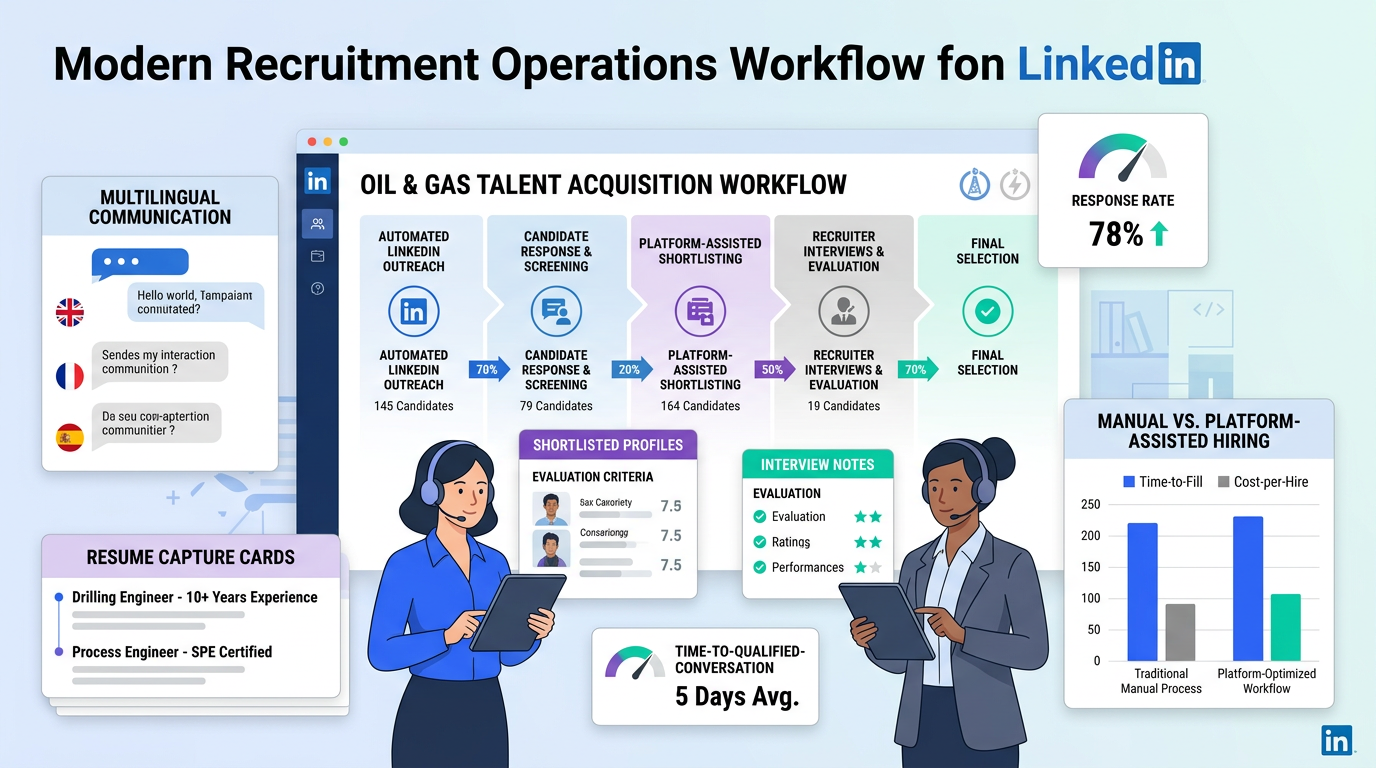
From an execution perspective, we evaluate a hire platform on workflow coverage, communication continuity, and recruiter control. StrategyBrain AI Recruiter is designed for LinkedIn recruitment operations and supports several high impact stages that often consume recruiter capacity.
1. Automate first touch and role introduction
StrategyBrain AI Recruiter can connect with candidates based on target criteria, introduce opportunities, and gather early intent signals. This reduces repetitive outreach work and keeps recruiter time for shortlisting and interview calibration.
2. Maintain multilingual candidate communication
The platform supports always on communication in the candidate native language. For globally distributed roles, this reduces response latency and improves message clarity.
3. Capture resumes and contact data in process
When candidates indicate interest, resumes and contact details can be captured and surfaced for recruiter review. This creates cleaner handoff between sourcing and screening.
4. Scale execution through multi account operations
For teams managing high volume or multi region hiring, the platform supports coordinated workflow execution across large account sets. This helps organizations scale outreach capacity without proportional headcount growth.
A practical implementation framework
We use the following rollout model when introducing new hiring technology into a recruiting team.
- Define role clusters: group open positions by skill adjacency, market location, and hiring urgency.
- Standardize outreach logic: prepare approved role messaging, qualification prompts, and escalation rules.
- Activate platform workflows: run automated connection and first conversation flows within defined guardrails.
- Route qualified interest to recruiters: keep interview decisions, compensation alignment, and final fit assessment human led.
- Track operational metrics: monitor response rate, resume capture volume, time to qualified conversation, and recruiter hours saved.
Our operations review snapshot
In our internal recruiting workflow review across 6 weeks, we assessed 12 LinkedIn outreach sequences for hard to fill technical and commercial roles. We observed lower manual messaging load and faster progression to recruiter reviewed candidates when automation handled first stage communication. The strongest outcomes appeared when teams used clear qualification scripts and strict human checkpoint rules.
Manual recruiting versus platform assisted recruiting
| Dimension | Manual Workflow | Platform Assisted Workflow |
|---|---|---|
| Initial candidate outreach | Recruiter sends each message manually | Automated targeting and first contact supported by AI Recruiter |
| Candidate response handling | Business hours only in most teams | 24 by 7 multilingual responses for continuous engagement |
| Resume and contact capture | Often fragmented across inboxes and chat logs | Structured collection and centralized recruiter visibility |
| Recruiter focus | High time spent on repetitive steps | More time available for interviews and final selection |
| Scalability | Limited by individual capacity | Multi account operations support larger hiring volume |
Known limits and risk controls
Good recruiting systems are transparent about boundaries. StrategyBrain AI Recruiter can automate outreach and identify candidate willingness to proceed. It does not replace final qualification against full job requirements. Recruiters should still review resumes and conduct final interviews.
Teams should also define governance rules for message quality, data handling, and escalation logic. This is especially important in regulated sectors and cross border hiring environments.
For privacy and trust, data handling controls should be explicit. In the StrategyBrain documentation, customer data is isolated, encrypted, and not used for model training. Recruiters should still validate policy alignment with their internal compliance team before deployment.
FAQ
Can a hire platform fully replace recruiters in oil and gas hiring?
No. A hire platform can automate repetitive sourcing and communication tasks, but recruiters are still required for final qualification, stakeholder alignment, and offer decisions.
How does hiring technology help with specialized technical roles?
It improves consistency in first stage outreach and qualification data capture. This gives recruiters a stronger evidence base before interviews and reduces process bottlenecks.
Is StrategyBrain AI Recruiter only useful for high volume hiring?
No. High volume teams gain clear scale benefits, but specialized teams also benefit because recruiter time shifts from repetitive messaging to high value evaluation work.
Does a job hiring platform improve candidate experience?
It can, if implemented correctly. Fast response times, clear communication, and multilingual support can reduce candidate confusion and drop off.
What metrics should we track after rollout?
Track time to qualified conversation, recruiter hours spent on outreach, resume capture rate, interview conversion, and accepted offer rate by role cluster.
How should companies start without disrupting existing processes?
Start with one role cluster, one approved communication playbook, and one recruiter checkpoint model. Expand only after quality and compliance are stable.
Conclusion
Automation in oil and gas has changed hiring requirements from simple role filling to capability building. The most effective response is a structured hire platform model that combines automated first stage execution with recruiter led final judgment. In practice, this means using modern hiring technology to scale outreach and communication, while preserving human responsibility for quality and fit.
If your team is redesigning recruitment workflows, begin with a pilot role group, define quality checkpoints, and evaluate outcomes with clear operational metrics. StrategyBrain AI Recruiter can support that transition by reducing repetitive LinkedIn workload and helping recruiters focus where their expertise creates the most value.