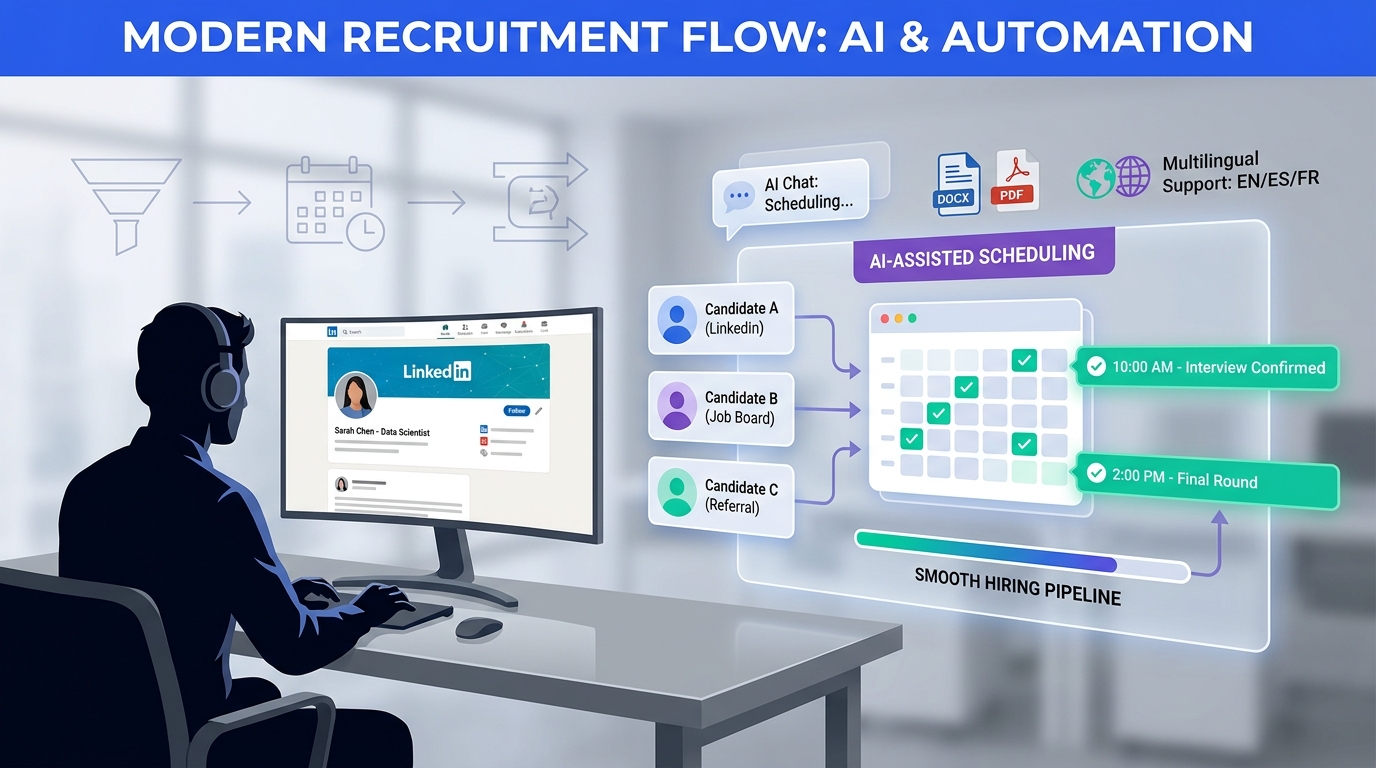
When candidate momentum keeps breaking before interviews, this article helps recruiters judge where hiring ai improves scheduling and avoids avoidable delays.
That matters because delay in recruiting rarely starts with the interview itself. It starts when recruiters are sorting uneven candidate sources, chasing replies after hours, checking who is actually interested, and then losing another two or three days to calendar back-and-forth. For a solo recruiter, that means wasted sourcing effort. For a small agency owner, it means slower placements and weaker client confidence. For an in-house talent lead, it means a strong applicant can cool off before the first online interview even happens.
In my own workflow, I have seen that an AI-supported front end helps most when it removes the repetitive steps before scheduling begins. StrategyBrain AI Recruiter is useful here because it can keep candidate conversations moving around the clock, communicate in the candidate's language when needed, and collect resumes and contact details from people who actually want to continue. That does not replace recruiter judgment. I still review the resume, decide who deserves a first call, and control the next-step interview process, but the handoff into scheduling becomes much cleaner.
The reference point is familiar. Recruiters do not receive one neat kind of applicant. They see the resume traditionalist who applies through standard channels, the referral who enters with social proof, the social media candidate who responds in a less linear way, and the creative job seeker who may send something unconventional such as a video introduction. Add the old reality that one open role can attract well over a hundred resumes, and the scheduling problem stops being a calendar issue alone. It becomes a coordination issue across very different candidate behaviors.
Once those candidates start replying at different hours, through different channels, and with different expectations for speed, the first breakdown is usually not evaluation. It is process consistency. The real question is which interview tools can move interested people into an online interview quickly, keep communication clear, and still leave the recruiter responsible for final selection. That is where automated interview scheduling fits inside a practical hiring ai workflow, and that is the frame for the rest of this article.
Table of Contents
- Why Interview Scheduling Breaks Before Interviews Start
- What Automated Interview Scheduling Actually Does
- What Different Applicant Types Teach Recruiters
- How It Improves the Online Interview Experience
- Interview Tools and Features That Matter Most
- How Hiring AI Connects Sourcing, Interest, and Scheduling
- Implementation Advice From a Recruiter Workflow View
- Comparing Common Scheduling Software Options
- Governance, Trust, and Human Oversight
- FAQ
Why Interview Scheduling Breaks Before Interviews Start
Most teams describe scheduling as admin work, but experienced recruiters know it is really a conversion step. A candidate who looked promising in sourcing or screening only becomes real pipeline once a meeting is booked and held.
That is why the applicant mix matters. Traditional applicants often wait for formal communication. Referrals usually expect speed because someone internal has already vouched for them. Social media candidates may engage outside normal office hours. Creative applicants may need a little more review before a recruiter decides whether to proceed. Those are not abstract personas. They create different timing pressures in the same requisition.
Industry commentary has long highlighted just how fragmented applicant flow can be: large resume volume per role, strong referral influence, meaningful social media sourcing, and employer openness to alternative formats such as video. For recruiters, that mix creates one practical problem. If interest capture and scheduling are still manual, every candidate type adds another communication pattern to manage.
Key insight: In many hiring teams, time-to-interview is not slowed by weak candidates first. It is slowed by fragmented candidate entry points and inconsistent scheduling follow-through.
What Automated Interview Scheduling Actually Does
Automated interview scheduling uses software to coordinate availability, invitations, reminders, and rescheduling without relying on repeated manual email exchanges. At a basic level, it lets candidates choose from approved time slots. At a more advanced level, it can support panel coordination, stage-specific rules, calendar syncing, time-zone handling, and status updates back into the recruiting system.
It is important to separate this from interview evaluation. Scheduling automation manages logistics. It does not decide who should be hired. In a broader hiring ai environment, other tools may support outreach, note capture, workflow prompts, or communications, but recruiters and hiring managers still own assessment and final decisions.
That distinction matters for candidate trust. If a candidate is told that automation is simply helping them book an online interview faster, that is usually easy to understand and accept. If teams blur logistics with evaluation, they create confusion that is unnecessary and avoidable.
What Different Applicant Types Teach Recruiters
The most useful lesson from the applicant-type framing is not the categories themselves. It is the reminder that different candidates enter the funnel with different signals, expectations, and response speeds.
The resume traditionalist
This candidate follows the standard path and often enters volume pipelines. The challenge here is scale. When one role attracts a heavy flow of resumes, recruiters need a reliable way to identify who is worth contacting and then move that person into a confirmed interview slot before attention drifts elsewhere.
The referral
Referral candidates often move on expectation as much as process. Because an employee connection is involved, delay can damage more than candidate experience. It can affect internal trust in the hiring team. Fast, well-structured scheduling is especially valuable here.
The social media candidate
This group is often more conversational and less tied to office-hour communication. That is one reason always-on messaging can support scheduling outcomes. If a candidate replies after work and confirms interest, the recruiter benefits when the process does not pause until the next morning.
The creative job seeker
When a candidate sends a nontraditional introduction, such as a portfolio-driven pitch or video element, the recruiter may need a little extra judgment before scheduling. Automation still helps, but only after a human has decided the person merits the next step.
Seen together, these applicant types explain why automated interview scheduling works best as part of a wider hiring ai workflow. You need a clean bridge from interest to action, not just a booking link dropped into a busy process.
How It Improves the Online Interview Experience
Candidates do not experience scheduling as an internal workflow. They experience it as evidence of how organized the employer or recruiter is. That is why automated scheduling has a direct effect on the online interview experience.
- Faster booking: candidates can choose a time without waiting through long email chains
- Clearer instructions: confirmations can include format, duration, preparation guidance, and joining details
- Better time-zone handling: distributed hiring becomes less error-prone
- Easier rescheduling: candidates can adjust plans without restarting the conversation
- More reliable reminders: attendance risk drops when prompts are timely and consistent
For recruiters, the benefit is not just convenience. It is reduced friction at the exact point where candidate momentum is most fragile. A well-run online interview process should feel easy to enter, easy to understand, and easy to change when real life gets in the way.
Interview Tools and Features That Matter Most
Not all interview tools are built for the same operating reality. A small retained search may only need controlled self-scheduling. A growth-stage employer may need panel coordination and stage logic. A high-volume team may need tight ATS syncing and standardized reminders. The right feature set depends on where your delays actually happen.
1. Self-scheduling with guardrails
Candidates should be able to pick available times, but recruiters still need to define interview lengths, eligible interviewers, and booking windows.
2. Real calendar syncing
If availability is not trustworthy, automation will scale mistakes instead of removing them.
3. Multi-stage coordination
Once the process goes beyond a single intro call, the software should support sequenced rounds, panels, and interviewer dependencies.
4. Automated reminders and confirmations
These are essential for online interview consistency, especially where links, documents, or prep instructions need to be attached.
5. Rescheduling controls
Good scheduling systems treat changes as normal, not exceptional.
6. ATS and workflow integration
Scheduling should update the recruiting record rather than create more duplicate admin work.
7. Candidate communication support
For teams using hiring ai upstream, the transition from interest confirmation to booking should be smooth rather than manual and fragmented.
| Feature | Why It Matters | Best Fit |
|---|---|---|
| Self-scheduling | Shortens email back-and-forth | Most recruiting teams |
| Calendar sync | Reduces conflicts and no-shows | Hiring managers and coordinators |
| Panel support | Handles complex stages | Growing and enterprise teams |
| Reminders | Keeps candidates informed | Online interview-heavy workflows |
| Rescheduling | Protects candidate momentum | Agency and in-house teams |
| ATS integration | Keeps records aligned | Recruiting ops and TA leaders |
How Hiring AI Connects Sourcing, Interest, and Scheduling
This is where recruiters often get the highest operational value from hiring ai. The best result is not a fully automated hiring process. It is a cleaner handoff between repetitive front-end communication and human decision-making.
- Source or attract candidates: applicants arrive through resumes, referrals, social channels, or direct outreach
- Confirm interest: candidates indicate whether they want to continue
- Collect resume and contact details: basic next-step information is captured cleanly
- Review and decide: the recruiter evaluates fit and decides who should move forward
- Send scheduling options: candidates book a time for an online interview
- Run reminders and updates: the system keeps candidates and interviewers aligned
- Advance or close the stage: feedback and next actions follow after the meeting
That sequence is exactly why I find AI Recruiter most useful before scheduling, not instead of it. In practice, I have used it to keep LinkedIn conversations moving when candidates replied late, to gather resumes from interested people without forcing another manual chase, and to hand me a cleaner pool of candidates for review. The gain is not that the system decides for me. The gain is that by the time I send interview availability, I am working from confirmed interest instead of a half-finished message thread.
For recruiters doing cross-border or after-hours outreach, the multilingual and always-on communication angle also matters. A candidate can move from first response to real next-step readiness while the recruiter is offline, which reduces avoidable lag in the path to scheduling.
Implementation Advice From a Recruiter Workflow View
Automation succeeds when the workflow behind it is already sound. It fails when teams ask software to compensate for unclear ownership or inconsistent process.
Define the handoff point
Be explicit about when a candidate becomes eligible for scheduling. Is it after interest confirmation, after resume review, or after a recruiter screen? That rule prevents over-automation.
Segment by candidate type
Do not assume every applicant should enter the same scheduling flow. Referrals, executive candidates, and late-stage finalists often need more recruiter-led handling than volume applicants.
Standardize the invitation content
Every booking message should answer the same basics: interview format, estimated length, interviewer names if appropriate, technical requirements, and rescheduling instructions.
Protect interviewer time
Set buffers, limit open slots, and make sure hiring managers keep calendars accurate. Otherwise the tool will only expose poor calendar hygiene faster.
Measure delay points
Look beyond time-to-hire. Track time from recruiter approval to booked interview, no-show patterns, reschedule frequency, and stage-level drop-off.
- Use automation to remove repetitive logistics
- Keep recruiter review in the decision path
- Give candidates flexible but controlled booking options
- Match the process to the candidate source and stage
Comparing Common Scheduling Software Options
Because this is a software-driven workflow, recruiters often compare general scheduling platforms before thinking through recruiting-specific needs. Three common options in the US market are Calendly, GoodTime, and ModernLoop. Each can be useful, but they solve slightly different parts of the problem.
Calendly
Experience: Simple and familiar for one-to-one booking. Effectiveness: Strong for straightforward intro calls, lighter for complex interview loops. Cost: Usually easier to adopt for small teams than dedicated recruiting platforms. Best fit: Solo recruiters, small agencies, or teams with simple stage design. Working alongside AI Recruiter: Useful when AI Recruiter has already helped confirm candidate interest and collect details; Calendly can then handle the actual slot booking cleanly.
GoodTime
Experience: Built more directly for recruiting coordination and interviewer management. Effectiveness: Better suited than generic scheduling tools for structured, multi-person interview workflows. Cost: Typically more of an operational investment than lightweight schedulers. Best fit: Mid-size and enterprise TA teams with high coordination complexity. Working alongside AI Recruiter: A strong combination when front-end candidate communication happens through hiring ai and interview orchestration needs to scale across many stakeholders.
ModernLoop
Experience: Designed for scheduling operations inside modern talent teams, often with emphasis on interviewer coordination. Effectiveness: Helpful where process design and consistency are central priorities. Cost: More suited to organizations with dedicated recruiting operations budgets. Best fit: Larger organizations with recurring panel-based online interview workflows. Working alongside AI Recruiter: Best where the recruiter wants AI support upstream in sourcing and candidate communication, then a more specialized platform for downstream interview logistics.
The practical point is this: none of these tools replaces the recruiter's judgment on candidate quality. And if your biggest delay happens before the booking link is ever sent, a scheduling platform alone will not fix it. That is where a front-end hiring ai layer can help prepare the right candidates for scheduling in the first place.
Governance, Trust, and Human Oversight
The more automation a team uses, the more clearly it should explain who is doing what. Candidates should know when technology is helping with communication and scheduling, and when a recruiter is making the actual progression decision.
For automated interview scheduling, that governance checklist is fairly straightforward:
- Human ownership: recruiters and hiring managers remain accountable for decisions
- Scope clarity: explain whether automation only handles outreach, interest capture, or scheduling
- Data handling: review how resumes, contact details, and communication records are stored
- Access control: limit who can view candidate data and calendar information
- Fair access: provide alternatives for candidates with time-zone, disability, or technology constraints
Where teams use AI-supported communication tools before scheduling, they should also confirm privacy expectations, storage practices, and internal compliance review. Used carefully, hiring ai can improve speed and consistency without blurring accountability.
FAQ
What is automated interview scheduling in recruiting?
It is the use of software to manage interview booking, confirmations, reminders, and rescheduling with less manual coordination from recruiters.
How does hiring ai help with an online interview process?
Hiring ai can support the steps leading into scheduling, such as candidate outreach, interest confirmation, and information collection. That makes it easier to move qualified candidates into an online interview quickly.
Are interview tools enough on their own?
Not always. If the main bottleneck is slow candidate response, uneven outreach coverage, or incomplete handoff from sourcing to scheduling, interview tools help only after that front-end problem is solved.
Should recruiters automate interview decisions too?
No. Scheduling automation is most useful for logistics. Recruiters and hiring managers should remain responsible for fit assessment, interview quality, and hiring decisions.
Can StrategyBrain AI Recruiter replace a recruiter?
No. It can support repetitive LinkedIn communication, collect resumes and contact details, and keep conversations moving, but the recruiter still reviews candidates and decides who should advance.
Which teams benefit most from automated interview scheduling?
Agency recruiters, internal TA teams, high-volume hiring groups, and distributed hiring teams usually benefit the most, especially when candidate responsiveness and speed-to-interview directly affect outcomes.
Conclusion
Automated interview scheduling works best when recruiters stop treating it as a stand-alone calendar feature and start treating it as a conversion layer inside a broader hiring ai workflow. That shift matters because modern applicant flow is mixed: resume applicants, referrals, social media candidates, and more creative profiles all enter with different expectations and timing patterns.
When the workflow is designed well, the right interview tools shorten the path to an online interview, reduce preventable admin work, and make the process feel more organized for everyone involved. And when an AI-supported communication layer helps confirm interest before scheduling begins, recruiters can spend more time making better judgments and less time untangling inboxes.
If you are reviewing your own process, start with a simple question: where does momentum actually break between first candidate interest and a confirmed interview? In many teams, that answer will tell you whether you need better scheduling, better front-end communication, or both.