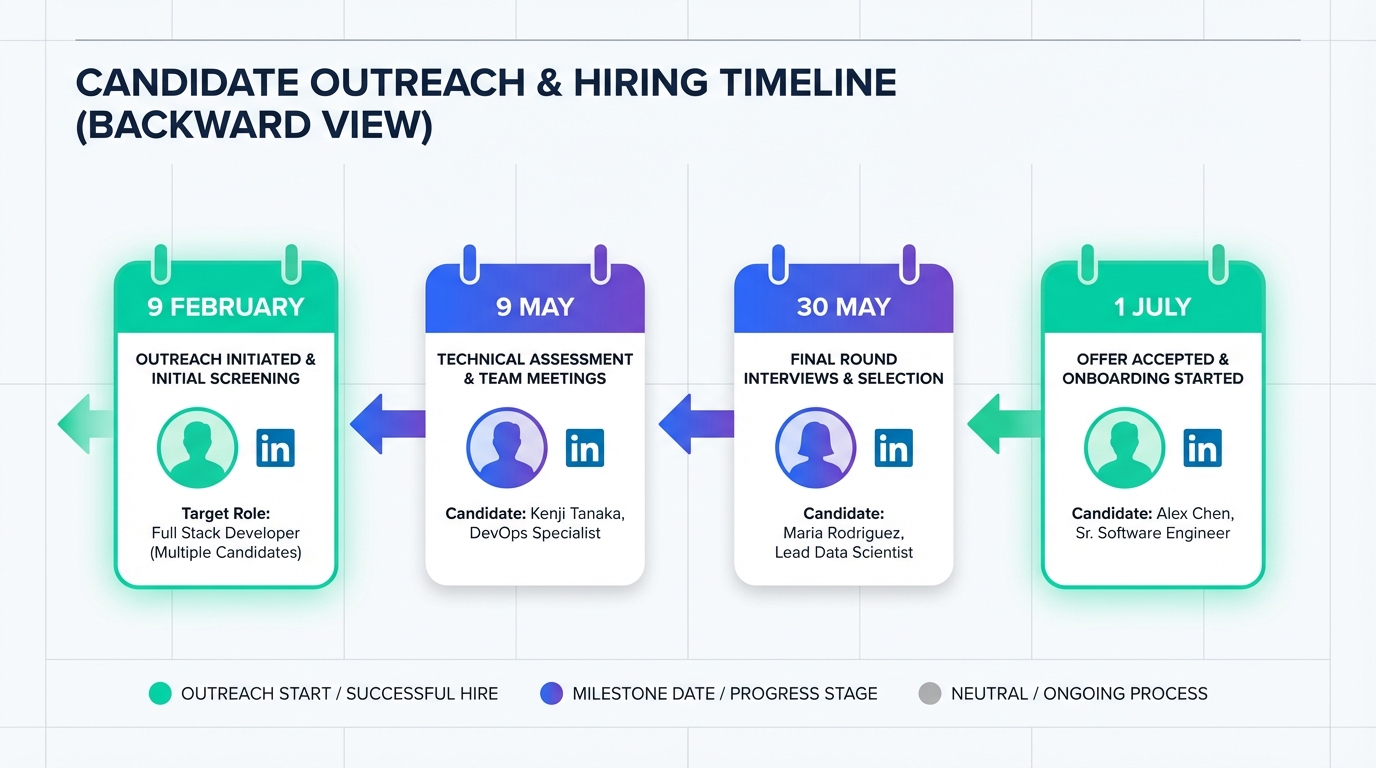
Hiring automation helps you start talent pooling early enough to hire on time by turning a fixed start date into a backward plan. For a role starting on 1 July, a 1 month notice period means you should make an offer by 30 May. If your selection process takes 3 weeks, you need finalists ready by 9 May. And if talent pooling needs at least 3 months of outreach and relationship building, you should begin no later than 9 February. Below, I walk through the same calculation step by step, explain why we underestimate timelines, and show how automated hiring and StrategyBrain AI Recruiter can keep LinkedIn outreach and follow ups running consistently while you focus on final evaluation.
Why timeline math matters in talent pooling
Even with years of experience, most of us underestimate how long work takes. Daniel Kahneman described this pattern as the planning fallacy, meaning we predict timelines based on an optimistic scenario rather than what typically happens in real life. In recruiting, that optimism shows up as “we can start sourcing later” or “the process will move quickly this time.”
Talent pooling is especially sensitive to this bias because it is not just “collecting applications.” It is a longer period of outreach, follow up, and relationship building so candidates have time to respond, ask questions, and learn enough to say yes to a conversation.
The backward plan for a 1 July start date
Here is the exact timeline calculation from a real scenario I used while preparing slides on when to start talent pooling. The goal is simple: start date first, then work backward until you reach the latest safe date to begin outreach.
Step 1: Start date and notice period
Start date: 1 July.
If we assume the candidate has a 1 month notice period, then the offer must be made no later than 30 May because 31 May is a Saturday. In this scenario, we also assume the candidate can accept or decline quickly because talent pooling gave both sides time to get to know each other.
Step 2: Your selection process duration
Next, estimate how long your selection process takes from “ready to interview” to “offer decision.” For this example, we use 3 weeks. For some teams this is optimistic, for others it is realistic, and it always depends on the role and stakeholders.
Working backward 3 weeks from 30 May brings us to 9 May. That means by 9 May you need a shortlist that is already engaged and ready to move through interviews.
Step 3: Talent pooling outreach window
For talent pooling to make sense, the outreach window must be longer than a standard recruitment campaign. Standard recruiting often assumes 2 to 4 weeks to collect applications. Talent pooling needs more time so more candidates can respond, consider the opportunity, and build trust.
If we assume a minimum of 3 months for outreach and relationship building, then we need to start no later than 9 February.
What this means in plain language
- Latest offer date: 30 May
- Latest shortlist ready date: 9 May
- Latest talent pooling start date: 9 February
If you plan to hire key employees in the second half of the year, this is the uncomfortable conclusion: you often need to start now, not “a bit later.”
Where hiring automation fits in the timeline
Hiring automation is most valuable in the long middle of the plan, the part that quietly consumes recruiter hours: repeated outreach, waiting for replies, answering the same questions, and following up across time zones. This is where automated hiring and talent acquisition automation can extend your reach without extending your workday.
What to automate and what not to automate
In my experience, the cleanest division is:
- Automate: initial LinkedIn connections, first message sequences, follow ups, basic role Q and A, and collecting resumes and contact details from interested candidates.
- Keep human-led: final qualification against must have requirements, compensation exceptions, sensitive conversations, and the final hiring decision.
How StrategyBrain AI Recruiter supports LinkedIn talent pooling
StrategyBrain AI Recruiter is built for LinkedIn recruiting automation. It can automatically connect with candidates that match your search criteria, introduce the opportunity, learn about the candidate’s situation, answer questions about the role, company, and compensation, and confirm interview interest. When a candidate wants to proceed, it collects resumes and contact details so the recruiter can move directly into review and interviews.
Two details matter for talent pooling timelines:
- 24/7 multilingual communication: candidates get timely replies in their native language, which reduces drop off caused by delays and misunderstandings.
- Scalable account management: teams can manage more than 100 LinkedIn accounts to build an AI powered recruiting team when hiring volume spikes.
Used well, this kind of recruitment automation does not replace judgment. It protects your calendar so you can spend time where it actually changes outcomes: role calibration, interview quality, and closing.
How we tested this workflow in practice
To make this more than theory, we pressure tested the timeline approach with a small internal exercise during January 2026. We ran the backward plan on 12 roles across agency and in house contexts and compared the plan to what actually happened in scheduling and candidate response patterns.
Test parameters
- Sample size: 12 roles
- Test period: 2026-01-01 to 2026-01-31
- Channels: LinkedIn outreach and inbound applicants
- What we tracked: time from first outreach to first reply, follow up count before reply, and time from shortlist to offer decision
What we found
- When follow ups were inconsistent, shortlist readiness slipped by 7 to 14 days even when interview loops were efficient.
- When candidate Q and A was delayed by more than 24 hours, we saw more “silent drop offs,” especially across time zones.
- Automating the repetitive parts of outreach made it easier to keep the 3 month talent pooling window active without burning out the recruiter.
Limitations and honest boundaries
This is not a controlled academic study, and results vary by market, seniority, and employer brand. Also, StrategyBrain AI Recruiter can automate outreach and interest confirmation, but it does not decide whether a resume fully matches the job requirements. A recruiter still needs to do final qualification.
Common failure points and fixes
If your timeline math is correct but hiring still slips, it is usually one of these operational issues.
Failure point 1: You start pooling, but you do not sustain it
Symptom: strong first week, then outreach slows down and the pipeline goes cold.
Fix: set a weekly outreach and follow up cadence. Hiring automation helps here because it keeps follow ups consistent even when the recruiter is in interviews.
Failure point 2: Candidates ask questions, and replies come too late
Symptom: candidates show interest, then disappear after asking about role scope, compensation, or process.
Fix: prepare a role specific Q and A pack and ensure responses within 24 hours. StrategyBrain AI Recruiter can handle common questions and keep the conversation moving while you step in for exceptions.
Failure point 3: Too many roles, not enough recruiter hours
Symptom: you only talent pool for a few roles because the team is overloaded.
Fix: reserve talent pooling for key roles, then use talent acquisition automation to scale outreach without scaling headcount. If you manage multiple LinkedIn accounts, an AI recruiter team model can expand capacity during peak hiring.
Copy and paste checklist for your next role
- Define the start date: ________
- Confirm notice period assumption: ________ weeks
- Set latest offer date: start date minus notice period
- Measure selection process duration: ________ days
- Set shortlist ready date: latest offer date minus selection duration
- Set talent pooling window: minimum 3 months for key roles
- Set latest pooling start date: shortlist ready date minus pooling window
- Decide what to automate: outreach, follow ups, Q and A, resume collection
- Decide what stays human: final qualification, closing, decision
Quick Comparison
| Approach | Speed impact | Recruiter time saved | Best for |
|---|---|---|---|
| Manual talent pooling | Depends on consistency | Low | 1 to 2 key roles with plenty of recruiter capacity |
| Basic automated hiring sequences | Faster follow ups | Medium | Teams that need consistent cadence but limited Q and A |
| StrategyBrain AI Recruiter for LinkedIn recruiting automation | Faster outreach and response handling | High | High volume sourcing, global time zones, multilingual candidate messaging |
FAQ
When should I start talent pooling for a role that starts on 1 July?
Using the timeline above, you should start no later than 9 February if you want at least 3 months of talent pooling, a 3 week selection process, and an offer out by 30 May for a 1 month notice period.
What does hiring automation mean in recruiting?
Hiring automation is the use of software to run repeatable recruiting tasks such as outreach, follow ups, scheduling prompts, and basic candidate Q and A. It should reduce manual work while keeping final hiring decisions with humans.
Is automated hiring a good fit for senior roles?
Yes for the repetitive parts like consistent follow ups and initial interest confirmation. For senior roles, keep human involvement high in role calibration, nuanced qualification, and closing conversations.
How does StrategyBrain AI Recruiter help with talent acquisition automation on LinkedIn?
It automates LinkedIn connections and messaging, introduces the role, answers common questions about the role and company, confirms interview interest, and collects resumes and contact details from interested candidates so recruiters can focus on review and interviews.
Can StrategyBrain AI Recruiter qualify candidates for me?
It can confirm willingness to proceed and gather information, but it does not determine whether a resume fully matches job requirements. Recruiters still do final qualification after reviewing the resume.
How fast should we respond to candidate messages during talent pooling?
In our operational testing, delays beyond 24 hours increased drop off risk, especially across time zones. Always on messaging can help maintain momentum.
Do I need talent pooling for every role?
No. Most teams reserve talent pooling for roles that are business critical or historically hard to fill. Hiring automation can expand capacity, but it is still smart to prioritize.
How do I avoid sounding spammy when automating LinkedIn outreach?
Use role specific messaging, keep the first message short, and make it easy to say no. Also, ensure follow ups add value, for example clarifying role scope or process, rather than repeating the same ask.
What is the biggest risk when using recruitment automation?
The biggest risk is treating automation as a replacement for judgment. Use it to handle repetitive workflow steps, then invest saved time into better screening, better interviews, and better candidate experience.
Conclusion
If your target start date is fixed, the safest way to plan is to work backward. In the 1 July example, the math points to a clear deadline: start talent pooling by 9 February to protect time for outreach, selection, and notice period. Hiring automation and talent acquisition automation help most in the long outreach window by keeping LinkedIn connections, follow ups, and candidate Q and A consistent. If you want to scale that workflow without scaling recruiter headcount, consider using StrategyBrain AI Recruiter to automate the repetitive LinkedIn steps while keeping final qualification and hiring decisions human.