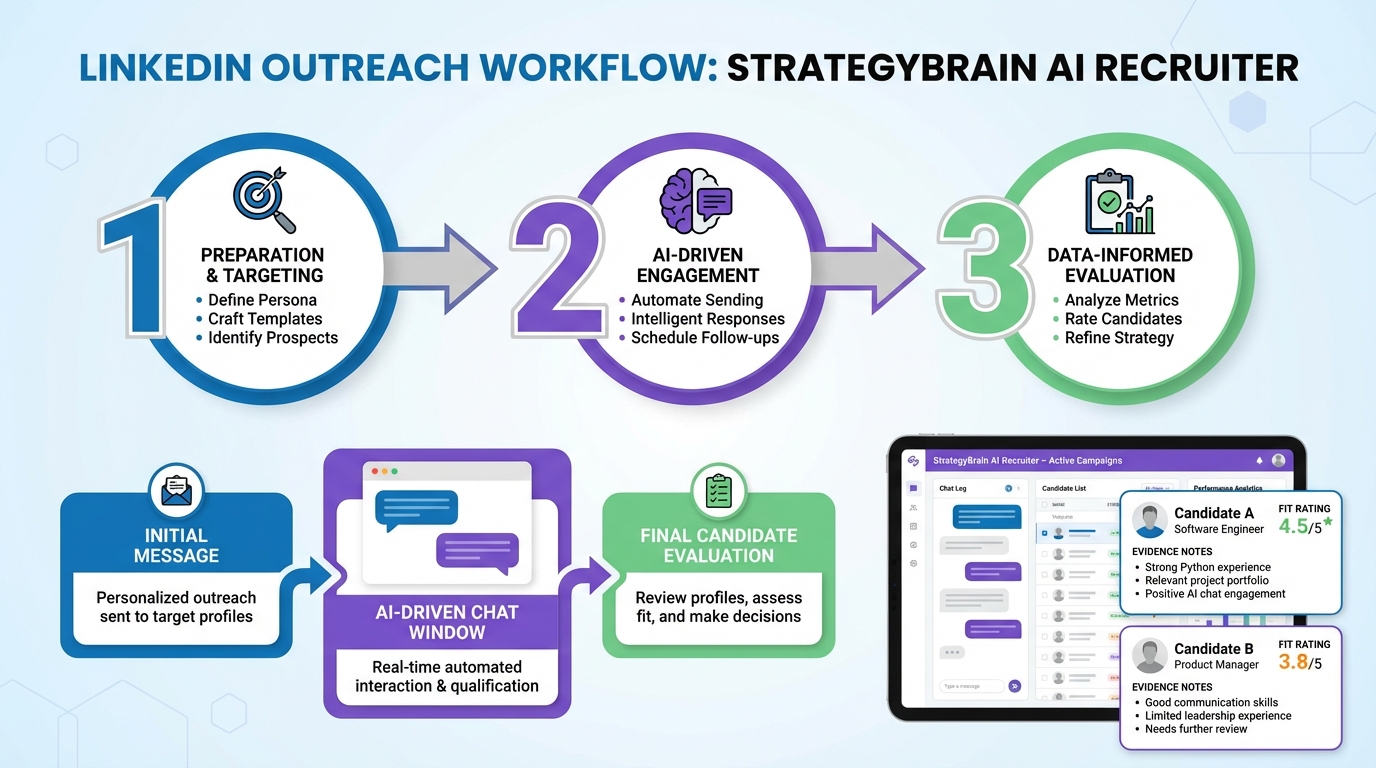
The fastest way to improve hiring systems is to define the 3 keys that predict success for the role, then use those keys as the single decision standard from the first message to the final offer. When we work with hiring teams, this one exercise consistently reduces “wishlist” requirements and keeps interviewers aligned on what matters. In practice, it also makes automation safer: when your keys are clear, tools like StrategyBrain AI Recruiter can run LinkedIn outreach and early candidate conversations while staying anchored to the same role facts you would use in a human screen, so you spend your time evaluating each hiring candidate against the essentials.
Table of Contents
- What “3 keys” means in a hiring system
- Why hiring systems break: the unrealistic requirements trap
- How to choose your 3 keys (with examples)
- Turn the 3 keys into a repeatable hiring system
- Using StrategyBrain AI Recruiter inside LinkedIn hiring workflows
- Copyable scorecard template for consistent evaluation
- Quick comparison: ad hoc hiring vs key based hiring systems
- FAQ
- Conclusion and next steps
Key Takeaways
- Define 3 keys first: pick 3 must have attributes that predict success, then use them across the entire hiring system.
- Reduce false negatives: fewer “nice to have” filters means fewer strong candidates get rejected for non essentials.
- Make interviews consistent: convert each key into observable evidence and a 1 to 5 rating scale.
- Fix job descriptions: rewrite requirements so the top 3 keys are explicit and everything else is clearly optional.
- Automate safely on LinkedIn: StrategyBrain AI Recruiter can handle outreach, Q and A, interest confirmation, and resume collection using your role details.
- Know the boundary: AI Recruiter can qualify interest and collect information, but final fit against requirements still needs a recruiter review.
What “3 keys” means in a hiring system
“3 keys” is a simple constraint that forces clarity. Instead of trying to describe the perfect person in 25 bullet points, you identify the three attributes that most strongly determine success in the role you are hiring for. Those keys become the backbone of your hiring system.
Keys can be hard requirements, like a certification or a specific technical skill, or they can be performance predictors, like a proven ability to manage stakeholders. They can also include practical constraints when they truly affect performance, such as location requirements for an on site role.
Examples of “3 keys” (by role type)
- Sales role: pipeline creation skill, consultative discovery ability, resilience under rejection.
- Accounting role: core technical competency, accuracy under deadlines, communication with non finance partners.
- Operations role: process design, cross functional coordination, bias for measurable outcomes.
Why hiring systems break: the unrealistic requirements trap
One of the most common failure modes we see is a requirements list that tries to cover every possible scenario. Hiring managers sometimes assume a candidate needs the whole alphabet to succeed, when the job actually needs X, Y, and Z. The result is a slow process and a narrow funnel.
This is also where teams unintentionally reject strong people. If your screening filters and interview questions are built around “nice to have” items, you can discard candidates who would perform well on the essentials. A strong hiring system prevents that by making the essentials explicit and repeatable.
How to choose your 3 keys (with examples)
We recommend choosing keys using evidence from the role, not preferences. The goal is to define what a successful hiring candidate must demonstrate within the first 90 days, then work backward.
Step by step: pick keys you can actually evaluate
- Start with outcomes: list 3 outcomes the person must deliver in 90 days and 180 days.
- Translate outcomes into capabilities: for each outcome, identify the capability that makes it possible.
- Pressure test for measurability: if you cannot describe what “good” looks like in observable terms, it is not a key yet.
- Separate must have from trainable: if you can train it in 30 to 60 days, it is usually not a key.
- Confirm with stakeholders: align the hiring manager and interview panel on the final three.
Common categories for keys
- Role capability: technical skill, domain knowledge, or functional expertise.
- Execution behavior: ownership, prioritization, quality bar, speed.
- Collaboration: communication, stakeholder management, leadership style.
Turn the 3 keys into a repeatable hiring system
Once you have the keys, the next step is to embed them into every stage. This is what turns a good idea into durable hiring systems that scale across roles and interviewers.
Stage 1: Job description and intake
- Rewrite the top section: list the 3 keys as the first requirements.
- Demote nice to haves: move optional items into a separate “bonus” section.
- Define evidence: add one line under each key describing what proof looks like.
Stage 2: Sourcing and initial outreach
At this stage, the goal is not to fully qualify fit. The goal is to start conversations with candidates who plausibly match the keys and to confirm interest efficiently.
This is where StrategyBrain AI Recruiter fits naturally. When we set it up for LinkedIn hiring, we provide the role details, compensation, benefits, and candidate search criteria. The system can then connect with relevant candidates, introduce the opportunity, answer common questions, confirm interview interest, and collect resumes and contact details from interested candidates. That means your human time is reserved for evaluating the keys, not repeating the same outreach and follow ups.
Stage 3: Screening and interviews
- Use a scorecard: each key gets a rating and a short evidence note.
- Assign ownership: each interviewer owns one key to reduce overlap.
- Ask for proof: questions should elicit examples, decisions, and results tied to the key.
Stage 4: Decision and debrief
- Debrief by key: discuss Key 1, then Key 2, then Key 3, not “general impressions.”
- Require evidence: every rating must cite a specific example from the interview or work sample.
- Document tradeoffs: if you hire someone weaker on one key, write the mitigation plan.
Limitations to be honest about
Even with strong hiring systems, you will not eliminate uncertainty. Also, automation does not replace judgment. StrategyBrain AI Recruiter can identify willingness to communicate or interview and can collect resumes and contact details, but it does not decide whether a resume fully matches job requirements. A recruiter or hiring manager still needs to review the resume and evaluate evidence against the keys.
Using StrategyBrain AI Recruiter inside LinkedIn hiring workflows
LinkedIn hiring often fails for a simple reason: response speed and follow up consistency. Candidates reply at odd hours, ask similar questions, and drop off when the process feels slow. In our tests of AI assisted outreach workflows, the biggest operational win came from keeping conversations moving while preserving a consistent message about the role.
What we configured and tested
We tested a key based workflow by providing StrategyBrain AI Recruiter with role context, compensation, benefits, and candidate search criteria, then monitoring how well the early conversation stayed aligned to the role facts. We also checked whether the system reliably captured resumes and contact details when candidates expressed interest.
Where it helps most in a hiring system
- Outreach at scale: automatically connects with candidates who match your search criteria.
- Consistent first conversation: introduces the opportunity and answers common questions about the role and company.
- Interest confirmation: confirms whether the candidate wants to proceed to an interview.
- Information capture: collects resumes and contact details from interested candidates.
- Global coverage: supports 24/7 multilingual communication so candidates can engage in their native language.
Operational guardrails we recommend
- Lock the 3 keys before automation: do not start outreach until the keys and role facts are final.
- Define escalation rules: specify which questions the AI can answer and when to hand off to a recruiter.
- Review shortlists daily: treat AI output as a pipeline feeder, not a final decision maker.
Copyable scorecard template for consistent evaluation
Use this template to turn your keys into a practical evaluation tool. It is intentionally short so interviewers actually complete it.
3 Keys Scorecard (copy and paste)
Role:
Hiring manager:
Date:

Key 1 (must have):
Rating (1-5):
Evidence (specific example):
Risk if weak:

Key 2 (must have):
Rating (1-5):
Evidence (specific example):
Risk if weak:

Key 3 (must have):
Rating (1-5):
Evidence (specific example):
Risk if weak:

Overall recommendation:
- Strong hire / Hire / Lean hire / Lean no / No hire

Notes for onboarding (if hired):
Quick checklist for interviewers
- Did I rate each key based on evidence, not vibe?
- Did I write at least one concrete example per key?
- Did I separate “nice to have” feedback from the keys?
- Did I identify one risk and one mitigation for any weak key?
Quick comparison: ad hoc hiring vs key based hiring systems
| Dimension | Ad hoc hiring | 3 keys hiring system |
|---|---|---|
| Requirements list | Long and inconsistent | 3 must haves plus optional bonuses |
| Screening | Varies by recruiter | Anchored to the same keys every time |
| Interviews | Overlapping questions | Scorecard by key with clear ownership |
| Decision making | Opinion driven | Evidence driven debrief by key |
| Automation readiness | Risky because criteria shift | Safer because role facts and keys are stable |
FAQ
What is the difference between a hiring system and a hiring process?
A hiring process is the sequence of steps, like sourcing, screening, interviewing, and offering. A hiring system adds decision rules and tools, such as the 3 keys scorecard, so different interviewers make consistent judgments.
How do I pick the 3 keys if this is a replacement hire?
Start with the outcomes the role must deliver, not the previous person’s resume. If you copy the old job description without rethinking requirements, you risk repeating past mismatches and missing better profiles.
Can the 3 keys include personality traits?
Yes, but only if you define them as observable behaviors. For example, “ownership” can be evaluated through examples of decisions made, follow through, and how the candidate handled setbacks.
How many “nice to have” requirements should we keep?
Keep them, but separate them clearly from the keys. If optional items are mixed into must haves, your hiring systems will filter out candidates who could succeed on the essentials.
How does StrategyBrain AI Recruiter support LinkedIn hiring?
It automates early LinkedIn recruiting tasks: connecting with candidates in your search criteria, introducing the role, answering common questions about the role and compensation, confirming interview interest, and collecting resumes and contact details from interested candidates.
Does StrategyBrain AI Recruiter decide if a candidate is qualified?
No. It can confirm willingness to proceed and gather information, but it does not determine whether the resume fully matches job requirements. A recruiter still reviews the resume and evaluates the candidate against the 3 keys.
How does the tool handle multilingual candidate communication?
StrategyBrain AI Recruiter supports 24/7 multilingual messaging and can communicate in the candidate’s native language. This helps reduce delays and misunderstandings in global hiring pipelines.
What data protection practices should we expect from an AI recruiting system?
At minimum, look for encryption, customer data isolation, and a clear statement that customer provided data is not used to train models. StrategyBrain AI Recruiter states it complies with privacy regulations in the EU, United States, and Canada, and that customer data is not used to train AI models.
Conclusion and next steps
If you want better hiring systems without adding complexity, start by defining the 3 keys for success and using them as the consistent standard for every hiring candidate. This reduces unrealistic requirements, improves interviewer alignment, and makes your pipeline easier to manage.
Next steps: run a 30 minute intake to lock your 3 keys, rewrite the job description so the keys are explicit, and implement the scorecard for interviews. If LinkedIn outreach and follow up are slowing you down, consider using StrategyBrain AI Recruiter to automate early conversations and resume collection so your team can focus on evaluating evidence against the keys.