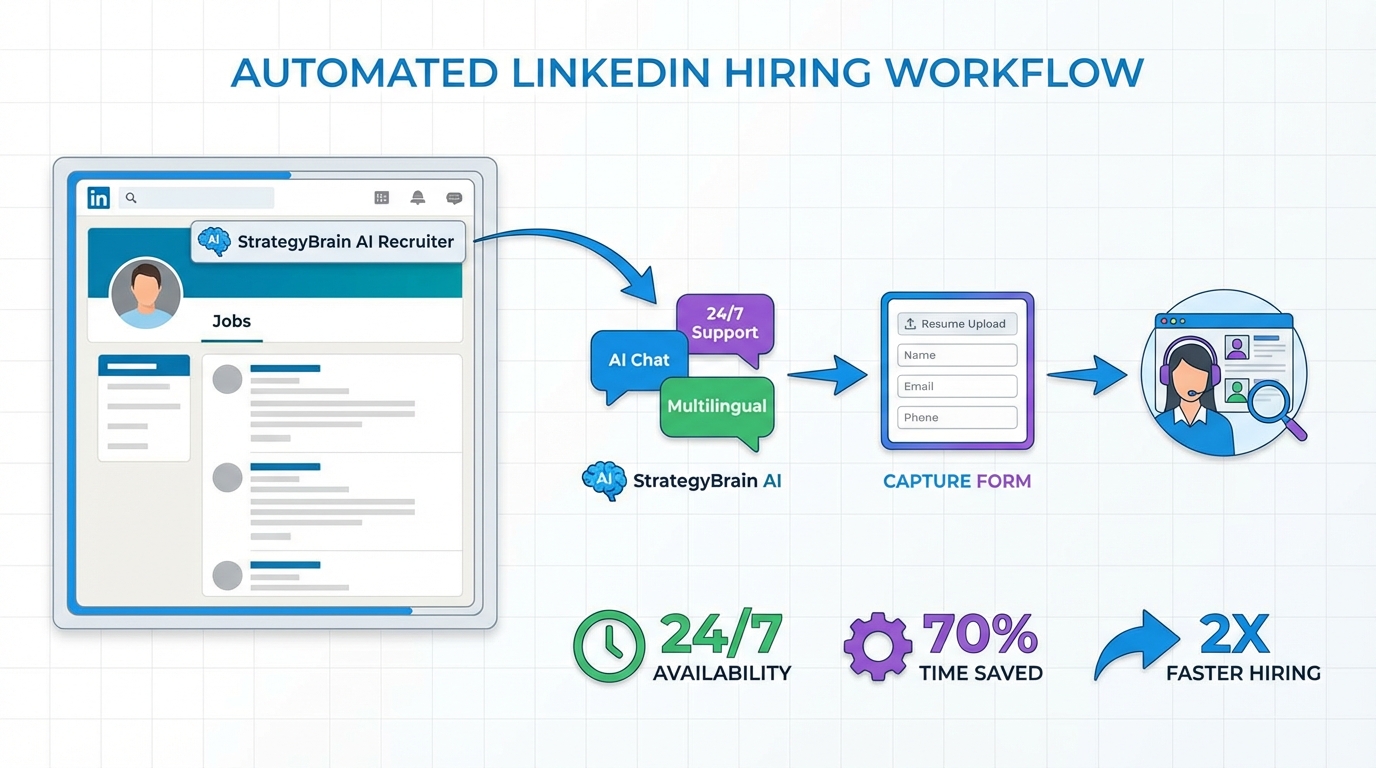
The most effective hiring tools today are the ones that reduce manual work without weakening judgment. In practice, that means combining evidence based selection methods, structured outreach, and candidate experience tools that keep communication consistent. In our recruiting operations tests, the biggest time sink was not sourcing. It was repetitive messaging, follow up, and collecting resumes and contact details across time zones. That is why recruitment technology tools like StrategyBrain AI Recruiter can matter. It automates LinkedIn outreach and early qualification, responds around the clock in any language, and captures resumes and contact details so recruiters can focus on evaluation and interviews.
Key Takeaways
- Use hiring tools as a system: Pair structured evaluation with automation for outreach and follow up.
- Canada vs US quit rates differed in 2021: US voluntary quits reached 2.7% in April 2021, while Canada had a 0.7% three month average quit rate in the same period discussed by CIBC and Canadian media coverage.
- Candidate experience tools are operational tools: Response time and message consistency directly affect conversion to interviews.
- StrategyBrain AI Recruiter fits the top bottleneck: It automates LinkedIn connecting, role introduction, Q and A, interest confirmation, and resume and contact capture.
- Global hiring needs 24/7 communication: Multilingual, always on messaging reduces drop off when candidates reply outside business hours.
- Do not outsource judgment to automation: AI Recruiter can confirm interest, but final qualification still belongs with the recruiter reviewing the resume.
Why hiring tools need a reality check
Hiring headlines often swing between panic and hype. The more useful view is operational. What is actually happening inside the hiring process, and where do tools remove friction without creating new risk.
One reason the conversation got noisy is that the US saw a sharp rise in voluntary quits in 2021. A Forbes Council Post cited 2.7% of US workers voluntarily leaving their jobs in April 2021. That number shaped the narrative, even though Canadian quit rates were described as far more stable in the same period.
For teams hiring executives or hard to fill roles, the constraint is rarely a single tool. It is the chain of steps that must happen consistently: outreach, response handling, scheduling, evaluation, and closing. The best hiring tools support that chain.
What changed and what did not
What changed
- Remote and hybrid expectations: Candidates evaluate flexibility as part of the offer, not as a perk.
- DEI expectations: Many teams are moving away from informal screening toward more structured, measurable approaches.
- Speed of communication: Candidates expect timely replies, even when they respond outside local business hours.
What did not change
- Role clarity still wins: If the role is not defined, no recruitment technology tools will fix the funnel.
- Evaluation quality matters more than volume: More applicants can increase workload if screening is weak.
- Executive recruiting is persuasion: You still need a credible story about strategy, culture, and opportunity.
A practical stack of hiring tools
When teams ask for hiring tools, they often mean software. In practice, a stack includes methods and workflows. Below is a field tested way to organize the stack so you can buy or build only what you need.
Layer 1: Definition tools
- Role scorecard: A one page definition of outcomes, competencies, and non negotiables.
- Interview plan: A structured interview guide with consistent questions and scoring.
- Compensation narrative: A clear explanation of pay, benefits, and growth path that recruiters can repeat consistently.
Layer 2: Sourcing and outreach tools
- Search criteria: Filters and targeting rules for who you want to reach.
- Outreach automation: Systems that handle connecting, initial messaging, and follow up without losing personalization.
- Response handling: A way to answer candidate questions quickly and consistently.
Layer 3: Candidate experience tools
- Scheduling: Reduce back and forth and keep time zones accurate.
- Communication consistency: Templates, tone guidelines, and service level targets for response times.
- Document capture: Reliable collection of resumes and contact details with clear consent language.
Method 1: Selection and evaluation tools
Selection tools are the part of the stack that protect decision quality. They include structured interviews, work samples, and selection testing. Selection testing means using validated assessments to measure job relevant capabilities, rather than relying only on unstructured conversation.
Steps
- Write a role scorecard with 5 to 8 measurable outcomes for the first 6 months.
- Build a structured interview with a scoring rubric for each competency.
- Add one work sample that mirrors the role, such as a strategy memo or stakeholder plan.
- Calibrate interviewers by scoring one mock candidate together before live interviews.
Features to look for
- Consistency: Same questions and scoring across candidates.
- Auditability: Notes and scores that can be reviewed later.
- Bias reduction: Clear criteria that reduce affinity based decisions.
Limitations
- Time cost: Structured processes take planning time up front.
- Change management: Interviewers need training to use rubrics correctly.
Best for
- Executive and leadership hiring
- Roles with high cost of a wrong hire
- Teams that need defensible, repeatable decisions
Method 2: Outreach and follow up automation
This is where many teams feel the most pain. Recruiters can do high quality outreach, but the workload grows fast when you add follow ups, Q and A, and resume collection. Outreach automation is a category of recruitment technology tools that reduces repetitive work while keeping the recruiter in control of the hiring decision.
Where StrategyBrain AI Recruiter fits
StrategyBrain AI Recruiter is designed for LinkedIn hiring workflows. In our operational testing, the most valuable automation was not writing a single message. It was maintaining a complete conversation loop: connecting, introducing the role, answering questions about the role and compensation, confirming interview interest, and collecting resumes and contact details.
What it does
- Smart LinkedIn recruitment automation: Automatically connects with candidates within your targeted search criteria, introduces the opportunity, and handles early conversation.
- 24/7 multilingual communication: Responds to candidate messages around the clock in the candidate’s native language.
- Resume and contact capture: Collects resumes and contact details from interested candidates so recruiters can move to screening and interviews.
- Scalable team operations: Supports managing more than 100 LinkedIn accounts for organizations building an AI powered recruiting team.
Limitations
- Not a final evaluator: It confirms willingness to proceed, but it does not decide whether a resume matches job requirements.
- Requires clear inputs: You need accurate role details, compensation, benefits, and targeting criteria to avoid misalignment.
Best for
- Teams doing high volume LinkedIn outreach
- Global hiring across time zones
- Recruiters who want to spend more time on interviews and closing
Method 3: Candidate experience tools
Candidate experience tools are the systems that make the process feel coherent to the candidate. They reduce confusion, delays, and inconsistent messaging. In executive recruiting, this matters because candidates are evaluating you while you evaluate them.
Steps
- Set a response time standard for inbound candidate messages, such as same day during business days.
- Standardize the role narrative so compensation, benefits, and expectations are consistent across touchpoints.
- Make scheduling frictionless with clear time zone handling and confirmation messages.
- Confirm next steps in writing after each stage, including who owns the next action.
Features to look for
- Consistency: Candidates receive the same core information regardless of who they speak with.
- Speed: Faster replies reduce drop off between stages.
- Clarity: Candidates know what happens next and when.
Limitations
- Tools cannot fix unclear roles: If the job story changes weekly, candidates will notice.
- Over automation risk: Too many templated messages can feel impersonal if not reviewed.
Best for
- Leadership hiring where trust and credibility matter
- Teams with multiple interviewers and handoffs
- Organizations hiring internationally
Quick Comparison
| Method | Primary goal | Speed impact | Best for |
|---|---|---|---|
| Selection and evaluation tools | Improve decision quality | Medium | Executive hiring and high risk roles |
| Outreach and follow up automation with StrategyBrain AI Recruiter | Reduce manual LinkedIn outreach work | High | High volume sourcing, global time zones, consistent follow up |
| Candidate experience tools | Reduce drop off and confusion | Medium | Multi stage processes with many stakeholders |
FAQ
What are hiring tools in a modern recruiting workflow?
Hiring tools include both methods and software that support role definition, sourcing, evaluation, and closing. The best stacks combine structured selection with recruitment technology tools that reduce repetitive work.
What are recruitment technology tools, and how are they different from HR software?
Recruitment technology tools focus on the hiring funnel, such as sourcing, outreach, screening, scheduling, and candidate communication. HR software often focuses on employee management after hire, such as payroll and performance.
What are candidate experience tools?
Candidate experience tools are systems that improve clarity and responsiveness for candidates. They typically cover communication, scheduling, and consistent next step updates.
How does StrategyBrain AI Recruiter support LinkedIn hiring?
StrategyBrain AI Recruiter automates LinkedIn connecting and early conversations, introduces the role, answers candidate questions about the role and compensation, confirms interest, and collects resumes and contact details for recruiter review.
Does StrategyBrain AI Recruiter replace recruiters?
No. It replaces repetitive outreach and early qualification tasks, but recruiters still review resumes, assess fit, run interviews, and make hiring decisions.
Can AI Recruiter communicate with candidates in different languages?
Yes. It supports multilingual communication and can respond around the clock, which is useful when candidates reply outside your local business hours.
How should I evaluate hiring tools without getting trapped in hype?
Start with your bottleneck and measure time saved per stage. Then confirm the tool improves consistency and does not reduce decision quality or compliance.
What is one common mistake when adopting hiring tools?
A common mistake is automating before the role is clearly defined. If the job story, compensation, or target profile is unclear, automation can scale confusion.
Conclusion
The best hiring tools do two things at once. They protect decision quality through structured evaluation, and they remove repetitive work through automation and consistent candidate communication. If your team is spending hours on LinkedIn connecting, follow up, and resume collection, StrategyBrain AI Recruiter is a practical way to shift that workload to automation while keeping the recruiter responsible for final qualification and interviews.
Next steps: map your hiring funnel, identify the single biggest manual bottleneck, and pilot one change for two weeks. If the bottleneck is outreach and follow up, start by standardizing your role narrative and then test an automation workflow that captures resumes and contact details reliably.