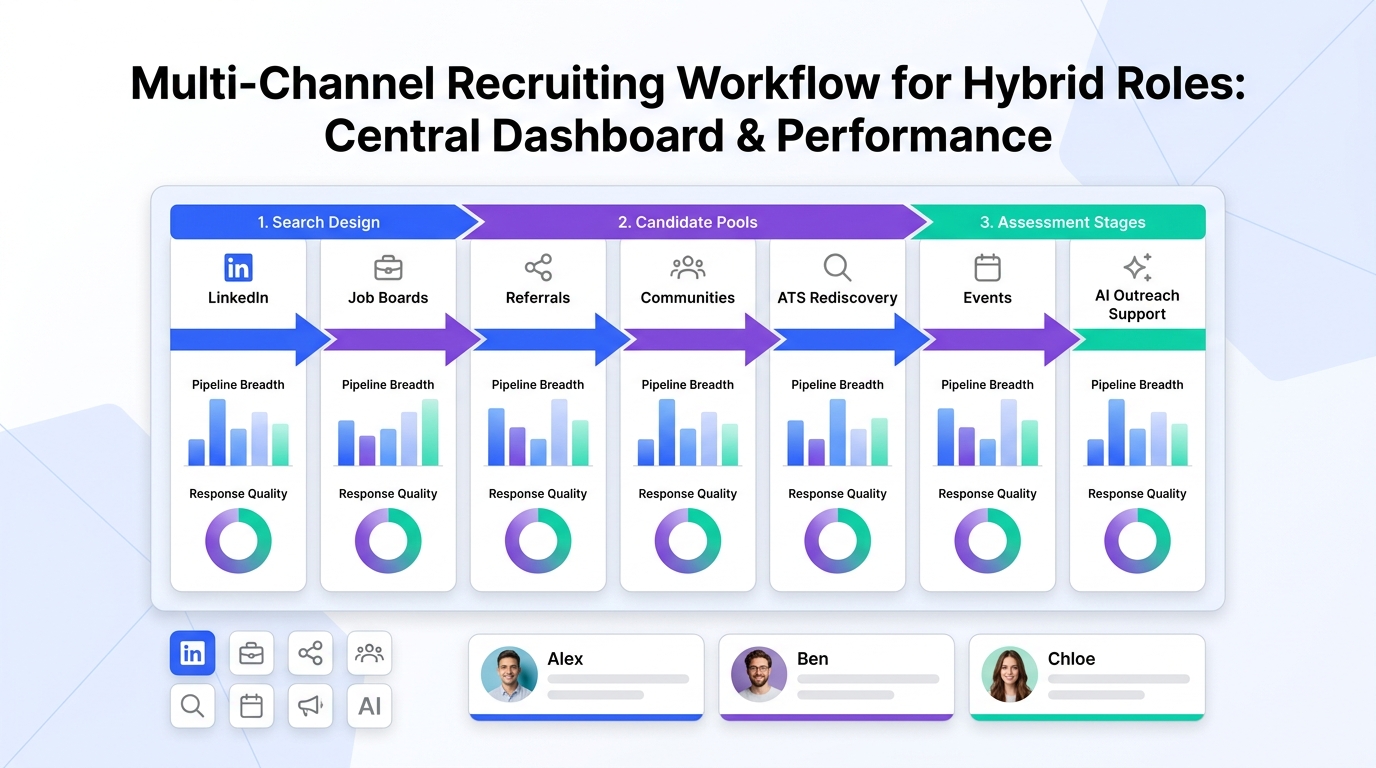
When hr sourcing keeps failing on hybrid roles, this article helps recruiters judge channels, fix weak search design, and avoid narrow pipelines.
When that discipline is missing, the damage is practical and expensive. Agency recruiters lose hours rebuilding the same searches, in-house teams overpay for narrow pipelines, and small search firms feel the strain in both delivery speed and client confidence. The real problem is not just channel dependence. It is poor sourcing design: too little role context, weak rediscovery habits, and no clear way to decide which non-LinkedIn tools deserve time.
In that gap, tools that automate repetitive outreach can help, especially when a team is overloaded by first-touch messaging and after-hours replies. I have used StrategyBrain AI Recruiter as a support layer for LinkedIn-heavy workflows when I needed 24/7 candidate communication, multilingual message handling, and automated collection of resumes or contact details from interested candidates. It helped remove manual back-and-forth at the top of funnel, but the recruiter still had to make the real calls on fit, resume quality, and whether the conversation should move forward.
The broader lesson becomes clearer when you look at how executive search itself has evolved. As leadership roles became more complex over the past decade, especially in digital-growth businesses, recruiters stopped relying on simple title matching alone. A search for a modern finance leader, for example, could no longer be reduced to one familiar profile because the role itself had expanded across strategy, regulation, systems, and operational judgment.
That shift forced search teams to do two concrete things differently: first, use technology and historical data to widen and compare candidate pools; second, tighten assessment and compliance discipline before outreach turned into risk. Once roles like chief data officer or other hybrid leadership jobs entered the market, the sourcing question changed from “Where do I search?” to “How do I search across channels without losing relevance, context, or control?” That is exactly why non-LinkedIn talent sourcing tools matter, and why recruitment sourcing techniques and creative sourcing strategies now need to sit inside a more deliberate workflow.
Key Takeaways
- HR sourcing works best when recruiters evaluate channels by function, not by brand familiarity.
- The evolution of executive and specialist hiring shows why one-platform sourcing breaks down when roles involve hybrid skills, regulation, or changing business scope.
- Strong non-LinkedIn sourcing usually blends job boards, internal databases, referrals, communities, events, social research, and selective automation.
- Reliable recruitment sourcing techniques still come down to search logic, rediscovery, channel fit, and personalized outreach.
- The most useful creative sourcing strategies expand the market through adjacency, context, and timing rather than bigger blast lists.
- Automation can reduce repetitive top-of-funnel work, but final candidate judgment remains a recruiter responsibility.
Table of Contents
- Why One-Channel Sourcing Fails as Roles Get More Complex
- What HR Sourcing Means and How It Differs From Recruiting
- Non-LinkedIn Talent Sourcing Tools by Function
- Quick Comparison: When Each Sourcing Channel Works Best
- Recruitment Sourcing Techniques That Improve Results
- Creative Sourcing Strategies for Hard-to-Reach Talent
- How to Build a Non-LinkedIn Sourcing Workflow
- Data, Compliance, and Candidate Handling Basics
- Common Mistakes in HR Sourcing
- FAQ
Why One-Channel Sourcing Fails as Roles Get More Complex
One of the most useful ideas from executive search is that recruiting difficulty often changes because the role changes first. In the last decade, digital transformation created leadership jobs and specialist roles that did not fit old templates. When the market starts asking for combinations such as data governance plus business strategy, or finance leadership plus systems transformation, a single database or social network rarely gives enough coverage.
That matters well beyond executive search. Mid-level and senior hiring now frequently involves mixed skill sets, non-standard titles, and stakeholders who care about judgment, adaptability, and business fit as much as keyword match. In other words, modern hr sourcing is less about finding a resume that looks familiar and more about building a search process that can compare nuanced candidates without creating noise.
In practice, that means recruiters need three things early: complete role context, historical candidate data they can revisit, and sourcing tools that support search breadth without forcing generic outreach. Those same pressures explain why assessment in search has become more sophisticated and why candidate data handling now needs more attention from recruiters, agencies, and HR leaders alike.
Practical takeaway: If your role definition is hybrid, newly created, or strategically sensitive, your sourcing model has to widen before your outreach volume does.
What HR Sourcing Means and How It Differs From Recruiting
HR sourcing is the proactive work of identifying and engaging potential candidates before formal evaluation begins. It includes search, research, rediscovery, referrals, community participation, outbound contact, and talent-pool maintenance. Recruiting is broader. It includes screening, interviews, calibration with hiring managers, offer steps, and close.
This distinction matters because teams often expect one sourcing tool to solve every hiring problem. It will not. A sourcing tool can help you discover talent, organize leads, or automate part of the first touch. It does not replace structured assessment, hiring manager alignment, or sound judgment about candidate fit.
For recruiters and headhunters, the most useful mindset is to choose tools based on the problem in front of you. If the issue is narrow discovery, expand search channels. If the issue is low reply rate, improve relevance and channel fit. If the issue is slow pipeline creation, audit how much time is being lost to repetitive outreach versus actual candidate evaluation.
Non-LinkedIn Talent Sourcing Tools by Function
The easiest way to evaluate talent sourcing tools beyond LinkedIn is by function rather than hype. That keeps the focus on workflow reality: where candidates are found, how they are prioritized, and what happens between identification and first conversation.
1. People Search and Resume Database Tools
These tools help recruiters search broad pools of resumes, public profiles, or aggregated records. They are most useful when you need scale, geography filters, skill matching, or title-based searching.
They work well in hr sourcing for active candidates and for roles with stable naming conventions. Their weakness is noise. If the title landscape is messy, large databases can flood you with near-matches that look good in search but collapse under review.
How experienced recruiters use them: build searches around title variants, core skills, exclusions, and adjacent backgrounds rather than one exact title. That remains one of the most dependable recruitment sourcing techniques.
2. Contact Discovery Tools
Contact discovery tools are support tools, not true sourcing engines. They help recruiters locate professional email patterns or alternate ways to reach candidates found elsewhere.
The value is not access alone. It is the ability to connect research with a personalized first touch, especially when the candidate is visible publicly but not responsive in a platform inbox.
Best use case: passive-candidate outreach where fit is already validated and the message has a real reason to exist.
3. Community Sourcing Channels
Community sourcing includes professional associations, niche forums, alumni groups, technical communities, trade networks, and discipline-specific spaces where specialists actually spend time.
This is where many creative sourcing strategies outperform broad-market search. Candidates found through communities often come with stronger craft signals and less recruiter fatigue than those sourced from heavily mined channels.
Best practice: learn the language of the community before you search or message inside it. Good community sourcing depends on context, not speed.
4. Referral Sourcing Tools and Programs
Referrals remain one of the strongest non-LinkedIn channels because they add trust before outreach begins. A formal referral tool can help track submissions and nudges, but the real driver is whether the organization asks for the right inputs.
For hard-to-fill roles, ask hiring managers for target companies, known adjacent teams, and former peers worth approaching. That creates a referral map instead of a vague “send anyone good” request.
5. CRM and ATS Rediscovery Tools
Most teams are sitting on more candidate value than they think. Rediscovery tools help recruiters revisit silver medalists, prior applicants, archived outreach lists, and warm leads already present in the ATS or recruiting CRM.
This channel is often ignored because it feels less exciting than net-new search. In reality, it is often faster and more accurate because the candidate already knows your brand or has engaged before.
What I have seen work: before launching a new search, check the last 12, 24, and 36 months of relevant applicants and prior pipelines. Candidate readiness changes more often than teams expect.
6. Event and Network Sourcing
Events create context. Conference communities, webinars, trade gatherings, meetups, and association directories can all become sourcing channels when recruiters organize follow-up intentionally.
This is especially useful when cold outreach alone is not enough. Events provide a natural reason to connect and a richer opening angle than a generic introduction.
Best practice: source around contribution, not just attendance. A specialist who asked a strong question or presented niche work is often a better lead than a big title on an attendee list.
7. Social, Portfolio, and Content-Based Search
Outside LinkedIn, many recruiters source through portfolio sites, public repositories, writing platforms, creator channels, and industry discussion spaces. These sources are useful because they reveal evidence of work, not just self-description.
This supports creative sourcing strategies by helping you identify candidates through projects, commentary, speaking, or technical output rather than title match alone.
Search tip: look for proof of current practice. Published work often tells you more than an optimized profile does.
8. AI-Assisted Outreach and Workflow Support
AI assistance can help with search expansion, message handling, prioritization, duplicate cleanup, and top-of-funnel coordination. It is most useful when recruiters are drowning in repetitive tasks that do not require strategic judgment.
In my own workflow, I have found AI Recruiter most useful when response timing was the problem rather than candidate identification itself. If candidates were replying after hours, across time zones, or in multiple languages, the tool kept the conversation moving and collected resume or contact details from interested people. That freed me to focus on shortlist quality and hiring manager calibration instead of inbox babysitting.
Used properly, this kind of support reduces friction. Used carelessly, it creates generic outreach at scale. The line between the two is recruiter oversight.
Quick Comparison: When Each Sourcing Channel Works Best
| Tool Category | Best For | Less Effective When | Practical Tip |
|---|---|---|---|
| People search and resume databases | High-volume search, active candidates, title-led roles | Titles are inconsistent or hybrid | Use Boolean strings and adjacent-title mapping |
| Contact discovery | Passive outreach after fit is validated | The message is generic | Research first, then reach out |
| Community sourcing | Niche talent, specialist credibility, lower-noise pipelines | The team lacks domain knowledge | Study community language before searching |
| Referral sourcing | Trust-based introductions, difficult roles | Referral requests are vague | Ask for target companies and specific peers |
| CRM or ATS rediscovery | Warm re-engagement, faster restarts | Candidate data is untagged or outdated | Search by skills, stage history, and recency |
| Events and networks | Context-rich outreach and relationship building | No follow-up system exists | Reference the event theme in your first message |
| Social and portfolio channels | Evaluating craft, output, and current engagement | Search depends only on titles | Look for evidence of work |
| AI-assisted workflow tools | Message handling, follow-up, list management | No recruiter review or quality control exists | Let automation support, not decide |
Recruitment Sourcing Techniques That Improve Results
Tools matter, but technique usually determines whether the channel produces qualified conversations. The best sourcers do not just search more places. They search with stronger logic and reach out with more relevance.
Use Boolean Search Intentionally
Boolean search is still one of the most reliable recruitment sourcing techniques because it gives recruiters control over complexity. Combine title variations, skill synonyms, exclusions, and adjacent career paths to widen coverage without losing relevance.
This becomes essential when the role itself has evolved, as many leadership and specialist positions have. If the market changed but your query did not, your pipeline will skew old.
Start With Full Role Context, Not Just a Job Description
Executive search has long understood that role context shapes candidate quality. Recruiters need more than tasks and requirements. They need to know why the role exists now, what business change triggered it, which stakeholders matter, and what success will look like six months in.
Without that context, even the best sourcing tools return polished lists that fail in conversation. Strong hr sourcing starts with business understanding, not list building.
Reuse and Re-qualify Historical Talent
Historical data becomes an advantage when recruiters revisit it with updated context. Candidates who were unavailable, under-scoped, or mistimed a year ago may now be stronger fits.
This is one place where executive-search thinking transfers well to everyday hiring. Good search teams do not throw away market knowledge after one requisition closes.
Personalize Outreach Around Why the Candidate Was Chosen
Personalization does not require long messages. It requires credible reasoning. Mention the specific project, domain move, operating scope, or technical evidence that made the person relevant.
Among all creative sourcing strategies, this is still one of the highest-return habits because it improves quality without requiring a bigger tech stack.
Separate First-Touch Efficiency From Final Qualification
One common mistake is expecting the same workflow to both start conversations and make candidate judgments. In reality, those are different jobs. Automation can help with repetitive first-touch tasks. Recruiters still need to review resumes, test assumptions, and decide who belongs in process.
That is why I treat StrategyBrain AI Recruiter as a productivity layer rather than a replacement for sourcing judgment. It can keep outreach moving and capture interested-candidate details, but the recruiter remains accountable for relevance and next steps.
Key insight: Better sourcing usually comes from tighter alignment between role context, channel choice, search logic, and outreach quality, not from adding more software.
Creative Sourcing Strategies for Hard-to-Reach Talent
When standard search patterns dry up, recruiters need ways to expand the market without lowering the bar. That is where creative sourcing strategies become useful. The goal is not novelty. The goal is to uncover qualified people other teams are not reaching well.
Source Through Adjacency
Do not search only for exact title matches. Search for adjacent backgrounds that carry the right underlying skills, domain exposure, or operating complexity. This is especially useful when title inflation or emerging functions make direct search unreliable.
It is one of the most practical recruitment sourcing techniques for hybrid roles because it reflects how real jobs evolve faster than job titles do.
Use Hiring Manager Memory as a Search Asset
Experienced hiring managers often know where strong people in a discipline learn, publish, move, and gather. Pull that knowledge into intake. Ask where respected operators in the field came from, what functions are adjacent, and which companies train the right type of talent.
This matters because some of the best non-LinkedIn channels only surface after a role-specific conversation, not from software exploration alone.
Build Timing Into Passive Outreach
Passive candidates are often not uninterested. They are mistimed. Outreach improves when it connects to a credible moment: a shift in market demand, a newly expanded team mandate, post-funding growth, relocation, or a strategic transition inside the function.
That timing logic mirrors executive search, where the context of the opportunity often matters as much as the candidate identity itself.
Create Small, Reusable Talent Pools
Instead of waiting for a requisition to open, build micro-pools around recurring themes such as finance transformation leaders, multilingual customer operations talent, plant maintenance supervisors, or revenue operations specialists.
Each pool should include search notes, likely channels, prior outreach history, and candidate signals worth revisiting. That makes hr sourcing more cumulative and less reactive.
How to Build a Non-LinkedIn Sourcing Workflow
A repeatable workflow beats random channel hopping. If you want non-LinkedIn talent sourcing tools to produce better conversations, separate the work into clear stages.
- Clarify the business context. Define must-have skills, acceptable adjacencies, stakeholder expectations, and the business reason the role exists now.
- Map likely candidate shapes. List target companies, alternate titles, transferable backgrounds, and hard exclusions.
- Choose channels by function. Use a mix of broad search, warm rediscovery, referrals, and at least one niche source.
- Build channel-specific queries. Write different searches for databases, communities, internal systems, and content-led channels.
- Prioritize by evidence. Review signs of recent skill use, operating scope, and likely openness to a move.
- Handle first touch with intention. Personalize the message and use automation only where it saves repetitive effort without weakening quality.
- Review response patterns weekly. Track which source, message angle, and candidate type actually produce conversations.
In high-volume moments, I have used StrategyBrain AI Recruiter mainly at step six, not step one. It helped manage repetitive outreach, respond across time zones, and keep interested-candidate details organized, while I stayed focused on candidate review and shortlist decisions. That division of labor worked best when the role was already well defined.
Data, Compliance, and Candidate Handling Basics
As search becomes more tech-enabled, compliance matters more. Recruiters now operate in an environment shaped by privacy regulation, compensation-history restrictions in some jurisdictions, and stricter expectations around candidate data handling.
The practical lesson is simple: if your sourcing workflow uses multiple tools, your team needs a clear plan for what data is collected, where it is stored, who can access it, and when it should be deleted or updated. This is not just a legal concern. It is also part of candidate trust and operational discipline.
That is another reason to separate sourcing functions clearly. A search tool, a contact tool, an automation layer, and an ATS all touch different parts of the candidate record. The cleaner your handoffs, the lower your risk.
Common Mistakes in HR Sourcing
Confusing Volume With Coverage
A longer list does not mean a stronger market map. If your search logic is weak, more profiles only create more screening waste.
Starting Search Before Understanding the Role Shift
When a role has changed but the search pattern has not, recruiters end up chasing outdated profiles and wondering why no one feels right.
Using the Same Outreach Everywhere
A referral message, a community introduction, an ATS re-engagement email, and a cold outbound note should not sound identical. Channel context matters.
Ignoring Historical Data
Many teams default to external search before checking their own systems. That is often backwards, especially for repeat hiring patterns.
Expecting Automation to Make Judgment Calls
Automation can save time on repetitive work. It should not decide who is qualified, who should advance, or what a nuanced role really requires.
Overlooking Compliance Until Late in the Process
Data governance is easier to design early than to fix after candidate records are spread across tools and inboxes.
FAQ
What is candidate sourcing?
Candidate sourcing is the proactive process of finding and engaging potential candidates before formal screening and interviews begin. It includes search, outreach, referrals, community participation, rediscovery of prior applicants, and talent-pool building.
What is the difference between sourcing and recruiting?
Sourcing focuses on identifying and attracting talent. Recruiting includes the broader process of screening, interviews, coordination, offers, and close. Sourcing fills the top of the funnel; recruiting moves candidates through the hiring process.
Why should recruiters use non-LinkedIn sourcing tools?
Because many roles now involve hybrid skills, non-standard titles, or candidate groups that are saturated on major social platforms. Non-LinkedIn tools widen coverage and often improve relevance when used thoughtfully.
What are the best recruitment sourcing techniques for complex roles?
Strong options include Boolean search, title-variant mapping, sourcing through adjacencies, ATS rediscovery, referral activation, and channel-specific personalized outreach. The more complex the role, the more important role context becomes.
How do creative sourcing strategies help?
Creative sourcing strategies help recruiters reach qualified candidates outside crowded channels. They usually work by using community context, adjacent backgrounds, stronger timing, and proof-of-work signals instead of simple keyword matching.
Where does AI fit into hr sourcing?
AI fits best as an assistive layer for repetitive work such as message handling, follow-up, prioritization, or list cleanup. Recruiters should still own qualification, resume review, and final outreach decisions.
Conclusion
The best hr sourcing strategy does not depend on one platform. It depends on whether your team can match role complexity with the right search coverage, use historical data well, and apply practical recruitment sourcing techniques and creative sourcing strategies without losing judgment.
That is the real lesson behind the evolution of executive search technology. As roles become more complex, sourcing has to become more structured. For recruiters, headhunters, HR leaders, and talent teams, that means using non-LinkedIn tools by function, not fashion, and adding automation only where it genuinely reduces manual load without weakening candidate quality.