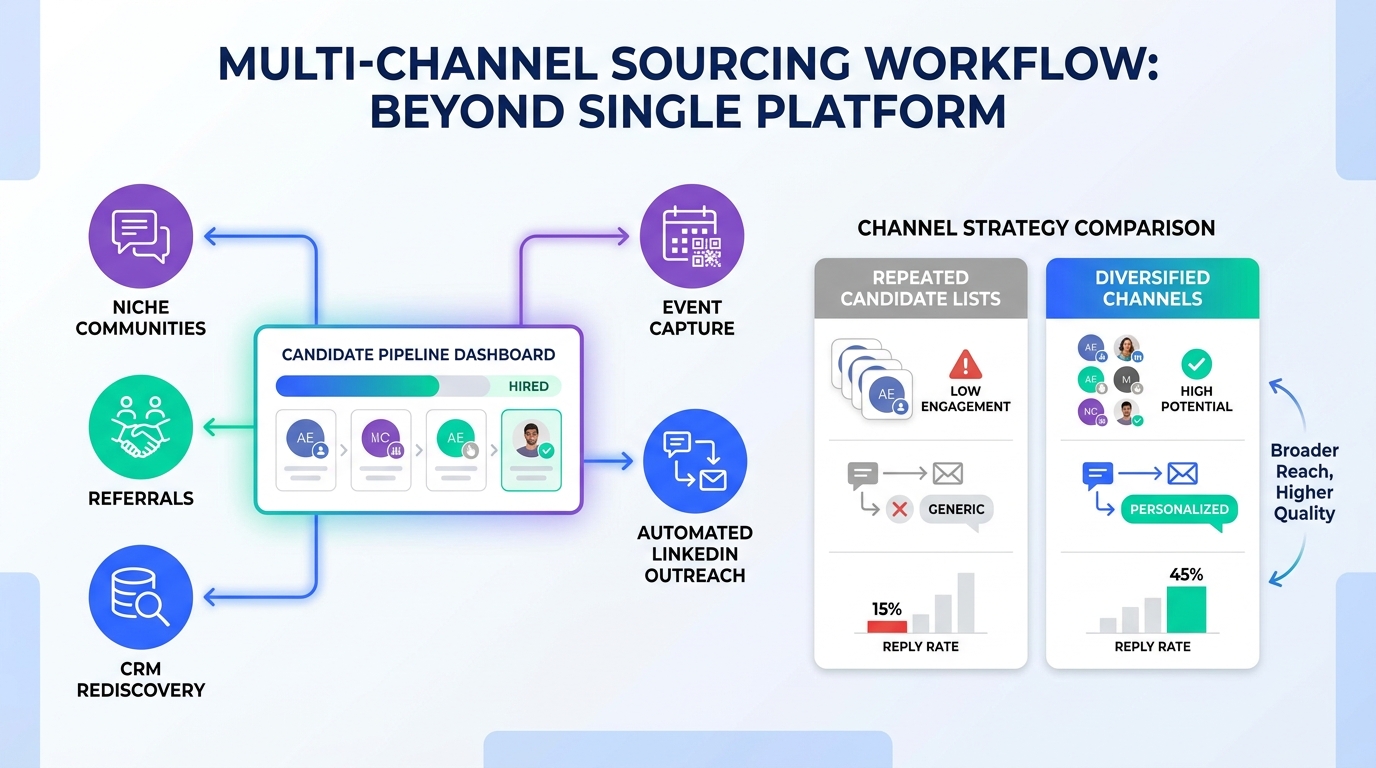
Repeated lists and late, generic outreach expose weak hr sourcing; this article helps recruiters judge better channels and avoid longer vacancies.
When recruiters rely on one familiar platform, the damage shows up fast: repeated candidate lists, slower replies, weaker differentiation, and too much time spent editing messages or reposting jobs instead of speaking to people. For small search firms, independent recruiters, and in-house teams, that means missed placements, longer vacancies, avoidable cost, and a brand problem candidates can feel when outreach sounds generic or late.
In my own workflow, I have found that StrategyBrain AI Recruiter is most useful when the problem is not final selection but the repetitive front end of outreach. Its automated LinkedIn messaging, after-hours follow-up, and multilingual communication can keep conversations moving when a recruiter would otherwise lose momentum; the recruiter still owns fit judgment, resume review, and the next decision. If you want to see how that setup is framed, the product workflow overview and the public conversation examples are useful starting points.
A useful way to see the problem is to look from the candidate side first. In executive search, a senior candidate can spend weeks polishing a resume, applying to posted roles, and refreshing a profile, yet still fail to create traction because they never moved beyond documents into human conversations. They adjust wording, chase perfect keywords, and wait for posted openings, while the real opportunity often sits in networks, direct outreach, community visibility, or conversations that begin before a public job appears.
That candidate-side pattern matters to recruiters because it reveals the same market truth from the other direction. If strong people are not discovered through postings alone, then non-LinkedIn talent sourcing tools and better recruitment sourcing methods become essential. The rest of this guide focuses on that gap: how to build hr sourcing systems beyond a single platform, which tool categories actually help, and which candidate sourcing ideas create better pipelines over time.
- Why postings and one platform fall short
- What HR sourcing means now
- Non-LinkedIn talent sourcing tool categories
- Recruitment sourcing methods that work in practice
- Where AI Recruiter fits in a sourcing workflow
- How to build a repeatable sourcing process
- How to make sourcing more inclusive
- Common sourcing mistakes to avoid
- FAQ
Why postings and one platform fall short
The executive job-search cautionary pattern is simple: a strong candidate assumes the resume should do the work, applies only to visible openings, stays behind the screen, and forgets that hiring decisions are shaped by relevance, relationships, and timing. Recruiters face the mirror image of that same problem. If your sourcing model depends too heavily on one network or on inbound applicants, you are also waiting for the market to come to you.
That creates three practical risks. First, you see the same talent as every competitor. Second, you miss people who are open to the right conversation but not actively applying. Third, your team confuses activity with progress by spending more time on search mechanics than on candidate movement.
Key insight: The best sourcing teams do not treat visibility as the same thing as access. Access comes from diversified channels, timely outreach, and a workflow that keeps people moving from discovery to conversation.
This is why experienced recruiters usually diversify earlier than less experienced ones. They know many strong candidates are not waiting in posted jobs, and many high-value conversations begin in referrals, alumni circles, niche communities, event follow-up, and past-candidate records.
What HR sourcing means now
HR sourcing is the proactive practice of identifying, organizing, and engaging potential candidates before they formally apply. It is distinct from posting a role and waiting for responses, and it is also distinct from later recruiting stages such as interviewing, offer negotiation, and onboarding.
In practical terms, sourcing includes candidate discovery, search logic, talent mapping, contact research, outreach, follow-up, pipeline tagging, and candidate rediscovery. For difficult searches, this stage often determines whether the entire hiring process has enough quality and speed to succeed.
It also helps to separate sourcing from resume collection. The reference case above showed why documents alone rarely move an executive search. The recruiter equivalent is assuming a database alone will produce a shortlist. In reality, sourcing works when the search channel, message, timing, and candidate context are all aligned.
Non-LinkedIn talent sourcing tool categories
When teams look for talent sourcing tools beyond LinkedIn, they often expect one replacement platform. In practice, the stronger setup is a stack of complementary systems. Different tools support different sourcing moments, and the right mix depends on role scarcity, hiring geography, process maturity, and recruiter capacity.
Niche job boards and specialist communities
Specialist platforms and communities are often better than broad professional networks for technical, regulated, creative, field, or regional roles. They usually trade overall volume for higher concentration and stronger relevance.
The practical test is simple: where does the target talent actually participate when not actively job hunting? If the answer is a niche community, forum, association board, or discipline-specific space, start there rather than defaulting to the largest directory.
Employee referral systems
Referrals remain one of the most durable recruitment sourcing methods because they introduce trust and context into the process. A structured referral tool can capture names, relationship strength, and role relevance instead of leaving referral sourcing to informal chats.
The mistake is to treat referrals as a side channel. If they are not tagged, followed up, and reviewed on a cadence, they disappear into inboxes or messaging threads.
Recruiting CRM and candidate rediscovery tools
A recruiting CRM supports long-term relationship management, segmentation, and re-engagement. That makes it especially useful for sourcers who need to revisit silver medalists, prior finalists, event attendees, or candidates who were strong but mistimed.
Candidate rediscovery is one of the most underused candidate sourcing ideas. Companies often already know qualified people but fail to reach them at the right moment because records are old, poorly tagged, or buried inside an ATS without a proactive workflow.
Outreach automation and sequencing tools
These tools help recruiters run multi-step outreach with reminders, reply tracking, and timing control. Used well, they improve consistency. Used poorly, they amplify generic messaging.
The right balance is operational support without surrendering judgment. Automation should handle cadence and continuity, while the recruiter still personalizes the reason for contact and decides who merits another touch.
Contact enrichment and multi-source aggregation tools
Aggregation tools pull profile fragments, contact data, and public signals from multiple sources into one view. This can reduce manual research time, especially when recruiters are searching across fragmented markets.
Still, more data is not the same as better sourcing. Aggregation is only valuable when recruiters validate fit and avoid polluting the pipeline with weak or outdated leads.
Event capture and talent community tools
Events, webinars, meetups, campus sessions, and industry gatherings often surface talent before those people become active applicants. Event tools matter because they preserve that early signal and route it into later sourcing campaigns.
Without disciplined capture, those warm contacts go cold quickly. With proper tagging and fast follow-up, they become one of the more effective long-term sourcing channels.
Boolean search and talent intelligence tools
Boolean search remains useful when recruiters need precision across public profiles, directories, portfolio sites, and community pages. Talent intelligence tools add market-level context by showing where certain skills cluster, how titles vary, and which regions may hold adjacent talent.
That combination supports a better sourcing judgment: Boolean helps you search accurately, while intelligence helps you decide where the search should happen in the first place.
Quick comparison of non-LinkedIn sourcing tool categories
| Tool Category | Best Use Case | Main Strength | Watch-Out |
|---|---|---|---|
| Niche job boards | Specialized roles | High relevance | Lower total volume |
| Referral systems | Warm introductions | Trust and context | Needs process discipline |
| Recruiting CRM | Nurturing pipelines | Long-term relationship tracking | Weak tagging reduces value |
| Candidate rediscovery tools | Re-engaging known talent | Fast pipeline creation | Records may be stale |
| Outreach sequencing tools | Follow-up consistency | Cadence control | Can create robotic messaging |
| Event capture tools | Community and campus sourcing | Early relationship building | Leads cool off quickly |
| Aggregation and enrichment tools | Multi-source searching | Research efficiency | Can add noise |
Recruitment sourcing methods that work in practice
Tools only matter when they support a method. The strongest recruitment sourcing methods usually reflect the same lesson from the executive job-search example: people are rarely moved by passive visibility alone. They move through relevance, conversation, and timing.
1. Build role-specific channel maps
Do not use one sourcing mix for every role family. Executive finance, high-volume operations, engineering, field leadership, and early-career hiring each have different signal sources. Create a short channel map for recurring roles so recruiters know where to search first.
2. Source passive candidates with context
Passive outreach works better when the recruiter understands why the person might listen now. Public work, niche community participation, leadership moves, team changes, or location shifts often create more meaningful openings than mass outreach lists.
3. Turn referrals into a managed sourcing lane
Ask employees and trusted contacts for names, not only shares. Capture who referred the person, how they know them, and why they fit. This turns referrals from goodwill into a repeatable sourcing channel.
4. Revisit your internal records before starting from zero
Many recruiters underestimate the value of previous applicants, former finalists, boomerang talent, and archived prospects. Revisiting those records can produce a viable first slate faster than any external search, especially if your team maintains useful notes and tags.
5. Work communities and alumni networks like relationships, not extraction
The candidate-side lesson from executive search is that people get found when they participate where hiring decision-makers pay attention. Recruiters can reverse-engineer that behavior by spending time in those same ecosystems and contributing before asking.
6. Reach out before the posting exists
One of the clearest takeaways from the reference article is that opportunities often exist before they are publicly advertised. Recruiters should apply the same logic in reverse and begin market conversations before the requisition is formally live, especially for predictable hiring needs.
Where AI Recruiter fits in a sourcing workflow
Even though this article is about sourcing beyond LinkedIn, many recruiting teams still spend a large share of their time there. In my experience, the issue is not whether LinkedIn matters; it is whether the recruiter is trapped doing repetitive front-end work that steals time from channel diversification.
That is where AI Recruiter can be useful as a supporting layer rather than a replacement for sourcer judgment. I have seen the value most clearly in three situations: when candidates reply after work hours, when cross-border or multilingual communication slows response quality, and when the recruiter needs a cleaner handoff from initial outreach to actual screening. The system can continue conversations, answer common role questions, and collect resumes or contact details from interested prospects, while the recruiter still makes the final call on fit and next steps.
For teams that want to understand those use cases in more detail, the vendor's implementation notes and trial environment are the most relevant resources. Used carefully, that kind of automation does not replace broader hr sourcing; it frees recruiter time so broader sourcing can actually happen.
Practical takeaway: If your team wants more non-LinkedIn sourcing, first remove repetitive LinkedIn tasks that consume recruiter attention. Otherwise, channel diversification stays theoretical.
How to build a repeatable sourcing process
Many sourcing issues are process issues disguised as tool issues. A repeatable non-LinkedIn workflow usually looks like this:
- Define the target profile. Align on required skills, likely backgrounds, adjacent talent pools, and realistic trade-offs.
- Choose 3 to 5 channels. Mix internal records, referrals, communities, niche platforms, and event or alumni sources.
- Build search logic. Include title variations, skill clusters, Boolean strings, and exclusion rules.
- Tag candidates consistently. Source, function, geography, seniority, readiness, and outreach status should all be visible.
- Run outreach in waves. Start with a personalized first touch, then follow with structured reminders.
- Track movement, not just send volume. Measure replies, screens, qualified pipelines, and source quality by role type.
- Review monthly. Drop weak channels, improve messaging, and update channel maps.
The executive-search lesson applies here too: if all the effort goes into polishing the visible artifact, whether that is a resume or a job post, the team misses the relational work that actually moves the search.
How to make sourcing more inclusive
Inclusive sourcing starts with channel diversity. When every search depends on the same platform, same title assumptions, and same network patterns, the resulting pipeline narrows.
Practical steps include broadening communities, searching adjacent titles, partnering with professional associations, reviewing outreach language, and measuring source mix over time. The goal is not a symbolic checklist. The goal is to create a process where more qualified people have a realistic chance of being discovered.
- Use several sourcing channels rather than one dominant platform.
- Search for transferable skill paths, not just exact title matches.
- Include underused professional communities in every sourcing plan.
- Review source diversity over time, not only final hiring outcomes.
- Challenge inflated pedigree or experience filters with hiring managers.
Common sourcing mistakes to avoid
Treating sourcing as emergency search
If sourcing begins only when a role becomes urgent, the team loses the advantage of relationship-based pipeline building.
Trusting documents more than conversations
The reference article showed why candidates fail when they rely only on resumes and applications. Recruiters fail in similar fashion when they rely only on posted jobs, profile databases, or polished employer messaging.
Using too many tools without a clear system
A larger stack can create more noise if ownership, tagging, and follow-up are inconsistent.
Ignoring candidate rediscovery
Many teams already know strong talent but do not have a repeatable way to revisit it.
Sending generic outreach
Candidates can tell when the recruiter has not explained why the conversation is relevant now.
Failing to calibrate with hiring managers early
Good sourcing depends on realistic adjacencies, not only idealized profiles.
FAQ
What is HR sourcing?
HR sourcing is the proactive process of finding, organizing, and engaging potential candidates before they apply. It focuses on candidate discovery, outreach, talent pooling, and re-engagement.
What are the best recruitment sourcing methods beyond LinkedIn?
Useful options include referrals, niche communities, alumni networks, internal candidate rediscovery, event follow-up, Boolean search across public sources, and CRM-led nurturing.
What are practical candidate sourcing ideas for hard-to-fill roles?
Start with previous finalists, ask for targeted referrals, map role-specific communities, search adjacent titles, and follow up quickly after events or webinars.
How do sourcing tools differ from an ATS?
Sourcing tools help recruiters discover and engage prospects. An ATS mainly manages applicants who are already in process. A recruiting CRM sits closer to sourcing because it supports long-term relationship management.
Can LinkedIn automation help even in a non-LinkedIn sourcing strategy?
Yes. If repetitive LinkedIn work consumes too much recruiter time, a tool such as StrategyBrain AI Recruiter can support outreach continuity and resume capture there, which gives recruiters more time to build stronger non-LinkedIn channels.
Conclusion
Non-LinkedIn sourcing works best when recruiters stop looking for a single replacement platform and start building a system. The candidate-side executive-search lesson is useful here: visibility alone rarely creates movement. Conversations, relevance, and timing do.
For recruiting teams, that means better hr sourcing through diversified channels, stronger internal rediscovery, disciplined follow-up, and practical tool support where repetitive work is slowing the search. If you want more effective pipelines, focus on the recruitment sourcing methods and candidate sourcing ideas that create real access to talent, not just more profiles to scroll through.