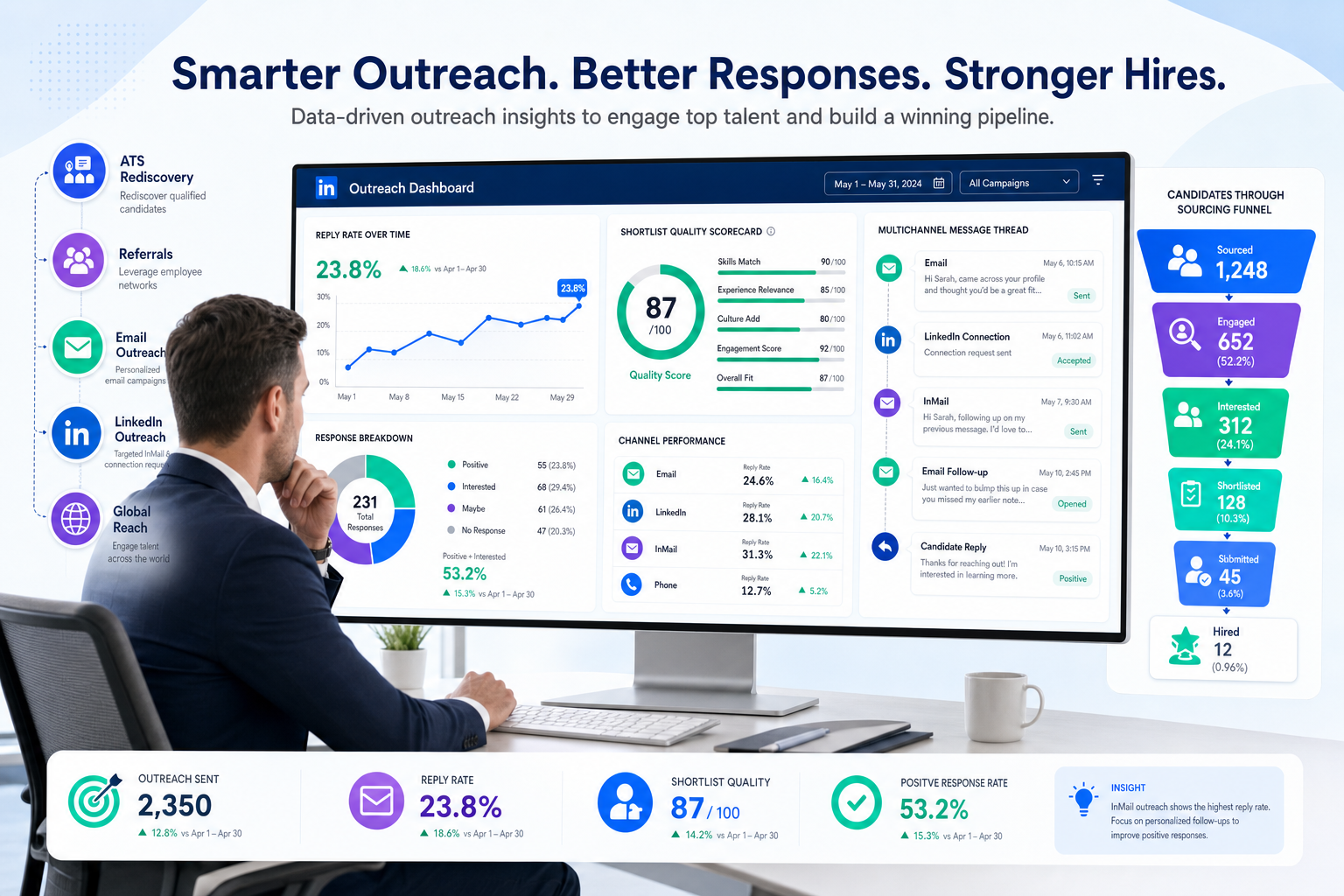
When candidate silence is hurting pipelines, this article helps headhunters judge hr sourcing by responsiveness and shortlist quality to avoid wasted outreach and weak slates.
That distinction matters more than many teams admit. When sourcing is reduced to posting, blasting, and waiting, the damage shows up quickly: passive candidates go silent, recruiters waste hours repeating outreach, hiring managers lose confidence in the slate, and smaller agencies feel the cost first because every missed conversation hurts both revenue and reputation. In-house teams feel it too when overloaded recruiters cannot keep follow-up consistent across channels.
In my own workflow, I have seen how StrategyBrain AI Recruiter can relieve that pressure when the problem is speed and continuity rather than final qualification. Its always-on candidate messaging, multilingual communication, and automated collection of résumés and contact details help keep conversations moving after hours or across time zones, while the recruiter still owns judgment, résumé review, and the decision to advance someone. That matters most when your process is breaking because interested people are waiting too long for a reply.
A useful way to understand this is to step outside sourcing software for a moment and look at workplace reality. In a 2018 discussion of mental health at work, the core problem was not lack of awareness alone. It was the silence created by stigma, the reluctance to speak up, and the practical damage that followed when employers missed early signs. Employees were left carrying family, financial, or personal strain on their own, and the result showed up in performance, behavior, absences, disability claims, and rising organizational cost.
The recruiting parallel is direct. Candidates do not usually say, “your sourcing process feels impersonal, repetitive, or hard to trust.” They simply stop replying, hesitate to share details, or disappear after an initial exchange. Once that happens, the team around the role feels it: the recruiter reopens searches, the manager questions pipeline quality, and the business pays for delay. That is why effective hr sourcing beyond LinkedIn is really about building channels, outreach habits, and support systems that make engagement easier before talent goes quiet.
- HR sourcing works best when teams combine reach with candidate care, not just bigger databases.
- Non-LinkedIn sourcing is strongest when internal data, rediscovery, referrals, niche channels, and outbound workflows work together.
- The opening lesson from workplace mental health applies to recruiting: silence is expensive, and early support prevents avoidable loss.
- Useful sourcing metrics include reply rate, interested rate, prospect-to-screen conversion, source-of-hire, and time-to-fill impact.
- Why Candidate Silence Matters in HR Sourcing
- What HR Sourcing Means Today
- Why Source Beyond LinkedIn
- The Main Types of Talent Sourcing Tools
- How to Evaluate Non-LinkedIn Sourcing Tools
- Practical Sourcing Strategies in Recruitment
- Candidate Sourcing Ideas That Still Work
- A Simple Multi-Channel Sourcing Workflow
- How to Measure Sourcing Success
- Common Mistakes to Avoid
- FAQ
Why Candidate Silence Matters in HR Sourcing
The mental-health reference point is useful because it highlights a pattern recruiters know well: when people feel unsupported, misunderstood, or unsure whether it is safe to engage, they withdraw. In the workplace article, that withdrawal affected attendance, behavior, claims, and cost. In sourcing, the equivalent shows up as ignored messages, stalled follow-up, low trust, and weaker conversion from prospect to screen.
For recruiters, this means sourcing quality is not only about finding names. It is also about whether your process gives candidates enough clarity and responsiveness to continue the conversation. For hiring managers, the implication is practical: a thin shortlist is often not just a market problem. It can be a workflow problem.
That is also why tool evaluation should include support for responsiveness and continuity. In global or high-volume search work, I have used AI Recruiter conversation workflows to keep replies moving overnight and collect contact details from interested prospects before momentum fades. It did not replace sourcing judgment, but it reduced the gap between candidate interest and recruiter action, which is often where preventable drop-off starts.
What HR Sourcing Means Today
HR sourcing is the proactive work of identifying, qualifying, and engaging potential candidates before they formally enter a hiring process. That includes passive talent, previous applicants, referrals, alumni, and people in adjacent backgrounds who may fit a role with the right positioning.
This is different from full-cycle recruiting. Recruiting includes intake, posting, screening, interviews, offers, and coordination. Sourcing sits earlier and focuses on creating a relevant pipeline. It is also different from simply storing applications in a system. Good records help, but records alone do not produce outreach strategy, shortlist judgment, or channel diversification.
The teams that do this well usually understand one simple point: the goal is not the largest list. The goal is a shortlist people can actually move on.
Why Source Beyond LinkedIn
LinkedIn is still a familiar sourcing channel, but overreliance creates predictable friction. Recruiters run into the same profiles, candidates receive near-identical messages, and response quality drops as inboxes become saturated. That is exactly the kind of silence problem discussed earlier: when too many similar approaches reach the same audience, candidates stop engaging.
Going beyond LinkedIn does not mean abandoning it. It means building a more resilient channel mix that includes ATS rediscovery, recruiting CRM lists, referrals, alumni networks, job boards, niche communities, technical forums, events, and internal mobility pipelines. In many real hiring environments, those sources are less crowded and more context-rich.
For agencies and internal teams alike, non-LinkedIn sourcing is also a risk-management decision. If one platform slows down, becomes expensive, or yields weaker replies, your process should still function.
The Main Types of Talent Sourcing Tools
When evaluating talent sourcing tools, I find it more useful to group them by job-to-be-done rather than by vendor hype. Most non-LinkedIn sourcing stacks fall into a few practical categories.
1. ATS and rediscovery tools
Your existing candidate database is often the fastest place to start. Past applicants, silver medalists, and archived pipelines already carry signal: prior interest, notes, interview history, and source data. If your search layer is weak, that value stays buried.
2. Recruiting CRM and nurturing workflows
A CRM matters when hiring is continuous rather than one-off. It helps teams organize talent pools, segment by role family, track outreach history, and keep relationships active over time.
3. External databases and job boards
These are useful when internal reach is thin or a market is new. The real test is whether search quality and profile freshness save recruiter time rather than create cleanup work.
4. Niche communities and specialist channels
For technical, healthcare, operations, design, or regulated roles, specialist communities often outperform broad networks because skill identity is clearer and relevance is higher.
5. Referral and internal mobility systems
These channels often produce strong-fit candidates because trust is built in. Volume may be lower, but shortlist quality and speed can improve.
6. Outreach automation and communication support
This category matters when response timing is the bottleneck. For teams working across regions, using AI Recruiter for multilingual follow-up and after-hours continuity can keep early engagement alive while the recruiter focuses on judgment calls and stakeholder alignment.
| Tool Category | Best Use | Main Value | Common Limitation |
|---|---|---|---|
| ATS rediscovery | Past applicants and silver medalists | Fast access to known talent | Search depends on clean data |
| Recruiting CRM | Talent pooling and nurture | Long-term relationship continuity | Needs recruiter discipline |
| External databases | Market expansion | Broader reach | More noise and duplicates |
| Niche communities | Specialized hiring | Higher relevance | Lower scale |
| Referral/internal tools | Warm networks and mobility | Stronger trust signals | Requires ownership |
| Communication automation | Fast follow-up and global hiring | Better continuity | Recruiter still must qualify fit |
How to Evaluate Non-LinkedIn Sourcing Tools
The best sourcing teams use a scorecard, not a feature wishlist. If the lesson from the workplace mental-health example is that early support prevents avoidable loss, then the recruiting version is this: evaluate tools by how well they help you notice, engage, and sustain candidate interest before it drops.
Search quality and ranking
A large database means little if relevant people stay hidden. Good search should reduce manual filtering and improve shortlist quality quickly.
Candidate experience and responsiveness
This factor is often underrated. Can the tool help your team respond quickly, keep tone consistent, and reduce dead air after a candidate shows interest? Silence is costly in sourcing, just as lack of support is costly in the workplace.
ATS and CRM integration
If updates do not flow back into your core systems, recruiters start tracking conversations in spreadsheets and inboxes. That is where process trust breaks.
Rediscovery strength
Can it resurface previous candidates with enough context to act? Many teams underuse their own history.
Multilingual or after-hours communication
For international hiring, this can make the difference between keeping a prospect warm and losing them. My practical experience with StrategyBrain AI Recruiter is that its value appears most clearly when recruiters cannot personally maintain 24/7 responsiveness, but still need conversations to progress respectfully and capture next-step information.
Channel fit for your market
The right stack for corporate sales hiring is not necessarily right for plant operations, nursing, or software engineering. Match the tool to where that talent actually spends time.
| Evaluation Area | What to Ask | Why It Matters |
|---|---|---|
| Search | Does it surface relevant profiles quickly? | Improves shortlist quality |
| Responsiveness | Can it support timely follow-up? | Reduces candidate drop-off |
| Integration | Does it sync with ATS and CRM records? | Prevents rework |
| Rediscovery | Can it reactivate existing talent pools? | Lowers wasted sourcing effort |
| Global communication | Can it handle time zones and languages? | Supports international reach |
| Market fit | Does it align with your role type? | Raises channel relevance |
Practical Sourcing Strategies in Recruitment
The most reliable sourcing strategies in recruitment are usually the least glamorous. They are consistent, candidate-aware, and tightly connected to hiring priorities.
Start with alignment, not search
Clarify must-haves, tradeoffs, target employers, likely candidate motivations, and compensation reality before anyone starts pulling names.
Use owned data before buying more reach
Revisit former finalists, prior applicants, alumni, referrals, and internal talent pools first. Many teams already have useful leads but no rediscovery habit.
Design for early support
The workplace lesson applies again here. If people hesitate when unsupported, then sourcing workflows should reduce uncertainty early. That means clear messaging, quick follow-up, easy resume sharing, and channel-appropriate communication.
Diversify channels deliberately
Good channel mix is not about using more sources. It is about avoiding five versions of the same audience.
Keep recruiters focused on judgment
Automation should absorb repetitive contact tasks, not replace evaluation. In my own use, AI Recruiter support for active sourcing worked best when I used it to keep introductions, follow-up, and résumé collection moving, while I handled fit assessment, shortlist ranking, and manager calibration.
Candidate Sourcing Ideas That Still Work
There are endless lists of candidate sourcing ideas, but the ones worth repeating tend to combine relevance, repeatability, and decent conversion.
- Re-rank past applicants against the new brief instead of assuming they are stale.
- Reopen silver-medalist pipelines where timing, not fit, was the original issue.
- Run targeted referral asks around one role family or location.
- Search adjacent titles when the market labels similar work differently.
- Use niche communities where specialists share actual work or domain problems.
- Build recurring talent pools for roles you fill every quarter.
- Combine inbound and outbound review under the same quality standard.
- Follow up faster across time zones so interest is captured while it is fresh.
That last point is often overlooked. Candidate intent is perishable. When someone replies outside your working hours and then hears nothing, interest cools. That is one of the clearest use cases for communication support tools inside a broader sourcing system.
A Simple Multi-Channel Sourcing Workflow
If you want a repeatable process, use a sequence that protects both speed and candidate experience.
- Define the role and tradeoffs clearly.
- Search ATS, CRM, referral, and alumni records first.
- Expand into external databases and niche channels.
- Tag prospects by fit level and urgency.
- Launch personalized outreach by channel.
- Keep communication responsive, including after-hours or multilingual follow-up where needed.
- Collect résumés and contact details cleanly.
- Review, qualify, and advance candidates manually.
- Feed outcomes back into the system for future rediscovery.
This workflow matters because it addresses the same structural problem raised in the opening: disengagement grows when people are left unsupported or unseen. In recruiting, support looks like clarity, continuity, and competent follow-through.
The point of modern sourcing is not maximum volume; it is reducing avoidable silence between first contact and real candidate interest.
How to Measure Sourcing Success
Sourcing should be measured with funnel quality metrics, not vanity activity counts.
- Reply rate: how many prospects respond at all.
- Interested rate: how many express genuine openness.
- Prospect-to-screen conversion: how many become recruiter screens.
- Source-of-hire: which channels actually convert to hires.
- Time-to-fill impact: whether sourcing shortens hiring timelines.
- Reactivation rate: how often past candidates re-enter active process.
- Response speed: how quickly candidate replies receive a next step.
That last metric deserves more attention. If response speed is slow, recruiters often blame the market when the issue is really workflow capacity.
Common Mistakes to Avoid
Confusing databases with strategy
Owning records is helpful. Knowing how to reactivate and engage them is the real sourcing skill.
Starting externally before checking what you already own
This leads to duplicate outreach and unnecessary spend.
Measuring outreach volume instead of engagement quality
A bigger list does not protect you from weak replies.
Ignoring candidate support in the first touch
When outreach is generic or follow-up is slow, people disengage quietly.
Expecting automation to decide fit
Tools can keep contact moving, capture details, and support communication. Recruiters still need to assess capability, motivation, and role match.
FAQ
What is candidate sourcing in recruitment?
Candidate sourcing is the proactive process of identifying and engaging potential candidates before they formally apply. It focuses on building a qualified pipeline, especially for passive candidates and future hiring needs.
How is sourcing different from recruiting?
Sourcing creates and warms the pipeline. Recruiting includes the broader process of screening, interviewing, offers, and hiring coordination.
Where can recruiters source candidates without LinkedIn?
Common non-LinkedIn channels include ATS databases, recruiting CRMs, prior applicants, employee referrals, alumni networks, niche communities, job boards, technical forums, events, and internal mobility programs.
What makes non-LinkedIn sourcing tools effective?
Search quality, rediscovery, candidate responsiveness, integration, and channel fit matter more than raw profile count.
How do you measure sourcing success?
Track reply rate, interested rate, prospect-to-screen conversion, source-of-hire, response speed, and time-to-fill impact.
When does communication automation help sourcing?
It helps most when candidate interest is being lost because recruiters cannot respond quickly enough, especially across time zones, high-volume search loads, or multilingual hiring situations.
Conclusion
Strong hr sourcing beyond LinkedIn is not just a search problem. It is a support problem, a responsiveness problem, and a process-design problem. The workplace lesson from mental health is simple but relevant: when people stay silent because the environment does not make engagement easy, organizations pay for it later.
That is why the best candidate sourcing ideas and sourcing strategies in recruitment do more than widen reach. They improve how teams rediscover known talent, diversify channels, respond quickly, and keep recruiters focused on final judgment. If your sourcing stack helps you do that, it is probably worth keeping. If it only helps you build a bigger list, it is probably not enough.