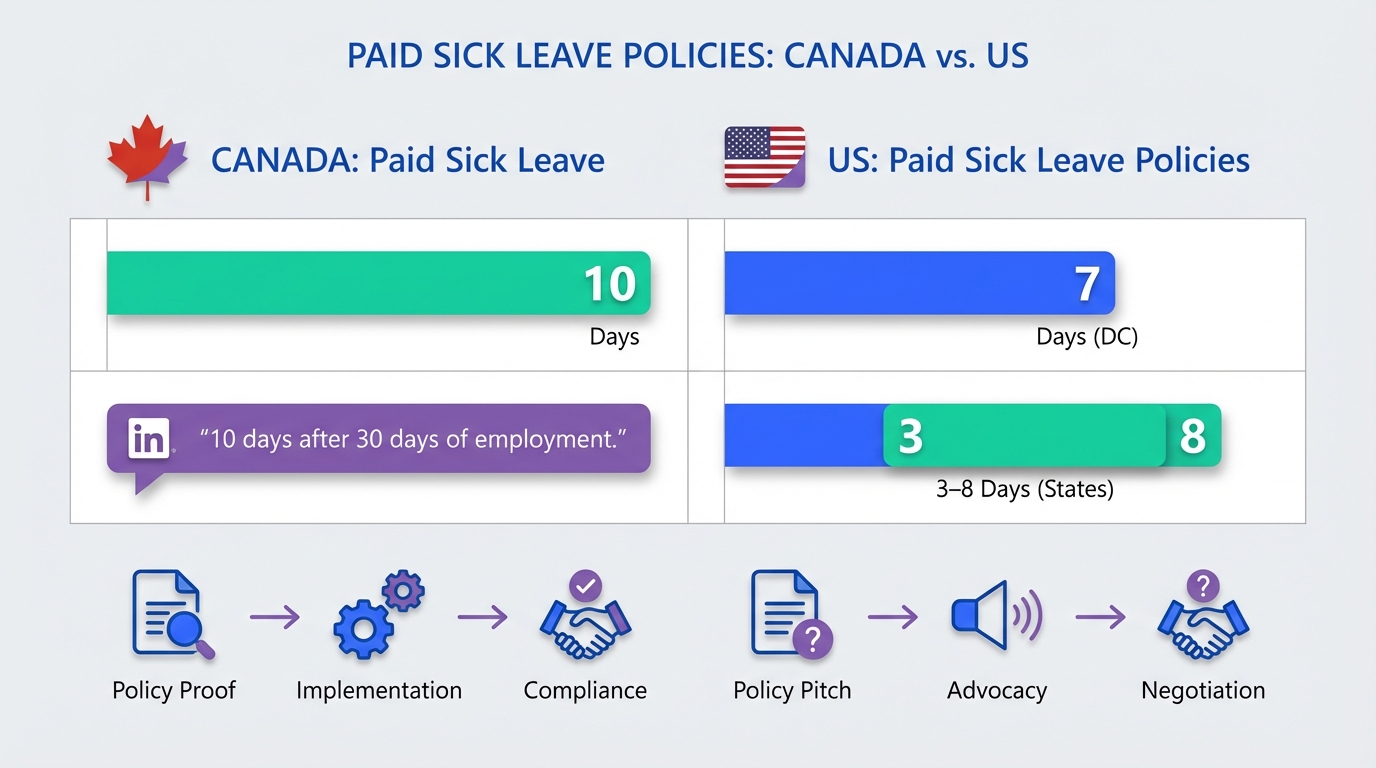
If you are evaluating an hr recruitment system or comparing online hr platforms, sick leave policy is a practical lever that changes candidate acceptance rates and relocation confidence. In Canada, federally regulated employers must provide up to 10 paid sick days worth up to 4% of an employee’s annual salary after 30 days of employment, while most other employees rely on provincial rules. In the US, there is no federal paid sick leave requirement after the 2020 policy expired, and coverage varies by state and city. This guide summarizes the specific Canada and US sick leave entitlements listed in the source, then shows how to operationalize them in HR tech software and in LinkedIn recruiting workflows using StrategyBrain AI Recruiter for consistent outreach, qualification, and follow up.
Key Takeaways
- Canada federal rule (specific industries): Up to 10 paid sick days worth up to 4% of annual salary after 30 days of employment.
- Canada provincial paid sick leave (as stated in the source): British Columbia provides 5 paid days after 90 consecutive days; Quebec provides 2 paid days after 3 months.
- Canada unpaid sick leave (maximums listed): Ranges from 0 days (Saskatchewan) to 12 days (Yukon), depending on jurisdiction.
- US federal baseline: No federal paid sick leave requirement; Family and Medical Leave Act provides unpaid leave for eligible employees and 56% of the workforce meets eligibility criteria (per cited US Department of Labor brief in the source list).
- US paid sick day laws (as stated in the source): 14 states plus 19 cities and 3 counties have paid sick day laws, with state maximums listed from 3 to 8 days and DC at 7 days.
- Operational HR insight: When fewer than 25% of jurisdictions mandate paid sick leave (as stated in the source), offering it can be positioned as a differentiator in candidate messaging and offer acceptance.
- Workflow advantage: StrategyBrain AI Recruiter can standardize how benefits like sick leave are explained and followed up on in LinkedIn conversations, in any language, 24/7.
Table of Contents
- Why sick leave belongs in your HR recruitment system
- Canada: federal paid sick leave for specific industries
- Canada: provincial paid and unpaid sick leave snapshot
- United States: federal baseline and state paid sick leave maximums
- How to operationalize sick leave in HR tech software
- How StrategyBrain AI Recruiter fits into LinkedIn recruiting
- Quick comparison table
- FAQ
- Conclusion and next steps
Why sick leave belongs in your HR recruitment system
I have seen benefits discussions derail otherwise strong candidates because the information arrives late, is inconsistent across recruiters, or is not framed in a way that helps a family make a relocation decision. That is why I treat sick leave as structured data inside an hr recruitment system, not as a footnote in a PDF.
In practical terms, your HR tech software should make it easy to do three things: store the policy by location, surface it in job messaging, and answer follow up questions quickly. This is also where online hr platforms and LinkedIn workflows intersect, because candidates often ask benefits questions in chat before they ever apply.
Canada: federal paid sick leave for specific industries
According to the source content, Canada mandates paid sick leave federally only for specific industries. The industries listed are airlines, ports, railways, pipelines, banks, and government agencies. The source also states that government agencies make up 6% of all employees.
The federal requirement described is: after 30 days of employment, covered employees must receive up to 10 paid sick days worth up to 4% of an employee’s annual salary.
How to use this in recruiting: If you recruit for federally regulated employers, this is a concrete, regulated benefit you can communicate early. If you recruit outside those industries, you should avoid implying the same entitlement exists nationally and instead rely on the provincial rules and the employer’s own policy.
Canada: provincial paid and unpaid sick leave snapshot
The source states that the remaining 94% of Canadian employees rely on provincial regulations, although some employers may choose to provide paid sick days even when not legally required.
Paid sick leave provinces mentioned
- British Columbia: After 90 consecutive days with an employer, employees are entitled to 5 days paid sick leave.
- Quebec: 2 paid sick days per year for employees who have been with their employer for 3 months. The source notes these paid leave days are grouped with other potential absences, including family leave.
Maximum unpaid sick days listed (by jurisdiction)
The source provides the following maximum unpaid sick days of yearly entitlement after minimum employment requirements are met:
- Alberta: 5 days
- Saskatchewan: 0 days
- Manitoba: 3 days
- Ontario: 3 days
- New Brunswick: 5 days
- Nova Scotia: 3 days
- Prince Edward Island: 3 days
- Newfoundland and Labrador: 7 days
- Yukon: 12 days
- Northwest Territories: 5 days
- Nunavut: 5 days
United States: federal baseline and state paid sick leave maximums
The source states that in the US there are no federal requirements for paid sick leave after the expiry of the 2020 10 day federal sick leave policy. It also states that the Family and Medical Leave Act provides eligible employees with unpaid leave in certain instances, and that 56% of the workforce meets the criteria for this coverage.
The source further states there are 14 states with paid sick day laws, plus 19 cities and 3 counties, with exceptions based on business size and length of employment.
Maximum paid sick days listed (by state or DC)
- District of Columbia: 7 days
- Connecticut: 5 days
- California: 3 days
- Massachusetts: 5 days
- Oregon: 5 days
- Vermont: 5 days
- Arizona: 5 days
- Washington: 5 days
- Rhode Island: 5 days
- Maryland: 8 days
- New Jersey: 5 days
- New York: 5 days
- New Mexico: 8 days
- Colorado: 6 days
How to operationalize sick leave in HR tech software
Here is the practical part that many online hr platforms still leave to spreadsheets. You want your hr recruitment system to turn policy complexity into consistent candidate communication.
Steps
- Normalize the policy into fields: Store location, paid days, unpaid days, eligibility waiting period, and whether the policy is statutory or employer provided.
- Create a benefits snippet library: Write short, plain language explanations recruiters can reuse in outreach and follow ups.
- Attach the right snippet to the right job: Map each requisition to the correct jurisdiction and employer policy version.
- Track candidate questions as tags: Tag conversations that mention sick leave, family leave, relocation, or benefits so you can measure what actually drives acceptance.
- Audit quarterly: Re verify the statutory baseline and update employer policy changes, then refresh your templates.
A simple framework we use: Policy, Proof, Pitch
This is the internal checklist I use to keep benefits messaging accurate and persuasive without over promising:
- Policy: What is the statutory baseline in this jurisdiction, and what does the employer add on top.
- Proof: Where is the authoritative reference stored in your HR tech software, and who last verified it.
- Pitch: The two sentence explanation a candidate can understand in chat, including eligibility timing.
How StrategyBrain AI Recruiter fits into LinkedIn recruiting
Benefits questions often show up in LinkedIn messages, not in the application form. StrategyBrain AI Recruiter is designed to automate the early LinkedIn workflow: it can connect with candidates that match your search criteria, introduce the role, answer questions about the company and compensation, confirm interview interest, and collect résumés and contact details from interested candidates.
In my experience, the biggest win is consistency. When a candidate asks, “How does sick leave work if I relocate,” the AI can respond immediately using the correct jurisdiction specific snippet you have approved, then follow up later if the candidate goes quiet. Because it supports 24/7 multilingual communication, the same benefits explanation can be delivered in the candidate’s native language, which reduces misunderstandings during cross border hiring.
Scope boundary: StrategyBrain AI Recruiter can identify willingness to proceed and collect résumés and contact details, but it does not decide whether a résumé fully matches job requirements. Recruiters still do final qualification after review.
Quick comparison table
| Region | Baseline described in source | What to store in an HR recruitment system | What to message in LinkedIn outreach |
|---|---|---|---|
| Canada (federal, specific industries) | Up to 10 paid sick days after 30 days, worth up to 4% of annual salary | Eligibility day 30, paid days 10, value cap 4% annual salary, covered industry flag | Confirm coverage and eligibility timing early for regulated employers |
| Canada (provincial examples) | BC 5 paid days after 90 days; Quebec 2 paid days after 3 months | Province mapping, waiting period, paid days, notes on grouping with other absences | Use province specific snippet and avoid implying a national rule |
| United States | No federal paid requirement; paid sick day laws vary by state and city | State and city policy mapping, employer policy overrides, exception notes | State the employer policy clearly and invite questions, then follow up |
FAQ
Is sick leave really something I should track in an hr recruitment system?
Yes. Candidates ask benefits questions early, and inconsistent answers create trust issues. Treat sick leave as structured fields in your HR tech software so recruiters and automated messaging stay aligned.
What does the source say about Canada’s federal paid sick leave?
The source states that federally regulated employers in specific industries must provide up to 10 paid sick days worth up to 4% of annual salary after 30 days of employment.
Which Canadian provinces are listed as mandating paid sick leave?
The source states British Columbia and Quebec. British Columbia provides 5 paid days after 90 consecutive days, and Quebec provides 2 paid days after 3 months, grouped with other potential absences.
Does the US have a federal paid sick leave requirement?
The source states there is no federal requirement for paid sick leave after the 2020 10 day policy expired. It also notes the Family and Medical Leave Act provides unpaid leave for eligible employees.
How many US states have paid sick day laws according to the source?
The source states 14 states have paid sick day laws, plus 19 cities and 3 counties.
How can StrategyBrain AI Recruiter help with benefits communication?
It can answer candidate questions in LinkedIn messages 24/7 using your approved benefits snippets, then follow up automatically. It also supports multilingual communication so the same policy explanation can be delivered in the candidate’s native language.
Can StrategyBrain AI Recruiter fully replace recruiter screening?
No. It can automate outreach, initial conversation, confirm interest, and collect résumés and contact details. Final qualification against job requirements remains a recruiter decision.
What is a safe way to position paid sick leave as a recruiting advantage?
State what is statutory in the candidate’s jurisdiction, then clearly separate what the employer offers beyond that baseline. Avoid implying a national rule when the entitlement is provincial, state, or employer specific.
Conclusion and next steps
Sick leave is not just a compliance detail. It is a candidate decision factor, especially when relocation and family logistics are involved. The source content highlights how fragmented the rules are across Canada and the US, which is exactly why an hr recruitment system should store jurisdiction specific baselines and employer policy overrides in a structured way.
Next steps: pick the jurisdictions you hire in most, convert the rules into fields inside your HR tech software, and create short messaging snippets recruiters can reuse. If LinkedIn is a major sourcing channel for you, use StrategyBrain AI Recruiter to deliver consistent, timely answers and follow ups so benefits do not become the bottleneck between interest and interview.