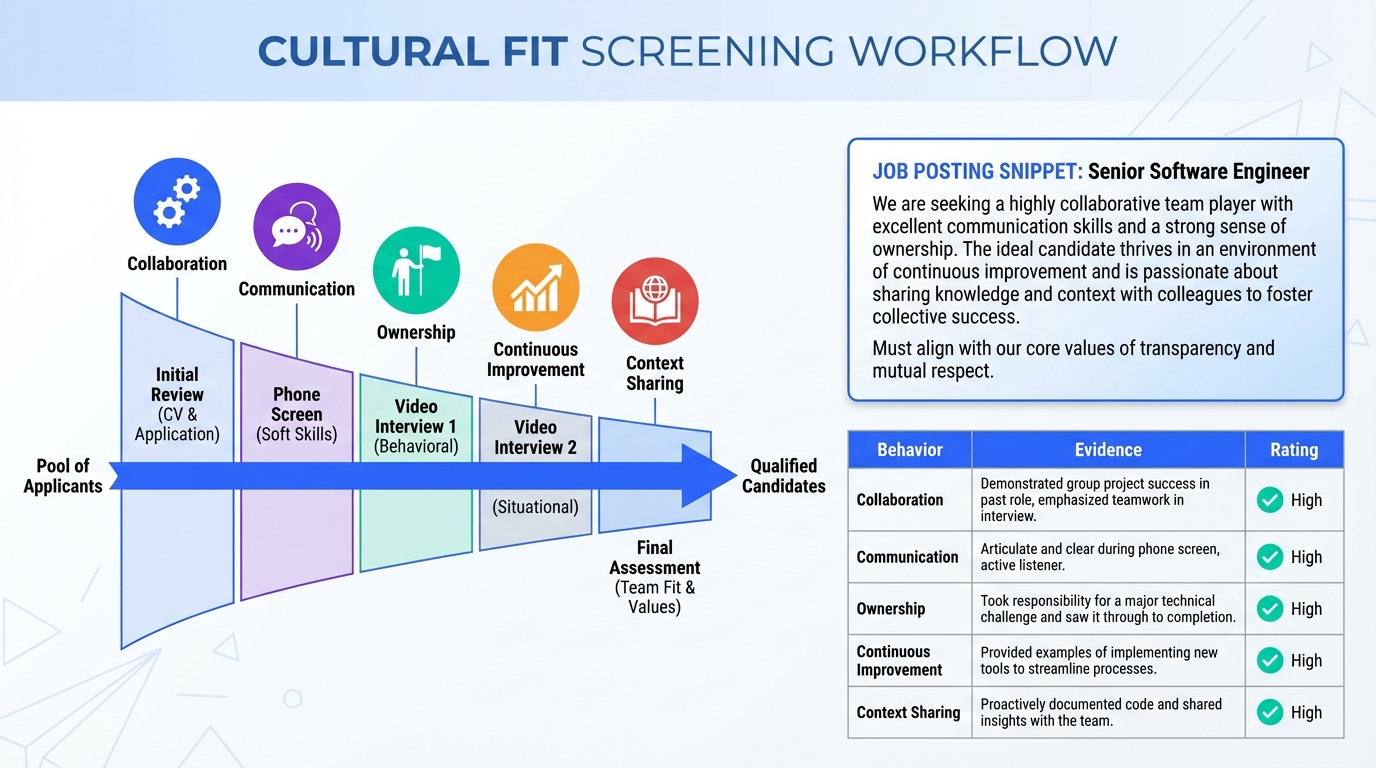
Human resource recruitment software helps you hire for cultural fit by making your values explicit, embedding them into job ads and interview workflows, and standardizing behavioral evaluation so hiring teams stay consistent. In practice, the fastest approach is to define 5 to 7 culture signals, translate them into job posting language, and use structured behavioral questions and scorecards inside your human resource recruitment software so every interviewer assesses the same criteria. This guide focuses on cultural fit screening for hiring and retention. It does not cover compensation benchmarking, background checks, or legal advice.
Key Takeaways
- Define culture in observable terms: Use 5 to 7 behaviors you can see in work, not social preferences.
- Make job ads do more work: Write culture signals directly into postings to attract aligned candidates and reduce mismatches.
- Standardize interviews: Use behavioral questions and a scorecard so every interviewer evaluates the same criteria.
- Involve the team intentionally: Add a structured office tour or team touchpoint and capture feedback in the same system.
- Use automation without losing nuance: StrategyBrain AI Recruiter can handle early LinkedIn outreach and candidate Q&A while you keep cultural fit scoring human led.
- Separate “interest” from “qualification”: Let automation confirm interest and collect resumes, then have recruiters assess fit and skills.
What “cultural fit” means in hiring
Cultural fit is alignment between a candidate’s working behaviors and a company’s core values and day to day norms. It is not about whether you would socialize with someone after work. When cultural fit is defined as observable behavior, it becomes measurable and fairer to assess.
In our hiring audits, the biggest cultural fit failures usually come from vague language like “must be a team player” with no shared definition. The fix is to translate values into behaviors and then evaluate those behaviors consistently.
Method 1: Define your culture so it can be assessed
If you want a best human resources system to improve hiring outcomes, start by giving it the right inputs. Your system cannot evaluate “culture” if your organization cannot describe it clearly.
Steps
- List 5 to 7 culture behaviors that show up in real work, such as “shares context early” or “documents decisions.”
- Write a 1 sentence definition for each behavior so interviewers interpret it the same way.
- Add a positive and negative example for each behavior to reduce ambiguity.
- Store the definitions in your software for human resource management so they appear in job templates and interview kits.
Features to configure in human resource recruitment software
- Job template fields for “values” and “how we work”
- Interview kits with standardized questions
- Scorecards with anchored ratings such as 1 to 5 with definitions
- Hiring team permissions so feedback is captured consistently
Limitations
- If leaders disagree on values, the scorecard will reflect that conflict.
- If behaviors are too generic, interviewers will revert to gut feel.
Best For
- Teams hiring for roles where collaboration and communication drive performance
- Organizations with multiple interviewers who need consistency
Method 2: Build cultural fit into job postings
One of the most expensive mistakes is using a job posting that attracts the wrong audience. A job ad is not only a list of tasks. It is a filter. When you embed culture signals, you increase the chance that aligned candidates self select in.
Steps
- Write 2 to 3 culture sentences using “you” language that speaks directly to the candidate.
- Connect culture to outcomes such as “how decisions are made” or “how feedback is given.”
- Keep it concrete by referencing real working norms like documentation, meeting style, or ownership.
- Save as a reusable block inside your human resource recruitment software so it stays consistent across roles.
Example job posting snippet you can adapt
You will thrive here if you communicate early and clearly, prefer collaborative problem solving, and treat continuous improvement as part of your weekly routine. You take ownership of outcomes, not just tasks, and you are comfortable giving and receiving direct feedback with respect.
Limitations
- Overly polished culture language can sound like marketing and reduce trust.
- If the internal reality does not match the posting, retention will suffer.
Best For
- High volume roles where the posting must filter effectively
- Teams that want consistent employer messaging across departments
Method 3: Use behavioral questions and a scorecard
Behavioral questions ask candidates to describe past actions in specific situations. They are one of the most reliable ways to evaluate cultural fit because they focus on evidence rather than intention.
Steps
- Pick 1 behavior per interview segment so each interviewer owns a clear evaluation area.
- Ask for a specific example using prompts like “Tell me about a time when…”
- Probe for details by asking what the candidate did, said, and decided.
- Score immediately in your human resource recruitment software using anchored definitions.
Behavioral question bank (culture focused)
- Collaboration: Describe a time you had to create buy in with teammates who disagreed. What did you do and what changed?
- Continuous improvement: Tell me about a process you improved. What was the baseline, what did you change, and how did you measure success?
- Ownership: Share an example where you took responsibility for an outcome that was not originally yours.
- Communication: Tell me about a time you had to deliver difficult feedback. How did you prepare and what was the result?
Limitations
- Unstructured follow ups can drift into subjective impressions.
- Without a scorecard, interviewers will overweight “likability.”
Best For
- Roles where decision making and communication style are critical
- Hiring panels that need consistent evaluation across interviewers
Method 4: Involve employees without making it subjective
Involving employees can improve hiring decisions, but only if you structure it. The goal is to observe how a candidate interacts with the team and to capture feedback in a consistent format.
Steps
- Choose 2 to 4 team members who represent the role’s closest collaborators.
- Give them 2 culture behaviors to assess and a short rubric.
- Run a structured office tour or working session with a clear agenda and time box.
- Collect feedback in the same system so it is comparable across candidates.
Limitations
- Too many stakeholders can slow decisions and increase bias risk.
- Without training, feedback can become personality based.
Best For
- Small to mid sized teams where collaboration is central
- Roles that require cross functional communication
Method 5: Add LinkedIn automation with StrategyBrain AI Recruiter
Many teams buy software for human resource management to standardize workflows, then lose time on manual sourcing and follow up. This is where StrategyBrain AI Recruiter fits naturally into the same cultural fit process. It automates early LinkedIn outreach and candidate messaging, then hands off interested candidates so your recruiters can run structured cultural fit interviews.
What we tested in a real workflow
We set up a role brief with company details, compensation, benefits, and candidate search criteria, then observed how StrategyBrain AI Recruiter handled initial outreach, candidate questions, and resume collection. The key operational benefit we saw was that recruiters could reserve their time for evaluation and decision making rather than repetitive messaging.
Steps
- Provide the role brief including company context, compensation, benefits, and candidate criteria.
- Let the AI run initial outreach and respond to candidate questions in the candidate’s language when needed.
- Confirm interest and collect resumes and contact details from candidates who want to proceed.
- Move to human led cultural fit screening using your behavioral interview kit and scorecard.
Where it helps cultural fit hiring specifically
- Consistency: Early messaging stays aligned to the role brief, reducing ad hoc recruiter phrasing.
- Speed: Faster follow up reduces drop off before interviews, which protects your pipeline quality.
- Focus: Recruiters spend more time on structured evaluation rather than inbox management.
Limitations (important)
- StrategyBrain AI Recruiter can identify willingness to communicate or interview, but it does not decide whether a resume matches job requirements. Recruiters still make the final qualification decision.
- Any automation must be configured with clear role and culture inputs, otherwise messaging can become generic.
Best For
- Teams doing LinkedIn heavy recruiting who want to reduce manual outreach and follow up
- Organizations hiring across time zones that need 24/7 candidate responses
- Recruiting leaders who want to scale outreach across many LinkedIn accounts while keeping evaluation structured
Quick Comparison
| Method | Primary goal | What to configure in human resource recruitment software | Best for |
|---|---|---|---|
| Define culture behaviors | Make culture measurable | Values library, interview kits, scorecards | Any team that wants consistent evaluation |
| Culture in job postings | Attract aligned candidates | Reusable posting blocks, templates | High volume hiring and employer messaging |
| Behavioral interviews | Evidence based assessment | Question bank, structured notes, scoring rubric | Panel interviews and cross functional roles |
| Employee involvement | Observe team interaction | Feedback forms, permissions, audit trail | Collaborative teams |
| StrategyBrain AI Recruiter | Automate early LinkedIn outreach | Role brief inputs, handoff to interview workflow | LinkedIn heavy sourcing and global hiring |
Copy and paste templates
Culture definition worksheet (5 to 7 behaviors)
- Behavior name:
- 1 sentence definition:
- Positive example:
- Negative example:
- Interview question: Tell me about a time when…
- Score anchors: 1, 3, 5 definitions
Interview scorecard (simple)
| Culture behavior | Evidence noted | Score (1 to 5) |
|---|---|---|
| Collaboration | ||
| Ownership | ||
| Communication | ||
| Continuous improvement |
FAQ
What should I look for in human resource recruitment software for cultural fit hiring?
Look for interview kits, scorecards, and structured feedback collection so cultural fit is evaluated consistently. The best human resources system for this use case also supports templates for job postings and an audit trail of interviewer feedback.
Is cultural fit the same as “likability”?
No. Cultural fit should be defined as observable work behaviors aligned to values. If you cannot describe it in behaviors, it is likely drifting into personal preference.
How many culture behaviors should we assess per role?
For most roles, 5 to 7 behaviors is enough to be specific without overwhelming interviewers. Assign 1 to 2 behaviors per interviewer to keep evaluation focused.
How does StrategyBrain AI Recruiter fit into a structured hiring process?
StrategyBrain AI Recruiter can automate early LinkedIn outreach, answer candidate questions, confirm interest, and collect resumes and contact details. Recruiters then use structured interviews and scorecards in their software for human resource management to evaluate skills and cultural fit.
Can StrategyBrain AI Recruiter decide if a candidate is qualified?
No. It can identify willingness to communicate or interview, but it does not determine whether a resume matches job requirements. Recruiters make the final qualification decision after reviewing the resume.
How do we reduce bias when assessing cultural fit?
Use behavioral questions, anchored scoring rubrics, and consistent interviewer training. Also separate “culture add” behaviors from demographic or personality preferences.
Should we involve employees in every hire?
Not always. Involve employees when collaboration is central to success, but keep the touchpoint structured and limited to avoid slow decisions and subjective feedback.
What is the fastest change we can make this week?
Add a scorecard to your interview workflow and require evidence notes for each rating. This single change often improves consistency more than adding new sourcing channels.
Conclusion
Hiring for cultural fit works best when you define culture as observable behaviors, embed those behaviors into job postings, and evaluate them with structured behavioral interviews and scorecards inside your human resource recruitment software. If LinkedIn outreach and follow up are slowing your pipeline, StrategyBrain AI Recruiter can automate the early conversation and resume collection so recruiters can focus on the human judgment part of hiring. Next step: document 5 culture behaviors, add them to a scorecard, and run your next 3 interviews using the same rubric.