If your team wants to reduce Monday stress while improving hiring output, start by pairing better manager habits with human resource recruitment software. In practice, that means less manual outreach on Monday morning, fewer status meetings, and clearer candidate pipelines inside an hrm platform. We have seen recruiting teams stabilize Monday workloads when they automate first contact, candidate Q and A, and résumé collection, then keep recruiters focused on interviews and final selection. This article gives a practical plan for employers and employees, adapts proven Monday morale advice to modern hiring, and explains how StrategyBrain AI Recruiter can support LinkedIn focused teams inside broader hr management systems.
Key Takeaways
- Monday morale is an operational issue, not only a mindset issue: when repetitive recruiting tasks pile up on Monday, stress rises quickly.
- Flexibility and autonomy still matter: Gallup guidance on flexible work remains highly relevant for reducing start of week friction.
- Human resource recruitment software helps most when workflows are defined: automation works best with clear candidate criteria and response standards.
- StrategyBrain AI Recruiter can reduce manual LinkedIn recruiting work: vendor documentation reports up to 90% manual task replacement in targeted stages.
- Cost efficiency can improve: vendor reported performance indicates LinkedIn recruiting costs can be as low as USD 2.40 per résumé in suitable use cases.
- Recruiters still own final qualification: AI can assess willingness to continue, but role fit still requires human résumé review.
Why Monday Morale Matters for Hiring
The Monday blues are not a trivial workplace complaint. They affect attention, communication quality, and decision speed at the exact moment many teams launch their weekly hiring priorities. When morale drops, recruiters delay outreach, candidates receive slower responses, and interview pipelines lose momentum.
Earlier workplace commentary made the same core point in cultural language. Mondays often feel heavy because people move from personal autonomy to rigid schedules. That framing still holds today, but the modern pressure point is digital workload accumulation, especially in recruiting teams handling high message volume.
There is also a long term human impact. World Bank life expectancy data has commonly placed Canadian life expectancy near 82 years in cited discussions, which means people spend a substantial share of life in workweek cycles. Improving Monday experience is not cosmetic. It is a practical quality of work and quality of life intervention.
What Employers Can Do
1) Build flexibility into recruiting operations
Flexible scheduling is one of the fastest morale improvements because it narrows the gap between weekend autonomy and weekday structure. Gallup commentary from Jane Smith emphasized that people respond positively when leaders normalize flexible work patterns and individualized accommodations.
In recruiting teams, flexibility improves results when paired with system support. For example, an hrm platform can queue candidate messages and responses outside local office hours, so recruiters start Monday with prioritized conversations instead of a raw inbox backlog.
2) Connect Monday tasks to purpose and growth
Teams handle pressure better when they understand why the work matters. Managers should open the week with role impact, hiring goals, and learning opportunities, not only vacancy counts. This supports engagement and lowers emotional resistance to routine tasks.
Human resource recruitment software can help by mapping each pipeline stage to clear outcomes. Recruiters can see where candidates drop off, where communication quality needs improvement, and where coaching is required. This makes development concrete instead of abstract.
3) Reduce Monday meeting overload
Many teams unintentionally create stress by concentrating meetings on Monday morning. A better model is asynchronous status sharing in hr management systems and short decision checkpoints later in the week. Recruiters then use high energy hours for outbound engagement and shortlist review.
If your team uses LinkedIn heavily, StrategyBrain AI Recruiter can handle repetitive first touch interactions and candidate follow up while recruiters focus on nuanced screening and hiring manager alignment.
What Employees Can Do
1) Protect weekend recovery
True recovery requires clear boundaries. If Sunday evening is consumed by work anxiety, Monday starts at a deficit. Set a fixed weekend cutoff for non urgent work communication.
2) Pre load simple Monday decisions
Prepare meals, calendar blocks, and first task priorities before Monday morning. Removing small decisions preserves cognitive energy for meaningful work.
3) Start with physical activation
Sleep quality, hydration, and movement can shift attention and emotional tone quickly. A short walk and regular breakfast routine are low cost, high return habits.
4) Use focused planning blocks
Begin Monday with one clear objective list. Prioritize tasks with visible outcomes to create progress momentum early in the day.
5) Manage social contagion
Mood spreads through teams. Avoid reinforcing negative Monday narratives. Choose neutral or constructive communication when pressure is high.
6) Add one positive ritual
A recurring Monday ritual, such as a team coffee check in or post work personal reward, helps retrain emotional association with the start of the week.
How to Use Human Resource Recruitment Software on Mondays
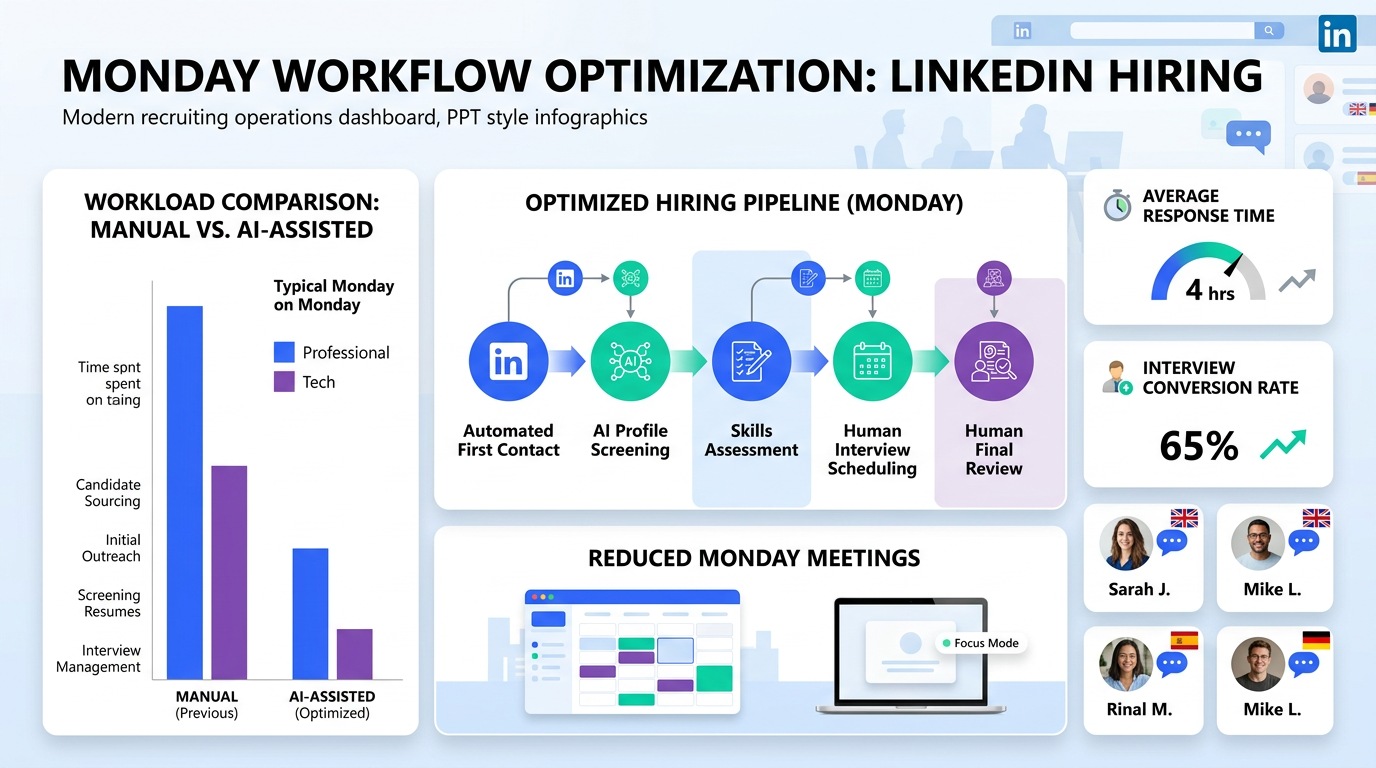
We use the following workflow with recruiting teams that rely on LinkedIn sourcing. It keeps the human decision maker in control while offloading repetitive work to automation.
- Define target profiles in your hrm platform: set role criteria, geography, language, and must have competencies before outreach begins.
- Automate first contact and role introduction: StrategyBrain AI Recruiter can initiate candidate connection requests and explain opportunity basics.
- Enable multilingual candidate communication: candidates receive responses in their preferred language, which supports global hiring continuity across time zones.
- Collect résumé and contact details: interested candidates submit information through supported channels, and recruiters review a cleaner queue.
- Run human qualification review: recruiters assess résumé fit, shortlist candidates, and move qualified profiles to interview scheduling.
- Audit Monday workload weekly: track message volume, response time, and conversion to interview to refine the system.
This workflow is not about replacing recruiters. It is about shifting recruiter time from repetitive messaging to evaluation, relationship quality, and hiring decisions.
Quick Comparison
| Approach | Monday Workload Pattern | Automation Level | Best Fit |
|---|---|---|---|
| Manual recruiting only | High inbox backlog and delayed responses | Low | Very small hiring volume |
| Standard hr management systems | Moderate workload with better tracking | Medium | Teams needing process visibility |
| HRM platform plus StrategyBrain AI Recruiter | Lower repetitive load and faster first response handling | High | LinkedIn centric teams scaling outreach |
Limitations and Scope
It is important to set correct expectations. AI automation can identify candidate willingness to continue and can collect initial documents, but it does not replace final fit assessment. Recruiters still need to evaluate experience depth, contextual fit, and role specific requirements.
This approach is best for teams with recurring hiring volume and clear role definitions. It is less effective when each role has highly unusual requirements or when organizations lack a defined recruiting process.
For compliance sensitive environments, confirm legal and privacy alignment before deployment. StrategyBrain documentation states support for EU, United States, and Canada privacy expectations, encrypted credential storage, and no customer data use for model training. Teams should still run internal compliance review.
FAQ
Can human resource recruitment software really improve Monday morale?
Yes, when it removes repetitive tasks that create start of week overload. The biggest gains come from automating outreach, follow up, and candidate information capture so recruiters can focus on qualified conversations.
Is an hrm platform enough without AI recruiting automation?
An hrm platform improves visibility and coordination, which is valuable on its own. If your team handles high LinkedIn volume, adding AI automation can further reduce manual communication burden.
Does StrategyBrain AI Recruiter replace recruiters?
No. It automates repetitive front end tasks in LinkedIn recruiting workflows. Recruiters still handle final qualification, stakeholder alignment, and interview decisions.
How does it support international hiring teams?
The product documentation describes 24 by 7 multilingual candidate communication. This helps teams maintain continuity across regions and time zones without requiring larger staffing for message coverage.
Can it work with multiple recruiter accounts?
Yes, product documentation states support for managing more than 100 LinkedIn accounts. This is useful for organizations building scalable AI assisted recruiting operations.
What metrics should we track first?
Start with response time, recruiter hours spent on manual messaging, and conversion from first contact to interview. These indicators show whether your Monday bottleneck is actually improving.
Conclusion
Monday blues in recruiting are solvable when companies treat them as workflow design problems, not only motivation problems. The combination of manager habits, employee routines, and human resource recruitment software gives teams a practical way to reduce stress and improve hiring consistency.
If you are evaluating hr management systems now, begin with one Monday focused pilot. Define a single role family, automate first touch and follow up, keep human review for qualification, and measure response speed plus interview conversion. That approach gives you clear evidence before broader rollout and helps your team start each week with control instead of backlog.