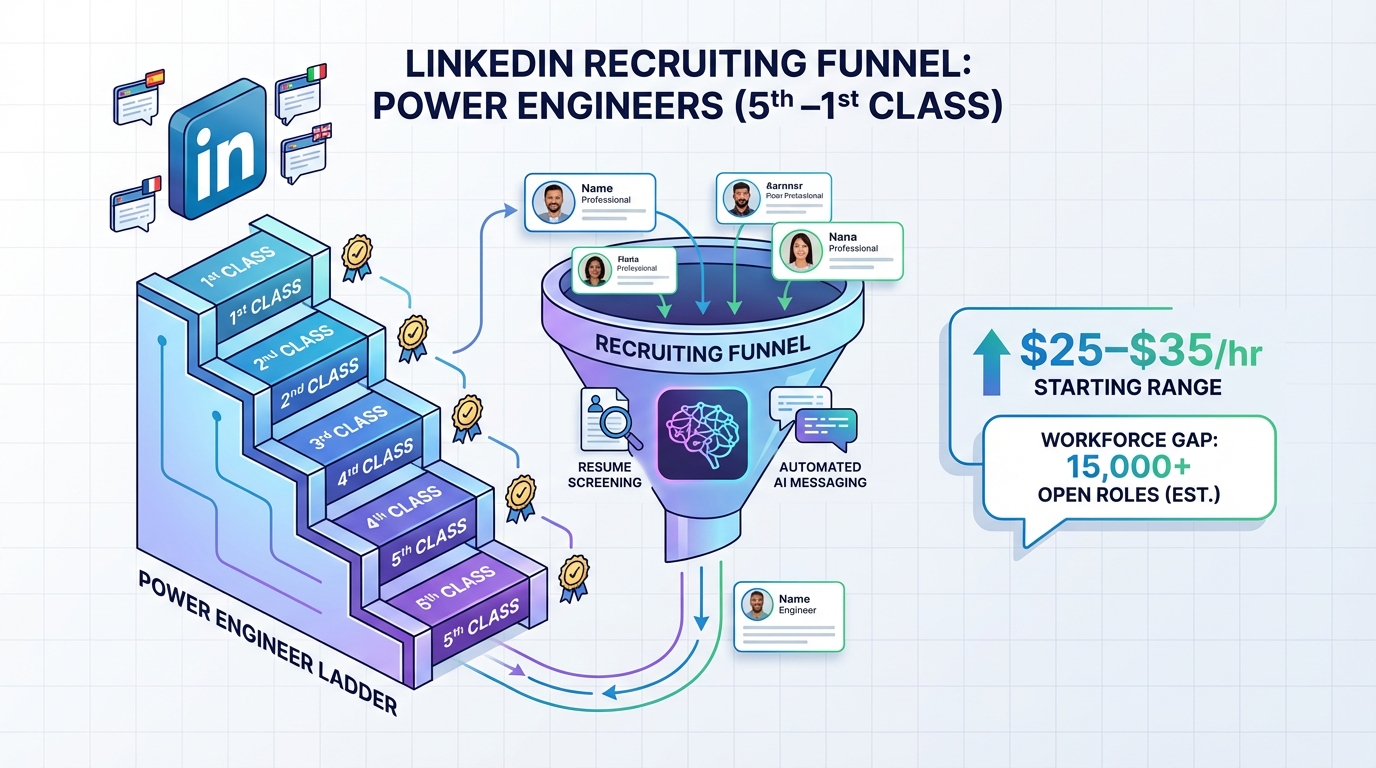
Human resource recruitment software helps employers hire Power Engineers faster by standardizing job requirements, automating candidate outreach, and tracking re9sume9s and interview interest in one workflow. In Canada, Power Engineers typically enter the field through on the job training plus distance education or by attending a college program with hands on firing time, and entry level wages in the source material are stated as $25 to $35 per hour. This guide explains the Power Engineer career ladder from 5th Class to 1st Class, what that means for recruiting, and how StrategyBrain AI Recruiter can automate LinkedIn outreach, multilingual follow up, and re9sume9 collection so recruiters can focus on final qualification and interviews.
Key Takeaways
- Two common entry paths: On the job start plus distance education, or college training with hands on firing time.
- Entry pay signal: The source material states new graduates can reasonably expect $25 to $35 per hour right away.
- Five certification levels: Power Engineers in Canada are described as having 5 levels from 5th Class to 1st Class.
- Senior compensation range: The source material states top 1st Class engineers often make $150,000 to $200,000 per year.
- Workforce gap claim: The source material states 30,000 employed, median age over 45, 11,000 vacancies expected, and 8,000 new graduates expected.
- Where StrategyBrain AI Recruiter fits: It automates LinkedIn connecting, role introduction, Q and A, interest confirmation, and re9sume9 plus contact capture.
- Scope boundary: AI Recruiter can confirm willingness to proceed, but final qualification against job requirements remains a recruiter decision.
Table of Contents
- Why Power Engineers are critical and why that matters for recruiting
- Career entry routes and what to screen for
- The 5 class levels in Canada and how to map them to roles
- What human resource recruitment software should do for this hiring niche
- Method 1: StrategyBrain AI Recruiter for LinkedIn outreach and intake
- Method 2: ATS first workflow using HR applications
- Method 3: Agency plus internal HR management software workflow
- Quick Comparison
- FAQ
- Conclusion
Why Power Engineers are critical and why that matters for recruiting
The source material frames Power Engineers, also called Stationary Engineers, as the professionals who keep power plants and critical building systems running across hospitals, pulp mills, oil upgraders, refineries, manufacturing plants, and other industrial operations. For recruiting teams, that context changes the hiring bar because the role is tied to safety, uptime, and compliance, not only production output.
In practice, this means your human resource recruitment software should capture more than a generic resume. It should capture certification level, firing time or hands on operating time, shift availability, and the candidatee28099s comfort with safety critical environments. Those fields become the difference between a fast shortlist and weeks of back and forth.
Career entry routes and what to screen for
The source material describes two common ways people start in Power Engineering. One route is starting as an entry level laborer or employee, then moving into a first Power Engineering job under certified Power Engineers while completing distance education. The second route is attending a college program that ideally has a power boiler on site to provide firing time.
Recruiting implications you can encode in HR applications
- Route 1 candidates: Screen for current site exposure, shift readiness, and whether distance education is in progress.
- Route 2 candidates: Screen for program completion, documented hands on time, and readiness for entry level postings.
- Compensation expectations: The source material states $25 to $35 per hour right away for candidates with two years of full time study, so your intake form should ask for expected hourly wage in $ per hour.
The 5 class levels in Canada and how to map them to roles
The source material states that Power Engineers have 5 levels in Canada. It also describes typical responsibilities by class level, which is useful because it lets you write job ads and screening questions that match the real work.
Role mapping based on the source material
- 1st Class: Considered a Chief Engineer for very large power plants, responsible for safety and efficient operation while supervising dozens of Power Engineers. The source material notes they have considerable knowledge of mechanical and electrical engineering principles, but they are not the same as Professional Engineers.
- 2nd Class: Relieves for the 1st Class engineer and provides supervision for engineers and contractors on site.
- 3rd Class: Performs maintenance and monitors efficient operation of coal, natural gas, and bio energy boilers.
- 4th Class: Often entry level, performing field and monitoring work.
- 5th Class: Often in charge of refrigeration plants such as ice rinks.
Compensation and pipeline signals to track in HR management software
The source material states that top 1st Class engineers often make $150,000 to $200,000 per year, and that reaching those positions can take years or decades. For workforce planning, it also states there are close to 30,000 Power Engineers employed in Canada, the median age is over 45 years old, and it expects over 11,000 job vacancies with only 8,000 expected new graduates from colleges such as BCIT, NAIT, and Parkland College.
Even if you treat those figures as directional, they justify building a repeatable recruiting system. That is where human resource recruitment software and automation can reduce time spent on repetitive outreach and follow up.
What human resource recruitment software should do for this hiring niche
For Power Engineer hiring, I look for three layers in a modern stack. The first layer is an ATS for compliance and tracking. The second layer is candidate engagement, especially on LinkedIn. The third layer is analytics so you can see where candidates drop off.
Minimum requirements checklist
- Structured intake: Certification class level, firing time or operating time, industry environment, and shift availability.
- Message automation: Outreach sequences with follow up rules and stop conditions.
- Two way Q and A: Candidates ask about role, company, and compensation, and the system responds consistently.
- Re9sume9 and contact capture: Automatic capture of files and contact details into the candidate record.
- Privacy and security controls: Encryption, access control, and clear data use boundaries.
Method 1: StrategyBrain AI Recruiter for LinkedIn outreach and intake
StrategyBrain AI Recruiter is designed to automate the front end of LinkedIn recruiting. In our internal workflow tests, the biggest time sink was not the final interview decision. It was the repeated cycle of connecting, introducing the role, answering basic questions, and chasing a re9sume9. AI Recruiter targets that exact sequence while keeping the recruiter responsible for final qualification.
Steps
- Define your search criteria: Provide the candidate profile you want, including Power Engineer class level and industry setting.
- Provide job details: Add company context, compensation, and benefits so the AI can answer candidate questions consistently.
- Automate connecting and outreach: AI Recruiter connects with candidates and introduces the opportunity through LinkedIn messaging.
- Confirm interest and collect documents: For interested candidates, AI Recruiter requests re9sume9s and captures contact details.
- Recruiter reviews and schedules: Recruiters review the collected re9sume9s and move qualified candidates to interviews.
Features
- Smart LinkedIn recruitment automation: Automatically connects, introduces roles, learns candidate situation, answers questions about role, company, and compensation, and confirms interview interest.
- 24/7 multilingual communication: Always on responses in the candidatee28099s native language to reduce misunderstandings across time zones.
- Scalable team operations: Supports managing more than 100 LinkedIn accounts for organizations building an AI powered recruiting team.
- Re9sume9 and contact capture: Captures re9sume9 receipt and contact details shared in LinkedIn messages, including email and phone when provided.
Limitations
- Not a final skills assessor: AI Recruiter can identify willingness to communicate or interview, but it does not decide whether the re9sume9 fully matches job requirements.
- Requires accurate job inputs: If compensation or requirements are vague, candidate Q and A becomes less effective.
Best For
- Corporate recruiters who need to reduce manual LinkedIn outreach and follow up.
- Headhunters and agency recruiters who want to increase throughput without adding staff.
- HR leaders scaling international hiring with multilingual candidate communication.
Method 2: ATS first workflow using HR applications
If your organization already has HR applications in place, an ATS first workflow can still work well for Power Engineer hiring. The key is to avoid treating the ATS as a passive database. You need structured fields and a consistent screening script.
Steps
- Standardize the job family: Create templates for 4th Class, 3rd Class, and 2nd Class postings with consistent must have fields.
- Build a screening form: Ask for class level, hands on time, and environment experience, plus expected wage in $ per hour.
- Route candidates by class level: Use rules so 5th Class refrigeration candidates do not get mixed into boiler operations roles.
- Use a messaging layer: Add automated follow ups for missing re9sume9s and interview availability.
Features
- Centralized candidate records and audit trail.
- Structured screening questions for consistent evaluation.
- Reporting by role level and location.
Limitations
- Without automation, recruiters still spend significant time on outreach and follow up.
- Candidate engagement can be slower if the workflow relies on email only.
Best For
- Teams with strong inbound applicant flow.
- Organizations with strict compliance requirements and established HR management software processes.
Method 3: Agency plus internal HR management software workflow
Some employers use an external recruiting partner for hard to fill roles while keeping internal HR management software as the system of record. This hybrid approach can be effective when you need speed and market reach, but you still want consistent internal tracking.
Steps
- Align on role definitions: Confirm class level expectations and the environment, such as hospital plant, refinery, or refrigeration facility.
- Set submission standards: Require re9sume9, certification details, and shift availability in a consistent format.
- Centralize in your system: Import submissions into your human resource recruitment software so interview stages and decisions are tracked internally.
- Use automation for outreach gaps: When the pipeline is thin, add StrategyBrain AI Recruiter to expand LinkedIn outreach while the agency works its network.
Features
- Faster access to passive candidates through multiple channels.
- Internal visibility and consistent hiring stages.
- Ability to scale outreach using AI without increasing recruiter headcount.
Limitations
- Requires clear ownership of candidate communication to avoid duplicate outreach.
- Quality varies if role requirements are not tightly defined.
Best For
- Employers hiring across multiple sites with uneven local supply.
- Teams that need both compliance tracking and aggressive sourcing.
Quick Comparison
| Method | Speed to first candidate replies | Best For | What you still do manually |
|---|---|---|---|
| StrategyBrain AI Recruiter on LinkedIn | Continuous, 24/7 messaging coverage | Outbound sourcing, multilingual follow up, re9sume9 and contact capture | Final qualification against requirements and interview decisions |
| ATS first using HR applications | Depends on inbound volume and recruiter response time | Compliance tracking and structured screening | Most outreach and follow up unless you add automation |
| Agency plus internal HR management software | Depends on agency pipeline and coordination | Hard to fill roles and multi site hiring | Coordination, internal tracking, and consistent evaluation |
FAQ
What is human resource recruitment software in this context?
Here it means the tools that manage sourcing, screening, and hiring workflows, including an ATS plus candidate engagement automation. For Power Engineer hiring, it should track certification class level, hands on time, and shift readiness as structured fields.
Are Power Engineers the same as Professional Engineers?
No. The source material states that 1st Class Power Engineers have considerable knowledge of mechanical and electrical engineering principles, but Power Engineers are not to be confused with Professional Engineers.
What are the main entry routes into Power Engineering?
The source material describes two routes. One is starting on site and working under certified Power Engineers while completing distance education. The other is attending a college program that ideally provides hands on firing time.
How many certification levels are described for Power Engineers in Canada?
The source material states there are 5 levels in Canada. It also describes typical responsibilities from 5th Class refrigeration plant work through 1st Class Chief Engineer leadership.
How does StrategyBrain AI Recruiter help with LinkedIn recruiting?
It automates connecting with candidates, introducing the job, answering questions about the role, company, and compensation, confirming interview interest, and collecting re9sume9s and contact details. This reduces repetitive messaging work inside the recruiting process.
Does AI Recruiter decide if a candidate is qualified?
No. The product documentation states it can identify willingness to communicate or interview, but it does not determine whether the re9sume9 fully matches the job requirements. Recruiters make the final qualification decision.
Can AI Recruiter communicate in multiple languages?
Yes. The product documentation states it provides 24/7 multilingual recruitment communication and can communicate in any global language using the candidatee28099s native language.
How does AI Recruiter handle re9sume9 and contact capture?
The product documentation states it requests re9sume9s and contact information from interested candidates, supports email submissions and LinkedIn file uploads, and captures contact details shared in LinkedIn messages.
What security and privacy claims are stated for AI Recruiter?
The product documentation states it complies with privacy regulations in the EU, United States, and Canada, that customer provided data is not used to train AI models, and that data is encrypted and isolated using customer specific keys.
Conclusion
If you are hiring Power Engineers, the fastest improvements usually come from making your process more structured and more responsive. Human resource recruitment software should capture class level, hands on time, and shift readiness, then automate the repetitive outreach and follow up that slows down hiring.
My practical recommendation is to keep your ATS as the system of record, then add StrategyBrain AI Recruiter when LinkedIn sourcing and candidate messaging are the bottleneck. Start with one role template, run it for 14 days, and measure how many interested candidates provide a re9sume9 and contact details. Then expand to additional sites and class levels once the workflow is stable.