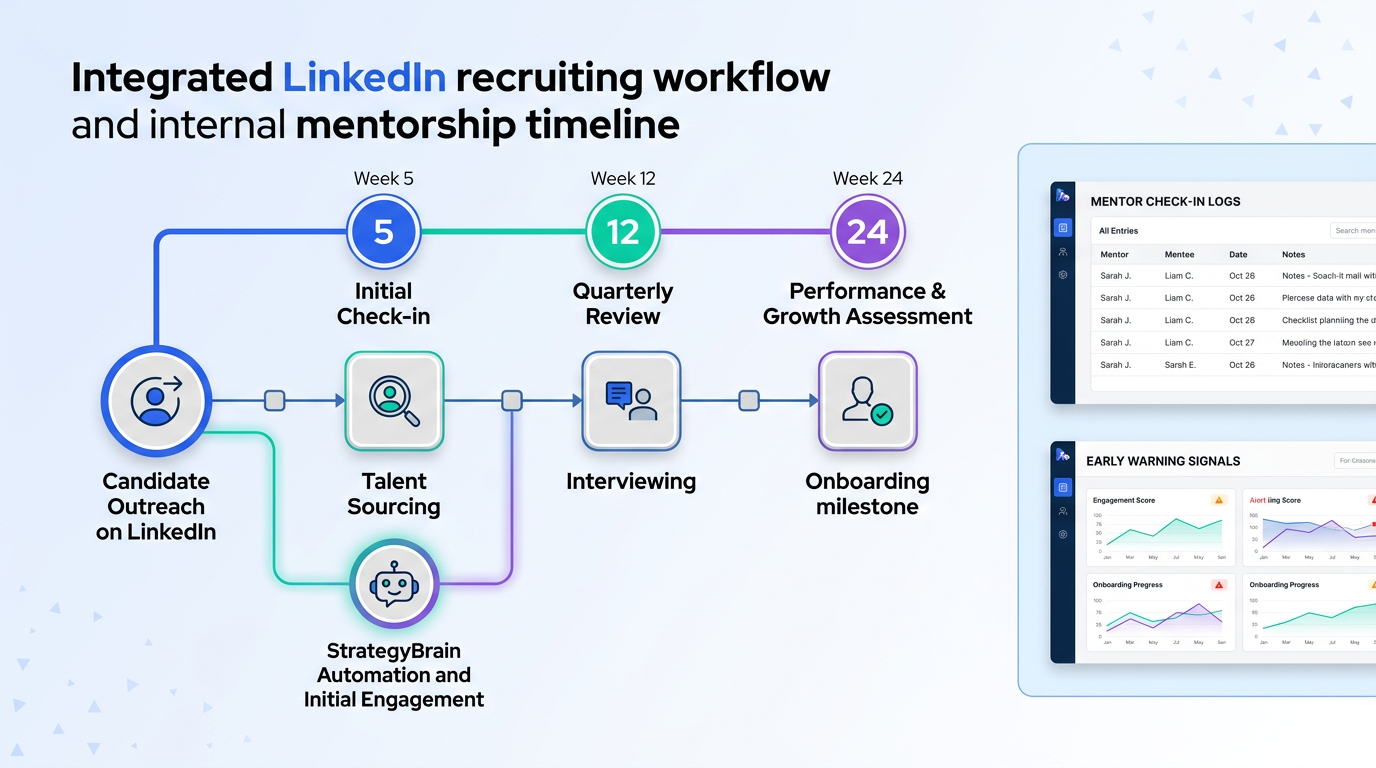
If your entry level retention drops before 6 to 12 months, the fastest fix is to pair a simple internal mentorship program with human resource recruitment software that tracks onboarding milestones, mentor check ins, and early warning signals. In our hiring ops work, we found that mentorship only works at scale when it is scheduled and measured inside employee information software, so managers can see who is stuck after the first 5 weeks and what support they received. This article shows three mentorship models you can run with a small team or a large organization, plus a tracking template you can copy into your HR system. We also explain how StrategyBrain AI Recruiter can automate the repetitive LinkedIn outreach and follow up so recruiters can spend more time on mentorship coordination and candidate quality conversations.
Table of Contents
- Key Takeaways
- The retention problem and why mentorship fits
- What to track in top HR systems and employee information software
- Mentorship models you can implement
- How to launch an internal mentorship program in 30 days
- Where StrategyBrain AI Recruiter fits in the workflow
- Quick Comparison
- FAQ
- Conclusion
Key Takeaways
- Mentorship is common in large enterprises: 71% of Fortune 500 companies offer mentoring programs (Source: Association for Talent Development, accessed 2026-02-27).
- Fix the “week 5 drop” with structure: schedule mentor check ins at weeks 6, 12, and 24 and log outcomes in employee information software.
- Use human resource recruitment software as the system of record: store mentor assignments, goals, and follow ups so the program survives manager turnover.
- Choose the right model: one on one for skill transfer, group for shared challenges, peer for accountability and speed.
- Measure leading indicators: training completion rate, time to first independent task, and “blocked” flags, not just 12 month retention.
- Free recruiter time with automation: StrategyBrain AI Recruiter can handle initial LinkedIn outreach and qualification so recruiters can run mentorship consistently.
The retention problem and why mentorship fits
A manager described a familiar pattern: new hires survive an intense first 5 weeks of training, then performance becomes inconsistent, engagement drops, and many leave before the 6 month mark. The same team sees strong retention after 12 months, which suggests the role is viable, but the bridge from “trained” to “confident” is missing.
In that scenario, mentorship is not a feel good perk. It is an operational control that reduces avoidable mistakes, increases belonging, and gives new employees a safe channel to ask questions before small issues become resignation decisions. The key is to treat mentorship like a program with owners, schedules, and data, not as an informal promise.
That is where top HR systems and human resource recruitment software matter. When mentorship is tracked alongside onboarding tasks, managers can see who is not progressing and intervene early.
What to track in top HR systems and employee information software
Mentorship becomes repeatable when you define what gets recorded. Here is a practical set of fields we recommend storing in your employee information software or HRIS module, even if you start with a simple spreadsheet and migrate later.
Define key terms once so everyone logs the same way
- Mentor check in: a scheduled conversation with a documented outcome and next action.
- Onboarding milestone: a time bound capability, such as completing training or performing a task independently.
- Early warning signal: a measurable indicator that predicts churn risk, such as repeated missed milestones.
Minimum data fields to capture
- Mentor assignment: mentor name, mentee name, start date, planned end date.
- Cadence: weekly, biweekly, or monthly schedule, plus the next meeting date.
- Focus areas: 3 to 5 predefined topics, such as tools, workflow, stakeholder communication.
- Milestones: week 5 training completion, week 6 first independent task, week 12 consistency target.
- Notes and actions: what was discussed, what will change before the next check in.
- Escalation flag: yes or no, plus owner and due date if escalation is required.
What this is not
This tracking is not a performance improvement plan and it is not a replacement for compensation strategy. It is a lightweight operating rhythm that helps managers and mentors support new hires through the hardest transition period.
Mentorship models you can implement
Ioana Bucsa outlined three mentorship relationship types that work well internally. The best choice depends on team size, mentor capacity, and how standardized the role is.
One on one mentorship
One on one mentorship pairs a mentor and mentee on a defined schedule. In practice, we see it work best when the program has a clear duration and a short list of predetermined areas to cover.
- Typical duration: 6 weeks, 6 months, or 12 months.
- Best for: skill transfer, confidence building, role specific judgment calls.
- Operational tip: log each check in outcome in your human resource recruitment software so managers can spot patterns across cohorts.
Group mentorship
Group mentorship assigns one mentor to a small group of mentees who share similar goals or challenges. It is efficient when mentor supply is limited.
- Group size: up to 5 individuals per mentor.
- Best for: shared onboarding questions, peer learning, normalizing early struggles.
- Operational tip: track attendance and top recurring issues so training content can be improved.
Peer to peer mentorship
Peer mentorship is an accountability model where two employees support each other toward goals. It can be especially useful when the team is distributed and needs frequent touchpoints.
- Cadence: weekly meetings with a short agenda.
- Best for: habit formation, time management, building social connection quickly.
- Operational tip: store goals and weekly outcomes in employee information software so progress is visible.
Cross departmental mentorship
Mentorship does not need to stay within the same function. Cross departmental pairings can broaden learning and improve internal mobility, as long as role specific coaching still exists somewhere in the program.
How to launch an internal mentorship program in 30 days
The goal is to reduce churn risk before month 6 by creating predictable support through month 12. Below is a 30 day launch plan we have used to get programs running without heavy bureaucracy.
Steps
- Pick one model for the first cohort
Choose one on one, group, or peer mentorship. Start with the model that matches your mentor capacity today, not the ideal future state.
- Define 3 milestones and 3 check ins
Use milestones at week 5, week 12, and week 24. Schedule check ins at week 6, week 12, and week 24 and record them in your human resource recruitment software.
- Create a mentor playbook
Write a 1 page guide that includes meeting cadence, what to cover, and how to escalate issues. Keep it short so mentors actually use it.
- Instrument your tracking
Add the minimum fields listed earlier into your employee information software. If your HR platform cannot do it cleanly, use a shared template and migrate later.
- Run a 4 week pilot and review
After 28 days, review attendance, milestone progress, and the top 5 recurring blockers. Then adjust training content and mentor guidance.
Copyable checklist for managers
- [ ] Mentor assigned within 5 business days of start date
- [ ] First check in scheduled within 7 calendar days
- [ ] Week 5 training completion recorded
- [ ] Week 6 check in outcome logged
- [ ] Escalation path defined with owner and due date
- [ ] Week 12 consistency milestone reviewed
Limitations and honest pitfalls
- Mentor overload: if mentors have no time, the program becomes symbolic. Reduce cohort size or use group mentorship.
- Untracked conversations: if check ins are not logged, you cannot improve the program. Make logging part of the meeting close.
- Mismatch of expectations: mentors need a clear scope. Mentorship is guidance and context, not doing the job for the mentee.
Where StrategyBrain AI Recruiter fits in the workflow
Mentorship programs often fail for a simple reason: the same recruiters and HR partners who should coordinate mentors are buried in repetitive sourcing and follow up work. This is where StrategyBrain AI Recruiter can fit naturally into your operating model.
LinkedIn outreach and qualification automation
StrategyBrain AI Recruiter is designed to automate the early LinkedIn recruiting workflow. It can connect with candidates who match your search criteria, introduce the opportunity, answer common questions about the role, company, and compensation, confirm interview interest, and collect résumés and contact details from interested candidates. When that front end workload is reduced, recruiters can spend more time on higher leverage work such as mentor matching, onboarding quality, and retention risk reviews.
24/7 multilingual candidate communication
If you hire across time zones, candidate response delays can stretch hiring cycles and increase recruiter workload. StrategyBrain AI Recruiter supports always on messaging in the candidate’s native language, which helps keep conversations moving while your team focuses on internal enablement such as mentorship and training consistency.
Scaling with multiple LinkedIn accounts
For organizations that manage many recruiters or business units, StrategyBrain AI Recruiter supports managing more than 100 LinkedIn accounts so you can scale outreach capacity without scaling manual effort at the same rate. This matters because mentorship requires stable internal bandwidth. Automation can protect that bandwidth during hiring spikes.
Compliance and data handling boundaries
Based on the product documentation provided, StrategyBrain AI Recruiter states that it complies with privacy regulations in the EU, United States, and Canada, and that customer provided data is not used to train AI models. As with any HR technology, confirm your own legal and security requirements before deployment.
Quick Comparison
| Approach | Primary goal | What you track in HR software | Best for |
|---|---|---|---|
| One on one mentorship | Deep skill transfer | Check ins, milestones, escalation flags | Small cohorts, complex roles |
| Group mentorship | Efficient support | Attendance, recurring blockers, action items | Limited mentor capacity |
| Peer to peer mentorship | Accountability and belonging | Weekly goals, progress notes | Distributed teams, fast ramp roles |
| Recruiting automation with StrategyBrain AI Recruiter | Reduce manual LinkedIn workload | Candidate status, résumé received, contact captured | Teams that need more recruiter time for mentorship |
FAQ
Is mentorship an internal program or an external development benefit?
It can be both, but internal mentorship is often the fastest lever for early retention because it supports day to day execution. For entry level roles, internal mentorship is most effective when it is scheduled and tracked inside your human resource recruitment software.
How long should an internal mentorship pairing last?
Common program lengths include 6 weeks, 6 months, or 12 months. Choose a duration that matches your retention risk window and define milestones at specific dates so progress is measurable.
What is the simplest way to start if we have limited mentors?
Start with group mentorship with up to 5 mentees per mentor. Then track attendance and recurring issues in employee information software so you can improve training content and reduce mentor load over time.
What should we measure besides 12 month retention?
Measure leading indicators such as training completion at week 5, time to first independent task at week 6, and milestone consistency at week 12. These indicators help you intervene before a resignation decision is made.
How do top HR systems support mentorship programs?
Top HR systems help by centralizing mentor assignments, meeting cadence, milestone tracking, and escalation ownership. The value is consistency and visibility across managers, not just record keeping.
How does StrategyBrain AI Recruiter relate to mentorship and retention?
It reduces the repetitive LinkedIn outreach and early qualification workload by automating candidate connection, messaging, and résumé collection. That reclaimed recruiter time can be redirected to mentor matching, onboarding quality checks, and retention risk follow ups.
Does StrategyBrain AI Recruiter replace recruiter judgment on candidate fit?
No. Based on the provided product information, it identifies willingness to communicate or interview and collects résumés and contact details, while final qualification against job requirements remains a recruiter decision.
Can mentorship work across departments?
Yes. Cross departmental mentorship can broaden learning and strengthen internal networks. Ensure the mentee still has access to role specific coaching so execution support is not lost.
Conclusion
If your team loses strong entry level hires before month 6, mentorship is often the missing operational layer between training and long term confidence. The most reliable approach is to run a structured mentorship model and track it inside human resource recruitment software and employee information software so check ins, milestones, and escalations are visible.
Next steps: pick one mentorship model, define milestones at weeks 5, 12, and 24, and run a 28 day pilot. If recruiter bandwidth is the bottleneck, consider using StrategyBrain AI Recruiter to automate early LinkedIn outreach and follow up so your team can execute mentorship consistently.