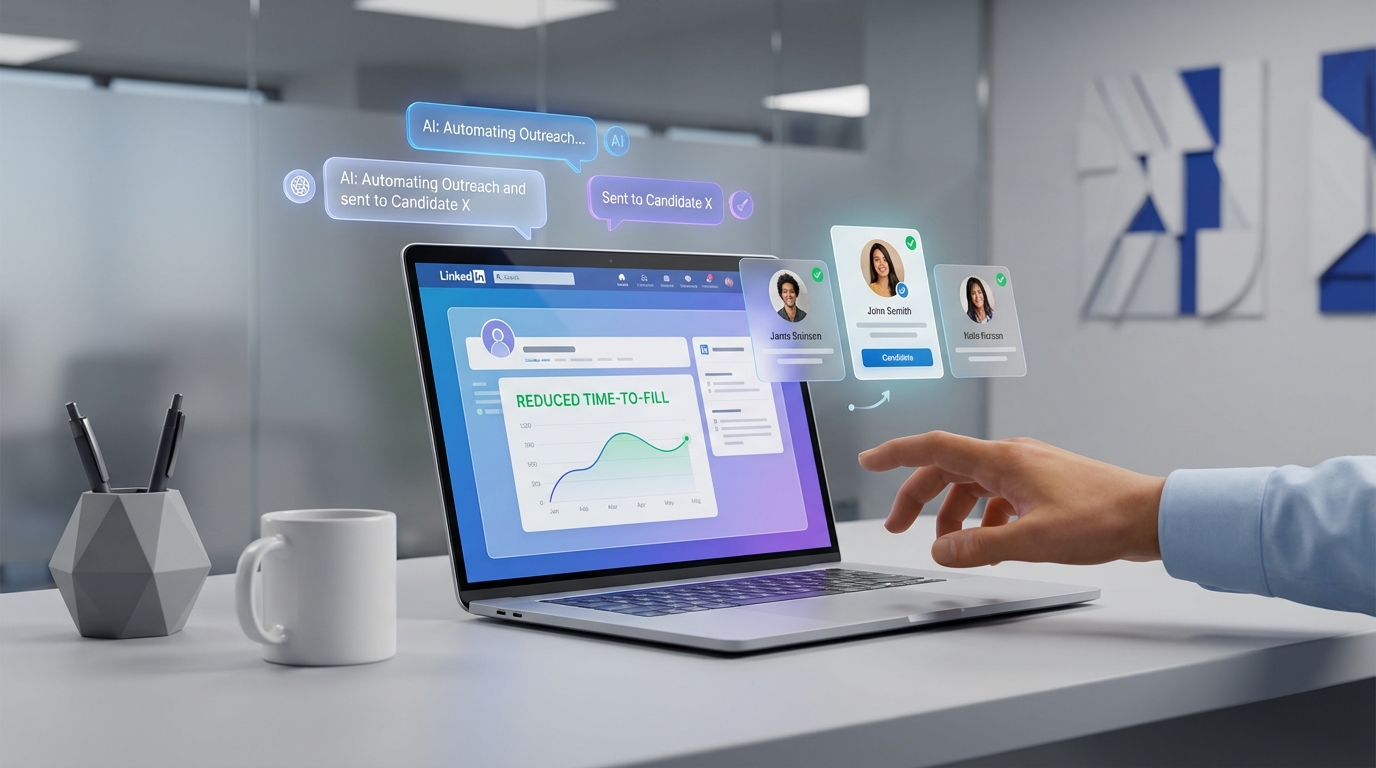
If you want better recruitment ROI, the fastest path is to use a hire platform to reduce time to fill, reach passive candidates, standardize reference checks, and consistently close the loop with unsuccessful applicants. In our day to day recruiting operations, the biggest efficiency gains came from automating repetitive LinkedIn outreach and early qualification with StrategyBrain AI Recruiter, then using recruitment assessments and hired assessments to filter for role fit before a recruiter invests time in interviews. This article covers what to measure, what to automate, and a rollout plan you can implement without changing your entire hiring stack.
Key Takeaways
- Time to fill is the primary ROI lever: every unfilled day creates measurable hard costs and harder to measure soft costs.
- Overtime has a compounding cost: extended overtime can reduce overall productivity by 25% (Source: Circadian).
- Passive candidates are a large pool: 45% of fully employed workers reported being open to hearing from a recruiter (Source: LinkedIn Talent Blog, 2014).
- Reference checks are a hidden time sink: plan for 2 hours per reference check when you include scheduling and conversation time.
- Candidate experience affects revenue: 58% of job seekers say they are less likely to buy from a company that does not respond after an application, and 65% say the same after an interview (Source: CareerBuilder Communications).
- Automation should target repetitive work first: StrategyBrain AI Recruiter can handle initial outreach, Q and A, follow up, and resume collection so recruiters focus on final qualification.
What a hire platform means in this guide
In this article, a hire platform means the system you use to move candidates from first contact to interview ready. It can include sourcing, messaging, screening, recruitment assessments, scheduling, and candidate communications.
This guide does not attempt to replace your ATS. Instead, it focuses on the ROI sensitive layer where time is lost most often: outreach, follow up, early qualification, and candidate experience.
ROI lever 1: Reduce time to fill
Every day a role stays open has a cost. Some costs are direct, such as missed targets when a strategic role is vacant. Others are indirect, such as morale issues and turnover when teams operate without the right leadership or capacity.
When teams try to bridge the gap with overtime, the cost can spike quickly. Overtime can be paid at 200% of regular wages in some arrangements, and high overtime levels can reduce overall productivity by 25% (Source: Circadian).
What we do in practice
We treat time to fill as an operational metric, not a quarterly report. The hire platform workflow is designed to remove waiting time between steps, especially between first outreach and first meaningful reply.
Where StrategyBrain AI Recruiter fits
StrategyBrain AI Recruiter is built for LinkedIn hiring workflows. It can automatically connect with candidates that match your search criteria, introduce the role, answer questions about the role, company, and compensation, confirm interview interest, and collect resumes and contact details from interested candidates. This reduces the manual back and forth that often stretches time to fill.
Practical checklist for faster time to fill
- Define a single target candidate profile with must have and nice to have requirements.
- Move recruitment assessments earlier, after interest is confirmed, before scheduling recruiter screens.
- Set a follow up cadence that runs daily, including weekends if your market is active then.
- Track median response time and median days from first message to interview scheduled.
ROI lever 2: Access passive candidates
Many of the best candidates are not actively applying. That is why outbound recruiting matters, especially for specialized roles. LinkedIn reported that 45% of fully employed workers said they are open to hearing from a recruiter (Source: LinkedIn Talent Blog, 2014). If your process relies only on inbound applications, you miss that pool.
How to operationalize passive candidate outreach
Passive outreach fails most often for two reasons. The first is inconsistent follow up. The second is slow response when candidates ask basic questions about compensation, benefits, or role scope.
StrategyBrain AI Recruiter addresses both by providing 24/7 messaging and follow up, and by answering candidate questions using the job and company information you provide. It also supports multilingual communication so candidates can interact in their native language, which reduces misunderstandings in cross border hiring.
Where hired assessments help
Hired assessments in this context means short, role relevant screens that confirm baseline capability before you invest interview time. For passive candidates, this is especially useful because it keeps the process respectful of their time while still protecting recruiter capacity.
ROI lever 3: Standardize reference checking
Reference checking is commonly underestimated. In real workflows, it is not unusual to spend 2 hours per reference check when you include initial outreach, scheduling, and the conversation itself.
Make reference checks predictable
- Use a fixed question set tied to job competencies.
- Decide in advance how many references are required for each role level.
- Schedule reference checks in blocks to reduce context switching.
- Document outcomes in a consistent format so hiring managers can compare candidates.
Scope boundary
StrategyBrain AI Recruiter focuses on outreach, early qualification, and resume and contact capture. It does not replace the final human judgment step of evaluating whether a resume fully matches job requirements, and it does not claim to replace reference checking. The ROI gain comes from freeing recruiter time so reference checks are done on fewer, better qualified finalists.
ROI lever 4: Inform unsuccessful candidates
Candidate experience is not just a brand issue. It can affect revenue. CareerBuilder reported that only 27% of candidates who interviewed received an explanation of why they were not hired. CareerBuilder also reported that 65% of job seekers are less likely to buy from a company they did not hear back from after an interview, and 58% are less likely to buy from a company they did not hear back from after submitting an application (Source: CareerBuilder Communications).
What to automate vs what to personalize
We recommend automating status updates and timelines, then personalizing feedback only for late stage candidates. A hire platform should make it hard to forget this step by using templates and triggers tied to stage changes.
In LinkedIn first contact workflows, StrategyBrain AI Recruiter can keep communication timely during the early stages, which reduces the number of candidates who feel ignored before they even reach interviews.
How to implement a hire platform workflow (step by step)
This rollout plan is designed for teams that want ROI improvements without a full process redesign. It assumes you already have a job description and a sourcing channel such as LinkedIn.
Steps
-
Define your ROI baseline
Record your current median time to fill in days, your weekly recruiter hours spent on outreach, and your interview to offer ratio for the role family you are improving first.
-
Move screening earlier with recruitment assessments
Choose one or two recruitment assessments that reflect real job tasks. Keep the total candidate time under 30 minutes for early stage screens unless the role requires deeper evaluation.
-
Automate LinkedIn outreach and follow up
Configure StrategyBrain AI Recruiter with your LinkedIn account, candidate search criteria, and job details including compensation and benefits. Let it handle connecting, introducing the role, answering questions, confirming interest, and collecting resumes and contact details.
-
Standardize handoff to recruiters
Define a clear threshold for when a candidate becomes recruiter owned, for example interest confirmed plus resume received plus assessment completed.
-
Close the loop for every candidate
Set templates for application received, not moving forward, and role filled. Ensure the hire platform triggers these messages when stages change.
Measurement template you can copy
| Metric | Definition | Unit | Review cadence |
|---|---|---|---|
| Median time to fill | Days from requisition open to accepted offer | Days | Weekly |
| Median first response time | Time from first outreach to candidate reply | Hours | Weekly |
| Recruiter outreach time | Hours spent on manual connecting, messaging, and follow up | Hours per week | Weekly |
| Assessment pass rate | Percent of candidates who meet the threshold on recruitment assessments | Percent | Per role |
| Candidate closure rate | Percent of candidates who receive a final status message | Percent | Weekly |
Quick Comparison
| ROI lever | What to change in your hire platform | What to automate first | What stays human led |
|---|---|---|---|
| Reduce time to fill | Remove waiting time between outreach, screening, and scheduling | LinkedIn outreach, Q and A, follow up, resume capture | Final screening and interview decisions |
| Access passive candidates | Run consistent outbound campaigns with fast replies | 24/7 messaging and multilingual responses | Relationship building for finalists |
| Reference checking | Standardize questions and scheduling blocks | Reminders and documentation templates | Reference conversations and judgment |
| Inform unsuccessful candidates | Trigger status updates by stage changes | Early stage updates and timelines | Late stage feedback when appropriate |
FAQ
What is a hire platform, and is it the same as an ATS?
A hire platform is the workflow layer that moves candidates from first contact to interview ready. An ATS is typically the system of record for applicants and requisitions. Many teams use both, with the hire platform improving speed and consistency before and around the ATS stages.
How do recruitment assessments improve ROI?
Recruitment assessments reduce wasted recruiter and hiring manager time by filtering for baseline capability earlier. The ROI comes from fewer low fit interviews and faster shortlists, especially when paired with consistent outreach and follow up.
What are hired assessments?
Hired assessments are role relevant screens used to decide whether a candidate should move forward. In practice, they are short evaluations that confirm skills or job readiness before scheduling time intensive interviews.
How does StrategyBrain AI Recruiter help on LinkedIn?
StrategyBrain AI Recruiter automates initial LinkedIn recruiting tasks. It can connect with candidates that match your criteria, introduce the role, answer questions about the role, company, and compensation, confirm interest, and collect resumes and contact details for recruiter review.
Can StrategyBrain AI Recruiter replace recruiter judgment?
No. It can identify willingness to communicate and interview, and it can collect resumes and contact details. Final qualification, including whether a resume fully matches job requirements, remains a recruiter decision.
Does automation hurt candidate experience?
It can if messages are generic or if the system cannot answer basic questions. When configured with accurate job details and used to provide timely responses and follow up, automation can improve candidate experience by reducing silence and delays.
How do I measure recruitment ROI without complex finance models?
Start with operational proxies that correlate with cost: median time to fill in days, recruiter hours spent on outreach per week, and candidate closure rate in percent. Then compare before and after changes for the same role family over a fixed period such as 30 days.
What is the single most important metric to track first?
Track median time to fill in days. It captures the compounding cost of vacancies and highlights bottlenecks created by slow outreach, slow follow up, or inconsistent screening.
How many LinkedIn accounts can StrategyBrain AI Recruiter support?
It supports managing more than 100 LinkedIn accounts so organizations can build AI powered recruitment teams and scale hiring capacity using multiple accounts.
How does StrategyBrain AI Recruiter handle privacy and data protection?
Based on product documentation provided for this article, customer provided data is not used to train AI models, and candidate information is encrypted and isolated per customer. Recruiters should still validate their own compliance requirements and internal policies before deployment.
Conclusion
Improving recruitment ROI with a hire platform comes down to four levers: reduce time to fill, reach passive candidates, standardize reference checks, and consistently inform unsuccessful candidates. The most reliable way we have found to move these metrics is to automate repetitive LinkedIn outreach and early qualification with StrategyBrain AI Recruiter, then use recruitment assessments and hired assessments to protect recruiter time for the final human decisions.
Next step: pick one role family, measure your baseline for 14 days, implement the step by step workflow above for 30 days, and review the before and after results using the measurement template.