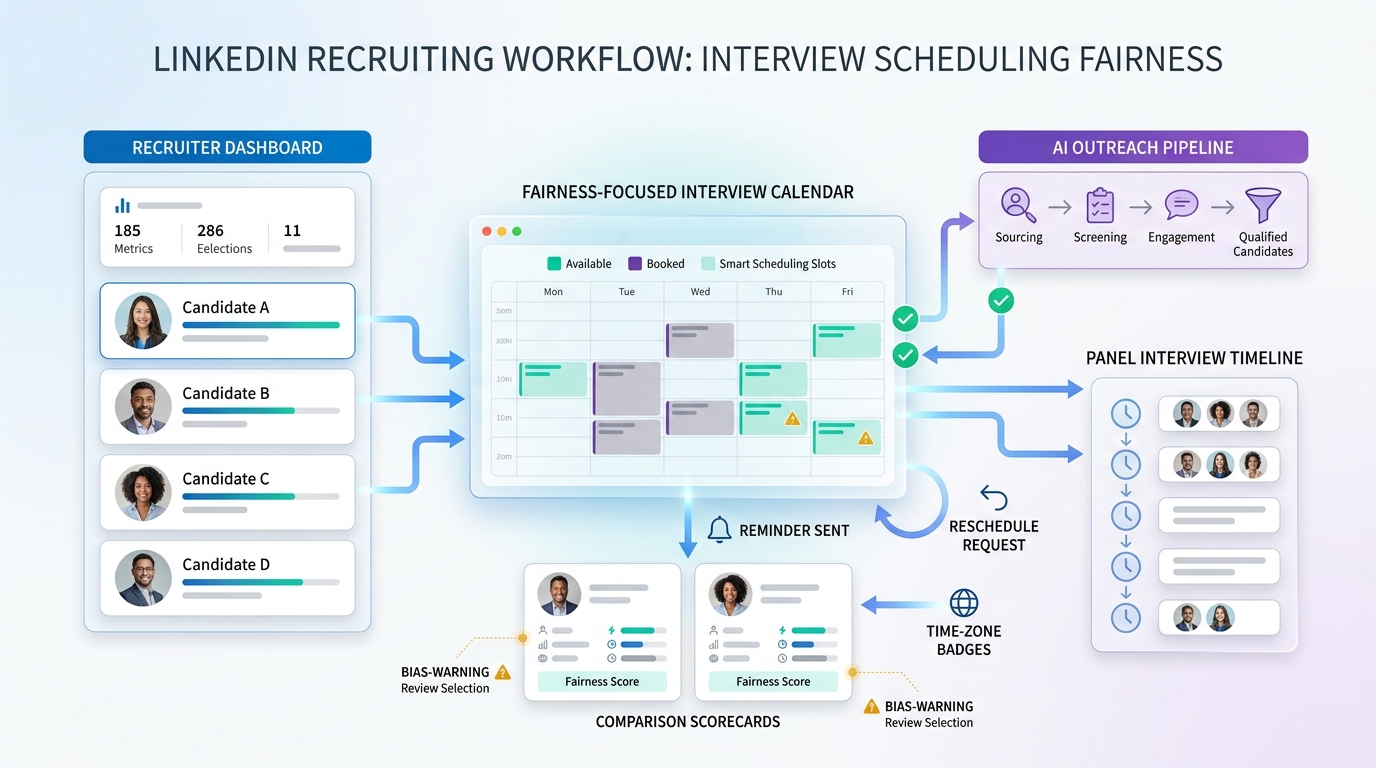
See how hiring teams can evaluate an interview scheduling app to avoid bias-driven delays, protect candidate comparison, and choose tools that keep decisions fair.
That matters because most hiring teams do not lose time only in sourcing or screening. They lose it in the messy middle: chasing calendars, nudging hiring managers, rebuilding panel times after one decline, and letting fast-moving candidates sit too long while internal opinions harden around incomplete impressions. For a solo recruiter, that means missed momentum and weaker client trust. For a small agency owner, it means consultants spending billable hours on admin. For an internal talent lead, it means a slower process that can make the wrong candidate feel easier to hire simply because they were easier to schedule.
In my own workflow, I have found that AI Recruiter is most useful before scheduling even starts. It can keep LinkedIn outreach moving, respond across time zones, and collect resumes and contact details from interested candidates so recruiters are not walking into scheduling with half-built candidate pipelines. That support matters when interview volume rises suddenly. The recruiter still owns final judgment, resume review, and who advances to interview, but the handoff into scheduling becomes cleaner and faster.
A useful reminder came from a 2020 virtual summit session built around a hiring problem many leaders recognize: no one really teaches managers how to hire, yet they still have to compare candidates across a flood of signals while trusting their instincts. The discussion focused on overloaded decision-making, confirmation bias, and lessons learned while scaling a growing company. In practice, that overload rarely begins at the final debrief. It starts earlier, when candidates are moving through screens, managers are trying to fit interviews around other priorities, and each delay changes how the team interprets interest, urgency, and fit.
Picture the actual recruiting motion. A recruiter lines up a screening conversation, checks who replied after hours, updates candidate records, and tries to secure a hiring manager slot before the strongest prospect goes quiet. Then a second interviewer cannot make the original time, a panel round has to be rebuilt, and another candidate who looked merely acceptable is suddenly the one with the cleanest path through the calendar. That is the moment scheduling stops being admin and starts shaping judgment.
If you are comparing top scheduling apps or wondering whether a calendar online free option is enough, that is the real selection question. An interview scheduler is not just a booking page. It is a control point for speed, consistency, and better candidate comparison when the hiring team is already carrying too many inputs at once.
Table of Contents
- Why Scheduling Affects Hiring Judgment
- What an Interview Scheduling App Should Actually Do
- Where General Schedulers Break Down in Recruiting
- Features That Matter Most
- Free vs Paid: When a Calendar Online Free Tool Works
- How Different Teams Should Choose
- How I Use AI Support Before Scheduling
- Implementation Practices That Reduce Friction
- Common Buying Mistakes
- Comparison Checklist
- FAQ
Why Scheduling Affects Hiring Judgment
The webinar theme behind the reference case was simple but important: hiring decisions often feel rational even when they are shaped by bias, overload, and incomplete comparison. Recruiting teams usually discuss those risks in scorecards and interview feedback, but they show up much earlier in the process.
When scheduling is slow or inconsistent, candidates are no longer being evaluated on the same footing. One person gets seen quickly, while another waits through multiple reschedules. One hiring manager enters the conversation with fresh context, while another joins after momentum has faded. The result is not just inconvenience. It is distorted decision quality.
That is why an interview scheduling app deserves more attention than it often gets. Good scheduling keeps candidate comparison fairer, helps teams move on real evidence instead of convenience, and reduces the chance that process friction quietly decides who looks strongest.
Key insight: In recruiting, calendar friction does not only slow hiring. It changes who gets seen, when they get seen, and how confidently teams compare them.
What an Interview Scheduling App Should Actually Do
At a basic level, an interview scheduling app automates interview booking between candidates and internal stakeholders. But for recruiting teams, that definition is too shallow. A true recruiting scheduler should support the way hiring actually unfolds: multiple interviewers, stage-based interviews, time zones, reminders, protected availability, and rescheduling without restarting everything from scratch.
For occasional hiring, a simple one-to-one booking page may be enough. For active agency recruiters, in-house talent teams, and hiring managers running several openings at once, scheduling becomes workflow infrastructure. The app needs to support movement between stages, not just meeting invitations.
That is also why many teams review scheduling alongside their broader recruiting systems. A scheduler does not replace sourcing, screening, or an applicant tracking platform, but it works best when it supports those steps instead of creating a separate admin layer.
Where General Schedulers Break Down in Recruiting
Teams often start by reviewing top scheduling apps built for sales calls, client meetings, or general appointments. That makes sense at first because the interfaces are familiar and setup is usually quick. The problem is that recruiting is not a standard appointment workflow.
In most real hiring processes, recruiters need to coordinate:
- Candidate availability and recruiter availability at the same time
- Hiring manager schedules that change weekly
- Panel or sequential interviews
- Time-zone conversion for distributed teams
- Rescheduling without restarting the whole chain
- Clear reminders and confirmations for all participants
Generic schedulers tend to work best when one host offers time and one guest selects it. Recruiting often requires layered approvals, interviewer substitutions, and stage progression. That is where broad booking tools start to feel thin.
The practical test is simple. If your recruiters are still manually checking multiple calendars for most interviews, chasing interviewer replies in chat, or rebuilding slots after every small change, you are not using scheduling automation in a meaningful way.
Features That Matter Most
The best interview scheduling app is not the one with the longest feature sheet. It is the one that removes the highest-friction moments from your hiring workflow.
1. Candidate self-scheduling with recruiter control
Self-scheduling is the first feature most teams want, and rightly so. It reduces email ping-pong and speeds up movement between stages. But in recruiting, full automation without recruiter guardrails can create its own issues. The better setup gives candidates flexibility while letting recruiters define stage-specific rules, buffers, and interviewer pools.
2. Multi-calendar coordination
This is where recruiting needs diverge sharply from general meeting software. If the system cannot handle more than one interviewer cleanly, recruiters will end up acting as the real scheduling engine. For panel interviews, this becomes the difference between automation and cosmetic convenience.
3. Rescheduling that preserves momentum
Every experienced recruiter knows that reschedules happen. The question is whether the tool makes recovery easy. A strong scheduler lets candidates and interviewers move appointments without forcing the recruiter to reconstruct the process from zero. That helps preserve candidate engagement and reduces drop-off after delays.
4. Time-zone accuracy
Time-zone mistakes are one of the easiest ways to create candidate frustration and internal embarrassment. If your hiring includes remote, cross-border, or after-hours communication, reliable time handling is a baseline requirement, not an advanced feature.
5. Multi-stage interview support
The reference case centered on overloaded decision-making. That makes stage structure especially important. Screening calls, technical interviews, stakeholder conversations, and final discussions should not all be managed the same way. The right app supports templates or stage logic so the process stays comparable across candidates.
6. Communication automation
Good scheduling tools do more than book time. They confirm the interview, remind the participants, and make next steps obvious. In recruiting, clear communication reduces no-shows and keeps the process from feeling improvised.
Free vs Paid: When a Calendar Online Free Tool Works
A calendar online free tool can absolutely work in some recruiting environments. The mistake is assuming it will keep working as hiring complexity grows.
| Hiring Situation | Free Tool Can Work | Paid Interview Scheduler Is Usually Better |
|---|---|---|
| Occasional screening calls | Yes | Not always needed |
| One recruiter and one interviewer | Sometimes | Helpful as volume grows |
| Panel interviews | Rarely | Yes |
| High-volume recruiting | No | Yes |
| Frequent reschedules | Limited | Yes |
| Stage-based workflows | Usually weak | Yes |
Free tools tend to be enough when:
- You hire only occasionally
- A single recruiter handles simple first-round screens
- You are testing candidate self-scheduling for one stage only
They usually become limiting when:
- Several interviewers need coordinated availability
- Hiring managers want protected scheduling windows
- Reschedules are common
- Candidate communication needs to stay consistent
- Different roles require different interview flows
The key lesson from the opening case applies here too. Once scheduling starts influencing who gets seen first and who gets delayed, you are no longer choosing a cheap admin tool. You are choosing how stable your hiring judgment will be under pressure.
How Different Teams Should Choose
Small search firms and solo recruiters
Small teams usually need speed, low setup effort, and enough automation to keep candidate momentum strong. A lightweight scheduler can work well if interview structures stay simple. The risk is waiting too long to upgrade after volume increases.
Growing in-house talent teams
Once more departments and hiring managers get involved, scheduling complexity climbs fast. These teams should prioritize multi-host coordination, reminders, stage templates, and rescheduling support. Consistency matters because uneven process design makes candidate comparison harder.
High-volume or enterprise teams
Enterprise hiring needs more than a pretty booking page. The right tool should support structured panel coordination, controlled interviewer access, process consistency across teams, and clear communication at scale.
Teams focused on candidate experience
Candidate experience improves when booking is quick, instructions are clear, and rescheduling feels manageable instead of punitive. Candidates rarely praise the scheduler itself, but they remember confusion, silence, and repeated calendar changes.
How I Use AI Support Before Scheduling
Scheduling breaks down fastest when the pipeline entering that stage is disorganized. That is why I treat AI support as upstream recruiting infrastructure rather than a replacement for recruiter judgment. In practice, I use AI Recruiter to keep LinkedIn outreach active, answer candidate questions when recruiters are offline, and gather resumes plus contact details from people who want to continue. That means fewer half-qualified conversations sitting in messages while recruiters scramble to build interview slots.
What I like most is not the promise of removing recruiter work entirely. It is the reduction of avoidable handoff gaps. When candidate interest is captured clearly and details are already collected, the transition into a scheduling workflow is smoother. For international searches or after-hours replies, the multilingual and round-the-clock messaging support is especially useful because promising candidates do not have to wait for the next business day just to confirm basic interest. Recruiters still decide who is genuinely qualified, who should be shortlisted, and when the interview process should begin.
If your workflow depends heavily on LinkedIn sourcing, the practical combination is straightforward: use AI Recruiter to reduce outreach and response lag, then use your chosen interview scheduling app to handle structured interview coordination. That pairing is especially helpful when small recruiting teams need to protect recruiter time without letting candidate momentum fade.
Implementation Practices That Reduce Friction
Even the best software will disappoint if the workflow behind it is unclear. These implementation habits matter more than most teams expect:
- Map stages before setting rules. Decide which interviews can be self-scheduled and which require manual review.
- Separate simple and complex interviews. Intro calls should not use the same setup as panel rounds.
- Define interviewer ownership. Be clear about who controls availability, buffers, and reschedule decisions.
- Standardize candidate messaging. Confirmations, reminders, and instructions should be consistent across roles.
- Watch where decision quality slips. If strong candidates wait longest because they require more coordination, your process is introducing avoidable bias.
- Test one easy stage and one complex stage. This reveals real fit faster than a polished demo.
These steps directly address the opening issue from the summit discussion: overloaded hiring decisions. Better scheduling does not eliminate cognitive bias, but it reduces one major source of inconsistency before the interview feedback stage even begins.
Common Buying Mistakes
- Treating scheduling as a minor utility. In reality, it shapes process speed and candidate comparison.
- Buying for feature count instead of workflow fit. A long checklist does not help if panel scheduling still needs manual rebuilding.
- Ignoring interviewer adoption. If hiring managers dislike the system, recruiters will end up doing the work manually anyway.
- Assuming free tools scale indefinitely. A calendar online free setup may work for one stage and fail at the next.
- Separating sourcing reality from scheduling design. If candidate responses come in across time zones and after hours, your interview process needs to account for that pace.
Comparison Checklist
When reviewing top scheduling apps, use a recruiting-specific lens:
- Can candidates self-schedule without creating chaos?
- Can the tool coordinate multiple interviewers reliably?
- Does it handle time zones clearly?
- Is rescheduling easy for both candidates and recruiters?
- Can it support panel and multi-stage interviews?
- Does it keep candidate communication consistent?
- Will your current volume outgrow a free version quickly?
- Does it help your team compare candidates more fairly and faster?
That last question is the one most teams skip. It is also the one that matters most.
FAQ
What is an interview scheduling app?
An interview scheduling app automates booking between candidates and hiring teams. Better tools also handle reminders, reschedules, time zones, and multi-interviewer coordination.
Can a free online calendar work for recruiting?
Yes, a calendar online free tool can work for basic screening calls or low-volume hiring. It usually becomes limiting once panel interviews, heavy rescheduling, or multi-stage workflows are involved.
How is interview scheduling different from general appointment booking?
Recruiting usually requires multiple stakeholders, stage progression, candidate communication, and process consistency. General booking tools are often built for simpler one-host workflows.
Why do recruiters need specialized scheduling support?
Because scheduling affects more than convenience. It influences speed-to-interview, candidate experience, interviewer workload, and the fairness of candidate comparison.
Where does AI Recruiter fit into this process?
AI Recruiter fits best before scheduling begins. It can help with LinkedIn outreach, candidate conversations, multilingual replies, and collecting resumes or contact details from interested candidates. Recruiters still make the final qualification and interview decisions.
When should a team move beyond a simple scheduler?
If recruiters are manually coordinating several calendars, rebuilding interviews after changes, or struggling to keep candidates engaged through delays, the team has likely outgrown a basic booking tool.
Conclusion
The best interview scheduling app does not just reduce email traffic. It protects hiring momentum, improves candidate comparison, and limits the kind of overloaded decision-making that lets the wrong hire feel deceptively right.
If you are evaluating top scheduling apps, start with your real workflow, not a generic feature grid. And if a calendar online free setup still seems sufficient, make sure it is not only cheap, but stable enough to support fair, timely, and disciplined hiring decisions.