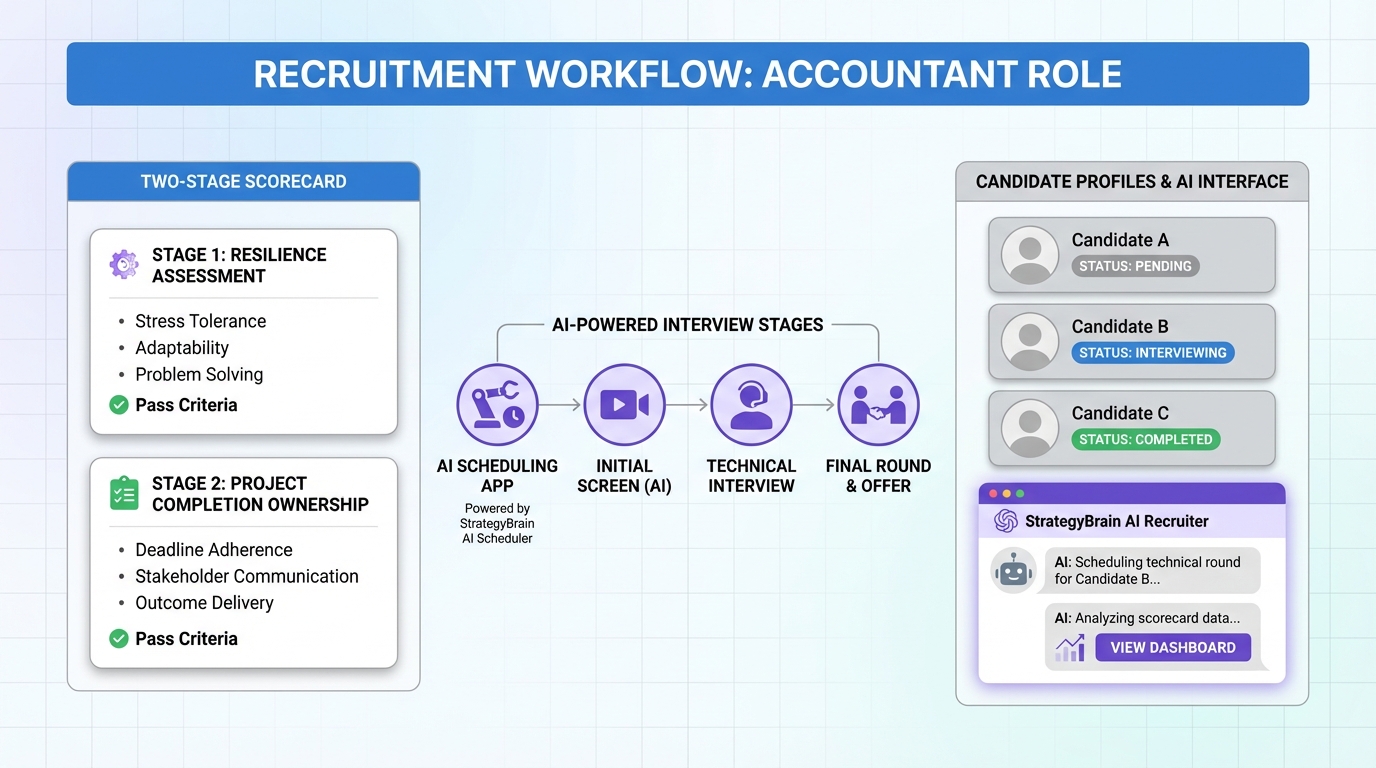
The most reliable way to identify the hardest working accountants is to run a consistent interview process that makes candidates comparable. In our hiring projects, the simplest approach is a two part scorecard focused on resilience and project completion ownership, then using an interview scheduling app to keep the process moving without back and forth. This article shows the exact questions we use, what strong evidence sounds like, and how to combine scheduling discipline with StrategyBrain AI Recruiter so your calendar fills with candidates who have already shown real interest and shared the basics you need to proceed.
Key Takeaways
- Two signals predict “hard working” best in interviews: resilience after failure and individual ownership in project completion.
- Use a scorecard so every interviewer evaluates the same evidence, not “vibes”.
- An interview scheduling app reduces drop off by shortening time from interest to booked slot and keeping reminders consistent.
- StrategyBrain AI Recruiter can pre qualify on LinkedIn by introducing the role, answering questions, confirming interview interest, and collecting resumes and contact details.
- 24/7 multilingual messaging helps global hiring by responding in the candidate’s native language and following up across time zones.
- Be honest about limits: AI Recruiter confirms willingness to interview, but final fit still requires a recruiter review of the resume.
Why “hard working” is hard to measure
“Hard working” is a high praise label, but it is not a measurable competency by itself. In interviews, it often gets confused with long hours, fast talking, or confidence. A better approach is to translate “hard working” into observable behaviors that show up in real work stories.
From the source material, two behaviors consistently separate candidates who push through complexity from those who stall: resilience when something goes wrong and project completion where the candidate can explain their personal contribution to a successful outcome.
Signal 1: Resilience
Resilience means the candidate can recover from a mistake or setback, take ownership, and move to a solution without blaming others. In accounting and finance roles, this often shows up in month end pressure, audit findings, system migrations, or stakeholder conflict.
Interview question set (resilience)
- Failure story: “Tell me about a time you failed at work. What happened, and what did you do next?”
- Ownership probe: “What part of that outcome was within your control?”
- Recovery actions: “What specific steps did you take to fix it, and what did you change afterward?”
- Learning check: “What would you do differently if the same situation happened again?”
What strong evidence sounds like
- Clear accountability: they name their mistake without hedging.
- Solutions focus: they describe actions, not intentions.
- Process improvement: they changed a control, checklist, review step, or communication pattern.
Red flags to note
- Blame shifting: the story is mostly about other people being wrong.
- No corrective action: they cannot name what they changed after the failure.
- Vague outcomes: no concrete result, no timeline, no stakeholders.
Signal 2: Project completion ownership
Project completion ownership means the candidate can explain how they personally delivered on expectations inside a team project. The source material highlights a key nuance: you want someone who respects the team, but can still articulate their individual contribution.
Interview question set (project completion)
- Project walkthrough: “Pick one project you are proud of. What was the goal, and what was your role?”
- Deliverables: “What did you personally produce or decide?”
- Constraints: “What was the hardest constraint, and how did you work around it?”
- Partnerships: “Who did you need to influence, and how did you keep the relationship productive?”
- Outcome: “How did you know it was successful, and what changed for the business?”
What strong evidence sounds like
- Role clarity: they can separate their work from the team’s work.
- Execution detail: they describe steps, reviews, and handoffs.
- Business impact: they connect the project to accuracy, timeliness, risk reduction, or stakeholder trust.
Copyable scorecard template
This is the practical tool we recommend using in every interview loop. It keeps the panel aligned and makes debriefs faster.
Interview Scorecard (Resilience + Project Completion)
- Resilience (1 to 5)
- Ownership of failure: 1 2 3 4 5
- Solution steps described: 1 2 3 4 5
- Learning and prevention: 1 2 3 4 5
- Project completion ownership (1 to 5)
- Role clarity and deliverables: 1 2 3 4 5
- Execution detail and follow through: 1 2 3 4 5
- Stakeholder management: 1 2 3 4 5
- Evidence notes
- Failure story summary:
- Project story summary:
- Risks or concerns:
- Hire recommendation: Yes or No or Hold
Workflow: using an interview scheduling app to keep momentum
Even a great scorecard fails if candidates drop out due to slow coordination. An interview scheduling app helps you standardize availability, reduce email ping pong, and keep reminders consistent. If you come from healthcare operations, think of it like a patient scheduling program that protects throughput. If you manage multiple hiring managers, it also functions like an appointments book that prevents double booking and missed handoffs.
Step by step scheduling workflow
-
Define the interview stages
Example: recruiter screen, hiring manager interview, panel, final. Keep each stage’s goal tied to the scorecard so you do not add meetings that do not produce evidence.
-
Set time boxes per stage
Use consistent durations for comparability. For example, 30 minutes for the resilience and project completion screen, then 45 to 60 minutes for deeper technical validation.
-
Publish structured availability
Offer a small set of high confidence slots rather than unlimited options. This reduces reschedules and keeps your funnel moving.
-
Automate confirmations and reminders
Send confirmation details immediately and reminders at consistent intervals. This is where scheduling tools outperform manual coordination.
-
Close the loop within 24 hours
Debrief quickly while evidence is fresh. If you need another interview, schedule it before the candidate disengages.
Common scheduling failure modes and fixes
- Problem: candidates say yes, then disappear. Fix: shorten time to first booked slot and use consistent reminders.
- Problem: hiring managers delay feedback. Fix: require scorecard submission before debrief attendance.
- Problem: too many interviews that repeat the same questions. Fix: assign each stage a single evidence goal and remove redundant meetings.
Where StrategyBrain AI Recruiter fits in the workflow
Scheduling efficiency improves when fewer unqualified or uninterested candidates reach your calendar. This is where StrategyBrain AI Recruiter can reduce the load before you ever open your interview scheduling app.
What we use it for in practice
- Automated LinkedIn outreach and follow up: it connects with candidates that match your search criteria and introduces the opportunity.
- Pre qualification for interview intent: it confirms whether the candidate is interested in interviewing and collects resumes and contact details from interested candidates.
- Always on communication: it responds 24/7 and can communicate in the candidate’s native language, which helps when you recruit across time zones.
Important limitation to keep your process honest
AI Recruiter can confirm willingness to proceed and gather the information needed to move forward, but it does not replace the recruiter’s final qualification step. You still need to review the resume and validate role fit during interviews using the resilience and project completion scorecard.
Quick Comparison
| Approach | Primary goal | What it improves | Best for |
|---|---|---|---|
| Scorecard based interview | Comparable evidence | Decision quality | Any accounting role where “hard working” must be proven |
| Interview scheduling app | Faster booking | Time to interview, fewer no shows | Teams coordinating multiple interviewers |
| StrategyBrain AI Recruiter | Automated outreach and intent confirmation | Recruiter time, candidate responsiveness | LinkedIn heavy sourcing and global hiring |
FAQ
What should I look for in an interview scheduling app for recruiting?
Look for fast booking, reliable reminders, and support for multiple interviewers. The goal is to reduce coordination time so you can spend more time evaluating evidence from the interview scorecard.
How do I test resilience without turning the interview negative?
Ask for a real failure story, then focus on ownership and recovery actions. Strong candidates usually appreciate the chance to show how they learn and improve.
What if a candidate cannot name a failure?
Treat it as a risk signal. You can reframe the question to “a time something did not go as planned,” but you still want a concrete example and a clear corrective action.
How do I evaluate project completion when the candidate emphasizes the team?
Ask for personal deliverables and decisions. A strong answer credits the team while still explaining what the candidate owned and how they ensured completion.
Can StrategyBrain AI Recruiter replace recruiter screening calls?
It can replace much of the repetitive early outreach and intent confirmation by introducing the role, answering questions, and collecting resumes and contact details. Final fit and hiring decisions still require human review and structured interviews.
Does AI Recruiter work only in English?
No. It supports multilingual communication and can respond in the candidate’s native language, which helps reduce delays and misunderstandings in global hiring.
How many LinkedIn accounts can AI Recruiter manage?
It supports managing more than 100 LinkedIn accounts for organizations that want to build AI powered recruiting teams and scale outreach capacity.
How should I connect AI outreach to my scheduling process?
Use AI Recruiter to confirm interest and collect the resume first, then send qualified candidates directly into your interview scheduling app flow. This keeps your appointments book focused on candidates who are ready to proceed.
Conclusion
To identify the hardest working accountants, you do not need more interview rounds. You need better evidence. Focus on resilience and project completion ownership, capture it with a consistent scorecard, and keep momentum with an interview scheduling app so strong candidates do not slip away. If LinkedIn sourcing is a major channel for you, StrategyBrain AI Recruiter can automate early outreach, answer candidate questions, confirm interview intent, and collect resumes and contact details so your interview calendar is reserved for candidates who are ready to move forward. Next step: copy the scorecard above, assign it to every interviewer, and tighten your scheduling workflow to close feedback within 24 hours.