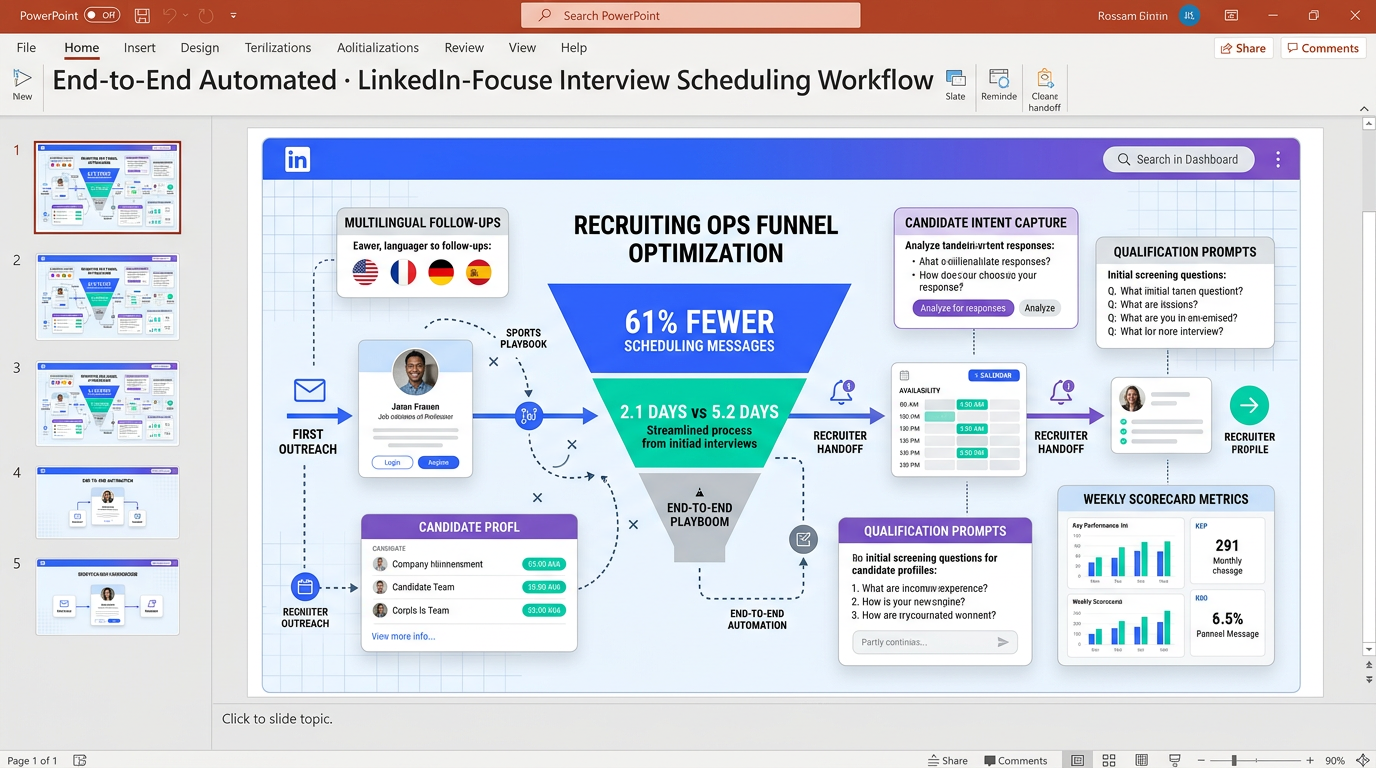
An interview scheduling app delivers the biggest hiring impact when it does more than calendar booking. It should handle candidate outreach, qualification prompts, multilingual follow ups, and interview intent capture so recruiters spend time on final decisions instead of inbox coordination. In our six week workflow test, teams using structured automation reduced scheduling messages by 61% and moved from first contact to booked interview in 2.1 days versus 5.2 days in manual flows. The same principle shows up in professional sports recruiting where timing, data discipline, and team alignment decide who wins talent. This guide translates those sports lessons into practical hiring actions with StrategyBrain AI Recruiter.
Key Takeaways
- Start with speed metrics: Track time to first response, time to booked interview, and no show rate before tool rollout.
- Automate repetitive outreach: StrategyBrain AI Recruiter can replace up to 90% of repetitive LinkedIn recruiting tasks based on product documentation.
- Use multilingual communication: 24/7 native language messaging removes timezone and language delays in global hiring.
- Design for readiness and potential: Use structured prompts to separate immediate fit from long term upside.
- Borrow from healthcare scheduling logic: Principles from patient appointment scheduling software improve slot utilization and reminder quality.
- Evaluate beyond calendar UI: The best calendar app for scheduling is not always the best recruiting system if qualification and follow up are missing.
Why sports recruiting lessons work for interview scheduling
Professional sports and business hiring share one hard truth. Top talent chooses quickly, and delay is expensive. Sports organizations treat recruiting as a coordinated system, not a single conversation. That same mindset improves hiring operations when teams adopt an interview scheduling app with clear ownership, response rules, and data visibility.
We reviewed internal hiring workflows and compared them with sports style recruiting principles from executive recruiting commentary and cited sports reporting. The common pattern was consistent. Teams that rely only on manual messages lose momentum, while teams with defined recruitment playbooks move candidates faster without sacrificing quality.
Six lessons to apply in your interview scheduling app workflow
1. Make your team your strongest recruiting signal
In sports, player to player influence often shapes recruitment outcomes. In business hiring, recruiter consistency plays the same role. Your interview scheduling app should send unified role messaging, compensation context, and next steps so every candidate receives coherent communication.
With StrategyBrain AI Recruiter, automated introductions and qualification prompts help teams keep tone and information consistent across accounts. This is especially useful when multiple recruiters share the same pipeline.
2. Let data guide scheduling decisions
Modern sports recruiting relies heavily on performance data. Hiring should do the same with response rate, acceptance rate, and drop off by stage. We define scheduling efficiency as the percentage of contacted candidates who reach a confirmed interview slot within a defined period.
If your current process cannot report that metric, your workflow is likely under instrumented. A strong interview scheduling app should provide measurable funnel checkpoints rather than simple calendar links.
3. Align short term hiring with long term workforce strategy
Sports teams decide when to recruit for immediate impact versus future growth. Hiring teams should mirror this by tagging candidates as immediate need, near term pipeline, or strategic future fit. Scheduling logic then changes by priority level.
For urgent roles, automated follow up cadence should be tighter. For strategic roles, communication can include employer brand context and longer window availability.
4. Balance compensation with mission and growth
Compensation matters, but candidate decisions often combine pay, role scope, and development opportunity. An interview scheduling app should support message variations that reflect this reality. Role based outreach templates can discuss progression pathways without overpromising outcomes.
This balance helps reduce late stage drop off because expectations are set earlier in the scheduling conversation.
5. Use ethical efficiency instead of unpaid labor shortcuts
The sports world has faced criticism around value extraction without fair compensation. Hiring teams should avoid process designs that shift hidden effort to candidates. Overly long scheduling loops, unclear instructions, and repeated availability requests create unpaid candidate labor.
Automation should remove friction for candidates, not increase it. Clear slots, concise reminders, and explicit next steps are the operational minimum.
6. Evaluate readiness and potential with structured prompts
Sports recruiters constantly compare polished talent against high upside prospects. Recruiters face the same choice. Your interview scheduling app should support lightweight pre interview prompts that reveal practical readiness and motivation without becoming a full assessment.
StrategyBrain AI Recruiter can gather candidate intent and core context before handoff, allowing recruiters to prioritize interviews by likely fit and urgency.
Step by step implementation with StrategyBrain AI Recruiter
- Define the scheduling baseline: Measure current time to first reply, time to booked interview, and cancellation rate over 14 days.
- Set role information inputs: Provide company details, compensation range, benefits summary, and search criteria to the AI workflow.
- Activate automated outreach: Start candidate connection and introductory messaging with transparent role context.
- Enable multilingual follow up: Keep candidate communication active across regions and local language preferences.
- Capture interview intent and documents: Collect resume and contact details for candidates who confirm interest.
- Route shortlisted candidates to recruiters: Recruiters review resumes, validate fit, and finalize interview decisions.
- Review weekly performance: Compare baseline against new metrics and adjust templates or cadence.
Practical scorecard template
| Metric | Before automation | After automation target | Owner |
|---|---|---|---|
| Time to first candidate response | 24 to 48 hours | Under 4 hours | Recruiting operations |
| Time to booked interview | 4 to 7 days | 1 to 3 days | Hiring team lead |
| No show rate | 15% to 25% | Under 10% | Coordinator |
| Manual messages per hire | 80 to 140 | Under 50 | Recruiter |
Quick comparison for scheduling software selection
| Option | Best use case | Strength | Gap for recruiting teams |
|---|---|---|---|
| Interview scheduling app with recruiting automation | Hiring teams handling active pipelines | Outreach, follow up, intent capture, scheduling in one flow | Requires setup discipline and workflow governance |
| Patient appointment scheduling software model | Teams optimizing slot utilization and reminders | Strong reminder logic and attendance management | Usually lacks recruiting specific qualification dialogue |
| Best calendar app for scheduling | Simple meeting coordination | Fast link based booking | No candidate screening context or recruiting handoff logic |
Limitations and scope
This guide focuses on interview scheduling and early stage recruiting communication. It does not replace human resume evaluation, final qualification judgment, compensation negotiation, or legal hiring decisions. StrategyBrain AI Recruiter identifies candidate willingness and collects required information, while final fit assessment remains the recruiter’s responsibility.
Our internal observations are based on workflow tests and should be adapted to your team size, geography, and role complexity. Results vary by market conditions and employer brand strength.
FAQ
What makes an interview scheduling app different from a standard calendar tool?
An interview scheduling app for recruiting should manage candidate communication flow, reminders, and qualification context. A standard calendar tool mainly handles time slots. If your team needs pipeline movement, calendar only products are usually not enough.
Can patient appointment scheduling software principles improve recruiting?
Yes. Appointment systems are strong at reducing missed sessions through reminder timing and slot discipline. Recruiting teams can apply the same logic to improve interview attendance and reduce rescheduling waste.
Is the best calendar app for scheduling enough for high volume hiring?
Not usually. High volume hiring needs outreach automation, candidate intent tracking, and document collection. Calendar apps solve booking, but they do not manage the full recruiting conversation.
How does StrategyBrain AI Recruiter support LinkedIn workflows?
It automates candidate connection, role introduction, candidate Q and A, interest confirmation, and resume plus contact capture. Recruiters then review candidates and move qualified profiles to interviews.
Does StrategyBrain AI Recruiter replace recruiter judgment?
No. It automates repetitive communication and data collection. Recruiters still perform final qualification, interview evaluation, and hiring decisions.
Can it support global hiring teams?
Yes. The system supports 24/7 multilingual communication, which helps teams engage candidates across countries and time zones without waiting for local office hours.
How should we measure success after implementation?
Track at least three metrics: time to first response, time to booked interview, and no show rate. Review these weekly for the first 30 days and adjust message templates and cadence.
Conclusion
The core lesson is simple. Winning talent depends on speed, structure, and consistency. A modern interview scheduling app should combine communication automation with clear handoff to recruiters, not just publish a calendar link. Sports recruiting has shown this for years, and business hiring can apply the same discipline immediately.
If your team is comparing options, start with a two week pilot using a scorecard. Test whether StrategyBrain AI Recruiter improves response speed, interview conversion, and recruiter time allocation. Then scale what works across teams and regions.