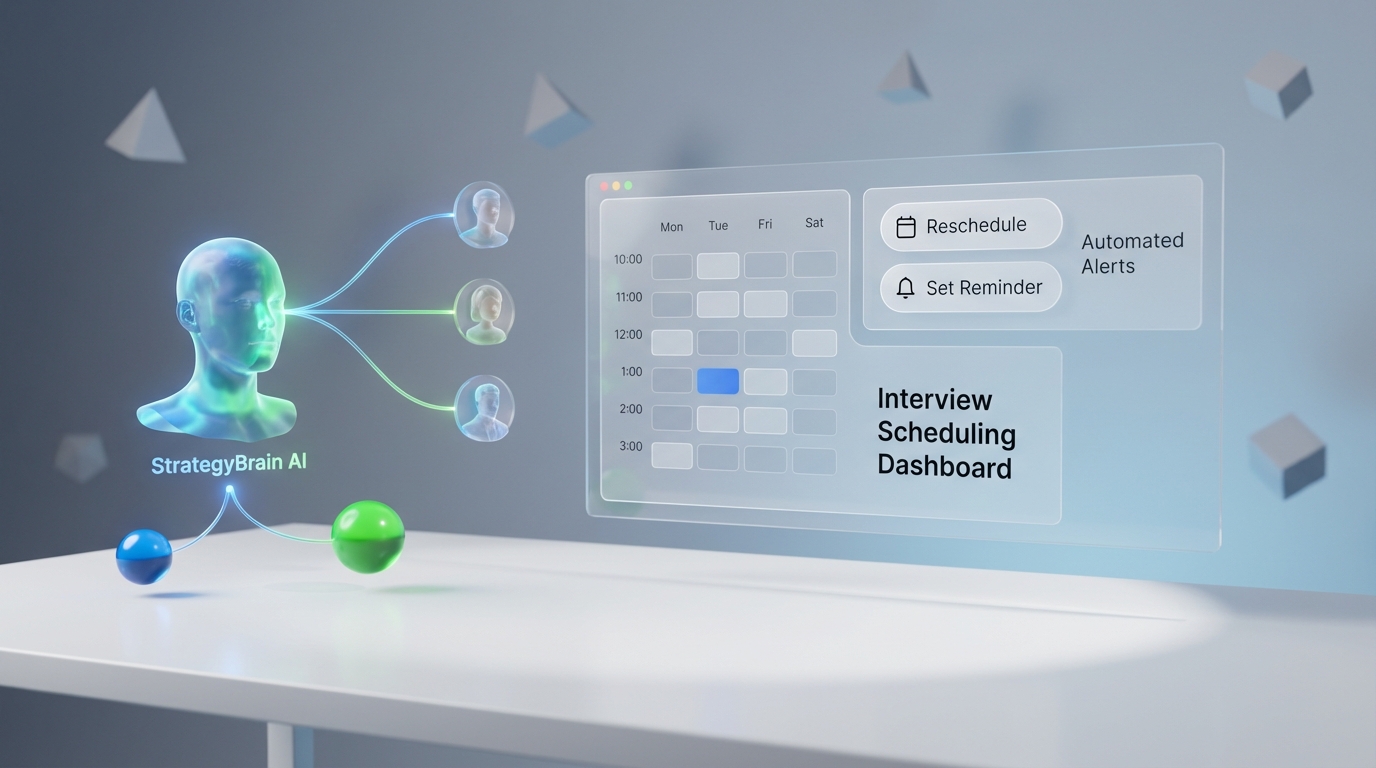
If you are selecting an interview scheduling app for 2026, plan for uncertainty rather than perfect growth. The latest staffing market outlook points to a flat 2025 in many major markets, driven by trade tariff uncertainty and broader macroeconomic and geopolitical risk. In practice, that environment increases interview churn: more reschedules, more no shows, and more back and forth across time zones. This article explains what the 2025 staffing forecast implies for scheduling capacity, what to look for in online calendar programs, and how to keep coordination lean for teams that need the best scheduling software for small business style simplicity. We also show where StrategyBrain AI Recruiter fits into the workflow by automating LinkedIn outreach and qualification so your scheduling layer only handles candidates who are ready to talk.
Key Takeaways
- 2025 demand signal: Staffing Industry Analysts expects the global staffing market to remain flat in 2025, with downside risk tied to tariffs and macro conditions.
- GDP linkage: A global GDP growth downgrade of -0.5% for 2025 was estimated to equate to a USD 9 billion loss in global staffing revenue (SIA estimate, based on IMF downgrade).
- Sensitivity: For each additional 1% reduction in global GDP growth, the staffing industry is estimated to lose 3% annual growth (SIA estimate).
- Regional divergence: Some markets are still expected to grow in 2025, including China +13% and India +12%, while others are expected to decline, including Germany -5% and the United States -4%.
- Scheduling implication: Flat or declining markets usually mean more interview changes, so rescheduling speed and automated reminders matter more than fancy features.
- Workflow leverage: StrategyBrain AI Recruiter can reduce manual coordination by automating LinkedIn connecting, role introduction, Q&A, interest confirmation, and résumé plus contact capture before interviews are scheduled.
Table of Contents
- What the 2025 staffing forecast actually says
- Why forecast volatility hits interview scheduling first
- Interview scheduling app requirements for 2026
- Capacity planning by market: where to expect churn
- How StrategyBrain AI Recruiter reduces scheduling load
- Implementation playbook: a resilient scheduling workflow
- Quick comparison table: methods to reduce scheduling overhead
- FAQ
- Conclusion
What the 2025 staffing forecast actually says
Here is the core message from the source material: Staffing Industry Analysts (SIA) downgraded its global staffing market forecast and expects the market to remain flat in 2025. The stated drivers are trade tariff uncertainty and other macroeconomic and geopolitical issues, which the report frames as ongoing downside risk to forecasts.
The report also highlights a close correlation between GDP and staffing growth in most developed staffing markets. It points to the International Monetary Fund (IMF) April announcement of downgrades to global GDP as a direct input into staffing expectations.
Key numbers you can cite in planning docs
- -0.5% global GDP growth downgrade (2025) was estimated by SIA to equate to a USD 9 billion loss of global staffing revenue.
- Each additional 1% reduction in global GDP growth is estimated to reduce staffing industry growth by 3% annually.
Markets expected to grow vs decline (2025)
The source lists markets with expected growth in 2025, including China +13%, India +12%, Spain +7%, Japan +4%, Poland +3%, and Italy and Australia at +2%. It also lists less positive outcomes for Germany -5%, the United States -4%, France -4%, and the United Kingdom -2%, with the Netherlands and Belgium anticipated to remain flat.
Why forecast volatility hits interview scheduling first
When hiring demand is flat or uneven across regions, recruiting teams tend to see two operational patterns. First, pipelines become more selective, which increases the number of touchpoints per qualified candidate. Second, calendars become less predictable because stakeholders change priorities quickly, and candidates often juggle multiple processes.
That is why an interview scheduling app is not just a convenience layer in 2026 planning. It becomes a risk control tool that reduces time lost to coordination, especially when you are hiring across time zones or when you need to keep costs tight like many teams looking for the best scheduling software for small business.
Interview scheduling app requirements for 2026
In this article, an interview scheduling app means software that automates booking, rescheduling, reminders, and availability management for interviews. Online calendar programs are the broader category that includes personal and team calendars, availability sharing, and meeting coordination.
Must have features for volatile hiring cycles
- Fast rescheduling: One click reschedule links and automatic updates to all attendees.
- Time zone safety: Candidate facing pages that display the candidate’s local time by default.
- Automated reminders: Email and calendar reminders that reduce no shows.
- Buffer and capacity controls: Limits per day, minimum notice windows, and buffers between interviews.
- Auditability: Clear logs of who booked, changed, or canceled, which matters for compliance and internal reviews.
Nice to have features when you scale
- Panel interview support: Multi interviewer availability matching.
- Routing rules: Assign candidates to interviewers based on role, region, or seniority.
- Templates: Standardized invite text and prep instructions.
What we see teams underestimate
In our experience reviewing recruiting workflows, the biggest hidden cost is not the initial booking. It is the follow up loop: confirming interest, answering questions, collecting résumés, and then discovering the candidate is not ready for an interview. If your scheduling tool is doing work for unqualified or uninterested candidates, you will feel overloaded even with good calendar software.
Capacity planning by market: where to expect churn
The forecast’s regional split is useful for planning scheduling capacity. If you recruit in markets expected to decline or stay flat, you should assume higher churn and more stakeholder scrutiny. If you recruit in growth markets, you should assume higher volume and more time zone complexity, especially for cross border hiring.
A simple planning heuristic you can reuse
- Declining markets (example: Germany -5%, United States -4%): prioritize rescheduling speed, reminders, and internal coordination because approvals and priorities shift more often.
- Growth markets (example: China +13%, India +12%): prioritize time zone handling, multilingual candidate communication, and interviewer capacity controls.
- Flat markets (example: Netherlands, Belgium): prioritize consistency and reporting so you can see where time is being spent.
How StrategyBrain AI Recruiter reduces scheduling load
StrategyBrain AI Recruiter is not an interview scheduling app by itself. It sits earlier in the funnel and reduces the number of calendar actions your team has to perform by automating the repetitive steps that usually happen before scheduling.
What it automates before the calendar invite exists
- LinkedIn outreach and connecting with candidates that match your search criteria.
- Role introduction and two way messaging that explains the opportunity.
- Candidate Q&A about the role, company, compensation, and benefits using the information you provide.
- Interest confirmation so interviews are scheduled for candidates who are actually open to moving forward.
- Résumé and contact capture for interested candidates, including details shared in messages.
Why this matters in a flat 2025 environment
If staffing demand is flat, recruiters often need to do more outreach to get the same number of interview ready candidates. AI Recruiter helps by handling the initial conversation and follow up loop continuously, including 24/7 multilingual communication. That means your online calendar programs and scheduling links are used later, when the candidate is already warmed up and qualified for a real conversation.
Limitations and scope boundaries
AI Recruiter can confirm willingness to communicate or interview, but it does not decide whether a résumé fully matches job requirements. Recruiters still review résumés and make the final qualification decision before moving candidates into interviews.
Implementation playbook: a resilient scheduling workflow
This is a practical workflow we recommend when you want scheduling to stay stable even when forecasts and priorities change. It is designed for teams that want the best scheduling software for small business simplicity, but still need enterprise grade discipline.
Step by step workflow
-
Define your scheduling capacity rules
Set interviewer limits per day, buffers between interviews, and minimum notice windows. This prevents calendar overload when volume spikes in growth markets.
-
Standardize candidate readiness criteria
Decide what must be true before a candidate gets a scheduling link. For example, interest confirmed and résumé received. This reduces wasted bookings.
-
Automate pre scheduling conversations
Use StrategyBrain AI Recruiter to handle LinkedIn connecting, role introduction, Q&A, and interest confirmation. Then hand off only interview ready candidates to your interview scheduling app.
-
Use scheduling links with time zone safety
Ensure the candidate sees times in their local time zone and receives clear instructions. This is essential for cross border hiring.
-
Instrument rescheduling and no show rates
Track cancellations, reschedules, and no shows weekly. In flat or declining markets, these metrics often move before hiring volume changes.
Copyable checklist for tool selection
- Does the interview scheduling app support one click rescheduling with automatic attendee updates?
- Does it display candidate local time by default and prevent time zone confusion?
- Can you enforce buffers, daily caps, and minimum notice windows?
- Can you template invite messages and interview prep instructions?
- Can you export logs for compliance and internal review?
- Can your upstream workflow confirm interest and collect résumés before scheduling, using automation such as StrategyBrain AI Recruiter?
Quick comparison table: methods to reduce scheduling overhead
| Method | What it reduces | Best for | Tradeoff |
|---|---|---|---|
| Interview scheduling app with rescheduling and reminders | Back and forth booking messages | Teams coordinating many stakeholders | Does not qualify candidates by itself |
| Online calendar programs with capacity controls | Interviewer overload and conflicts | Small teams needing simple governance | Still requires candidate readiness checks |
| StrategyBrain AI Recruiter for LinkedIn outreach and qualification | Manual outreach, follow up, and early stage Q&A | Teams that need more interview ready candidates without adding headcount | Recruiters still review résumés for final fit |
FAQ
What is the difference between an interview scheduling app and online calendar programs?
An interview scheduling app focuses on booking workflows such as availability sharing, automated reminders, and rescheduling. Online calendar programs are broader and include personal and team calendars, availability management, and general meeting coordination.
Why does a flat staffing market forecast matter for scheduling?
Flat demand often increases churn in the process: more reschedules, more stakeholder changes, and more candidate drop off. That makes rescheduling speed, reminders, and readiness gating more important than extra features.
Which markets were expected to grow in the 2025 forecast?
The source lists China at +13% and India at +12% as the highest growth markets, with additional growth expected in Spain +7% and Japan +4%, among others.
Which markets were expected to decline in the 2025 forecast?
The source lists Germany at -5%, the United States at -4%, France at -4%, and the United Kingdom at -2% as markets with less positive outcomes anticipated for 2025.
How does StrategyBrain AI Recruiter help if I already have scheduling software?
It reduces the number of scheduling actions you need by automating LinkedIn outreach, role introduction, candidate Q&A, interest confirmation, and résumé plus contact capture. Your scheduling tool then focuses on candidates who are ready to interview.
Does StrategyBrain AI Recruiter replace recruiter judgment?
No. It can confirm willingness to communicate or interview, but it does not decide whether a résumé fully matches job requirements. Recruiters still review résumés and make final screening decisions.
Can StrategyBrain AI Recruiter communicate with candidates in different languages?
Yes. It supports 24/7 multilingual candidate communication and can respond in the candidate’s native language to reduce misunderstandings across regions and time zones.
How should small businesses evaluate the best scheduling software for small business needs?
Start with reliability: time zone safety, rescheduling, reminders, and capacity controls. Then ensure your upstream process confirms interest and collects résumés before scheduling, which can be automated with StrategyBrain AI Recruiter.
Conclusion
For 2026 planning, the staffing forecast signals a year where uncertainty can create operational drag even when hiring volume is not exploding. The most practical approach is to choose an interview scheduling app that makes rescheduling and reminders effortless, pair it with disciplined capacity rules in your online calendar programs, and reduce wasted bookings by qualifying candidates before they ever see a scheduling link. If your team is trying to keep coordination lean like teams seeking the best scheduling software for small business, StrategyBrain AI Recruiter can take over the repetitive LinkedIn outreach and early qualification steps so interviews are scheduled only when there is real intent. Next step: implement the checklist above, then track reschedule and no show rates weekly to see where your workflow is leaking time.