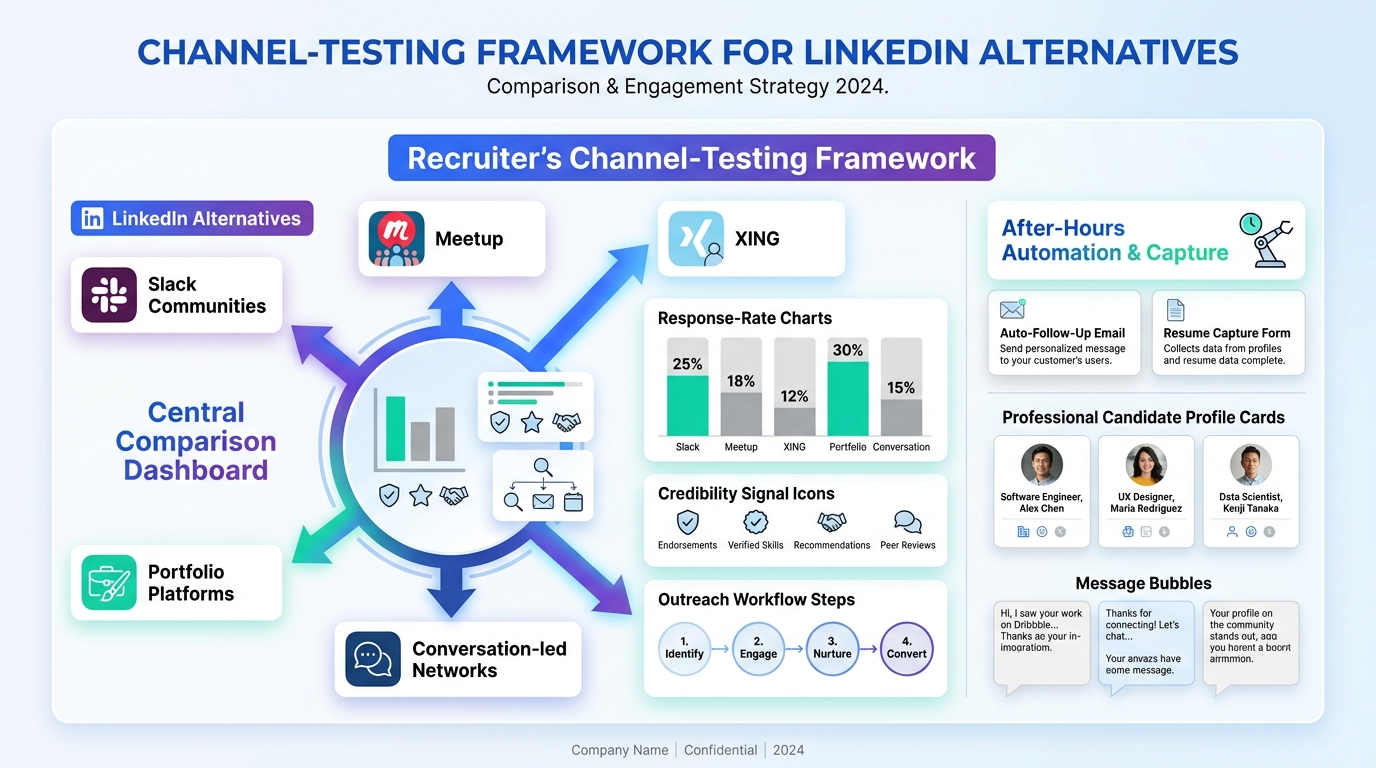
Test professional networking social media sites early to spot weak signal, compare channel fit, and avoid wasted recruiter outreach.
That matters because most hiring teams do not fail from lack of access. They fail from using every channel the same way, overvaluing polished profiles, and waiting too long to learn whether a platform actually surfaces responsive, credible talent. For solo headhunters, that means wasted outreach hours. For boutique firms, it means weaker delivery margins and slower fills. For in-house teams, it often shows up as low response rates, recycled pipelines, and hiring managers losing confidence in sourcing quality.
In my own LinkedIn-heavy workflows, I have found that StrategyBrain AI Recruiter is most useful when the problem is not strategy but execution discipline. It can automate first-touch LinkedIn outreach, keep candidate conversations moving after hours, and collect resumes or contact details from interested prospects, while the recruiter still makes the final call on fit, CV quality, and interview next steps. That separation matters: the machine handles repetition, while the recruiter keeps judgment.
A simple internal workshop from a recruiting team illustrates the bigger lesson. In an 18-minute spaghetti tower challenge, small groups were split by function, given the same materials, and asked to build the tallest structure that could actually hold a marshmallow on top. One team overplanned, another aimed for an impressive design, and several left the marshmallow test too late. Their structures collapsed in the final minutes because the real constraint had not been tested early enough.
The winning group did something less glamorous but more useful: they simplified, tested sooner, and adjusted around what the task actually required. That is exactly how recruiters should approach LinkedIn alternatives. When teams evaluate a professional network platform or other professional social media platforms, the mistake is usually not choosing the wrong trend. It is delaying proof. The rest of this article breaks down which professional networking social media sites work best by use case, what signal to test first, and where LinkedIn still earns its place.
Table of Contents
- Why Most LinkedIn Alternative Tests Fail
- What Counts as a LinkedIn Alternative?
- Quick Comparison Table
- When LinkedIn Still Makes Sense
- Best for Job Search and General Career Networking
- Best for Local and Community-Based Networking
- Best for Industry Conversation and Thought Leadership
- Best for Freelancers, Creatives, and Portfolio-Led Work
- Best for Founders, Startups, and Operator Networks
- Best for Regional Professional Networking
- How I Use StrategyBrain on LinkedIn
- How Recruiters Should Choose the Right Platform Mix
- Common Mistakes When Testing LinkedIn Alternatives
- FAQ
Why Most LinkedIn Alternative Tests Fail
The spaghetti challenge is a useful metaphor for channel strategy because the marshmallow looked easy until teams put it on top. In recruiting, every platform has its own marshmallow: the hidden assumption that breaks the workflow late. On one site, it is weak candidate responsiveness. On another, it is poor searchability. On another, it is a strong community culture that rejects transactional outreach.
Experienced recruiters learn to test that weight early. Instead of asking whether one network can replace LinkedIn entirely, they ask narrower questions:
- Can I find the right people here?
- Will they respond in this environment?
- What proof of credibility is visible before outreach?
- Can I move a conversation from discovery to screening without friction?
- Is this channel worth the recruiter time it consumes?
That mindset is what separates a useful sourcing experiment from a vanity test. The goal is not the tallest-looking tower. It is the structure that still stands when real hiring pressure is added.
What Counts as a LinkedIn Alternative?
A LinkedIn alternative is any professional social media platform, networking space, or community that helps people build work relationships, discover opportunities, or establish professional credibility outside LinkedIn’s main ecosystem.
For recruiters, that can include regional business networks, event-based communities, Slack groups, founder circles, portfolio-first platforms, and real-time conversation channels. The value usually comes from one of five things: better niche targeting, stronger proof of work, more authentic interaction, regional relevance, or access to professionals who do not spend much time on LinkedIn.
That is why experienced hiring teams do not treat all professional social media platforms as direct substitutes. They treat them as channels with different norms, different signals, and different candidate behavior.
Quick Comparison Table
| Platform Type | Best For | Key Strength | Audience | Typical Cost | Main Limitation |
|---|---|---|---|---|---|
| Regional professional networking | Local business relevance | Professionals in specific European markets | Free and paid options | Limited value outside core regions | |
| Meetup | Local networking and events | Relationship depth | Professionals, specialists, local communities | Free and paid options | Not built for structured recruiting workflows |
| Slack communities | Niche talent communities | Visible peer interaction | Operators, recruiters, marketers, technical specialists | Usually free to join | Discovery can be fragmented |
| X or Twitter-style networks | Thought leadership and live industry discussion | Public expertise signals | Founders, recruiters, marketers, creators | Free and paid options | High noise without list discipline |
| Portfolio-first communities | Creative and proof-of-work hiring | Work samples first | Designers, writers, visual creatives | Free and paid options | Less useful for broad corporate hiring |
| Founder and startup communities | Startup hiring and operator networking | Warm trust and referrals | Founders, early-stage teams, builders | Community dependent | Often informal or invitation-led |
If you are comparing professional networking social media sites, the practical takeaway is simple: there is no universal winner. The right choice depends on role type, geography, and whether you value scale, proof, or conversation quality most.
When LinkedIn Still Makes Sense
Any balanced discussion of LinkedIn alternatives should be honest about this: LinkedIn still matters. If you need broad white-collar coverage, standardized work history, and a familiar place to reach passive candidates, it remains the default benchmark.
In practice, LinkedIn is often still the best move when your team needs:
- Broad access across many industries and seniority levels
- Consistent work-history formatting
- Employer brand visibility at scale
- A familiar communication environment for passive candidates
- Mainstream B2B networking and content distribution
Where another professional network platform can outperform LinkedIn is in niche discovery. If your recruiters keep seeing the same talent pool, the same titles, and the same low-reply patterns, that is usually a sign that breadth is no longer the bottleneck.
Recruiter takeaway: Use LinkedIn for coverage. Use alternatives for sharper signal.
Best for Job Search and General Career Networking
If the goal is mainstream career networking or general job visibility, the strongest alternatives are usually platforms that still support a professional identity but feel less saturated than LinkedIn.
XING for structured regional career networking
XING remains one of the better-known LinkedIn alternatives in region-specific business ecosystems. For recruiters hiring in markets where it has real adoption, it can be a practical professional network platform for profile discovery and job visibility.
The advantage here is local relevance. Rather than assuming all candidates live on global professional social media platforms, recruiters can source in the places professionals already trust for regional networking, language-specific roles, and mid-career moves.
Practical advice: Use XING when your geography matches its audience strength. Do not treat it as a universal substitute if your talent market is elsewhere.
Career communities and alumni-style networks
Structured career communities can also work well for candidates who want more focused opportunity discovery and less self-promotion noise. They are especially useful for early-career talent, referrals, and sector-specific openings.
Recruiter note: If you hire students, recent grads, or community-connected talent, test these channels alongside mainstream sourcing rather than relying on one large network.
Best for Local and Community-Based Networking
One of the clearest reasons teams look for LinkedIn alternatives is that they want more real interaction and less feed-driven noise. That is where local and community-based channels earn their place.
Meetup for relationship-led hiring
Meetup is useful when networking needs to happen through local events, specialist gatherings, and repeated real-world participation. It is not a direct LinkedIn clone, but it can be valuable for city-based recruiting or ecosystem hiring where reputation grows through presence.
Local engineering meetups, startup communities, HR events, and operator groups often create stronger trust than a polished digital profile. A recruiter who shows up, follows up, and stays visible over time will usually get better conversations than one who only posts jobs.
- Use Meetup for relationship building, not just broadcasting openings
- Send recruiters with a follow-up plan, not only a badge
- Track conversation quality after events
- Think in talent mapping horizons, not only immediate req filling
Slack communities for niche professional communities
Slack groups are often among the most useful nontraditional LinkedIn alternatives for specialist hiring. They allow recruiters to see real participation, resource sharing, and problem-solving behavior in context.
For recruiting teams, that means Slack can help identify practitioners in product, operations, talent acquisition, growth, and technical specialties. It is one of the stronger professional networking social media sites when your goal is quality interaction rather than pure volume.
Practical advice: Join to listen first. Contribute before pitching. In community spaces, trust usually compounds before reply rates do.
Best for Industry Conversation and Thought Leadership
Some professionals are easier to discover where they discuss their work publicly than where they maintain a formal profile. That is why real-time conversation channels are now a normal part of modern sourcing.
X or Twitter-style networks for live expertise signals
Conversation-led platforms can be useful when hiring for roles where point of view matters: startup operators, marketers, recruiters, founders, creators, and community-facing commercial talent. These spaces surface professionals who react to market shifts, share frameworks, and build credibility in public.
They also matter for recruiter visibility. Teams that want to reach professionals who influence peers often get more traction in a conversation-first environment than in a resume-style database.
The drawback is obvious: noise. Without disciplined lists, topics, and filtering, these channels can consume time quickly. They are not always the best professional social media platforms for structured pipeline management, but they are useful for discovery and relationship starts.
- Follow topic clusters, not just job titles
- Look for consistency of insight, not vanity reach
- Use public interaction to warm outreach
- Move promising prospects into a clearer recruiting workflow fast
Best for Freelancers, Creatives, and Portfolio-Led Work
For many creative professionals, a traditional work-history profile is secondary to visible output. In those cases, portfolio-first communities often outperform a general professional network platform.
Recruiters hiring designers, writers, and visual creatives need proof of work more than title history. A strong portfolio shows style, judgment, and project thinking in a way a business profile usually cannot.
This is why niche communities are often the better answer when someone asks about LinkedIn alternatives for creative hiring. The signal is closer to the work itself.
- Review work samples before scaling outreach
- Personalize messages to visible projects or style
- Bring hiring managers in early for portfolio review
- Do not over-filter on corporate profile polish
Best for Founders, Startups, and Operator Networks
Startup hiring is one of the clearest cases where LinkedIn alternatives can outperform broad platforms. Founders and early operators often spend more time in peer circles, founder channels, specialist Slack groups, and event communities than in standard professional directories.
In these networks, reputation and introductions matter more than formal title sequencing. A recruiter hiring a founding operator, early growth lead, or first talent partner may get better traction through community trust than through cold profile outreach alone.
These are still part of the broader landscape of professional networking social media sites, but the social behavior is different. It is faster, more contextual, and more referral-driven.
- Lead with mission and scope
- Use warm intros where possible
- Show up consistently in founder and operator spaces
- Expect credibility to come from contribution, not just brand
Best for Regional Professional Networking
One of the biggest sourcing mistakes is assuming global networking habits are universal. They are not. In some markets, a regional professional social media platform or local business network has more trust and daily use than LinkedIn.
That is why regional mapping matters. If your team recruits across countries, identify which professional network platform professionals actually use in each market rather than defaulting to one global playbook.
- Map channels by country and language
- Ask local recruiters where professionals actually participate
- Adjust outreach style to platform norms
- Measure response quality, not just profile count
For international recruiting, the best alternative is often the one candidates already recognize as part of their normal professional routine.
How I Use StrategyBrain on LinkedIn
Because this topic sits close to LinkedIn usage in day-to-day recruiting, it is worth being specific about where I have found StrategyBrain AI Recruiter genuinely helpful. I do not use it to replace sourcing judgment or candidate assessment. I use it to prevent the classic late-stage collapse that happens when too many good prospects reply at once and no one keeps pace.
In practical terms, the tool helps by automatically introducing relevant opportunities to targeted LinkedIn prospects, handling follow-up messaging outside normal work hours, and capturing resumes or contact details when a candidate wants to continue. That has been particularly useful when I already know the audience I want and need cleaner execution on the repetitive parts of outreach. If you want to see the workflow context, the vendor also publishes examples around LinkedIn automation steps and conversation handling.
My main takeaway is the same lesson from the marshmallow exercise: test the real weight early. If your bottleneck is first-touch consistency, after-hours replies, or contact capture from interested candidates, a support layer like AI Recruiter can keep the tower standing. If your bottleneck is weak role calibration or poor candidate evaluation, no automation layer will fix that; the recruiter still has to judge resumes, verify alignment, and decide who advances.
How Recruiters Should Choose the Right Platform Mix
When teams ask which platform is best for professional networking, the honest answer is usually: build a mix. Different talent groups reveal themselves in different environments, and good recruiters match channel to behavior.
Use this simple decision framework:
- Need broad visibility? Start with LinkedIn.
- Need niche expertise? Use Slack communities or specialist groups.
- Need local relationships? Use Meetup or regional communities.
- Need visible thinking and market voice? Use conversation-led platforms.
- Need proof of work? Use portfolio-first communities.
- Need founders or startup operators? Use founder and peer networks.
Operationally, document performance by role family. A channel that works for startup operators may fail for finance leadership. A platform that produces strong creatives may underperform for enterprise sales. Compare response quality, interview conversion, and hiring manager confidence in signal, not just raw lead count.
Key insight: The best LinkedIn alternatives are usually not replacements. They are sharper tools for specific recruiting conditions.
Common Mistakes When Testing LinkedIn Alternatives
Most poor results come from weak testing discipline, not from the platform itself. The same lesson showed up in that 18-minute tower exercise: assumptions become expensive when they are left untested until the end.
Using every platform the same way
A community channel is not a database. An event network is not a job board. A conversation feed is not a static resume repository. Each professional social media platform has its own norms, and recruiters need to adapt their approach.
Expecting instant scale from niche communities
Niche communities often produce stronger relevance but less volume. That tradeoff is usually worth it for hard-to-fill or credibility-sensitive roles.
Ignoring visible participation signal
On alternative networks, credibility often appears through discussion quality, event attendance, shared resources, or visible work. Recruiters who only scan profile headlines miss the best evidence.
Overbuilding before testing candidate response
This is the recruiting version of waiting until the last minute to place the marshmallow. Before investing heavily in a channel, test outreach, response quality, and conversion behavior on a small sample.
Leaving hiring managers out of nontraditional channels
When sourcing in portfolio-first or operator communities, hiring managers should help define what strong signal looks like. Their input improves targeting earlier.
Comparing platforms too broadly
Do not ask whether one site beats LinkedIn overall. Ask whether it performs better for a specific talent segment, geography, or hiring condition. That is how experienced teams evaluate professional networking social media sites realistically.
FAQ
What is the best LinkedIn alternative?
There is no single best alternative for everyone. The right option depends on your goal. Recruiters often use Slack communities, Meetup, XING, founder circles, and conversation-led platforms when they need better niche relevance or more authentic interaction than LinkedIn usually provides.
Which platform is best for professional networking?
The best platform depends on whether you need broad reach or targeted access. LinkedIn remains strong for scale, but another professional network platform may work better for local communities, startup ecosystems, creative hiring, or industry-specific discussions.
Are there LinkedIn alternatives for job search?
Yes. Candidates can use regional business networks, community groups, alumni-style communities, event-based platforms, and portfolio-led spaces alongside LinkedIn. For recruiters, these channels can surface talent that is less active on mainstream professional social media platforms.
Which sites work better for specific industries?
Industry-specific communities usually work better when hiring depends on visible expertise, shared context, or proof of work. Technical, startup, creative, and community-led roles benefit most from niche environments.
Can professional networking social media sites replace LinkedIn completely?
Usually not for most hiring teams. LinkedIn still offers broad coverage and familiarity. But alternatives can outperform it in narrower scenarios such as regional networking, startup hiring, community-based sourcing, and portfolio-driven recruiting.
Conclusion
If you are evaluating LinkedIn alternatives, think like the team that tested the marshmallow early rather than the team that saved the real constraint for the end. Broad platforms win on scale. Niche communities win on relevance. Event networks win on relationship depth. Conversation-led spaces win on live expertise. Portfolio-first channels win on visible work.
For recruiters, the practical opportunity is not finding one universal replacement. It is learning which professional networking social media sites match the behavior of the talent you need, and then testing those channels against real response and conversion criteria.
That is the most reliable way to choose a better professional social media platform or professional network platform: prototype early, measure honestly, and keep human judgment where it matters most.