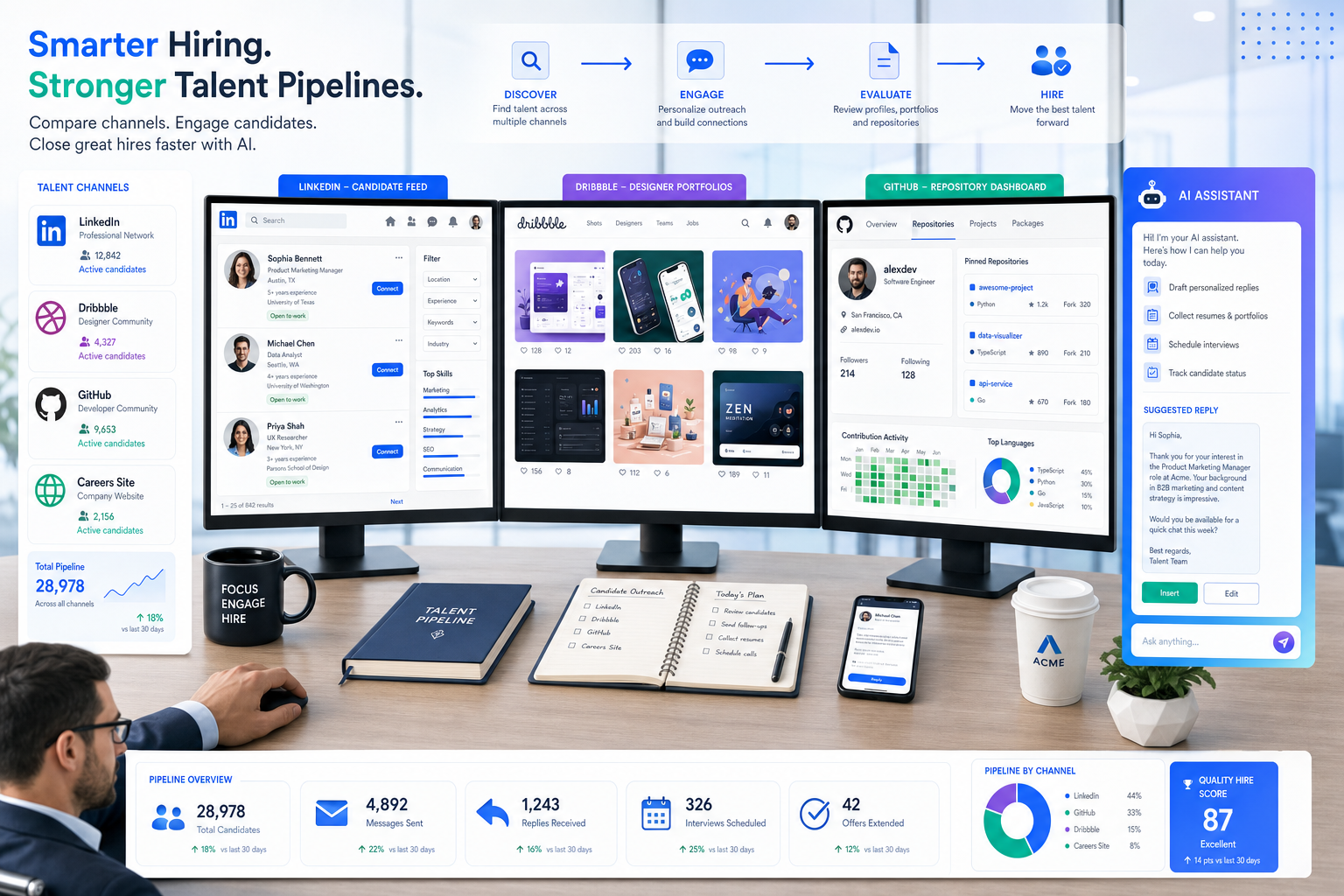
Headhunters can use this analysis of professional networking social media sites to spot better-fit channels and avoid response loss.
That matters in real recruiting work because the platform problem is rarely just reach. Teams lose time when strong candidates are scattered across feeds, portfolios, coding communities, regional networks, and freelance marketplaces, while recruiters are still expected to reply quickly, remember prior context, and keep every conversation warm. For smaller search firms, that creates an operational tax. For solo recruiters, it means late-night follow-up and avoidable drop-off. For in-house teams, it leads to slower hiring, weaker candidate experience, and more pressure on employer credibility.
In my own LinkedIn-heavy workflow, one practical way to reduce that strain has been using StrategyBrain AI Recruiter for the repetitive front end of outreach and candidate replies. What helped most was not “automation” in the abstract, but the specific ability to keep conversations moving after hours, answer routine role questions in multiple languages, and collect resumes or contact details from interested candidates while I still handled final judgment, resume review, and interview decisions. For recruiters comparing broad networks with niche professional social media platforms, that support can keep LinkedIn useful without forcing every sourcing step to live there.
The pressure behind that workflow is not hard to recognize. Many younger professionals entered work during economic uncertainty, were taught to optimize achievement early, and now live in a career environment where staying visible online can feel mandatory. They are often digitally native, always reachable, and constantly exposed to other people’s polished success. In recruiting terms, that means a candidate may want visibility and opportunity, but may also be exhausted by endless posting, personal branding, and being perpetually available.
That is exactly why a one-platform mindset breaks down. A designer who is tired of maintaining a broad professional feed may still keep an excellent portfolio. An engineer who ignores polished networking posts may show depth in public repositories or technical discussion. A startup operator who dislikes constant self-promotion may still engage in a niche founder or operator community. Once you see how burnout, attention overload, and always-on expectations shape candidate behavior, the question changes from “What replaces LinkedIn?” to “Which professional networking social media sites let recruiters meet people where their real professional identity still shows up?”
Practical takeaway: LinkedIn remains useful for broad reach, but niche professional platforms often perform better when candidates are tired of feed-driven visibility and prefer proof of work, community participation, or regional relevance.
- Why LinkedIn alternatives matter now
- What to evaluate beyond user volume
- Quick comparison table
- Startup-focused networks
- Creative and portfolio networks
- Developer communities and social coding
- Regional professional networks
- Freelance and independent talent platforms
- Community-first networking without constant posting
- How I combine alternatives with LinkedIn workflow support
- How recruiting teams should choose the right mix
- Common mistakes when evaluating alternatives
- FAQ
Why LinkedIn Alternatives Matter Now
When recruiters search for LinkedIn alternatives, they are usually reacting to one of three problems: weak response rates, poor fit despite large profile counts, or fatigue from trying to manage every candidate interaction in one crowded channel. The deeper issue is behavioral. Many professionals still want career mobility and visibility, but they do not necessarily want to perform that visibility on a mainstream feed all the time.
That gap matters because the best professional networking social media sites are no longer defined only by profile volume. They are defined by where a person feels comfortable showing credible work. In some markets, that is a startup community. In others, it is a design portfolio, a coding repository, a regional business network, or a freelance marketplace where availability is explicit and expectations are clearer.
From a recruiter’s perspective, this shift resembles a burnout problem as much as a sourcing problem. If candidates are always plugged in, always branded, and always reachable, some will retreat from broad professional feeds without withdrawing from professional life. The recruiter who understands that behavior usually sources better than the recruiter who just searches the biggest database.
What to Evaluate Beyond User Volume
A LinkedIn alternative should be judged by what it reveals, not just by how many users it claims. In practice, I use five filters before deciding whether a platform deserves time in a sourcing stack.
- Match quality: Does the network attract the kind of professionals this role actually needs?
- Proof of work: Can you see portfolios, repositories, client work, writing, or community contributions?
- Response context: Does the platform naturally frame why the candidate might engage?
- Attention burden: Is the candidate expected to maintain a heavy social presence, or can credibility stand on work and participation?
- Hiring relevance: Does the environment support real outreach, relationship building, or active availability?
This is where many professional social media platforms outperform broader career networks. They may have fewer profiles, but they often contain stronger intent signals and less noise.
Quick Comparison of Professional Networking Social Media Sites
| Platform Type | Best For | Main Strength | Main Limitation | Best Recruiting Use |
|---|---|---|---|---|
| Startup hiring networks | Founders, operators, early hires | High startup intent | Narrower audience | Growth-stage and venture-backed roles |
| Creative portfolio networks | Designers and visual creatives | Visible work samples | Less useful outside creative roles | Portfolio-led screening |
| Developer communities | Engineers and technical contributors | Proof of technical work | Public activity is uneven | Technical sourcing and credibility checks |
| Regional professional networks | Local-market professionals | Language and market relevance | Limited global portability | Country-specific hiring |
| Freelance platforms | Contractors and specialists | Availability and delivery focus | Weaker long-term networking depth | Project or interim hiring |
| Community-first groups | Niche specialists | Trust through participation | Slower discovery | Warm pipeline building |
For most hiring teams, the right answer is a blend of professional platforms, not a single replacement.
Startup-Focused Networks
Startup-focused networks work best when the role depends on appetite for ambiguity, ownership, and small-team pace. They are not just narrower databases. They are environments where candidates self-select around a specific working style.
Why they work
People active in startup networks are usually signaling more than skill. They are signaling a preference for fast-moving teams, broad scope, and career paths that are less linear than enterprise ladders.
- Best for: product, growth, early engineering, operations, and founding-team hires
- Strength: stronger intent alignment than general networks
- Limitation: less useful for highly regulated or large-enterprise hiring
Recruiting advice
On these professional networking social media sites, screen for motivation as much as capability. Ask whether the candidate has chosen environments with changing priorities, constrained resources, or broad role ownership. That tells you more than a polished headline.
Creative and Portfolio Networks
Creative hiring is where alternatives often beat LinkedIn outright. Portfolios let recruiters assess visual judgment, craft, and consistency before outreach starts.
Why they work
Many designers and visual creators are willing to show work but not willing to spend constant energy on broad professional posting. Portfolio networks respect that reality.
- Best for: graphic design, product design, branding, motion, illustration, and content design
- Strength: fast evidence of style and execution
- Limitation: polished output can hide weak collaboration or process depth
Recruiting advice
Use these professional social media platforms to ask better questions, not just to shortlist faster. A strong portfolio should lead to discussion about process, stakeholder management, constraints, and revision choices.
Developer Communities and Social Coding
For technical recruiting, some of the strongest alternatives are not classic social networks at all. They are public records of contribution, documentation, collaboration, and technical taste.
Why they work
Developer-oriented networks can reveal how someone builds, maintains, explains, and improves work over time. That is a different credibility signal from title-based search.
- Best for: software engineering, DevOps, platform roles, developer relations, and technical leadership
- Strength: visible proof of work
- Limitation: many excellent engineers work mostly in private environments
Recruiting advice
Do not confuse public activity with total ability. Instead, use these professional networking social media sites to understand communication style, maintenance habits, issue discussion, and technical ownership.
Regional Professional Networks
Regional networks matter more than many global recruiters expect. In some markets, local language, privacy norms, salary expectations, and business culture shape response behavior more than brand awareness does.
Why they work
Professionals often present themselves differently in local networks than on global career platforms. Local relevance can improve both candidate density and message resonance.
- Best for: country-specific searches, multilingual recruiting, and localized employer positioning
- Strength: better alignment with market norms
- Limitation: smaller reach beyond that geography
Recruiting advice
If outreach underperforms internationally, do not assume talent scarcity first. Sometimes the issue is channel mismatch. The right regional professional platforms can produce stronger replies simply because the context feels more native to the candidate.
Freelance and Independent Talent Platforms
When the hiring need is execution speed rather than long-term career branding, freelance marketplaces can outperform traditional networking sites.
Why they work
These environments attract professionals who are used to scoped work, deliverables, and explicit availability. That reduces ambiguity in project-based hiring.
- Best for: contract work, specialist projects, interim support, and overflow delivery
- Strength: clear availability and work orientation
- Limitation: less useful for long-horizon relationship building
Recruiting advice
Treat these professional social media platforms as execution channels. Define scope, outcomes, turnaround expectations, and communication rhythm before outreach. That is usually what determines success here.
Community-First Networking Without Constant Posting
Some of the best candidates are active professionals who dislike personal branding. They show up in specialist communities, forums, member groups, and discussion-led spaces instead.
Why they work
These environments reward useful participation. That matters in a world where many candidates are tired of always-on visibility and would rather build trust through substance than self-promotion.
- Best for: niche functions, specialist roles, and reputation-based fields
- Strength: deeper trust and better context
- Limitation: slower and less standardized sourcing
Recruiting advice
Enter with patience. In community-first professional platforms, transactional outreach usually fails. Recruiters who contribute, observe norms, and build familiarity tend to get better long-term results.
How I Combine Alternatives With LinkedIn Workflow Support
My own lesson from using multiple networks is that sourcing does not break first. Follow-up does. Once you pull candidates from a broad career network, a regional community, and a niche portfolio or coding platform, the real risk becomes delayed replies, inconsistent records, and dropped intent.
That is where I found AI Recruiter most helpful in practice. I used it mainly to keep LinkedIn conversations moving when candidates replied outside my normal hours, to answer common role questions without forcing every message through my inbox first, and to gather resumes and contact details from people who wanted to move forward. It did not replace recruiter judgment, and I would not want it to. I still reviewed resumes, decided who merited serious progression, and adjusted outreach strategy by market and role type.
For firms doing international or high-volume outreach, the multilingual and 24/7 communication support described on the product page addresses a real operational gap: good candidates often respond when recruiters are unavailable. In that sense, it works best as workflow support around LinkedIn while niche professional networking social media sites do the job of improving fit upstream.
If your process already depends heavily on LinkedIn, but your best candidates increasingly surface elsewhere, that combination can be practical: use niche discovery where the audience is most authentic, then use disciplined LinkedIn follow-up support to prevent response loss.
How Recruiting Teams Should Choose the Right Mix
The best recruiting teams do not ask which platform is universally best. They ask which environment reveals the signal this role depends on.
A simple selection framework
- Start with candidate behavior. Where does this talent group naturally show proof of value?
- Define the trust signal. Do you need portfolio evidence, code visibility, local relevance, founder intent, or project availability?
- Assess attention burden. If candidates are fatigued by broad-feed networking, choose channels that rely less on constant posting.
- Adapt outreach style. A message that works on LinkedIn may sound clumsy in a design community or local market network.
- Protect follow-up discipline. Once conversations begin, make sure response handling and resume collection do not become the bottleneck.
Practical recommendations by hiring scenario
| Hiring Need | Best Network Style | Why It Fits |
|---|---|---|
| Startup operator | Startup-focused network | Shows clear early-stage intent |
| Senior designer | Portfolio network | Visual judgment is visible upfront |
| Backend engineer | Developer community | Technical work is easier to validate |
| Local-market sales hire | Regional network | Language and market fit matter most |
| Urgent project specialist | Freelance platform | Availability is clearer than long-term branding |
| Niche industry relationship build | Community-first group | Trust grows through participation |
Common Mistakes When Evaluating Alternatives
1. Looking for one direct replacement
There is rarely a one-for-one substitute. Different professional social media platforms solve different sourcing and credibility problems.
2. Overvaluing volume
A giant database can still underperform if the audience is broad, tired, and loosely relevant. Concentration often beats scale.
3. Ignoring candidate burnout behavior
If a candidate avoids mainstream posting, that does not mean they lack ambition or quality. It may simply mean they prefer a different form of professional visibility.
4. Reusing identical outreach everywhere
Portfolio networks, coding communities, and regional channels each require different language and different respect signals.
5. Letting follow-up become the bottleneck
Even a strong sourcing mix fails if candidate replies sit untouched or resumes are collected inconsistently. That is why workflow support matters once outreach starts.
FAQ
Is there a real alternative to LinkedIn?
Yes, but usually not one universal replacement. The strongest alternatives are niche professional networking social media sites built around specific audiences or proof-of-work formats.
Which platform is best for job seekers?
It depends on how they show value. Designers benefit from portfolio-led visibility, engineers from technical communities, startup candidates from founder-oriented networks, and local-market professionals from regional platforms.
Why do niche platforms sometimes work better than LinkedIn?
Because they can reduce noise and reveal more authentic signals. They also place less pressure on constant public posting, which matters in an always-on professional environment.
Can recruiters still rely on LinkedIn if they use alternatives?
Yes. For many teams, LinkedIn remains a broad communication layer, while niche professional platforms improve discovery and fit. Used together, they can be more effective than either alone.
Where does AI Recruiter fit into this workflow?
It fits best after sourcing begins. In my experience, AI Recruiter is useful for keeping LinkedIn conversations active, handling routine candidate questions, and collecting resumes or contact details, while the recruiter keeps control of final screening and decisions.
Conclusion
The most useful way to think about LinkedIn alternatives is not replacement, but fit. In a labor market where many professionals are highly connected yet increasingly selective about where they show up, the best professional networking social media sites are the ones that match how candidates actually prefer to be seen.
For recruiters, that means using broad networks for reach, niche professional social media platforms for precision, and dependable workflow support to prevent response loss once conversations begin. If you choose networks by audience behavior rather than by brand habit, your sourcing gets sharper and your outreach gets more human.