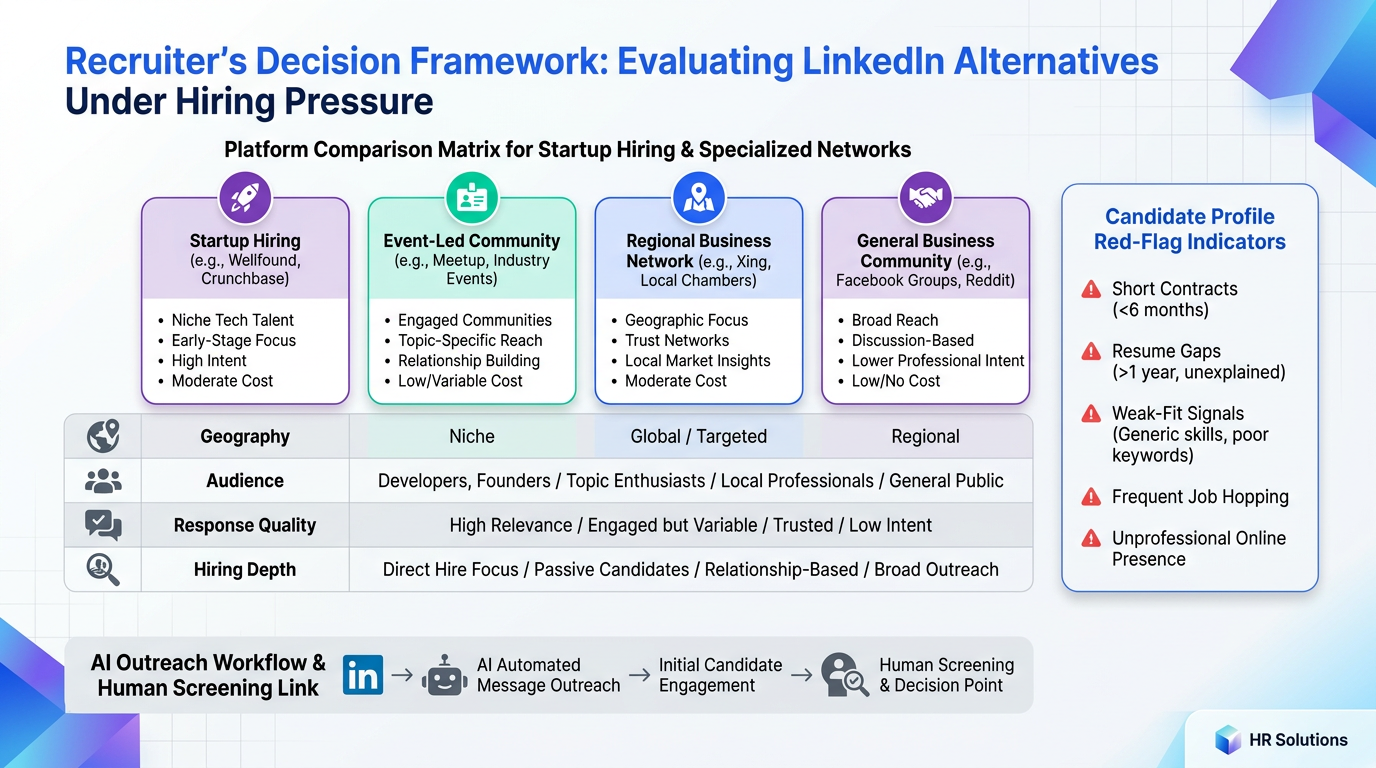
When hiring pressure rises, this article helps recruiters evaluate professional networking social media sites to avoid weak-fit sourcing and costly hiring mistakes.
That sounds simple until a search turns urgent. A hiring manager needs coverage, a founder wants faster intros, or an agency desk has to source talent across markets with limited time. In those moments, teams often default to the biggest network instead of the right one. The cost is familiar: weak reply rates, mismatched candidates, rushed interviews, and avoidable hiring mistakes that affect delivery, client trust, and recruiter productivity.
In my own workflow, tools that reduce the manual load help most when the pressure is high but judgment still has to stay human. I have found StrategyBrain AI Recruiter useful for handling repetitive LinkedIn outreach, keeping candidate conversations moving after hours, and collecting resumes or contact details from interested people without losing context. What matters is that the recruiter still owns the final call on fit, motivation, and next steps, which is exactly how it should be.
A familiar version of this problem shows up when a team adds a contract accountant in a hurry. The brief gets written quickly, resumes start arriving, and one candidate looks promising enough to move forward. But once you slow down, warning signs can emerge: a string of two- or three-month contracts that never extended, several short permanent roles with no clear progression, or large resume gaps that need explanation before anyone assumes the profile is a safe bet.
The same pattern appears across general LinkedIn alternatives. A platform can look active, but if it does not help you surface motivation, career trajectory, market fit, or practical communication history, it creates the same risk as a rushed contract hire. That is why the best professional networking social media sites are not just places to post jobs or send messages. They are channels you can evaluate by audience quality, response behavior, regional relevance, and the amount of real hiring context they reveal.
If you are researching general LinkedIn alternatives, the first thing to know is that there is no single platform that replaces everything. Today’s professional networking social media sites are more specialized. Some are built for relationships and community, some are stronger for startup hiring, and some work best for local or regional business networking.
From a recruiter’s perspective, that specialization is not a weakness. It is usually the point. Hiring managers, agency recruiters, founders, and HR teams get better results when they choose a network based on audience, conversation style, and hiring workflow instead of assuming one large platform fits every role.
In this guide, you will learn how to evaluate alternatives, which platforms make sense for different hiring and networking goals, and how to choose the right mix for job seekers, recruiters, and business teams.
- How to compare platforms by audience, geography, and hiring depth
- Which options fit startup recruiting, local networking, and regional business outreach
- What works best for a social network for IT professionals versus broader social networking sites for business
- How red-flag thinking from contract hiring can improve platform selection and outreach
Table of Contents
- Why Platform Choice Goes Wrong Under Hiring Pressure
- What Makes a Good LinkedIn Alternative?
- Quick Comparison of Professional Networking Social Media Sites
- Best for Startup and Tech Networking
- Best for Event and Community Networking
- Best for Regional Business Networking
- Relationship-First vs Hiring-First Platforms
- How Recruiters and Hiring Teams Should Choose
- Common Mistakes When Using LinkedIn Alternatives
- FAQ
Why Platform Choice Goes Wrong Under Hiring Pressure
The contract-accountant scenario is useful because it exposes a recruiting truth that applies well beyond finance hiring. Tight timelines push people toward fast decisions. When that happens, recruiters may overvalue surface activity and undervalue decision signals. On a resume, those signals might be repeated short contracts, unexplained gaps, or a downward career move that needs context. On a networking platform, the equivalent signals are lower-quality profiles, weak engagement history, vague candidate intent, or a market mismatch between where you are sourcing and where the role actually sits.
That is why I do not evaluate general LinkedIn alternatives by size alone. I evaluate them by whether they help me spot the same kinds of risk early. Can I tell if the user is really open to contract work? Can I understand why someone is moving from a permanent role into project-based work? Can I see enough context to know whether this person has operated at the company size, pace, or technical level the client needs?
Key Insight: A networking platform becomes more valuable when it helps recruiters make better judgments, not just generate more activity.
That filtering discipline also shapes how I use LinkedIn itself. When message volume is high, I do not want to lose candidate replies overnight or let interested people drop out while I am juggling interviews. That is where AI Recruiter on LinkedIn can support the process. It can keep outreach moving, answer role questions in a timely way, and gather resumes from candidates who want to proceed. The practical benefit is speed without handing over the final evaluation, because a recruiter still has to interpret the resume, career logic, and motivation behind the move.
What Makes a Good LinkedIn Alternative?
A strong alternative should be judged by use case, not by name recognition alone. In recruiting, I usually look at six filters first: audience type, networking style, geographic relevance, hiring depth, community quality, and whether the platform supports direct conversations or mainly feed-based posting.
That matters because not all professional networking social media sites solve the same problem. A founder hiring early engineers needs a very different environment from a sales leader looking for local partnerships or an HR team building employer presence in a specific region.
For recruiters and hiring managers, practical evaluation questions include:
- Does the platform attract the exact talent or business audience you need?
- Are profiles detailed enough to support outreach and screening?
- Can users message directly, join communities, or attend events?
- Does it offer company pages, jobs, or recruiting filters?
- Is the activity level strong in your industry or region?
- Can you detect intent, consistency, and career logic, or only surface visibility?
That last question comes directly from hands-on hiring reality. A candidate with a history of very short contracts may still be strong, but you need a platform and a process that help you ask why. The same applies when someone is pursuing their first contract role, stepping down in title, or moving between sectors. A good network helps you start better conversations instead of forcing you to guess.
Quick Comparison of Professional Networking Social Media Sites
| Platform Type | Best For | Networking Style | Hiring Value | Best Fit for Recruiters |
|---|---|---|---|---|
| Startup hiring community | Founders, startups, tech talent | Direct introductions and job discovery | High for startup roles | Early-stage hiring, product, engineering, growth |
| Event-led community network | Local professionals, interest groups, operators | Events and real-time interaction | Medium | Community recruiting, local brand building, referrals |
| Regional business network | DACH professionals and employers | Profiles, jobs, business networking | High in-region | German-speaking market recruiting |
| General business community | Broad professional audience | Content, messaging, groups | Medium to high | Employer awareness and passive talent outreach |
| Niche professional forum or group | Specialist talent pools | Discussion-first community | Medium | Hard-to-fill roles and credibility-led outreach |
For HR and recruiting teams, this comparison highlights an important truth: the right stack often includes more than one channel. One platform may drive visibility, another may drive conversation, and a third may support actual applications.
That mix is especially important when the role is sensitive to background quality. In contract hiring, company size and industry environment matter because people who have worked only in one setting do not always ramp quickly in another. The same logic applies to platform selection. If the role sits in a startup, a legacy enterprise network may produce reach but not readiness. If the role is regional, a global platform may create noise but not relevance.
Best for Startup and Tech Networking
If your real question is not just “What are general LinkedIn alternatives?” but “Where do I find startup-ready talent?” then startup-focused ecosystems deserve special attention. This is especially true when you need a social network for IT professionals or technical candidates who prefer direct, practical conversations over broad professional posting.
Among the strongest startup-oriented options, Wellfound stands out for tech and startup hiring because it is consistently associated with direct founder access, startup profiles, salary transparency, and a strong concentration of tech jobs. For recruiters, that combination matters because it shortens the gap between discovery and conversation.
Why startup-focused platforms work for tech hiring
- Candidate intent is clearer: users are often already open to startup roles
- Company context is stronger: startup profiles help candidates evaluate fit faster
- Technical talent is concentrated: useful for engineering, product, data, and design recruiting
- Direct contact is more natural: outreach feels less formal and more role-specific
For hiring teams, this makes these platforms one of the better answers to the search for a social network for IT professionals. Instead of broadcasting widely, recruiters can focus on candidate pools that already understand startup pace, equity tradeoffs, and role ambiguity.
Practical advice: If you are hiring software engineers, product managers, DevOps talent, or startup marketers, write outreach that references the company mission, team stage, and role scope. Generic recruiter messages tend to underperform in startup communities because candidates expect more context and more transparency.
I use the same discipline on LinkedIn when startup roles require scale. With AI Recruiter, repetitive first-touch messaging and follow-up can continue while I focus on the harder judgment calls: whether the candidate's background really fits the team stage, whether a title change makes sense, and whether interest is genuine or just casual curiosity. That separation between automation and recruiter judgment is where the workflow becomes useful rather than risky.
Best for Event and Community Networking
Not all professional networking now happens through static profiles. A growing share happens inside communities, events, and recurring local groups. That is why event-led platforms like Meetup are relevant when evaluating professional networking social media sites.
This kind of platform is less about polished digital identity and more about live interaction. For recruiters, that can be valuable in ways that a standard online directory is not. You see who participates, who speaks, who organizes, and who consistently contributes to a niche topic.
When event-led networking is the better choice
These communities are useful when your hiring or business goals depend on trust and repeated interaction. They are especially effective for:
- Local hiring in competitive markets
- Community-based recruiting for hard-to-reach roles
- Building relationships before roles open
- Partnership and referral development for business teams
For readers searching broader social networking sites for business, this is an important distinction. Some networks are not job boards at all, yet they can outperform job-driven channels for relationship-led recruiting and local visibility.
Practical advice: HR teams should not measure event-led networks only by immediate applications. Measure them by warm introductions, recurring attendance, hiring pipeline quality, and employer credibility within a niche community.
This is also where recruiters should be careful about false urgency. Event-led communities rarely behave like direct-response channels, so they should not be judged by the same speed metrics as contract-fill sourcing. Their value is in trust accumulation, not just immediate conversion.
Best for Regional Business Networking
One of the biggest mistakes in this topic is assuming every alternative is global. In reality, some platforms become much more useful when geography matters. XING is a good example because it is widely associated with the German-speaking DACH market.
That makes region-specific options highly relevant for employers, agencies, and business development teams operating in local labor markets. If your hiring activity is concentrated in Germany, Austria, or Switzerland, a regionally strong platform can be more practical than a broader but less locally active network.
Why regional focus changes platform value
- Audience fit improves: more relevant employers, candidates, and business contacts
- Local norms are clearer: profiles and outreach better match market expectations
- Business networking is stronger: useful for both recruiting and partnerships
- Signal quality rises: less noise from irrelevant geographies
For companies comparing social networking sites for business, geography should be treated as a first-level filter, not an afterthought. A platform that looks smaller globally may still be stronger for actual hiring conversations in a specific region.
Practical advice: If you recruit across regions, do not duplicate the same employer messaging everywhere. Adapt your profile, job language, and outreach style to the local market instead of treating business networking as one universal channel.
Regional hiring also sharpens the same concern seen in contract hiring: can the person ramp in this environment? Industry size, company complexity, and local market expectations all influence that answer. A platform that helps you assess those variables early saves time later.
Relationship-First vs Hiring-First Platforms
Readers often blur the line between a networking platform and a job board. In practice, this is one of the most useful distinctions to make. Some alternatives are relationship-first communities, while others are hiring-first platforms that add networking features on top.
Relationship-first platforms
These focus on conversation, events, groups, community participation, and reputation built over time. They are valuable when your goal is to build a market presence, find niche contacts, or create trust before a vacancy goes live.
Hiring-first platforms
These are stronger when the immediate goal is candidate sourcing or application flow. Their useful features often include profiles, company pages, job listings, messaging, candidate search filters, and recruiting workflows.
| Model | Main Strength | Best Use | Recruiting Advice |
|---|---|---|---|
| Relationship-first | Trust and repeated engagement | Local communities, niche sectors, referrals | Invest time before you need applicants |
| Hiring-first | Speed and role-specific discovery | Open positions, direct sourcing, active candidates | Make roles and employer details very clear |
For recruiters, choosing between these models depends on urgency. If a role is open now, a hiring-first platform usually wins. If your challenge is long-term pipeline quality, community-led channels may produce better outcomes over time.
The mistake is expecting one environment to do both equally well. In the same way you would not assess a contract accountant only by whether they accepted the interview, you should not assess a networking platform only by whether it generated impressions. You need the right signals for the job at hand.
How Recruiters and Hiring Teams Should Choose
When clients or hiring managers ask me about general LinkedIn alternatives, I usually recommend a simple selection process rather than a long unranked list. The goal is to match platform behavior to hiring reality.
- Define the audience first. Are you hiring startup engineers, local salespeople, regional operators, or senior business leaders?
- Choose the networking style. Do you need direct sourcing, community engagement, events, or employer visibility?
- Check geographic relevance. A global-looking network is not always the most active one in your market.
- Assess hiring depth. Look for profiles, company pages, jobs, messaging, groups, events, and search filters.
- Test response quality. The best platform is the one that produces relevant conversations, not just profile views.
- Look for red flags early. Watch for unclear motivation, inconsistent career patterns, weak profile detail, or audience mismatch.
This approach works well for both professional networking social media sites and broader social networking sites for business. It also helps recruiting teams avoid spending too much time in channels that look busy but generate little hiring progress.
Practical advice for hiring managers: assign each platform one job. For example, use a startup-focused network for technical sourcing, an event-led platform for community visibility, and a regional platform for local employer branding. That creates a cleaner workflow and better measurement.
Where LinkedIn remains central, I have had the best experience pairing recruiter judgment with structured automation rather than replacing one with the other. For example, my preferred use of AI Recruiter is to keep message flow active, answer routine candidate questions, and capture interested replies while I review resumes for substance. That helps most in high-volume search, overseas recruiting, and after-hours response windows, but it does not remove the need to judge fit, tenure logic, or role motivation yourself.
Common Mistakes When Using LinkedIn Alternatives
Most underperformance comes from using the wrong expectations, not the wrong platform. Here are the mistakes I see most often in recruiting teams and business users.
Treating every platform like a social feed
Some networks are built around conversations, events, or direct role discovery. If you only post updates and wait, you may miss the actual value of the platform.
Ignoring niche context
A social network for IT professionals needs different messaging from a broad business audience. Technical communities respond better to specifics, while general business groups may engage more with relationship-led content.
Using generic recruiter outreach
Copy-paste outreach performs poorly in specialized communities. Candidates and operators can tell when the sender has not understood the platform culture.
Overlooking regional behavior
Some social networking sites for business are strongest in particular countries or language markets. If your jobs are region-sensitive, that matters more than raw platform size.
Expecting one platform to do everything
There is no universal replacement for LinkedIn. The better strategy is to build a practical mix of general visibility, niche sourcing, and community participation.
Ignoring career-pattern clues once replies come in
Platforms create access, but they do not remove the need for judgment. If a candidate has repeated short assignments, short permanent roles, large gaps, or a move that looks like a step down, recruiters still need to ask why. Those answers often determine whether the hire ramps fast or becomes a costly reset.
FAQ
What is the best LinkedIn alternative for job seekers?
The best option depends on the kind of role the person wants. Startup-focused candidates usually benefit from startup hiring communities, while local professionals may get better traction through event-led groups or region-specific business networks. The strongest results come from choosing a platform that matches industry and geography.
Which platform is best for IT professionals?
If the goal is startup and technical hiring, a startup-focused platform is often the best social network for IT professionals. It is especially useful when engineers, product teams, and tech candidates want direct access to founders, clearer role context, and a stronger concentration of technical jobs.
Are there free professional networking sites?
Yes. Many professional networking social media sites allow users to create profiles, join communities, browse opportunities, or participate in events without an upfront cost. The practical limitation is usually feature depth, reach, or recruiting tools rather than basic access.
Which sites are better for startup hiring?
Startup hiring usually works best on platforms built around founders, startup teams, and tech candidates. These environments are stronger for direct outreach, role transparency, and candidate intent than broad general-purpose networks.
What works best for local business networking?
For local business networking, event-led communities and region-specific platforms often outperform broad digital networks. They create more opportunities for repeat interaction, referrals, and trust building, which are critical for both hiring and partnership development.
Can LinkedIn automation replace recruiter screening?
No. It can support outreach, follow-up, multilingual communication, and resume collection, but recruiters still need to evaluate experience, motivation, and role fit. That division of work is the safest and most practical way to use automation in hiring.
Conclusion
The market for LinkedIn alternatives is no longer about finding one identical replacement. It is about choosing the right combination of professional networking social media sites for the outcome you need. Startup hiring communities are stronger for tech recruiting, event-led networks are better for real-time relationships, and region-specific business platforms can be more effective in local markets.
If you are a recruiter, HR leader, or hiring manager, start with the role, audience, and geography instead of the platform brand. That is the most reliable way to choose between a broad business network, a social network for IT professionals, or other social networking sites for business that support hiring and relationship building in different ways.
The opening lesson from contract hiring still applies: speed is helpful, but only if your process makes room for judgment. The best platform stack helps you see the right signals early, ask better questions, and keep good candidates moving without lowering hiring standards.