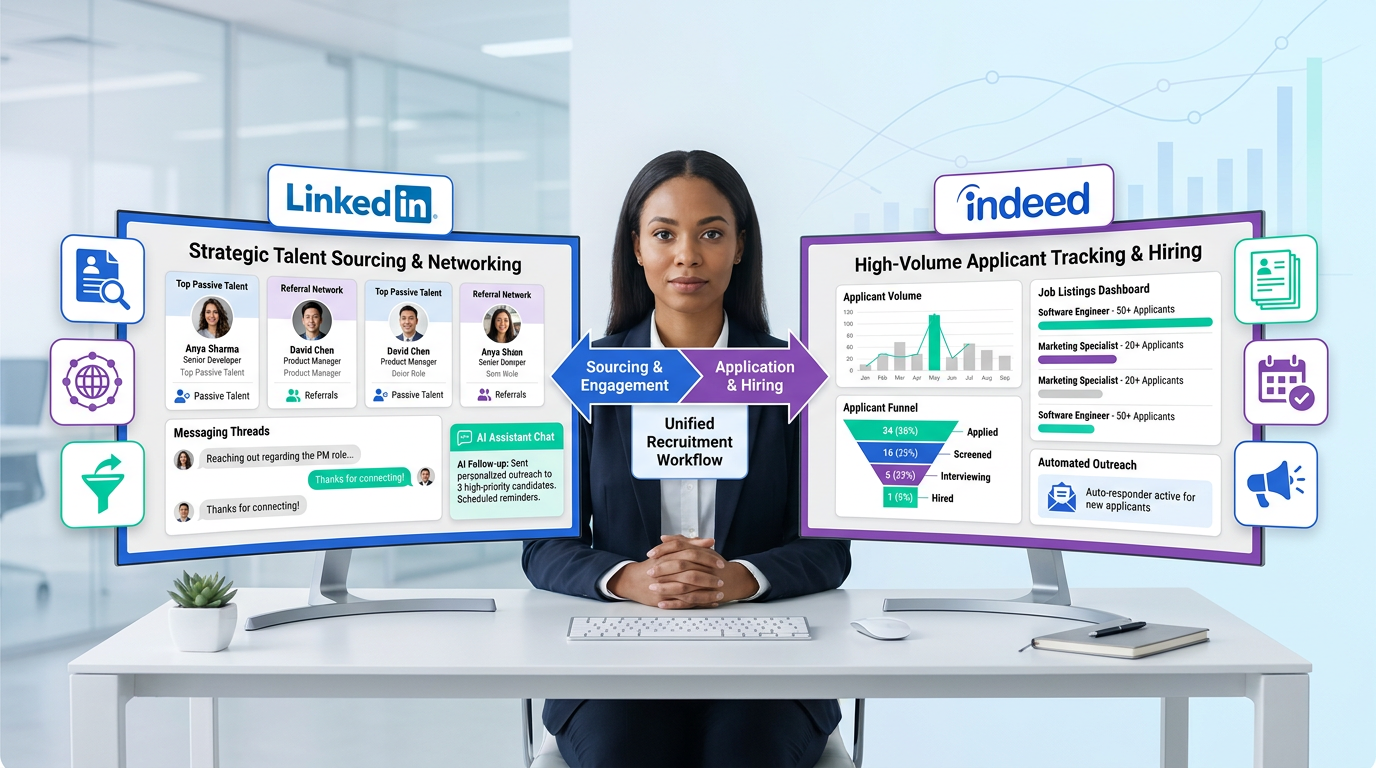
This recruiter-focused guide shows when is LinkedIn or Indeed better for jobs means stronger fit, faster hires, or wasted pipeline.
That judgment matters because the wrong channel does not just waste posting budget. It creates thin pipelines for niche searches, bloated pipelines for broad roles, slower response times, weaker employer credibility, and more manual follow-up for recruiters, agency owners, and in-house talent teams. In smaller firms especially, every hour spent chasing low-intent applicants or missing strong passive talent shows up in revenue, placement speed, and client trust.
In my own LinkedIn-heavy recruiting work, tools that reduce repetitive messaging have helped most when they stay in a support role rather than pretending to replace recruiter judgment. I have found AI Recruiter useful for handling first-touch outreach, after-hours candidate replies, and multilingual follow-up on LinkedIn, especially when a search depends on reaching passive talent consistently. It can introduce roles, capture resumes and contact details, and keep conversations moving, while the recruiter still owns resume review, fit assessment, and the final decision on who enters the interview process.
A good example comes from a familiar recruiting career crossroads: accountants who discover they no longer want another month-end close, but also do not want to throw away years of finance training. Recruiters who work with that group quickly learn that these candidates are not responding to a generic job-board pitch alone. They often want to understand whether a move into recruitment still lets them use their accounting background, whether they will gain broader exposure to finance across companies, and whether a more performance-driven career actually fits their appetite for client-facing work.
That moment of hesitation is where platform choice starts to matter. If a recruiter relies only on broad inbound traffic, these career-switch candidates can get lost among active applicants. If the recruiter relies only on networking without process discipline, follow-up becomes inconsistent and credibility drops. The case exposes the real LinkedIn vs question: when does a networking-led platform outperform a volume-led board, and when should recruiters add broader LinkedIn alternatives to match candidate intent?
Table of Contents
- Quick answer
- Why the platform choice changes by role
- LinkedIn vs Indeed: recruiter comparison
- What career-switch candidates teach recruiters
- LinkedIn vs by hiring use case
- Best LinkedIn alternatives by search intent
- How I support LinkedIn workflows in practice
- Mistakes recruiters and job seekers make
- FAQ
- Final verdict
Quick Answer
If you are asking is LinkedIn or Indeed better for jobs, the practical answer is this: Indeed is usually stronger for broad, active job search and high application volume, while LinkedIn is stronger for relationship-led recruiting, passive candidates, referrals, and career moves where identity and credibility matter as much as the application itself.
That is why the follow-up query is indeed or LinkedIn better almost always needs a use-case answer instead of a universal winner. Recruiters filling entry-level customer support roles often need a different channel mix than recruiters trying to persuade an accountant, analyst, or finance manager to consider a move into recruiting or another consultative career.
Recruiter takeaway: Use Indeed when search breadth matters most. Use LinkedIn when candidate trust, profile depth, and outreach quality matter most. Add alternatives when the target role is remote, startup-focused, community-driven, or career-transition sensitive.
Why the Platform Choice Changes by Role
Experienced recruiters know that platform performance changes because candidate motivation changes. A person actively applying to many jobs behaves differently from someone quietly evaluating whether to leave a stable but unsatisfying profession. The accountant who is questioning long hours, limited upside, or repetitive close cycles is not just searching for jobs. That candidate is weighing identity, earnings, client exposure, and whether existing expertise can transfer into a new path.
In other words, some hiring decisions are simple inventory problems and some are persuasion problems. Job boards help with inventory. LinkedIn helps more with persuasion because it gives candidates context: who is reaching out, what the hiring manager looks like, whether shared connections exist, and whether the role feels like a credible next step rather than a random pitch.
This distinction also explains why career-switch recruiting often rewards recruiters who understand the candidate's bigger story. In the accounting-to-recruiting example, the candidate may value five things at once: keeping some relevance from their original training, gaining visibility across industries, earning based on performance, building stronger soft skills, and doing work that has a more direct effect on people. Those motives do not surface well in a purely transactional apply flow.
LinkedIn vs Indeed: Recruiter Comparison
| Factor | Indeed | |
|---|---|---|
| Best for | Networking, sourcing, referrals, passive talent, professional brand | Active job search, broad listings, direct applications, top-of-funnel volume |
| Candidate intent | Often mixed: open, passive, researching, networking | Usually more active and application-ready |
| Recruiter strength | Outbound outreach and market mapping | Inbound applicant generation |
| Best role types | Professional, specialist, relationship-driven, mid-senior roles | High-volume, entry-level, broad-market, location-based roles |
| Application flow | Mixed between on-platform and external paths | Often simpler and more direct |
| Best use in career transitions | Strong, because context and persuasion matter | Useful, but less effective when trust-building is required |
For recruiters, that table is more useful than a generic popularity debate. It reflects what happens on actual searches. When the candidate needs more than a job title and salary range to make a move, LinkedIn tends to outperform because the conversation itself becomes part of the qualification process.
What Career-Switch Candidates Teach Recruiters
The reference case of accountants considering recruitment is valuable because it shows how often career decisions are driven by transferable strengths, not just technical mismatch. Many accountants who explore recruitment are not rejecting discipline, analysis, or business rigor. They are looking for a role where those strengths can be applied in a more consultative, commercial, and human-centered way.
As recruiters, we see similar patterns in many transitions: operations into customer success, journalists into content strategy, teachers into enablement, and accountants into talent advisory. The question is not only whether a candidate can do the next job. It is whether the next role preserves useful parts of the current identity while solving what the candidate dislikes most about the current one.
That is one reason LinkedIn often wins these searches. It gives recruiters room to position the move around leverage, exposure, earning structure, soft-skill growth, and impact. Those were core themes in the original accounting-to-recruiting logic, and they remain highly relevant to how recruiters pitch any career pivot with credibility.
1. Transferable expertise matters
A recruiter speaking with an accountant-turned-candidate is rarely starting from zero. The candidate already understands finance structures, business drivers, and how teams succeed or fail. On LinkedIn, that depth is visible in a way that a basic application form usually cannot capture.
2. Exposure can be a stronger motivator than title
Many professionals move because they want broader exposure across industries and companies, not simply a new title. Recruiters can frame that narrative more effectively through direct outreach and profile-based conversation than through a high-volume job board workflow.
3. Performance-linked upside attracts a different audience
Some candidates are drawn to roles where output has a clearer connection to reward. That does not apply to everyone, but it matters to commercially minded professionals. Those conversations often begin more naturally in a networking environment than in a mass-application environment.
4. Soft skills become hiring signals
In recruitment, trust, empathy, communication, and relationship management are core capabilities. LinkedIn makes those signals easier to assess through profile activity, mutual connections, recommendations, and message quality. That is much harder to infer from a resume alone.
5. Impact needs a believable story
The strongest recruiting pitches often connect the role to meaningful impact. In the accounting-to-recruiting example, the argument is clear: helping someone choose the right role affects careers, teams, and business performance. Candidates considering such a move usually need that story to feel real, not scripted.
LinkedIn vs by Hiring Use Case
The phrase LinkedIn vs only becomes useful when tied to a concrete hiring scenario. Here is where the split usually shows up.
LinkedIn vs Indeed for entry-level jobs
Indeed often performs better for entry-level recruiting because listing volume and active applicant flow matter more. Candidates are usually in market, speed matters, and the job seeker is less dependent on referral context.
LinkedIn vs Indeed for experienced professionals
LinkedIn is usually stronger for experienced professionals because profile history, recommendations, employer brand, and recruiter outreach all influence response rates. This is where the answer to is LinkedIn or Indeed better for jobs usually shifts toward LinkedIn.
LinkedIn vs Indeed for passive candidates
LinkedIn wins clearly. Passive candidates are less likely to run repeated keyword searches and more likely to respond to targeted outreach, especially when the recruiter can explain why the move fits their background and long-term goals.
LinkedIn vs Indeed for career-switch candidates
LinkedIn is often the better environment because the recruiter needs to position the opportunity, not just advertise it. The candidate may be asking whether prior experience still matters, whether the move changes income structure, and whether the day-to-day work will feel more meaningful.
LinkedIn vs Indeed for local high-volume hiring
Indeed usually has the edge when the search is local, broad, urgent, and process-led. In those cases, application throughput often matters more than relationship building.
Best LinkedIn Alternatives by Search Intent
When people search for general LinkedIn alternatives, they usually do not want a random list. They want a better fit for a specific search style.
General job boards
Best when a candidate wants scale, speed, and straightforward applications. These are closest to Indeed in user behavior and work well for active search.
Remote-job platforms
Best when remote filters on large platforms feel noisy or unreliable. Useful for distributed hiring and remote-first candidates.
Startup-focused hiring sites
Best when the candidate wants smaller teams, broader role scope, and higher-variance opportunities. Good for people who are motivated by growth and learning over structure.
Niche industry boards and communities
Best when relevance matters more than volume. These can outperform both LinkedIn and Indeed for specialized functions or tightly networked professions.
Direct company career pages
Best when the candidate already knows the target employer. This route often gives the cleanest application path and the most accurate open-role list.
The recruiter lesson is simple: alternatives are not substitutes in the abstract. They are tools for different intents. If your market includes passive candidates, trust-led transitions, or specialist persuasion, LinkedIn may still anchor the strategy even when alternatives help broaden reach.
How I Support LinkedIn Workflows in Practice
Because this topic is really about LinkedIn usage experience as much as platform comparison, it is worth being specific about where support tools help and where they do not. In my own workflow, the biggest LinkedIn bottlenecks are repetitive first-touch messages, reply lag outside work hours, and conversation loss when multiple prospects respond at once across searches.
That is where I have used StrategyBrain AI Recruiter as an assistant layer rather than a replacement for recruiter craft. It can automatically connect with candidates in targeted searches, introduce the opportunity, answer routine role questions, and continue follow-up in the candidate's language when timing or geography would otherwise slow the process. For passive candidate recruiting on LinkedIn, that continuity matters.
What I like in practice is that it handles the repetitive front end while leaving the actual recruiting judgment where it belongs. If a finance candidate considering a move into recruiting sends back a resume and asks nuanced questions about compensation, team structure, or long-term fit, I still review the profile, decide whether the background is really transferable, and choose whether to move the person forward. The tool helps maintain momentum; it does not make the hiring decision.
For teams that want to see how these conversations are structured, the conversation examples are useful, and the broader workflow overview shows how LinkedIn outreach can be automated without removing recruiter oversight. In searches where passive talent is the difference between average and excellent outcomes, that support can be genuinely practical.
Mistakes Recruiters and Job Seekers Make
Treating one platform as the universal winner
The query is indeed or LinkedIn better sounds binary, but real hiring rarely is. The right answer changes with role type, candidate intent, and how much persuasion the move requires.
Using LinkedIn only as a job board
LinkedIn is strongest when used for outreach, referrals, and credibility building, not just posting jobs. Recruiters who ignore that usually underuse the platform.
Using Indeed for roles that need trust-building
Indeed can generate applicants quickly, but not every role is a volume problem. Career transitions and specialist moves often need context-rich conversations.
Ignoring candidate psychology in career pivots
A professional leaving accounting, consulting, or another structured field is often evaluating risk, status, income, and identity at the same time. Platform choice should reflect that complexity.
Automating without human review
Support tools are helpful, but recruiters still need to evaluate resumes, verify fit, and guide the next step. Automation should reduce manual repetition, not replace professional judgment.
FAQ
Is LinkedIn or Indeed better for jobs?
Indeed is usually better for active search and broad application volume. LinkedIn is usually better for networking, passive-candidate visibility, and roles where recruiter outreach or referrals matter.
Is Indeed or LinkedIn better for recruiters?
Indeed is often better for inbound volume. LinkedIn is often better for sourcing, persuasion, and hard-to-fill professional roles. Most recruiters use both, plus a few alternatives.
Why does LinkedIn work better for career transitions?
Because the candidate often needs more context before applying. LinkedIn allows recruiters to position the opportunity around transferable skills, earnings model, exposure, and long-term fit.
Are LinkedIn alternatives worth using?
Yes, especially for remote hiring, startup hiring, niche talent, and direct-employer targeting. The best alternative depends on search intent, not just traffic size.
Can AI support LinkedIn recruiting without replacing recruiters?
Yes. Support tools can help with outreach, follow-up, multilingual communication, and resume collection, while the recruiter still owns fit assessment and interview decisions.
Final Verdict
If you want the clearest answer to is LinkedIn or Indeed better for jobs, use Indeed for broad active search, use LinkedIn for trust-led and relationship-led recruiting, and add general LinkedIn alternatives when the market is niche, remote, startup-focused, or community-driven.
From a recruiter's perspective, the deciding factor is not which platform is bigger. It is which platform fits the candidate's decision process. The accountant considering a move into recruitment is a good reminder of that. When a candidate is weighing transferable expertise, exposure, earnings, soft skills, and personal impact, platform context matters. That is where LinkedIn often has the edge, and where thoughtful support from tools like AI Recruiter can make LinkedIn workflows more responsive without removing recruiter judgment.