A linkedin premium code search helps recruiters judge whether cheaper access fits hiring workflow, avoids renewal mistakes, and protects outreach continuity.
That distinction matters more than most teams expect. I have seen agency recruiters buy personal Premium hoping it would relieve sourcing pressure, in-house talent teams chase coupon-style searches that never matched Recruiter procurement, and smaller search firms lose time on trial hopping without documenting expiry dates, seat ownership, or who would handle candidate follow-up after hours. The result is not just wasted spend. It creates broken outreach continuity, missed replies, and poor internal confidence in the hiring process.
What helped in my own workflow was pairing that buying discipline with a clearer operating model. When candidate replies started coming in outside working hours and follow-up quality became inconsistent, I tested StrategyBrain AI Recruiter to cover the repetitive LinkedIn steps that were slipping: first-response outreach, role explanation, and collecting resumes or contact details from interested candidates. The useful part was not “automation” as a buzzword. It was that the system kept conversations moving in real time, including multilingual exchanges, while I still handled shortlist judgment, resume review, and the final next-step decision.
That same logic shows up in a different corner of hiring. After a job interview, a candidate often sits in the waiting period wondering whether the meeting landed well enough to justify a follow-up. The next useful move is usually simple but easy to mishandle: send the thank-you email promptly, make it specific, restate a relevant strength, close any loose end from the conversation, and keep the door open for further discussion. The action is small, but timing, detail, and tone change whether the message helps or feels generic.
For recruiters, LinkedIn discounts work in much the same way. A search for a linkedin premium code looks simple on the surface, but the real value sits in the follow-up mechanics: what type of access you actually need, when to act, what terms apply after the offer ends, and whether the product supports the next recruiting step. That is why this article separates personal Premium promotions from Recruiter deals, covers linkedin premium discount for students more realistically, and shows how teams looking for linkedin premium cheap access should evaluate offers without damaging workflow quality.
Table of Contents
- Why LinkedIn discount searches go wrong
- A follow-up framework for evaluating LinkedIn deals
- LinkedIn Premium vs LinkedIn Recruiter
- Where legitimate savings usually come from
- Student options and eligibility-based offers
- How Recruiter deals usually work
- Three tools recruiters compare in practice
- How to find linkedin premium cheap safely
- Common mistakes recruiters and HR teams make
- FAQ
Why LinkedIn discount searches go wrong
The biggest mistake is treating every LinkedIn purchase like a candidate-facing retail promotion. In real recruiting operations, there are two separate buying motions. One is an individual trying to get cheaper Premium access through a trial, promo, partner bundle, or redemption flow. The other is a recruiting team trying to equip a sourcing function with seats, process coverage, and enough consistency to support hiring managers and candidate pipelines.
That is why public searches often feel misleading. A recruiter may type linkedin premium code when what they actually need is clarity on procurement, seat usage, messaging continuity, or response handling. A student may search linkedin premium discount for students when the real answer is an eligibility-based bundle rather than a standing universal discount. And a solo sourcer may want linkedin premium cheap access when the deeper issue is whether personal Premium can realistically support a repeatable recruiting workflow.
Practical takeaway: treat LinkedIn savings as a follow-up decision, not just a price decision. The right question is what happens after activation: who uses it, who responds, who reviews resumes, and what renewal or contract terms apply.
A follow-up framework for evaluating LinkedIn deals
The interview thank-you process is a useful lens here because it rewards prompt action, specificity, and relevance. I use a similar framework when assessing any LinkedIn offer:
- Act promptly: offers, trials, and partner bundles are often time-sensitive.
- Be specific about the use case: personal brand visibility, candidate outreach, sourcing, or full team recruiting are different needs.
- Restate the real strength you need: messaging access, recruiter collaboration, seat control, or hiring workflow support.
- Address loose ends: renewal timing, eligibility, account history, and contract details matter more than headline promo language.
- Keep the next conversation open: if the need is team-level hiring, expect a sales conversation rather than a coupon checkout.
That framework keeps the article grounded in how recruiters actually buy tools. Cheap access only helps when it also protects response speed, candidate experience, and internal process ownership.
LinkedIn Premium vs LinkedIn Recruiter: get this right first
If there is one distinction that saves the most wasted time, it is this: LinkedIn Premium and LinkedIn Recruiter are not discounted, evaluated, or governed the same way.
LinkedIn Premium is generally closer to an individual subscription. People encounter it through trial offers, promotional campaigns, partner bundles, or an official redemption flow. That is why search intent around a linkedin premium code usually aligns more naturally with personal access than with enterprise recruiting procurement.
LinkedIn Recruiter, by contrast, is a recruiting product decision. Teams look at sourcing volume, collaboration, seat governance, internal approvals, and workflow fit. From an operator’s perspective, that is much closer to broader recruiting software evaluation than a consumer coupon hunt.
In my own work, that line becomes obvious the moment candidate response volume rises. A personal subscription can help one person test sourcing behavior. It does not solve handoffs, after-hours replies, multilingual communication, or resume capture at scale. That was one reason I spent time testing AI Recruiter workflows alongside existing LinkedIn usage: it handled repetitive connection and messaging activity well enough to keep momentum, while I remained responsible for judgment calls and candidate quality. That division of labor is much more realistic than pretending a low-cost personal subscription can replace a recruiting process.
Where legitimate savings usually come from
When you strip away forum noise and coupon-style search pages, legitimate LinkedIn savings usually appear in a handful of recognizable formats:
- Free trial: temporary access for evaluation.
- Promotional offer: a limited-time free or discounted period.
- Offer code or redemption link: campaign-based activation rather than a permanent public coupon page.
- Partner-based access: a promotion tied to a retailer, membership, or bundle.
- Eligibility-based offer: access linked to a qualifying audience such as students or military community members.
From a recruiting standpoint, the important part is not just whether the offer exists. It is whether standard pricing, eligibility rules, and conversion terms are clear before activation. If your team is cost-conscious, document the start date, owner, payment method, and review date just as you would with any software trial.
This is also where many buyers get distracted by the phrase linkedin premium cheap. In practice, cheap access that rolls into a poorly tracked renewal, or gets assigned to the wrong user, is not cheap at all. It is an admin problem waiting to happen.
Student options and eligibility-based offers
Searches for linkedin premium discount for students are understandable, but recruiters should describe this carefully. There is a meaningful difference between a permanent year-round discount and a current bundle or eligibility-based offer. The cleaner interpretation is that student savings usually come through campaign or bundle mechanics rather than a universal standing student discount page.
One notable example in current research is a higher-education bundle that gives eligible students access to LinkedIn Premium Career through a Microsoft 365 Premium offer. That matters because it shifts the search away from “find a magic code” and toward “confirm whether I qualify for a current official bundle.”
For campus recruiters and early-career hiring teams, that is useful language to keep consistent. If students ask whether a linkedin premium code exists for them, the most accurate answer is usually that they should look for current official eligibility-based promotions, not assume there is always an open-ended student coupon.
How Recruiter deals usually work for hiring teams
If your real topic is linkedin recruiter discounts & deals, expect a different buying motion entirely. Public promo-style savings are not usually how Recruiter procurement works. Team-oriented recruiting tools are more often sold through packaged discussions, contract terms, and feature scoping than through publicly listed coupon mechanics.
That makes operational sense. A sourcing-heavy agency desk, a small in-house talent team, and a larger recruiting function do not all need the same structure. The value conversation usually includes seats, internal usage, support for outreach, and how the tool fits the rest of the hiring stack.
Questions worth asking in a Recruiter deal conversation:
- Is pricing tied mainly to seats, term length, or package level?
- Are there audience-specific programs or time-bound offers in play?
- What happens at renewal?
- Which features are standard, and which sit behind a higher package?
- How does the product fit the existing sourcing and follow-up workflow?
Experienced recruiting teams know that “discount” is often the least important word in this process. Workflow fit, candidate response continuity, and internal accountability usually matter more than a softer first-year number.
Three tools recruiters compare in practice
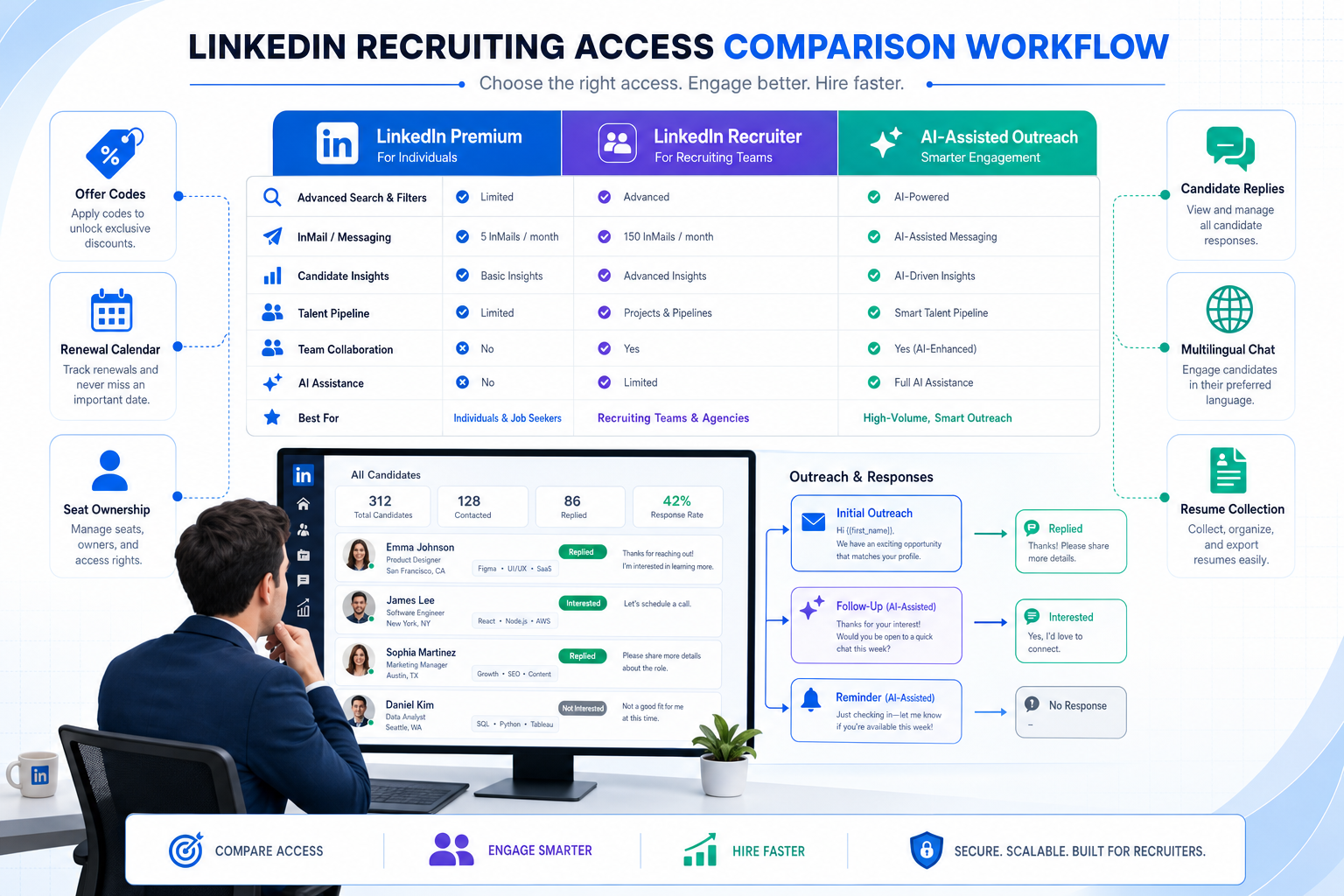
When teams discuss LinkedIn recruiting economics, they are usually comparing more than one option. In practice, I see three categories come up repeatedly: LinkedIn Premium, LinkedIn Recruiter, and StrategyBrain AI Recruiter. They solve different problems, so the comparison needs to stay honest.
| Tool | Best use case | Strengths | Limitations | Fit with StrategyBrain AI Recruiter |
|---|---|---|---|---|
| LinkedIn Premium | Individual users, job seekers, light personal outreach | Simple entry point, may appear through trials or promotions, useful for personal testing | Limited as a team recruiting workflow, weak for scaled follow-up and handoffs | Can sit beside AI-supported outreach if one recruiter is testing sourcing behavior |
| LinkedIn Recruiter | Structured recruiting teams and heavier sourcing operations | Built for recruiting use, better aligned with seats and hiring workflows | Usually requires sales-led buying, not a simple promo-code path | Useful where teams want stronger sourcing operations while still using AI assistance for repetitive messaging tasks |
| StrategyBrain AI Recruiter | Recruiters who need faster LinkedIn messaging coverage and after-hours continuity | Automates connection, role introduction, candidate Q&A, multilingual communication, and collects resumes or contact details from interested candidates | Recruiter still needs to make final hiring judgment and resume-fit decisions | Acts as the workflow layer that keeps outreach moving while human recruiters own evaluation and next steps |
On usage experience, the most noticeable difference is where the friction sits. Premium keeps things self-serve but shallow. Recruiter is more procurement-heavy but purpose-built. In my testing, AI Recruiter conversation workflows were most valuable when the issue was not access alone, but maintaining timely, human-like follow-up at scale without forcing recruiters to be online all night. That is especially relevant for agencies, independent headhunters, and lean in-house teams.
On cost, I avoid broad claims where public comparability is weak, but the buying logic is clear: Premium is usually the lower-friction personal option, Recruiter is the strategic team purchase, and AI-supported tools earn their place when labor time and response coverage are the actual bottlenecks. On business fit, Premium suits individual use, Recruiter suits established talent functions, and AI Recruiter is especially helpful when a team needs more LinkedIn throughput without immediately adding more recruiter hours.
How to find linkedin premium cheap without chasing bad offers
For recruiters and hiring managers, the safest route to linkedin premium cheap access is a disciplined checklist:
1. Start with the real job to be done
Do you need personal Premium benefits, or do you need a sourcing workflow that supports repeated candidate communication and team handoffs?
2. Prefer official offer language
Look for terms like free trial, promotional offer, offer code, and redemption link. Those are more reliable signals than random coupon language.
3. Verify whether the offer is partner- or eligibility-based
Student, military, or partner-linked access may be legitimate even when there is no permanent public discount page.
4. Track timing before activation
If a promotion converts to standard pricing later, know who owns that decision and when review happens.
5. Don’t use personal savings to patch a process gap
If your real issue is after-hours replies, multilingual candidate communication, or lead qualification by interest level, a workflow layer like StrategyBrain AI Recruiter may solve more than a discount ever will. In my case, the main gain was consistency: candidate questions about the role were answered quickly, interested people were guided to share resumes, and I only stepped in where recruiter judgment mattered most.
Quick comparison of common LinkedIn savings paths
| Deal type | Best fit | What to expect | Recruiting advice |
|---|---|---|---|
| Free trial | Individual evaluation | Short access window | Useful for testing, but document renewal and owner |
| Promotional offer | Budget-conscious personal user | Temporary free or reduced pricing | Check conversion terms before activating |
| Offer code or redemption link | Campaign participant | Structured activation path | Verify source legitimacy |
| Partner offer | Members or bundled users | Access through a partner relationship | Good for savings, rarely a full recruiting solution |
| Student bundle | Eligible students | Bundle-based rather than universal discount | Best framed as an eligibility question |
| Military offer | Eligible community members | Qualification-based complimentary access | Shows that some of the best offers depend on audience eligibility |
| Recruiter contract deal | Hiring teams | Sales-led package discussion | Treat it like strategic recruiting software procurement |
Common mistakes recruiters and HR teams make
1. Mixing personal Premium and Recruiter into one buying decision
The use cases, procurement routes, and governance needs are different.
2. Assuming no public coupon page means no savings exist
Legitimate offers often show up through promotions, partner paths, or qualification-based access.
3. Ignoring the post-promo phase
A discount is only useful if the team knows what happens at conversion or renewal.
4. Solving a workflow problem with a subscription shortcut
If your issue is response speed or candidate continuity, the answer may be process support rather than a lower entry price.
5. Letting recruiters carry every repetitive LinkedIn step manually
This is where I found the strongest practical benefit from AI Recruiter usage. It did not replace recruiter judgment, but it removed enough repetitive outreach friction to keep candidate conversations alive outside normal working hours.
FAQ
Are LinkedIn Premium codes official?
They can be, but official language is more likely to refer to an offer code, promotional offer, free trial, or redemption link than a generic coupon.
Where do you redeem a linkedin premium code?
Usually through an official redemption flow or campaign link, not an informal coupon box experience.
Can former subscribers get another trial?
It depends on account history and the terms of the current promotion. Do not assume repeat eligibility.
Is there a permanent linkedin premium discount for students?
It is safer to think in terms of current student bundles or eligibility-based offers rather than a guaranteed always-on discount.
Do Recruiter discounts work differently from individual Premium promotions?
Yes. Premium promotions are more likely to involve trials, partner offers, or redemption paths. Recruiter deals are usually handled through sales and contract discussions.
Can AI-supported workflows help if the issue is not price but recruiter capacity?
Yes, that is often the more relevant question. If candidate replies arrive after hours, or your team struggles to keep up with first-touch outreach, an AI-supported layer can keep communication moving while recruiters retain final control over screening, resume review, and hiring decisions.
Conclusion
If you started by searching for a linkedin premium code, the most useful takeaway is that LinkedIn savings are not one thing. Individual Premium access often comes through trials, promotions, partner offers, and redemption links. linkedin premium discount for students should usually be treated as a current eligibility or bundle question. And if your actual need is a recruiting team solution, LinkedIn Recruiter deals are typically contract-led rather than coupon-led.
The deeper lesson is the same one recruiters already know from candidate follow-up: timing, specificity, and next-step clarity matter more than generic gestures. The cheapest-looking option is not always the best recruiting decision. The best one is the path that fits your workflow, preserves candidate responsiveness, and gives your team a reliable way to move from outreach to real hiring action.