When linkedin recruiter competitors are on your shortlist, this guide helps hiring leaders diagnose workflow gaps, compare fit, and avoid costly stack mistakes.
That distinction matters because most teams do not start this search due to curiosity. They start when recruiters are spending too much time repeating first-touch outreach, missing after-hours replies, losing context between sourcing and follow-up, or paying for seats that still leave hiring managers without a clear view of pipeline health. For a small search firm, that means wasted desk time and thinner margins. For an in-house TA team, it means slower hires, weaker candidate experience, and more friction with stakeholders who want faster answers.
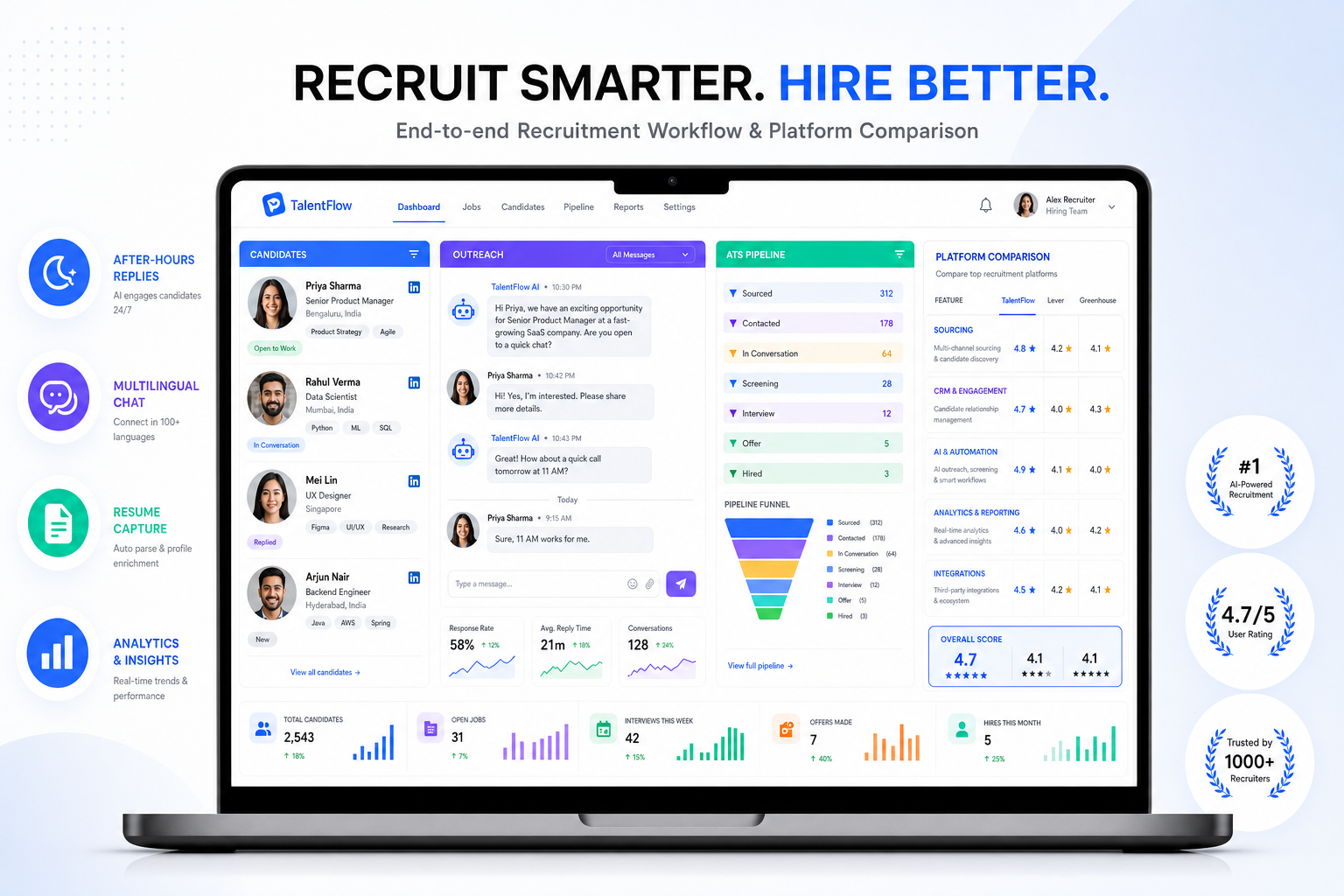
In my own workflow, one practical way to relieve that pressure has been using AI Recruiter as a support layer around LinkedIn activity, especially for repetitive outreach, multilingual follow-up, and late-hour candidate replies. It helps keep conversations moving when recruiters are offline, while the recruiter still owns résumé review, fit assessment, and the final decision on who advances. That kind of support does not replace judgment, but it can remove a lot of avoidable manual drag from the top of funnel.
A useful way to frame this came from the broader workplace conversation around happiness at work. Every year, March 20 puts employee wellbeing back into focus, and the underlying research is consistent: people work better when they feel supported, informed, and able to make progress without unnecessary friction. In recruiting, that shows up in very concrete actions. A recruiter checks a requisition list, opens overnight candidate replies, tries to answer a compensation question, logs a note for the hiring manager, and then realizes half the context is scattered across tabs, inboxes, and browser searches.
That is why choosing among linkedin recruiter competitors is not only a sourcing decision. It is also a workflow and experience decision. If happier, more effective work comes from the right mix of tools, then the best alternatives to LinkedIn Recruiter are the ones that reduce recruiter friction, support better candidate communication, and fit the operating style of your team. The rest of this guide answers what are good alternatives for LinkedIn Recruiter by use case, not by hype.
Table of Contents
- Why teams start looking for alternatives
- How to evaluate title fit, search intent, and product fit
- What makes a good LinkedIn Recruiter alternative?
- Quick comparison table
- Three common platform paths recruiters compare
- The 4 main categories of alternatives
- How I use AI support in LinkedIn recruiting
- How to choose the right platform for your team
- Why ATS and CRM depth matter
- Common mistakes buyers make
- FAQ
Why teams start looking for alternatives
When recruiters search for linkedin recruiter competitors, the intent is usually practical and commercial. They want to know whether another tool, or another stack design, will improve sourcing reach, outreach throughput, candidate response handling, analytics, or cost efficiency. The search is often triggered by one of four things:
- Too much time spent on repetitive LinkedIn messaging
- Not enough visibility outside one network
- Weak handoff between sourcing activity and ATS or CRM records
- Seat costs that feel hard to justify against actual recruiter output
That is also why this topic connects naturally to workplace effectiveness. In hiring teams, frustration is rarely caused by one feature gap alone. It is caused by the accumulation of small process interruptions: switching tabs, rewriting the same first-touch messages, waiting overnight for candidate replies, forgetting who needs follow-up, and trying to reconstruct context before a hiring manager check-in. Those are not minor inconveniences. They shape recruiter focus, team morale, and the consistency of candidate experience.
How to evaluate title fit, search intent, and product fit
Before comparing tools, it helps to evaluate the search itself. The topic linkedin recruiter alternatives and the seed keyword linkedin recruiter competitors both signal comparison intent, but not all searchers want the same thing. Some want sourcing databases beyond LinkedIn. Some want automation around LinkedIn workflows. Others really want an ATS or CRM that reduces operational friction after sourcing begins.
From an SEO and CTR perspective, strong titles and opening lines usually do three things well:
- State the hiring outcome clearly. Readers click when they can see the article will help them choose, not just browse a list.
- Reflect the real use case. Agency recruiters, in-house TA, and small teams care about different tradeoffs.
- Signal practical judgment. A title should imply comparison, workflow experience, or use-case fit rather than generic software praise.
That same logic applies inside the article. If a platform only looks good in a demo but does not help a recruiter answer candidates, collect contact details, route résumés, and keep ownership clear, it is not a strong alternative in practice.
What makes a good LinkedIn Recruiter alternative?
A useful alternative should be assessed against the capability areas recruiters care about most: network coverage, advanced search, outreach workflow, ATS/CRM integrations, analytics, and seat efficiency. Those are the areas where buyers usually feel the pain first.
From an operator’s perspective, the best replacement is not always the most recognizable platform. It is the one that helps recruiters move candidates from discovery to conversation to interview without losing context. In other words, a sourcing tool can be valuable, but if it increases admin burden or leaves follow-up scattered, the day-to-day experience still breaks down.
Key insight: Many teams think they are replacing LinkedIn Recruiter because they need better search. Often, they are really trying to reduce recruiter friction and build a more workable hiring system.
That is where ATS and CRM depth begin to matter. Strong search is useful, but process control is what keeps hiring teams aligned. It is also where candidate experience improves, because messages are timely, notes are visible, and hiring managers can see what is happening without chasing recruiters for updates.
Quick comparison table of linkedin recruiter competitors
| Platform | Best For | User Experience | Likely Effect | Cost Pattern | Best Fit | How it can work with AI support |
|---|---|---|---|---|---|---|
| SeekOut | Enterprise sourcing and technical search | Strong for discovery and talent mapping | Useful when LinkedIn feels too narrow | Usually custom enterprise pricing | Large internal teams and specialized hiring | Can pair with LinkedIn message automation to keep outreach moving after sourcing |
| hireEZ | Sourcing plus outbound workflow | More outreach-oriented than pure databases | Helps teams turn searches into contact sequences | Usually custom pricing | Sourcing teams and outbound-heavy recruiters | Can complement LinkedIn conversation handling when recruiters need coverage outside business hours |
| Gem | CRM, analytics, and recruiting operations | Strong visibility and nurture workflows | Improves pipeline accountability and rediscovery | Usually custom pricing | In-house TA and ops-minded teams | Can sit alongside LinkedIn automation by keeping recruiter-owned follow-up and reporting organized |
These three are often part of the same shortlist, but they solve different problems. SeekOut is usually strongest when talent discovery is the issue. hireEZ tends to stand out when recruiters need more outreach structure. Gem is often chosen when process visibility and CRM discipline matter most.
Three common platform paths recruiters compare
1. Search-first platforms
Search-first tools are for teams that genuinely need more candidate discovery. If recruiters keep seeing the same profiles, or need broader open-web visibility, this path makes sense. In technical recruiting especially, talent mapping and attribute depth can matter more than a familiar interface.
The tradeoff is that search-first tools do not automatically fix the conversation layer. A recruiter may still need help answering candidate questions quickly, keeping contact active overnight, or collecting résumés without manually chasing every reply.
2. Outreach-oriented platforms
Some teams do not need a better database as much as they need better movement from shortlist to conversation. That is where outreach-oriented platforms become more relevant. They matter if recruiters already know how to find talent but struggle to keep consistent contact, sequence follow-ups, and capture engagement signals cleanly.
This is also where a LinkedIn-specific support layer can be useful. In my experience, adding AI Recruiter to repetitive top-of-funnel messaging helped reduce dead time between candidate interest and recruiter review. It automatically handled introductions, candidate replies, and information collection, while I still decided which profiles were worth screening further.
3. CRM and ATS-centered stacks
Other teams are really trying to fix process maturity. They need better stage tracking, ownership, notes, visibility, and reporting. If hiring managers often ask what happened to sourced candidates from last quarter, the issue is not only sourcing volume. It is operational continuity.
That makes CRM and ATS-centered platforms an important part of the conversation around best alternatives to LinkedIn Recruiter. Many buyers discover that they do not need a full replacement for every feature; they need a better combination of sourcing, communication, and system-of-record discipline.
The 4 main categories of alternatives
Sourcing platforms
This group is strongest when your core problem is candidate discovery. If your team says, “We need open-web sourcing beyond LinkedIn,” start here. These platforms often emphasize talent sourcing, market mapping, technical recruiting, and broader profile visibility.
Recruiting CRM and pipeline tools
This category matters when the search itself is not the only problem. Many teams actually need better follow-up, rediscovery of past candidates, recruiter ownership, and cleaner candidate relationship management.
ATS-first recruiting suites
If your recruiting bottleneck is process rather than discovery, ATS-first suites can be a better fit than a sourcing database. They support requisitions, approvals, stages, scorecards, reporting, and hiring-manager collaboration.
LinkedIn workflow automation and AI support
This category matters when the team still wants to work heavily in LinkedIn but needs less manual repetition. It is useful for repetitive first-touch outreach, candidate Q&A, after-hours reply coverage, multilingual conversations, and résumé capture before recruiter review. The important caveat is that final evaluation should remain with the recruiter.
How I use AI support in LinkedIn recruiting
I do not look at AI support as a replacement for a recruiter. I look at it as coverage for the part of the day that gets crowded with repeated actions. In a LinkedIn-heavy workflow, I have used AI Recruiter to handle the opening communication loop: connect with candidates that match the search criteria, introduce the role, answer common questions about the company or compensation, and collect résumé or contact information from interested people. That changes the work shape in a useful way, because my time shifts from chasing replies to reviewing actual interest.
What I found most useful was not a vague promise of automation but three specific operating benefits. First, candidate conversations could continue after normal working hours, which matters because many replies arrive when recruiters are offline. Second, multilingual communication removed some friction in cross-border searches. Third, interested candidates could send contact details and résumés in a structured way, which reduced the back-and-forth before the recruiter stepped in.
If you want to understand how that works in practice, the product walkthrough at this LinkedIn recruiting tutorial is close to how I think about it operationally: let the system carry repetitive top-of-funnel conversations, but keep recruiter control over fit judgment, shortlist decisions, and interview next steps.
How to choose the right platform for your team
Here is the framework I would use with any recruiting team comparing linkedin recruiter competitors.
- Define the actual bottleneck. Is the issue sourcing coverage, first-response speed, candidate follow-up, ATS workflow, or hiring-manager visibility?
- Separate search problems from workflow problems. A better database does not automatically create a better recruiting process.
- Check whether LinkedIn remains central. If it does, workflow support around LinkedIn may matter as much as replacement search capability.
- Map recruiter ownership. Make sure automation supports the recruiter instead of obscuring who reviews, decides, and advances candidates.
- Test using real roles. Compare tools on technical hiring, evergreen roles, and urgent searches rather than generic demo examples.
This is also where the workplace-happiness angle becomes practical again. The right stack does not just improve process metrics. It makes the work more sustainable. Recruiters can spend more energy on judgment, persuasion, and stakeholder management, instead of drowning in repeated first-touch admin.
Why ATS and CRM depth matter more than many buyers expect
A lot of buyers begin with sourcing frustration and later realize they have a workflow problem. You may think you need more profiles, when the actual issue is poor pipeline tracking, inconsistent follow-up, or no shared source of truth for the hiring team.
That matters because recruiting effectiveness is cumulative. Candidate search, outreach, reply handling, résumé capture, interview scheduling, stakeholder alignment, and reporting all need to connect. If one of those handoffs breaks, recruiter effort increases and candidate experience usually declines.
For that reason, some of the best alternatives to LinkedIn Recruiter are not direct lookalikes. They are combinations: a sourcing layer for discovery, AI support for repetitive LinkedIn communication, and a CRM or ATS that keeps the whole process visible.
Common mistakes to avoid when comparing alternatives
Confusing a sourcing tool with an operating system
A search platform and an ATS or CRM solve different problems. Treating them as the same will distort the evaluation.
Buying for features instead of recruiter behavior
A long feature list is not a workflow. Ask what the recruiter actually does hour by hour and whether the tool reduces friction in that sequence.
Ignoring candidate communication reality
Candidates do not only reply during office hours, and not every search is single-language. If your team hires across time zones or regions, support for ongoing communication matters.
Assuming LinkedIn replacement is the only path
Sometimes the right move is not a total switch. It may be a layered approach where LinkedIn remains the channel, but repetitive communication is delegated and pipeline management is strengthened elsewhere.
Skipping the economics of team size
Small agencies and lean in-house teams should weigh complexity carefully. The best tool is not always the biggest suite. It is the one that creates the clearest improvement for the headcount you actually have.
FAQ
What are good alternatives for LinkedIn Recruiter?
Good alternatives depend on the bottleneck. If you need broader sourcing, search-first platforms are usually the right starting point. If you need better outreach or candidate follow-up, outreach-oriented tools or LinkedIn workflow automation may fit better. If your issue is process visibility, a CRM or ATS-centered stack may be the stronger answer.
What are the best alternatives to LinkedIn Recruiter for headhunters?
For headhunters, the best choice usually depends on desk model. Search-led firms may prioritize broader discovery. Relationship-led firms may value CRM depth more. Recruiters who live in LinkedIn every day may benefit from support that automates repetitive messaging while keeping final fit judgment with the consultant.
Are linkedin recruiter competitors always cheaper?
Not necessarily. Some are enterprise tools with custom pricing. The better question is whether the alternative creates better output per recruiter seat, better process visibility, or less manual work.
Can AI support LinkedIn recruiting without replacing recruiters?
Yes. A support layer can automate first-touch communication, answer basic candidate questions, collect contact details or résumés, and keep conversations moving after hours. The recruiter should still review fit, decide who moves forward, and own the hiring decision.
Should small teams replace LinkedIn Recruiter or add support around it?
Small teams should first identify whether the problem is search depth or workflow friction. In many cases, adding support around LinkedIn and tightening ATS or CRM discipline creates more value than swapping one large tool for another.
Conclusion
The market for linkedin recruiter competitors is broader than a list of substitute databases. The real decision is about how your team works: where recruiter time is being lost, where candidate communication breaks down, and which combination of tools creates a smoother, more productive process.
If you are narrowing your shortlist, start with the actual friction point. Then compare options by sourcing coverage, communication flow, ATS or CRM integration, recruiter control, and day-to-day usability. That is the most practical way to answer what are good alternatives for LinkedIn Recruiter and to choose a setup that supports both hiring output and a healthier recruiting workflow.