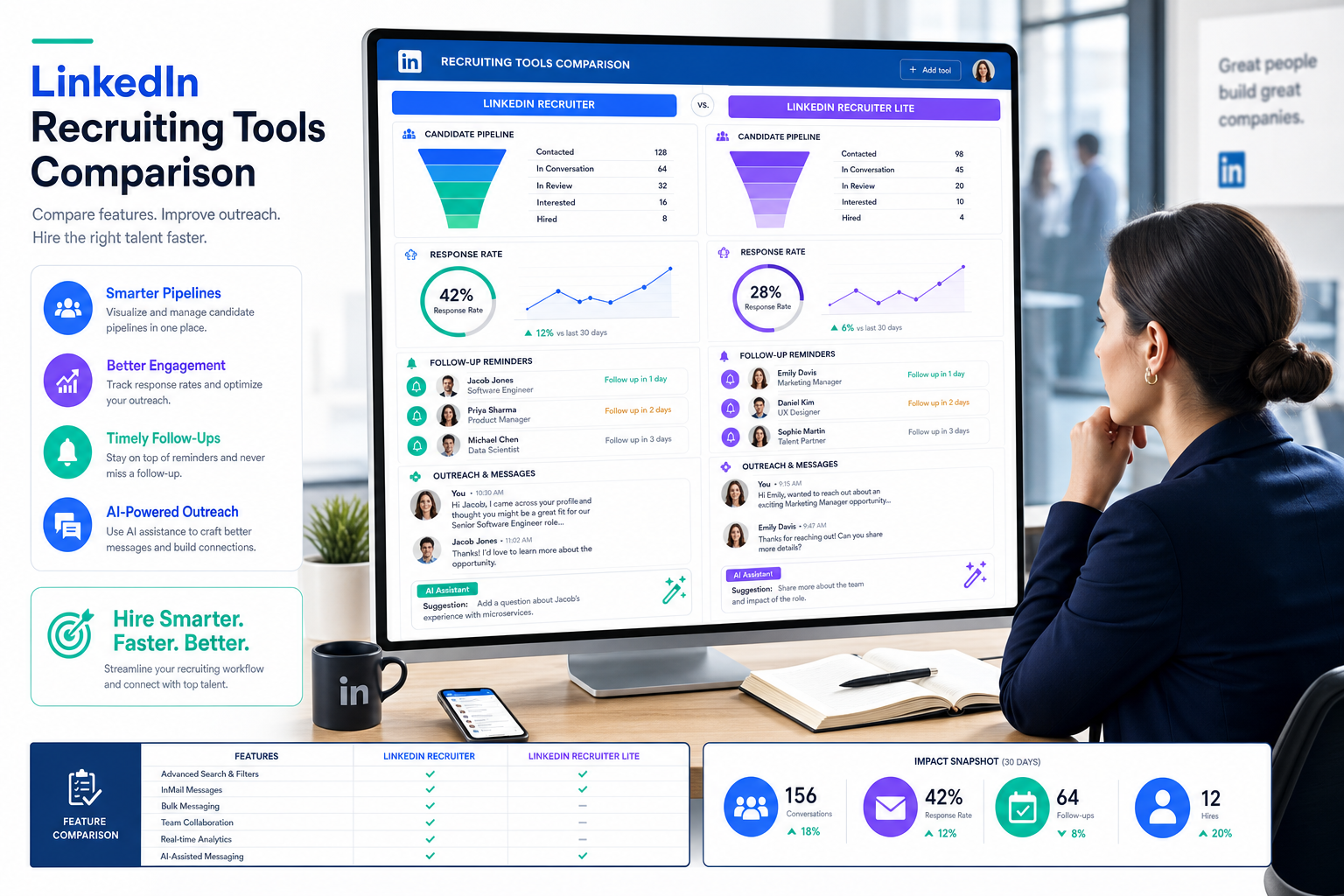
When hiring picks up, headhunters comparing linkedin recruiter competitors can spot workflow gaps, choose the right stack, and avoid follow-up drag.
That sounds obvious until a busy desk is juggling passive outreach, candidate replies after hours, hiring manager updates, and duplicate follow-ups across systems. For a solo headhunter, that means missed response windows and more manual screening. For a small agency owner, it means recruiter time gets absorbed by message handling instead of search quality and client delivery. For an in-house TA lead, it often turns into reporting gaps, inconsistent handoffs, and avoidable software spend.
In my own LinkedIn-heavy workflows, one practical way to ease that pressure has been using StrategyBrain AI Recruiter for the repetitive front end of outreach. It can keep candidate conversations moving, respond across time zones, and collect resumes or contact details from interested prospects while the recruiter still makes the final judgment on fit, resume quality, and next steps. That matters most when the problem is not finding names, but keeping momentum once replies start arriving.
A useful way to frame this comes from a very different business context: after a turbulent 2015, Canadian employers were reading a macroeconomic outlook that mixed bad news with a few clear reasons for optimism. Global growth was expected to strengthen in 2016 and 2017, Canada’s GDP outlook was set to improve from 1.2% to 2.0% and then 2.3%, and employment conditions looked steadier even if not as aggressive as in the U.S. In practice, that kind of outlook does not let recruiting teams relax. It forces them to open requisition lists, recheck hiring priorities, and decide which roles need immediate sourcing before demand tightens.
Once that hiring confidence returns, the operational strain shows up fast. Recruiters have to revisit old LinkedIn threads, sort who is open to talk, update candidate stages, and push shortlists to employers who suddenly want to hire into better market conditions. That is exactly where the search for linkedin recruiter alternatives starts to make sense. Most teams are not asking for a clone. They are asking what are good alternatives for linkedin recruiter when market conditions improve, hiring picks up, and the real constraint becomes recruiter execution rather than raw intent to hire.
- Most linkedin recruiter competitors are best judged by recruiting bottleneck, not by feature count.
- When hiring confidence rises, response handling and workflow follow-through often become bigger problems than search access alone.
- No single platform solves every sourcing, CRM, ATS, and reporting need equally well.
- For many teams, pairing LinkedIn workflows with automation or ATS discipline works better than forcing a one-tool replacement.
Why Better Hiring Conditions Change the Tool Decision
One of the most useful lessons from that Canada outlook is not the headline optimism itself. It is the operational consequence. When employers believe the next year may be stronger than the last, recruiting work gets more urgent very quickly. Leaders move from caution to action. They reopen paused headcount, prioritize revenue roles, and expect recruiters to convert market opportunity into actual hires.
That shift matters because the pressure moves downstream. The challenge is no longer just finding talent on a large network. It becomes replying faster, tracking intent better, keeping passive prospects warm, and avoiding the familiar mess of scattered notes and half-finished follow-up. In other words, improved demand exposes whether your sourcing stack is built for execution.
That is why serious evaluations of linkedin recruiter competitors should begin with timing and workflow pressure. If your market is moving into a stronger hiring cycle, even a decent sourcing database can feel weak when recruiters still have to manually chase every conversation and re-enter every update.
What Really Counts as a LinkedIn Recruiter Alternative
A LinkedIn Recruiter alternative is any platform, workflow, or paired stack that helps a team achieve the same outcomes recruiters actually care about: discovering relevant people, starting outreach, tracking replies, rediscovering talent, collaborating with hiring stakeholders, and moving candidates into a controlled process.
That does not always mean a direct one-for-one replacement. In practice, some teams replace search depth with broader multi-source sourcing. Others improve candidate nurture through CRM functionality. Others decide the real problem was never sourcing at all, but weak handoff into pipeline management, interview coordination, or reporting.
So when someone asks for linkedin recruiter alternatives, the more useful interpretation is this: what stack reduces recruiter friction without leaving the rest of the funnel unmanaged?
Quick Comparison of Common Alternatives
Below is a practical comparison of several widely discussed options. It is not a winner list. It is a use-case guide.
| Alternative | Best For | Primary Strengths | Likely Limitations | Ideal Team Size |
|---|---|---|---|---|
| SeekOut | Talent intelligence and targeted sourcing | Useful for hard-to-find profiles and focused search work | May need other systems for nurture and process control | Mid-size to enterprise |
| hireEZ | Outbound recruiting and sourcing automation | Multi-source discovery and recruiter workflow support | Not always a full operating system for hiring | Small to large TA teams |
| Gem | CRM-led recruiting and pipeline nurture | Strong visibility for outreach tracking and rediscovery | Usually best when paired with existing systems | Scaling in-house teams |
| iCIMS | ATS-centered hiring operations | Structured workflows, approvals, and reporting | Less centered on pure passive sourcing | Mid-size to enterprise |
| Jobvite | End-to-end recruiting process coverage | Broad process control and team collaboration | May not be the sharpest choice for sourcing-first teams | Mid-size organizations |
| Zoho Recruit | Budget-conscious teams and simpler workflows | Administrative ease and broad recruiting coverage | Can feel lighter for advanced talent intelligence | Small teams and agencies |
| Bullhorn | Agency and staffing environments | Fast-moving desk workflow support | Fit varies for corporate TA teams | Staffing firms and agencies |
| Entelo | Sourcing and recruiting automation | Candidate discovery plus workflow assistance | Often needs other systems for full-funnel control | Growing TA teams |
| JobDiva | Agency database-driven recruiting | Operational depth for recruiting firms | Best fit depends on desk style and process maturity | Staffing and search firms |
Three brands come up often in actual buying conversations because they represent different paths. SeekOut is usually part of the discussion when the pain is search precision for specialized roles. Gem is often evaluated when follow-up, nurture, and candidate rediscovery are the bigger issues. Bullhorn is a common reference point for agency environments where speed, activity tracking, and desk discipline matter more than a pure sourcing lens.
From a usage standpoint, each has tradeoffs. Search-focused teams may like the relevance of a specialized sourcing platform but still need separate process control. CRM-led teams may get much cleaner outbound follow-up but remain dependent on another system for approvals and structured hiring stages. Agency teams may prefer a workflow-heavy system but still want a LinkedIn-specific layer to keep candidate communication moving.
That pairing point matters. In workflows where recruiters live inside LinkedIn all day, I have found that AI Recruiter can work alongside a broader stack by handling repetitive candidate messaging, after-hours replies, and resume collection while the recruiter stays responsible for qualification and submission decisions. For users who want to see how that conversation layer works in practice, the conversation examples are useful because they show the operational role more clearly than a feature list does.
How to Choose by Recruiting Use Case
The most honest answer to what are good alternatives for linkedin recruiter is that the right answer changes with the weakest part of your funnel.
Best for candidate discovery and passive sourcing
If your recruiters consistently struggle to identify passive candidates, prioritize tools known for multi-source search, deeper talent intelligence, and faster shortlist creation. The test is simple: can a sourcer move from job criteria to an outreach-ready list faster than they can today?
This matters most in stronger hiring markets, where employers want action quickly and the cost of a slow shortlist goes up. Better macro conditions do not reduce sourcing pressure. They usually increase it.
Best for CRM-led recruiting and nurture
If your team already finds enough names but loses track of conversations, a CRM-oriented option is often stronger than a search-first replacement. This is common in executive search, recurring volume hiring, and any team with a long re-engagement cycle.
That is also where many recruiters feel the gap between discovery and execution. A candidate replied six months ago. Another said “not now, maybe later.” A third was interested but never resumed the thread. The right competitor is the one that helps your desk reuse that history without turning every search into manual archaeology.
Best for inbound applications and process control
If your hiring volume depends more on posted jobs, approvals, and interview discipline than on passive outreach, ATS-led platforms usually matter more than a sourcing-first alternative. In these cases, the best recruiting software is often the system that makes intake, stage control, and reporting cleaner, not the one with the biggest promise around discovery.
Best for technical recruiting
For engineering, data, infrastructure, and security roles, teams often need richer search logic and better talent segmentation. The best option here is usually the one that reduces irrelevant profiles before the recruiter spends time on contact and persuasion.
Best for small teams and cost-sensitive hiring
Small teams usually do not need every enterprise layer. They need enough search capability, enough process structure, and low enough administrative friction that a recruiter can actually use the tool consistently. Cost matters, but total workflow drag matters more.
Where AI-Supported LinkedIn Workflow Helps Most
There is a separate question underneath the usual alternative debate: do you need a new system, or do you need help operating the one you already rely on?
That is where I think many LinkedIn-heavy teams misdiagnose the problem. In my experience, the painful part often starts after a candidate is found. Replies come in outside working hours. Candidates ask basic role questions. Some are open to move, some are not, and some are interested enough to share a resume if someone stays on top of the thread. When that communication layer is slow, the recruiter loses momentum even if the search itself was solid.
Using StrategyBrain AI Recruiter, I found the biggest benefit was not “replacement” in the abstract. It was continuity. The tool can automatically connect with candidates in defined search criteria, keep conversations moving in the candidate’s language, and ask interested people for resumes or contact details. That helped in exactly the scenario exposed by a stronger hiring market: more urgency, more threads, and less tolerance for lag. I still had to review resumes, judge fit, and decide who should move to interview, which is how it should be.
For recruiters who want to understand that workflow before testing it, the vendor’s setup walkthrough and field notes on active sourcing are more useful than generic automation claims because they show where AI support ends and recruiter judgment begins.
The Capability Buckets That Matter Most
When evaluating linkedin recruiter competitors, I recommend keeping the scoring model narrow and practical. These are the categories that usually matter most in a live recruiting workflow.
1. Search depth and Boolean control
Recruiters still need precise filtering, especially for niche functions. Strong tools make search practical, not just technically possible.
2. Candidate suggestions and shortlist relevance
Do the recommendations actually save time on a real req, or do they create cleanup work? Relevance beats volume.
3. Communication continuity
This is one of the most overlooked categories. Can your team maintain timely outreach, handle replies, and keep interested candidates moving without losing context? In hiring markets that are starting to improve, this often matters more than another marginal search filter.
4. Collaboration and ownership
Recruiters, coordinators, clients, and hiring managers need shared visibility into who contacted whom, what happened next, and what still needs action.
5. Funnel visibility
Leaders need to know where the process is breaking: at discovery, response, screening, interview scheduling, or close. If a platform cannot support that view, it becomes harder to scale hiring during more active periods.
6. Contact readiness and outreach support
For outbound-heavy teams, the practical question is whether the tool helps a recruiter turn identified talent into live conversations with less manual effort.
Why ATS and Recruiting Software Still Matter
Even when the buying conversation begins with LinkedIn sourcing, the decision should never stop there. Hiring confidence can return faster than operational discipline. When it does, a team without a reliable ATS or broader recruiting workflow ends up creating more activity without more control.
An applicant tracking system still matters because sourcing wins must be converted into process wins. Notes need to be centralized. Stages need to be clear. Hiring managers need visibility. Reporting needs to be credible. That is why many teams that search for linkedin recruiter alternatives are really evaluating a stack question, not a single-tool question.
The best recruiting software setup is the one that supports the whole motion: sourcing, candidate communication, resume capture, interview progression, and reporting. If a tool improves search but breaks everything that follows, it is not really an upgrade.
A Practical Selection Process for Recruiters
If you are seriously reviewing linkedin recruiter competitors, use a process that matches live recruiting conditions rather than idealized demos.
- Start with the market reality. Are you preparing for a more active hiring cycle, protecting against recruiter overload, or trying to reduce tool spend?
- Name the exact bottleneck. Discovery, reply handling, nurture, submission speed, stakeholder visibility, or reporting?
- Pick the category before the vendor. Sourcing platform, CRM, ATS-led system, or LinkedIn workflow support?
- Test one real role. Use an active requisition with genuine requirements and actual stakeholders.
- Measure effort, not just output. Count the steps required to find, contact, qualify, and move a candidate.
- Review handoff quality. Can the recruiter move from LinkedIn activity into the rest of the hiring process cleanly?
- Check what still requires human judgment. The best tools reduce repetitive work but do not remove the recruiter’s responsibility for fit, resume review, and client or hiring-manager alignment.
Key insight: the strongest alternative is usually the one that protects recruiter momentum when hiring demand starts to improve, not the one with the longest feature sheet.
Common Mistakes When Replacing or Pairing Tools
Assuming every alternative should fully replace LinkedIn Recruiter
Many teams do better with a paired workflow. One tool may help with search. Another may help with outreach continuity. A third may own process control.
Buying for database scale instead of recruiter throughput
A larger talent pool means little if your team cannot turn replies into resumes, resumes into screenings, and screenings into submissions efficiently.
Ignoring stronger-market pressure
When employers regain confidence, recruiting volume often rises faster than workflow maturity. Tool choices that felt acceptable during a slower period can break down quickly once requisitions reopen.
Confusing automation with qualification
Automation can help maintain conversations and gather information, but recruiters still need to decide whether a candidate is actually right for the role.
Letting price alone drive the decision
Software cost matters, especially for smaller agencies and lean in-house teams, but poor workflow fit creates hidden costs in missed follow-up, recruiter fatigue, and weaker delivery.
FAQ
Can any tool fully replace LinkedIn Recruiter?
Sometimes for a narrow use case, yes. Across search, outreach, collaboration, and process visibility, many teams still prefer a paired setup.
What are good alternatives for LinkedIn Recruiter for headhunters?
Good alternatives depend on whether the headhunter needs better passive search, cleaner nurture, agency workflow control, or help handling ongoing LinkedIn conversations. The right answer is tied to desk style and client delivery model.
Which linkedin recruiter competitors are best for small agencies?
Small agencies usually benefit most from tools that reduce manual follow-up, keep candidate history accessible, and do not create heavy admin work. Simplicity and throughput often matter more than enterprise complexity.
Are linkedin recruiter alternatives cheaper but less effective?
Not always. Lower cost does not automatically mean worse outcomes. The better test is whether the tool improves search relevance, response handling, and process speed for your actual roles.
Should I replace LinkedIn Recruiter or add workflow support around it?
If your real bottleneck begins after candidates reply, adding workflow support can make more sense than replacing the core sourcing environment. If search quality itself is the issue, then a stronger sourcing alternative may be the better move.
Conclusion
The best way to assess linkedin recruiter competitors is to look at what happens when hiring conditions improve and recruiters are expected to move faster. That is the moment when weak follow-up, fragmented systems, and poor handoffs become impossible to hide.
So if you are comparing linkedin recruiter alternatives, do not start by asking which platform looks most impressive in a demo. Start by asking where your workflow breaks under real demand. For some teams, the answer will be deeper sourcing. For others, it will be CRM discipline, ATS structure, or LinkedIn message continuity supported by tools such as StrategyBrain AI Recruiter. The right competitor is the one that helps your recruiters convert hiring optimism into hires without losing control of the process.