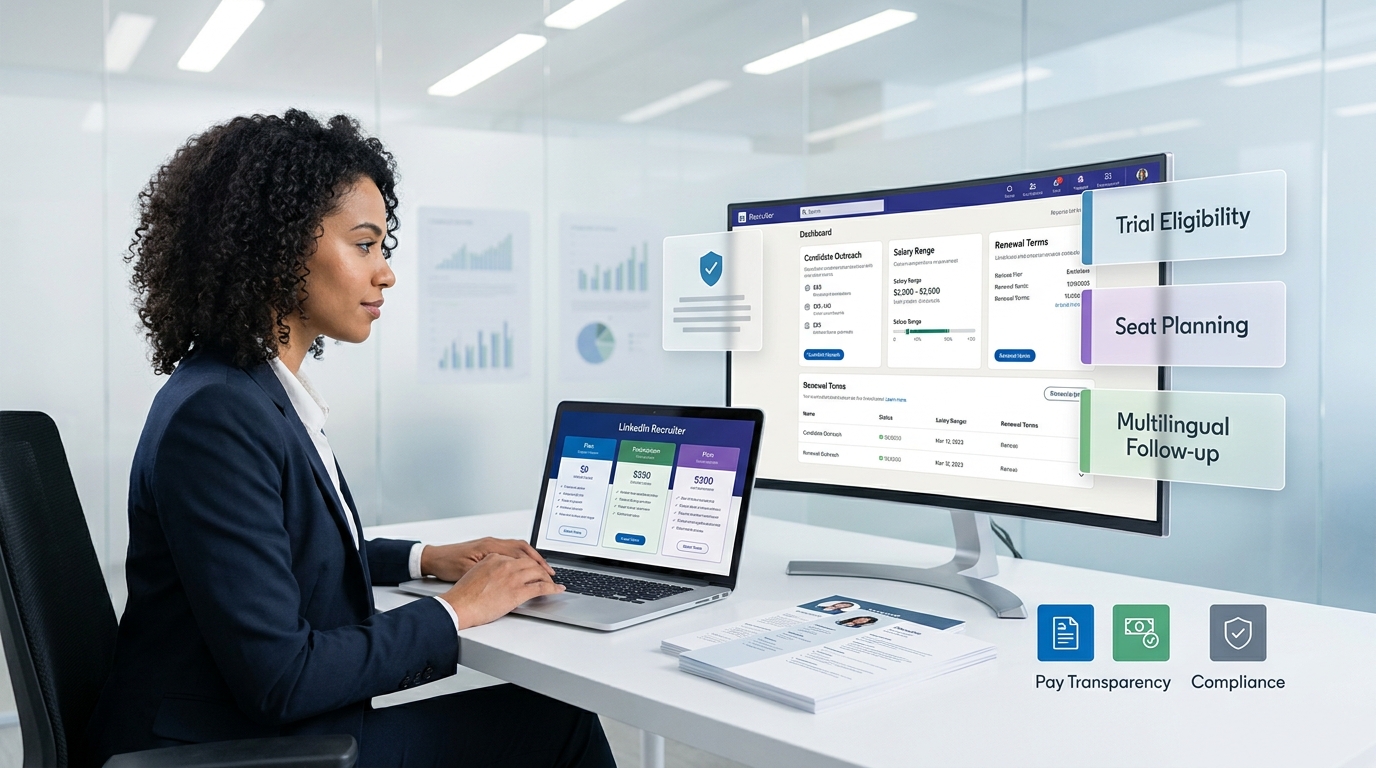
Chasing a linkedin premium code without checking eligibility, renewal terms, and workflow fit can cost recruiters more than it saves.
That sounds basic, but it is where a lot of hiring teams lose money. Solo headhunters waste hours chasing expired offers, agency owners buy the wrong subscription level, and in-house talent teams mistake a short trial for a sourcing strategy. The cost is not only financial. It shows up in delayed outreach, uneven candidate follow-up, budget friction with finance, and a weaker experience for applicants who already expect clearer pay information, faster replies, and less guesswork from employers.
In my own LinkedIn-heavy recruiting work, one of the more practical ways I have reduced that friction is by pairing subscription decisions with a tighter outreach workflow using StrategyBrain AI Recruiter. I do not use it as a substitute for recruiter judgment. I still decide who is worth pursuing, review the résumé, and make the next-step call. Where it helps is in the repetitive layer that usually gets messy around trials, seat usage, and response handling: automated candidate outreach on LinkedIn, multilingual follow-up across time zones, and résumé/contact capture once a prospect shows real interest.
A good example of why this matters comes from the wider compliance pressure now shaping recruiting behavior. In British Columbia, employers hiring roles open to BC residents have had to include an expected wage or salary range in public job postings since November 1, 2023, and the broader pay transparency rules also restrict when employers can ask about pay history and protect workers who discuss compensation. That sounds separate from discount hunting, but in practice it changes how recruiters evaluate LinkedIn tools: they are not just buying access to profiles anymore, they are supporting a process where public postings, compensation conversations, and candidate trust all need to line up.
Once salary ranges become mandatory in postings and candidates know they can push back on opaque compensation practices, the old habit of buying a subscription first and figuring out the process later starts to break down. That is why searches for linkedin premium code, student discount linkedin, and coupon code linkedin are only useful when tied to a bigger question: which LinkedIn product fits the recruiting task, what compliance or communication burden sits around it, and whether the offer actually lowers total recruiting friction rather than just the first invoice.
Practical takeaway: Most LinkedIn deals are not broad public coupons. They usually appear as trials, partner offers, member redemptions, or negotiated team terms, and the right choice depends on both recruiting workflow and the hiring context around pay transparency.
Table of Contents
- Why recruiting context matters before you look for a deal
- What LinkedIn discounts and deals actually exist
- Map the product before you hunt for a code
- What pay transparency changes for LinkedIn buying decisions
- How legitimate redemption usually works
- Is there a real student discount linkedin offer?
- How recruiter teams usually secure better terms
- How I use StrategyBrain AI Recruiter around LinkedIn workflows
- Common mistakes when chasing coupon-style offers
- How to evaluate a LinkedIn deal as a recruiting buyer
- FAQ
Why recruiting context matters before you look for a deal
Experienced recruiters rarely evaluate LinkedIn subscriptions in a vacuum. We evaluate them against the actual job to be done.
If you are filling a role in a market shaped by pay transparency rules, you are dealing with more than sourcing volume. You may need to publish salary ranges, keep compensation messaging consistent between the job post and recruiter outreach, avoid bad habits around pay-history questions, and respond faster to candidates who are comparing opportunities in a more informed way. In that environment, a deal only helps if it supports cleaner execution.
The British Columbia framework is a useful example because it puts real deadlines and obligations on employers. Public postings need compensation ranges. Certain employers must post annual pay transparency reports on a phased schedule. Employees and applicants have stronger protection when discussing pay. For recruiters, that means a LinkedIn subscription sits inside a more accountable process than it did a few years ago.
So when someone searches coupon code linkedin, the mature buying question is not just, “Can I save money?” It is also, “Will this product and offer structure help me manage outreach, documentation, candidate expectations, and team usage without creating more downstream friction?”
What LinkedIn discounts and deals actually exist
In practice, the realistic savings paths tend to fall into a handful of categories:
- Free trials for eligible users
- Partner promotions tied to another membership or service relationship
- Redeem-link offers that work through a specific landing page
- Segment-based opportunities such as student-oriented or nonprofit-related offers
- Contract negotiation for larger recruiting teams buying seats or annual commitments
This is why the term linkedin premium code can mislead buyers. It suggests a simple coupon box at checkout, but official promotions are usually narrower than that. They often depend on eligibility, region, previous trial history, or the exact product category.
For recruiters, the difference matters because the wrong assumption creates three problems at once: you buy the wrong plan, you miss the terms that govern renewal, and you fail to align the subscription with the workload your team actually has.
Map the product before you hunt for a code
Search intent overlaps across several LinkedIn products, and that is one reason discount discussions become confusing.
| Product | Typical User | How Deals Usually Appear | Best Use Case |
|---|---|---|---|
| Premium Career | Job seekers and individual professionals | Trials, partner promotions, redeem links | Personal visibility and job-search support |
| Premium Business | Business users and network builders | Trials or limited promotions | Broader networking and outreach |
| Recruiter Lite | Solo recruiters, agency recruiters, hiring managers with light sourcing needs | Less often coupon-driven; more straightforward subscription evaluation | Individual sourcing and outreach |
| LinkedIn Recruiter | In-house talent teams and larger hiring organizations | Quote-based discussions, seat planning, annual terms | Team sourcing at scale |
In other words, a coupon code linkedin search is usually more relevant to consumer-style Premium plans than to a true recruiting procurement decision. If you run an agency desk or manage corporate recruiting seats, your best savings often come from planning usage correctly rather than from finding a public code.
What pay transparency changes for LinkedIn buying decisions
The pay transparency angle is not a side issue. It changes the buying logic.
When a jurisdiction requires salary or wage ranges in public postings, recruiters have to maintain greater consistency between what appears in the ad, what is said in outreach, and what the hiring team is prepared to discuss. When employers also face restrictions on using pay history and employees gain protection for discussing compensation, sloppy sourcing workflows become more visible and more risky.
That makes LinkedIn buying decisions more operational than cosmetic. A recruiter using a discounted subscription still needs a process for:
- keeping outreach aligned with posted compensation ranges
- tracking candidate questions about pay and role scope
- documenting responses across recruiters or accounts
- avoiding inconsistent compensation language across regions or business units
I have seen this most clearly when a team gets excited about a short-term deal but has no plan for who replies after hours, who captures candidate questions, or who checks whether salary messaging in private outreach still matches the public post. The savings disappear fast when recruiter time gets pulled back into cleanup.
How legitimate redemption usually works
Most real promotions follow a redemption workflow, not an open coupon model. That means the offer is typically connected to a landing page, a time limit, and terms you need to read closely.
- Confirm the exact product. Make sure the offer applies to the plan you want.
- Check eligibility. Some deals are for new users, selected regions, or specific members only.
- Use the official redeem path. Many promotions work through a dedicated link rather than a generic checkout code field.
- Review billing rules. Trials often require payment details and may auto-renew.
- Document the terms. Save screenshots or internal notes on start date, end date, seat count, and cancellation deadline.
That final step matters more than people think. If your recruiting team is already juggling live searches, candidate messaging, and compliance-sensitive compensation conversations, nobody remembers trial terms unless ownership is explicit.
Is there a real student discount linkedin offer?
The safest answer is that you should not assume there is a permanent, universal student plan available to everyone at all times.
What does exist more often are student-oriented promotions connected to another institution, partner arrangement, or eligibility program. So a search for student discount linkedin can uncover something legitimate, but that does not mean there is a standing public page with guaranteed terms for every student account.
If you are advising interns, campus ambassadors, or early-career recruiters, the practical guidance is to verify:
- whether the offer is active now
- whether the student status or partner relationship actually qualifies
- whether the promotion is limited to one redemption per user
- whether the deal applies through a special landing page only
From a recruiting perspective, this matters most in campus hiring. Candidates are now more likely to compare employer transparency, compensation clarity, and communication speed. A student-facing offer may help an individual user, but it does not replace a disciplined employer-side workflow.
How recruiter teams usually secure better terms
For Recruiter Lite and full LinkedIn Recruiter, the real deal conversation usually moves away from promo-code language and into procurement.
That means the strongest savings tend to come from:
- Seat planning so you do not overbuy licenses
- Annual or multi-year commitments where appropriate
- Volume discussions for larger teams
- Organization-based eligibility through associations, memberships, or nonprofit structures
If you are responsible for budget, ask these questions before signing:
- How many recruiters will actually log in every week?
- Will usage be centralized or spread across departments?
- Do we need sourcing power, or do we really need workflow discipline?
- Are salary-range and compensation conversations now forcing more documented recruiter coordination?
Those questions become more important in a pay transparency environment because the subscription is no longer just a sourcing line item. It is part of how your organization presents roles, answers candidate questions, and maintains internal consistency.
How I use StrategyBrain AI Recruiter around LinkedIn workflows
I want to be careful here and stay practical. I do not treat automation as proof that a subscription is worth buying, and I do not think any tool removes the need for recruiter judgment. But I have found that StrategyBrain AI Recruiter helps in the exact layer where LinkedIn usage often becomes expensive in hidden ways.
My pattern is simple. I decide the search criteria, define the role and compensation language I am comfortable using, and determine what kind of candidate response counts as genuine interest. Then I use AI Recruiter to handle the repetitive first-contact work on LinkedIn, continue replies after hours, and gather résumés or contact details from interested prospects. When someone moves beyond initial interest, I step back in, review the résumé, and decide whether they should advance.
What I like most is not just automation volume. It is the reduction in message drift. When your team is hiring across time zones or handling compensation questions carefully, consistent replies matter. The multilingual communication capability is useful for international hiring, and the résumé/contact capture removes the annoying gap where a candidate says they are interested but the handoff stalls. If you want to see the broader operating model, the main StrategyBrain site and the workflow overview explain the setup in more depth.
Where this connects back to LinkedIn discounts is straightforward: if you are paying for access, you should also care about whether your team actually converts that access into timely conversations and captured candidate data. Otherwise, even a discounted subscription underperforms.
Common mistakes when chasing coupon-style offers
1. Treating every LinkedIn product the same
Premium Career, Premium Business, Recruiter Lite, and LinkedIn Recruiter serve different buyers and use different pricing logic.
2. Assuming a public code is the normal route
Many legitimate promotions are eligibility-based and tied to a redemption page, not a broadly published coupon field.
3. Ignoring the post-trial workflow
If no one owns follow-up, cancellation, and recruiter usage, the deal often creates more waste than value.
4. Forgetting the compliance context
When your region or candidate market is pushing toward more transparent compensation practices, subscription buying has to support more consistent communication, not just lower cost.
5. Confusing access with execution
Having LinkedIn seats does not guarantee disciplined outreach, timely responses, or captured applicant information. That is the gap where process and supporting tools matter.
How to evaluate a LinkedIn deal as a recruiting buyer
If you want a workable shortlist before committing, use this framework:
- Define the recruiting job to be done. Individual networking, light sourcing, or team recruiting at scale are different needs.
- Map the right product. Do not look for a recruiter deal in a consumer-style Premium offer.
- Verify legitimacy. Check the official path, the terms, and the renewal rules.
- Test the workflow around the subscription. Who sends outreach, who replies after hours, who captures candidate details, and who handles compensation questions?
- Review compliance fit. If your market is affected by salary-range posting rules or stronger pay transparency expectations, make sure the tool supports message consistency.
- Measure real savings, not just entry price. A small discount with poor adoption is not a win.
That is the real lesson behind most linkedin premium code searches. The code is not the strategy. The strategy is aligning product type, recruiting process, candidate expectations, and total team usage.
FAQ
Is there an official linkedin premium code available to everyone?
Usually not as a permanent public offer. Most legitimate deals are tied to trials, partner relationships, redemption links, or user eligibility.
Does coupon code linkedin intent usually apply to recruiter products?
Often less than people expect. Public coupon-style searches are more common around individual Premium products, while recruiter products are more often handled through subscription selection or negotiated team pricing.
Is there a standing student discount linkedin program?
Do not assume there is a universal ongoing program. Student-related offers are more often partner-based or campaign-based and can change over time.
Can I get another free trial if I already used one?
You should not count on it. Trial eligibility is often restricted, and prior redemptions may affect future access.
Why does pay transparency matter in a LinkedIn subscription discussion?
Because recruiters increasingly need consistent salary messaging across job posts, outreach, and candidate conversations. A subscription only helps if the workflow around it supports that consistency.
What is the best savings path for a recruiting team?
Usually seat planning, annual term review, and organizational eligibility matter more than hunting for a public code. Teams should also evaluate whether better outreach execution will do more for ROI than a small upfront discount.
Conclusion
The search for a linkedin premium code is understandable, but most meaningful LinkedIn savings come through eligibility, trials, partner offers, or negotiated team terms rather than a permanent public coupon system. For recruiters, the better decision framework starts with product fit, moves through redemption and renewal terms, and ends with the workflow needed to turn access into qualified conversations.
The pay transparency example from British Columbia sharpens that point. When salary ranges in job postings, compensation consistency, and candidate trust all matter more, buying LinkedIn access without a process is a weak bargain. If you are using LinkedIn heavily, pairing the right subscription choice with a disciplined operating model, and where useful a support layer such as StrategyBrain AI Recruiter, is usually worth more than chasing random coupon pages that never really fit the work.