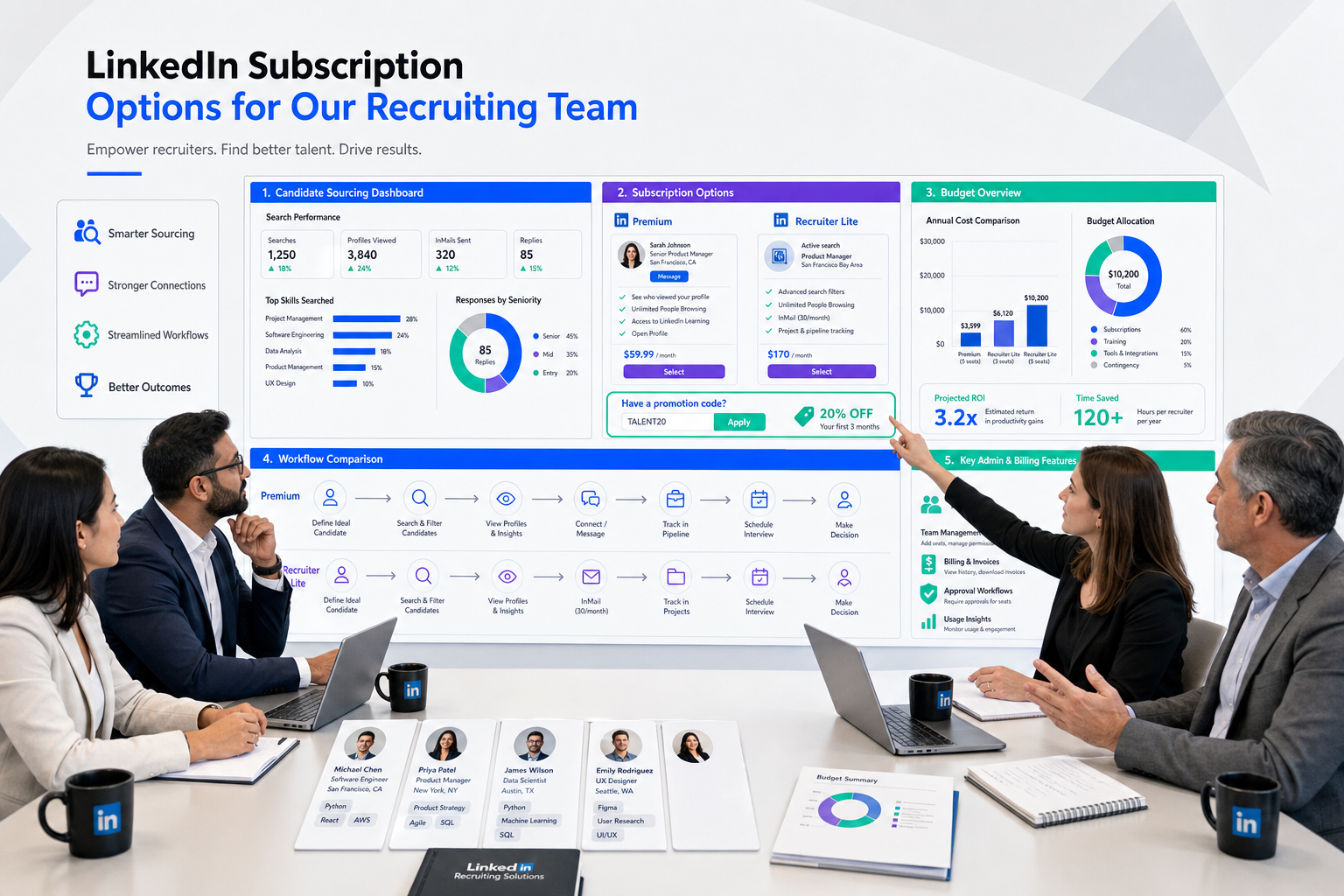
A bad linkedin premium code choice can derail sourcing and budgets, so this article helps recruiting leaders judge fit, avoid workflow disruption, and prevent team conflict.
That distinction matters more than most teams expect. In smaller search firms, one bad assumption can ripple across sourcing volume, candidate response time, finance approvals, and even internal trust. A recruiter thinks they found a cheaper route into LinkedIn, a manager assumes it will cover hiring work, and an owner later discovers the discount applied to the wrong product, the wrong account type, or the wrong region. What looked like a simple saving turns into lost outreach time, messy subscription changes, and avoidable friction between recruiters and operations.
In my own LinkedIn-heavy recruiting work, I have found that a structured support layer helps most when the real problem is not just price, but breakdown between outreach, follow-up, and decision ownership. Tools such as AI Recruiter can reduce that strain by automating first-touch messaging, keeping candidate conversations moving after hours, and collecting resumes or contact details from interested people while the recruiter still makes the final call on fit, shortlist quality, and next steps. That matters when a discount decision risks interrupting active pipelines rather than simply lowering a bill.
The broader lesson is familiar to anyone who has managed a tense team situation: disagreement itself is not always the enemy; unmanaged disagreement is. In office life, conflict often shows up because people care about outcomes, work closely together, and bring different priorities to the same task. Recruiting teams experience a version of that every time one person wants cheaper access, another wants reliable workflow, and a third wants clean budget control. The issue can become useful if it forces better questions, but it becomes damaging when nobody agrees on what product is actually being evaluated.
That is why searches for linkedin promotion code or even the awkward long-tail query linkedin premium discount coder often lead teams into the wrong conversation. The real choice is not just whether a discount exists. It is whether the offer supports the work without creating internal conflict over ownership, product scope, and account control. The rest of this article breaks that down the way experienced recruiting operations teams usually do: define the product, confirm eligibility, isolate the point of disagreement, and only then decide whether the deal is worth taking.
Why LinkedIn deals create conflict inside recruiting teams
Most people search for savings because they assume the offer itself is the hard part. In reality, the harder part is deciding what problem the team is trying to solve. A recruiter may want profile-level access, a hiring manager may want better candidate search, and an agency owner may want controllable seat costs across multiple users. Those are not the same need, so one code or one promotion rarely resolves all three.
This is where a useful idea from workplace conflict management applies. Productive disagreement can challenge bad assumptions and improve decisions, but only when the team names the issue clearly. Negative conflict shows up when people argue from different definitions. In LinkedIn budgeting, that usually means one person is discussing member Premium, another is discussing Recruiter Lite, and finance thinks the conversation is about a broader recruiting contract.
From a recruiting operator's perspective, the damage is practical:
- Workflow loss: active sourcing pauses while users test offers that do not apply
- Budget confusion: personal subscriptions get mixed with managed software spend
- Relationship strain: recruiters and leadership blame each other for failed redemptions
- Brand risk: candidate follow-up slows when account changes interrupt outreach
- Procurement waste: teams evaluate discounts before clarifying the real hiring use case
Practical takeaway: the healthiest recruiting teams do not try to avoid disagreement about LinkedIn costs; they turn it into a clearer product decision.
Which LinkedIn offers apply to Premium, Recruiter Lite, or Recruiter seats
If you remember only one thing from this article, remember this: promotion language follows product language. If an offer talks like a personal subscription, it usually behaves like a personal subscription. If it talks like a seat, license, or commercial package, it belongs in a different buying process.
| Product Type | Typical User | Main Hiring Use | How Offers Usually Work |
|---|---|---|---|
| Premium member subscription | Individual recruiter or professional | Personal account features, messaging, visibility | Often tied to an offer code or redemption link |
| Recruiter Lite | Solo recruiter, founder, small team | Candidate search and lighter hiring outreach | Product-specific availability and account eligibility |
| Recruiter seats or licenses | In-house TA teams and agencies | Team sourcing, coordination, and managed usage | Usually handled through sales, account review, or contract terms |
| Ads credits | Marketing or employer brand users | Campaign promotion | Separate from recruiter access and Premium promotions |
That is why a linkedin premium code may be useful for one recruiter and irrelevant for the team budget. It can lower the cost of an individual plan without solving candidate search depth, seat governance, or shared workflow needs. I see this most often in boutique agencies where one person finds a deal and assumes the team has found a buying strategy.
When evaluating any linkedin promotion code, ask:
- Is this for a personal account or a hiring product?
- Will the buyer be an individual, operations lead, or procurement team?
- Does the offer change workflow, or only subscription cost?
- What happens to active outreach if the current account must be cancelled first?
Five practical checks before you use a LinkedIn deal
The conflict-resolution framing is useful here because it gives recruiting teams a better way to assess discounts. Before anyone redeems anything, run through five checks that mirror how strong teams handle disagreement.
1. Build agreement on the real problem
Do you need cheaper access, better sourcing capability, or uninterrupted recruiter workflow? Teams that skip this step usually chase the wrong offer.
2. Get the right people into the conversation
The recruiter using the account, the manager approving spend, and the ops or finance owner should all know what is changing. This reduces last-minute surprises.
3. Keep the discussion factual
Do not compare a personal Premium deal against a seat-based recruiting product as if they are direct substitutes. Stick to use case, account status, region, and product scope.
4. Agree on what success looks like
Success may mean lower cost, but it may also mean no interruption to outreach, no billing confusion, and no need to rework approval flow later.
5. Make a follow-through plan
If a code requires cancellation, account switching, or staged activation, document who will do what and when. The best discount is still a bad decision if it disrupts candidate engagement for a week.
These checks sound simple, but they are exactly where many recruiters save the most time. They turn a messy coupon search into a controlled buying decision.
How to redeem a LinkedIn Premium code or activation link
Once the product and owner are clear, redemption becomes easier. Official help patterns indicate that some offers use manual codes while others come through direct activation links. It is also common for active Premium subscribers to face extra steps before a new offer can be applied.
- Confirm the exact product. Check whether the promotion applies to Premium, Recruiter Lite, or something else.
- Review account status. If an account already has Premium, see whether cancellation is required before redemption.
- Use the correct redemption path. Some users keep searching for a code when the valid offer is actually a link.
- Redeem on the intended account. Many recruiters juggle personal and work-related LinkedIn identities.
- Check billing geography. Region and currency can affect eligibility.
- Save confirmation details. This helps if finance or management later asks what changed.
If a linkedin premium code fails, the cause is often one of the following:
- the account already has an active subscription
- the offer is for a different product
- the offer is limited by region or currency
- the promotion is account-specific or time-limited
- the user found an ad credit instead of a recruiter or Premium offer
- the wrong login was used during redemption
For active recruiters, the timing point matters most. Do not test a code at the exact moment a subscription matters for live outreach. Give yourself a buffer.
How recruiters compare LinkedIn workflow tools around deal decisions
Because this topic sits between software use and recruiting operations, it helps to compare the categories recruiters usually consider when trying to lower LinkedIn costs without hurting output. Below is a practical comparison of three familiar options teams often use around LinkedIn recruiting workflows.
| Tool / Category | Usage Experience | Operational Effect | Cost Fit | Best For | Works Alongside AI-Supported Recruiting? |
|---|---|---|---|---|---|
| LinkedIn Recruiter Lite | Native and straightforward for lighter sourcing | Useful for individual search and outreach, but limited for scale | May suit solo users better than seat-heavy teams | Independent recruiters, founders, small hiring teams | Yes; often paired with external workflow support when follow-up volume rises |
| LinkedIn Recruiter seats | Built for structured team sourcing | Stronger for collaboration and higher-volume hiring | Usually evaluated as managed software spend rather than coupon spend | In-house TA functions and established agencies | Yes; AI-supported communication can reduce manual load around outreach and response handling |
| CRM or ATS workflow layer | Helpful for record-keeping and pipeline visibility | Improves coordination, but does not replace sourcing access itself | Varies by stack and team size | Teams already juggling multiple channels and approval flows | Yes; especially useful when paired with automated candidate messaging support |
The reason I do not treat discounts as a standalone topic is simple: recruiters rarely buy LinkedIn access in a vacuum. They buy it in the middle of pipeline pressure, manager expectations, and candidate response windows. That is where an AI-supported layer can matter more than a small one-time promotion.
My experience using AI support to protect sourcing continuity
I have used StrategyBrain AI Recruiter in situations where the bigger risk was not whether LinkedIn access cost a little less, but whether outreach momentum would break while the team sorted out account decisions. What helped most was not a flashy promise. It was the practical combination of always-on candidate replies, multilingual communication when candidates answered outside local business hours, and automatic collection of resumes or contact details once someone showed real interest. That took pressure off the recruiter at exactly the stage where subscription confusion usually causes delays.
Just as important, the tool did not replace recruiter judgment. I still reviewed the resumes, decided who moved forward, and controlled the next step with the hiring manager or client. In other words, the automation covered repetitive LinkedIn messaging work while the human recruiter kept ownership of fit, shortlist quality, and final decision-making. For teams trying to avoid the internal conflict that comes from patchy follow-up, that division of labor is useful.
If your operation is more complex, the broader AI Recruiter workflow approach is worth studying because it is designed around LinkedIn recruiting tasks specifically, not generic marketing automation. I would still caution any team to evaluate it against their own process, but in my experience it addresses the exact gap that often appears when people focus too narrowly on a linkedin promotion code: saving money on access means little if candidate conversations stall.
How recruiting teams should budget without repeating the same mistake
The article's opening point about productive versus damaging conflict comes back here. The right question is not, "Can we find a discount?" It is, "Can we reduce spend without weakening the recruiting system that produces hires?"
Use this budgeting lens:
- Solo recruiters: a discounted personal plan may be enough if the work is mostly individual and lightweight.
- Small agencies: check whether the real bottleneck is sourcing access or follow-up capacity before chasing another code.
- In-house teams: evaluate seat-based products through workflow continuity, user governance, and finance clarity.
- Multi-region hiring teams: expect local pricing and account eligibility differences instead of assuming one global answer.
Healthy recruiting operations do not pretend every stakeholder wants the same thing. They surface the disagreement early, define the product correctly, and then decide whether the offer actually improves hiring work.
FAQ
Can I use a LinkedIn Premium code on an existing account?
Sometimes, but active subscribers may face restrictions or need to cancel first before a new promotion can be redeemed.
Is Recruiter Lite the same as LinkedIn Premium?
No. Recruiter Lite is a separate hiring-focused product. Premium is usually tied to an individual member subscription and different account features.
Why does a LinkedIn promo code fail even when it looks legitimate?
Common reasons include active subscription status, wrong product type, regional limits, account-specific eligibility, expired timing, or use of the wrong login.
Is a linkedin promotion code the best way for agencies to lower LinkedIn costs?
Not always. Agencies often save more by matching the correct LinkedIn product to the workflow and then protecting outreach continuity during any account change.
What does linkedin premium discount coder usually mean in search?
In practice, that query often reflects broad discount intent rather than a clear product decision. The user may be looking for Premium savings, Recruiter Lite access, or recruiter seat cost relief without separating those categories.
Should I focus on a discount or on workflow support first?
If active hiring is underway, workflow support usually comes first. A discount that interrupts candidate communication can cost more than it saves.
Conclusion
For recruiters, LinkedIn deals are easiest to use when they are treated as a decision-management issue rather than a coupon chase. A linkedin premium code can be valuable, but only after you confirm the exact product, the account owner, the redemption path, and the workflow risk.
The strongest teams handle this the same way they handle conflict at work: name the issue clearly, keep the discussion factual, agree on success, and follow through with a plan. Do that, and a linkedin promotion code becomes a useful option instead of a source of internal friction. Ignore it, and even a promising linkedin premium discount coder search can send the team into the wrong buying decision.