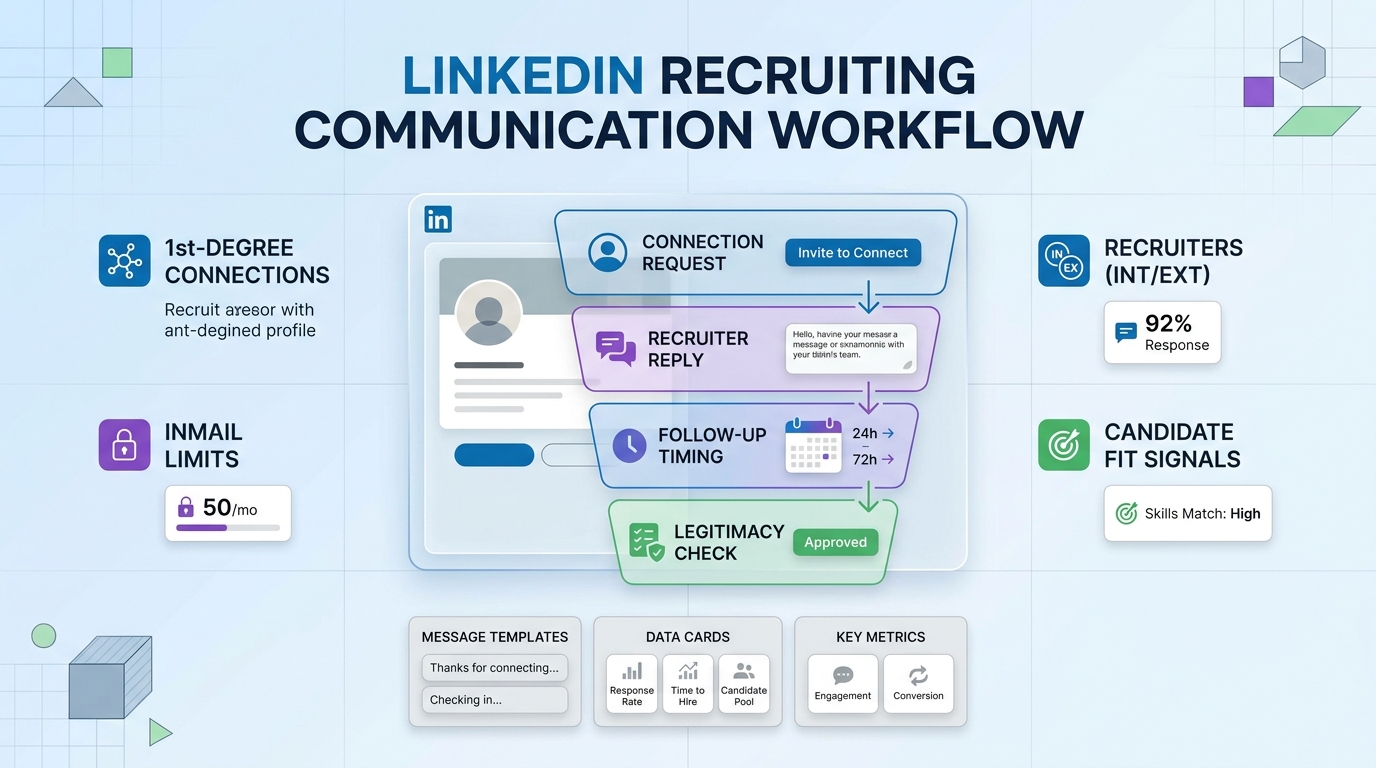
This guide helps candidates judge how to get in touch with recruiters on LinkedIn so their outreach reaches the right person and avoids wasted follow-ups.
That sounds simple, but in practice the breakdown usually starts when candidates assume LinkedIn gives everyone the same messaging options and recruiters assume every good prospect will know how to approach them. The result is wasted follow-up, missed replies, weaker candidate experience, and for smaller search firms or lean in-house teams, real time loss that compounds across dozens of open conversations.
In my own workflow, tools that reduce repetitive LinkedIn back-and-forth have been most helpful when they handle the first layer of outreach discipline rather than replacing recruiter judgment. StrategyBrain AI Recruiter is relevant here because it can automate initial LinkedIn connection and role introduction, keep candidate replies moving after hours, and collect resumes or contact details from interested people, while the recruiter still makes the final call on fit, shortlist quality, and next steps.
You can see the same logic in another recruiting scenario that often gets overlooked. When a finance or accounting professional considers moving into contract work, the decision is rarely about freedom alone. They have to weigh uneven hours, the reality that one week can be overloaded while the next is thin, and the pressure to keep marketing themselves even while delivering for current clients.
That choice becomes easier or harder based on whether the right recruiter can be reached at the right moment. A specialist contractor may review openings, compare short-term project demands, check whether a recruiter actually works in their niche, and hesitate before sending a note because they do not know if direct messaging will even go through. That is exactly where LinkedIn recruiter subscription details, messaging limits, and knowing how to reach out to a recruiter on LinkedIn stop being platform trivia and become part of real career and search execution.
If you are trying to understand LinkedIn recruiter subscription details while also figuring out how to get in touch with recruiters on LinkedIn, the key is to separate two different experiences: the recruiter’s tools and the candidate’s options. Recruiters may use LinkedIn Recruiter or Recruiter Lite to search for talent and contact people, while job seekers usually depend on 1st-degree connections, standard Messaging, and carefully written connection requests.
- Why this matters before you message any recruiter
- What LinkedIn recruiter subscription details actually mean
- How candidates can get in touch with recruiters on LinkedIn
- How to approach a recruiter on LinkedIn when your work is specialized
- What to say: message templates by scenario
- When to follow up and when to stop
- Internal vs external recruiters: how your approach should change
- How recruiters and HR teams can manage LinkedIn volume better
- Staying safe: how to check if a LinkedIn recruiter is legitimate
- FAQ
Why this matters before you message any recruiter
Experienced recruiters know that outreach quality is tied to workload patterns. Some talent segments behave a lot like contract markets: response volume is uneven, urgency spikes around active openings, and the strongest prospects are often selling their value while evaluating multiple possibilities at once. That is why the best outreach is not built on volume alone. It depends on timing, specialization, and a clear signal that the message is relevant.
The contractor example is useful because it highlights three realities that also shape LinkedIn outreach:
- Work can be irregular. Recruiters and candidates both operate in bursts, which makes slow or unclear messaging more expensive.
- Everyone is partly selling. Candidates are promoting their niche, and recruiters are also selling the role, the process, and their own credibility.
- Specialization matters. General messages underperform when the person on the other side works in a focused discipline like finance systems, controllership, audit, or transformation.
That is the backdrop for understanding how to get in touch with recruiters on LinkedIn. You are not just trying to send a message. You are trying to reach the right person in a market where attention is filtered by relevance.
What LinkedIn recruiter subscription details actually mean
When people search for LinkedIn recruiter subscription details, they are often mixing together several LinkedIn products that serve different users. The important distinction is that Recruiter Lite is positioned as a recruiting tool for smaller-scale hiring needs and is available as a monthly or yearly subscription, while general Premium plans are not the same thing as recruiter-focused Talent Solutions tools.
For job seekers, the practical takeaway is simple: a recruiter may have more contact options than you do. LinkedIn help content shows that recruiters can reach candidates through Recruiter or Recruiter Lite, and in some situations may also have email functionality available. By contrast, candidates typically need to work within standard Messaging rules and connection status.
For recruiting teams and HR leaders, the advice is to use precise platform language when explaining outreach internally. Terms such as 1st-degree connections, Messaging, InMail credits, Recruiter Lite, and Talent Solutions line up with how users search and how LinkedIn documents its own features. That helps reduce confusion for hiring managers who assume every LinkedIn user has identical messaging access.
| Area | Candidate experience | Recruiter experience |
|---|---|---|
| Direct Messaging | Usually limited to 1st-degree connections and Pages | May contact candidates through recruiter tools |
| Connection strategy | Often required before messaging | Often optional depending on tool access |
| Subscription relevance | Usually not a recruiter tool buyer | May use Recruiter Lite or broader Talent Solutions access |
If your goal is really how to get in touch with recruiters on LinkedIn, understanding this asymmetry helps you choose the right tactic instead of sending generic messages that never get delivered.
How candidates can get in touch with recruiters on LinkedIn
The most reliable answer to how to get in touch with recruiters on LinkedIn is usually not “send a cold message.” It is “find the right recruiter, send a brief personalized connection request, and message them once they accept.” LinkedIn confirms that once someone accepts your invitation to connect, you can message them directly.
That makes the outreach flow much more straightforward than many candidates expect. Instead of writing a long introduction up front, start with a focused note that gives the recruiter a reason to recognize the relevance of your profile. Mention the role, team, location, or specialty area that connects you to their work.
This matters even more in specialist markets. A contractor in accounting, finance, compliance, or ERP support is not looking for any recruiter. They are looking for a recruiter who understands the niche well enough to tell whether the opportunity is worth the disruption of changing assignments.
- Identify the right recruiter. Look for someone tied to the function, location, or business unit you want.
- Reference something specific. A job posting, hiring team, office, or skill domain makes your outreach more credible.
- Lead with fit, not biography. One or two relevant strengths beat a full career summary.
- Ask for a clear next step. That could be guidance, confirmation of fit, or the best place to apply.
This is also the cleanest answer to how to reach out to a recruiter on LinkedIn if you do not already know them.
How to approach a recruiter on LinkedIn when your work is specialized
If you want to know how to approach a recruiter on LinkedIn, think like someone who understands hiring flow. Recruiters are screening for relevance, timing, and signal quality. They are not looking for a life story in the first message.
In niche functions, that rule gets sharper. The strongest contractor-style candidates often win attention because they present themselves as specialists rather than generalists. That mirrors what hiring teams want from short-term or high-impact talent: a clear area of depth, not a vague promise to do everything.
A strong first touch usually includes four elements: the right person, a relevant role or company reference, one or two concise proof points, and a specific ask. This structure aligns with how recruiters triage outreach. It also respects that some recruiters support multiple open roles and move quickly between requisitions.
Best practices for first contact
- Keep it short. A recruiter should understand your point in seconds.
- Use real relevance. Mention a job ID, function, or market segment if available.
- Show your niche. Specialized capability reads stronger than broad self-description.
- Avoid desperation language. Professional confidence reads better than pressure.
- Do not ask for too much too soon. Asking for a brief conversation or fit check is better than demanding a referral.
- Make your profile support your message. Your headline, recent experience, and skills should reinforce your note.
Recruiting tip: If your profile does not show what kind of work you do, even a good message can fail. Outreach and profile credibility work together.
What to say: message templates by scenario
Searchers looking for how to reach out to a recruiter on LinkedIn usually want exact wording. The best templates are not flashy. They are specific, respectful, and easy to answer.
Template 1: Connection request before applying
Hi [Name], I came across your recruiting work for [function/company]. I am interested in [role area] and have experience in [1 relevant point]. I would be glad to connect and follow your team’s openings. Thank you.
Template 2: Message after applying
Hi [Name], I recently applied for the [job title] role and wanted to introduce myself. My background includes [1 to 2 relevant points] that align with the position. If helpful, I would appreciate any guidance on fit or next steps. Thank you for your time.
Template 3: Reaching out without a current opening
Hi [Name], I work in [specialty] and have been following hiring activity in [team/company area]. My experience includes [specific strength], and I would love to connect in case relevant roles open in the future. Thanks for considering my request.
Template 4: External recruiter or headhunter
Hi [Name], I see that you recruit in [industry/function]. My background is in [specialty], with experience in [relevant niche or level]. If you are currently working on roles in this space, I would be happy to connect and share more context. Thank you.
For specialists who move between projects, these templates work because they do what good contractors also have to do in the market: keep selling a clear skill set without sounding generic.
When to follow up and when to stop
One reason people struggle with how to get in touch with recruiters on LinkedIn is that they assume persistence always helps. In recruiting practice, it only helps when it stays professional and tied to a real update.
A reasonable follow-up is short and spaced out. For example, if you sent a connection request or message and received no response, one polite follow-up after several business days is usually enough. If you applied to a newly posted role, follow-up can make sense when it adds context, such as a directly relevant certification, location fit, or availability.
This is especially important for contractors and consultants whose schedules already swing between heavy and light periods. Over-messaging a recruiter rarely improves your odds, but one useful follow-up tied to a fresh detail can help.
- Good follow-up: “I wanted to follow up on my note regarding the operations role. My recent experience leading regional scheduling may be relevant to the position.”
- Weak follow-up: “Just checking again.”
- Bad follow-up: Multiple messages in a short period with no new information.
Internal vs external recruiters: how your approach should change
A practical part of learning how to approach a recruiter on LinkedIn is recognizing whether the person is an internal recruiter or an external recruiter. The same message does not always work equally well for both.
Internal recruiters
Internal recruiters are usually hiring for their own company. They care about fit for a specific role, team, location, or level. Your outreach should mention the exact opening or business area and show why you fit that environment.
External recruiters or headhunters
External recruiters may work across several clients or searches. They are often evaluating your marketability beyond one immediate job. Your message should highlight your specialty, seniority, and the kinds of opportunities you are open to considering.
For project-based talent, this distinction matters even more. An internal recruiter may want proof you can solve an immediate business gap, while an external recruiter may be mapping your fit for future mandates over the next three to six months.
| Recruiter type | What they usually want first | Best candidate angle |
|---|---|---|
| Internal recruiter | Fit for a specific opening | Reference the role and your direct match |
| External recruiter | Broader profile-market fit | Summarize your niche, level, and target roles |
How recruiters and HR teams can manage LinkedIn volume better
Although this topic often targets candidates, LinkedIn recruiter subscription details also matter to the teams running hiring operations. If recruiters have broader outreach options than candidates do, the responsibility to communicate clearly becomes even more important.
Recruiters should be explicit about the role, team, and reason for outreach. HR leaders should standardize how recruiters introduce opportunities, especially when using recruiter tools that let them contact a higher volume of people. Hiring managers should align with recruiters on what “qualified interest” looks like so candidate follow-up is handled consistently.
From an operations standpoint, good outreach on LinkedIn usually includes:
- a clear role title or talent area
- transparent employer or client context when appropriate
- a concise explanation of why the candidate was selected
- a simple next step, such as a short screening conversation
In my experience, this is also where AI Recruiter has practical value. I would not use it to decide who is qualified. I would use it to keep first-touch outreach moving, answer routine early questions about role context, and collect resumes from interested candidates while I focus on the deeper evaluation work. For firms handling multiple LinkedIn conversations across time zones, that kind of support reduces the feast-or-famine communication problem that specialist recruiting often creates.
If you want to review more of that workflow logic, the product walkthrough and conversation examples are useful because they show where automation can support consistency without removing recruiter accountability.
Staying safe: how to check if a LinkedIn recruiter is legitimate
Trust is now part of the recruiter-contact journey. Before replying in depth or sharing personal information, it is worth checking whether the recruiter profile looks legitimate.
Start with the basics: does the profile show a credible work history, an employer connection that makes sense, and activity consistent with recruiting work? If the message asks for unusual information too early, pushes you off-platform immediately, or creates urgency without context, treat that as a warning sign.
For recruiters, HR, and headhunters, this is not just a candidate issue. Clear profile accuracy, recognizable employer details, and professional message quality all improve response rates and reduce friction caused by scam concerns.
- Check profile completeness. Sparse profiles deserve extra scrutiny.
- Review employer alignment. The role, company, and recruiter background should fit together logically.
- Watch for premature requests. Be cautious if asked for sensitive personal data too early.
- Look for platform trust signals. Verification and other legitimacy cues can help, but should not replace common-sense review.
- Stay on platform first. Early conversation through LinkedIn Messaging is often safer than rushing to unknown channels.
FAQ
Does messaging a recruiter on LinkedIn help after applying?
It can help if the message adds context and stays relevant. A short note that references the role and highlights one or two matching strengths is useful. A generic “please review my application” message usually adds less value than candidates expect.
Can I message a recruiter directly if we are not connected?
In many cases, free messaging is limited, so you may not be able to send a standard direct message unless you are already a 1st-degree connection. That is why a short personalized connection request is often the most practical first step.
What is the difference between Recruiter Lite and regular LinkedIn Premium?
Recruiter Lite is positioned as a recruiting tool for smaller-volume hiring needs and is available on a monthly or yearly subscription basis. It is different from general Premium plans because it is designed for recruiting workflows rather than general professional account upgrades.
How do I know how to reach out to a recruiter on LinkedIn if I am in a niche field?
Lead with your specialty, not your whole background. Recruiters in niche markets want a fast signal that you match the role family they cover. Mention your area of depth, current level, and the type of role or project you are targeting.
Should I contact an internal recruiter differently from an external recruiter?
Yes. Internal recruiters usually want evidence that you fit a specific role or team, so reference the opening directly. External recruiters or headhunters may be assessing broader market fit, so summarize your niche, level, and the kinds of roles you want.
What should I do if a recruiter does not respond?
Send one professional follow-up after several business days if you have something relevant to add. If there is still no response, move on and focus on other roles, other recruiters, and improving the clarity of your profile and outreach targeting.
Is it safe to share my resume and personal details right away?
Share information carefully. It is reasonable to share a resume with a credible recruiter, but do not provide sensitive personal details too early. Verify profile legitimacy, review the context of the opportunity, and stay cautious if the communication feels rushed or inconsistent.
Conclusion
The best answer to how to get in touch with recruiters on LinkedIn is practical rather than complicated. Understand that recruiters may have subscription-based outreach tools that candidates do not. Then focus on what you can control: finding the right person, sending a personalized connection request, writing a concise follow-up, and checking legitimacy before sharing more information.
If you remember one thing, make it this: how to reach out to a recruiter on LinkedIn and how to approach a recruiter on LinkedIn both come down to relevance, brevity, specialization, and professional timing. That is how experienced recruiters prefer to be contacted, and it is also how strong candidates stand out.