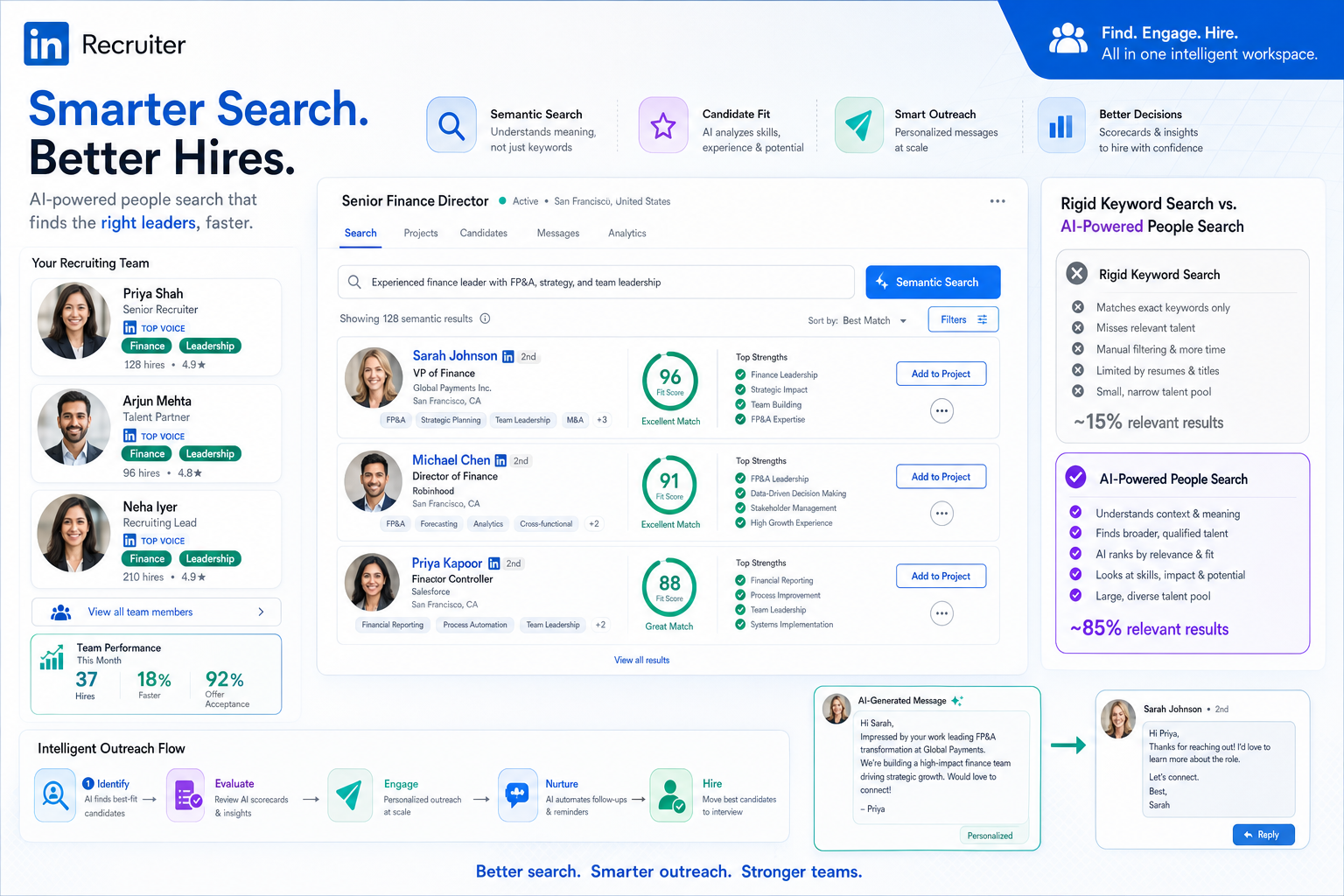
When tight talent markets make rigid briefs miss strong candidates, this article helps recruiters judge whether people GPT can widen the pool without weakening shortlist quality.
That matters because sourcing breaks down long before interview scheduling does. A recruiter can build a technically correct search, review dozens of profiles, and still miss the right person if the market is tight, the brief is too rigid, or the team is screening for credentials without understanding what the job actually needs. In practice, that creates wasted outreach, slower shortlists, frustrated hiring managers, and avoidable revenue pressure for both agency and in-house teams.
In my own workflow, tools like StrategyBrain AI Recruiter have been most useful not as decision-makers, but as support for the repetitive parts of sourcing and outreach that otherwise bury a desk. When candidate response handling, multilingual follow-up, and initial interest capture run in the background, recruiters get more time to refine prompts, assess resumes, and decide who really belongs on a shortlist. That division of labor matters: AI can keep conversations moving, but the recruiter still owns final evaluation and next-step judgment.
You can see the same logic in accounting and finance hiring, where precision matters and talent shortages punish weak search habits. Employers looking for controllers, tax specialists, or senior finance leaders are not just filling seats; they are managing compliance exposure, reporting accuracy, succession gaps, and leadership credibility. When firms insist on narrow background rules or inflexible work structures, the search gets harder fast, especially for intermediate and senior talent.
A recruiter in that market does not simply post and wait. They review the role scope, check whether CPA, CMA, or CFA credentials are truly mandatory, compare public-practice talent against private-industry alternatives, and test whether remote or hybrid flexibility would reopen the pool. That scene is exactly why ai candidate sourcing now matters beyond convenience. A modern people GPT workflow, combined with practical tests such as ai people search free and more advanced ai person search methods, helps recruiters surface adjacent-fit talent without losing the precision that high-risk roles demand.
- Why precision matters in AI candidate sourcing
- What people GPT means for recruiters
- How AI sourcing actually works
- How to test ai people search free options
- How to evaluate an ai person search workflow
- Where LinkedIn automation fits after sourcing
- Best use cases for recruiters and hiring teams
- Common mistakes to avoid
- FAQ
Why precision matters in AI candidate sourcing
The strongest lesson from specialist recruiting markets is simple: hard hiring problems usually fail at the definition stage, not the messaging stage. In accounting and finance recruitment, for example, firms often need professionals who can handle audits, budgeting, compliance, systems, and stakeholder communication at the same time. If the search is too literal, recruiters miss people with transferable leadership depth. If it is too broad, they flood the shortlist with profiles that look relevant on paper but create risk in the real job.
That same pressure exists in technical, commercial, and executive hiring. Titles vary. Skills are described inconsistently. Great candidates move between industries. And when the talent market is tight, rigid requirements can wipe out most of the reachable pool before outreach even begins.
Experienced recruiters already know this from desk work: the best search process balances four things at once:
- Technical fit for the core job
- Business context around why the role exists
- Flexibility on location, title, or background substitutes
- Risk control for high-impact hires
That is where people GPT becomes useful as a sourcing model. It allows the recruiter to express the whole hiring logic in natural language instead of relying only on exact-match title strings.
What people GPT means for recruiters
In recruiting, people GPT is best understood as conversational candidate discovery with semantic interpretation. Instead of translating a hiring brief into a long Boolean string, the recruiter can describe the person in plain English: what they have done, what environment they come from, what credentials matter, which constraints are flexible, and which deal-breakers are real.
For example, a recruiter might search for:
Find senior finance leaders who have owned budgeting across multiple departments, led audit readiness, and can move from public-practice rigor into a growth-stage private company with hybrid flexibility.
That kind of brief is hard to express cleanly with keywords alone. A classic title search may overweight “Controller” and miss “Head of Finance,” “Finance Director,” or operational leaders who have already handled the relevant work.
The practical value is not just speed. It is better first-pass discovery across:
- Equivalent titles that vary by company size or industry
- Adjacent skills that signal capability without matching exact phrases
- Context clues such as regulated environments, leadership scope, and reporting complexity
- Substitute backgrounds that expand the pool without lowering standards
That is why experienced recruiters should treat people GPT as a way to frame sourcing logic, not as a promise of fully automated judgment.
How AI sourcing actually works
Many teams talk about AI sourcing as if it were one search box. In reality, a strong workflow has several layers, and each one matters more when the role is sensitive or the market is thin.
1. Turn the hiring brief into a real search narrative
Start with business context, not just title. What outcome must this person own? What credentials are mandatory? Which industry patterns are relevant? Where can you be flexible?
This mirrors specialist recruitment in finance and accounting, where the recruiter has to distinguish between what is regulated necessity and what is simply habit. The same discipline improves any ai person search process.
2. Use semantic retrieval to widen the pool
The system then looks for profiles that are conceptually aligned, not only those that repeat your exact wording. This is the core reason AI can uncover adjacent-fit candidates that a Boolean string may miss.
3. Enrich and rank before outreach
Once profiles surface, recruiters need context. What kind of team did the person lead? Was their work strategic or execution-heavy? Are they likely in the right compensation band? Enrichment and ranking save time, but only if the recruiter can still inspect why someone was matched.
4. Keep outreach moving without losing control
Search creates value only when it reaches the market. This is where I have found AI Recruiter genuinely helpful on LinkedIn-heavy workflows. It can handle repetitive connection requests, initial role introductions, and candidate interest conversations continuously, including after hours and across languages. In practical use, that means I can run the sourcing logic, review the profiles, and let the outreach layer keep momentum while I focus on shortlist quality.
Just as importantly, that support does not remove recruiter accountability. I still review the resumes, decide whether a candidate truly matches, and determine whether the hiring manager should see them.
5. Recalibrate with live market feedback
If your first wave of outreach gets weak replies, the issue may not be outreach quality at all. It may be job rigidity, compensation mismatch, or unrealistic background constraints. Specialist recruiters have always done this manually; AI sourcing just makes the recalibration cycle faster.
How to test ai people search free options
The phrase ai people search free attracts a lot of interest because recruiters want low-risk testing. That is sensible. But free access often covers only one part of the workflow.
| Free access model | What it usually includes | What recruiters should verify |
|---|---|---|
| Free trial | Short-term access to premium features | Search limits, export caps, seat count |
| Freemium plan | Basic search with restricted volume | Whether semantic matching is included |
| Public web discovery | Search across indexed public profiles | Freshness, profile quality, privacy controls |
| Outreach-only free layer | Messaging support without deep sourcing | Whether recruiter review remains manageable |
My recommendation is to test free options against three live briefs:
- An easy role with standardized titles
- A difficult role with supply constraints
- A confusing role with broad title variation
Then score the first 20 results on relevance, cleanup effort, and discovery value. The key question is not whether the tool finds people. It is whether it finds people you would likely have missed without creating more manual screening work than it saves.
How to evaluate an ai person search workflow
When recruiters evaluate an ai person search workflow, database size gets too much attention on its own. Breadth matters, but specialist recruiting teaches a more disciplined evaluation model. In a high-stakes search, relevance and fit logic matter more than headline volume.
1. Coverage
Can the workflow reach the type of talent you actually need, including passive candidates and non-standard title holders?
2. Relevance
Do the top results make recruiter sense? This is where many systems fail. They surface keyword overlap instead of real capability alignment.
3. Explainability
Can you tell why a candidate matched? Was it leadership scope, skill overlap, comparable environment, or location fit? Recruiters need that visibility to trust ranking.
4. Workflow fit
How easily does the system move from search to shortlist to outreach? A disconnected workflow adds drag instead of reducing it.
5. Flexibility testing
One of the best lessons from accounting and finance recruitment is that rigid role design shrinks the pool dramatically. A sourcing workflow should help you test alternatives quickly: remote versus on-site, public-practice versus in-house, direct title matches versus adjacent backgrounds.
Recruiter takeaway: The strongest AI sourcing workflows do not just accelerate search. They make hidden trade-offs visible before a hiring team wastes weeks pursuing an unrealistic brief.
Where LinkedIn automation fits after sourcing
AI sourcing and LinkedIn outreach are related but different layers of the same recruiting process. Search identifies possibility. Outreach tests market reality.
In my experience, this is where many teams under-invest. They improve discovery but still rely on inconsistent manual follow-up, especially outside working hours or across regions. That is one reason I see value in using StrategyBrain AI Recruiter alongside a sourcing workflow. It can continue candidate conversations, introduce opportunities, answer common role questions, and collect resumes or contact details from interested prospects while the recruiter manages evaluation.
The most useful scenarios include:
- LinkedIn-heavy recruiting desks where message volume slows recruiter response time
- Cross-border searches where native-language communication improves clarity
- Agency teams that need to keep multiple searches active without dropping candidate follow-up
Used well, this does not turn sourcing into autopilot. It simply removes the repetitive friction between identification and recruiter review.
Best use cases for recruiters and hiring teams
AI candidate sourcing is most valuable when the brief has ambiguity, the market has supply pressure, or the hiring team needs to reassess assumptions quickly.
Hard-to-standardize roles
Emerging functions and mixed-scope leadership jobs rarely fit a clean title taxonomy. People GPT works well here because it lets recruiters describe outcomes and substitutes, not just labels.
Credential-sensitive hiring
In fields like finance, legal, compliance, or healthcare-adjacent operations, the challenge is balancing mandatory qualifications with broader capability. AI sourcing can help widen the search without ignoring risk.
Adjacency mapping
Sometimes the best hire comes from the next-nearest background, not the obvious one. AI can surface those candidates faster than exact-match search.
Rapid recalibration
When a hiring manager is unsure whether the brief is realistic, AI sourcing can expose market patterns quickly. That helps recruiters shift from order-taking to talent advisory.
LinkedIn sourcing at scale
When candidate discovery leads to heavy outreach volume, combining semantic search with AI Recruiter can make the workflow more durable. Search identifies the right pool; AI-supported messaging keeps the top of funnel moving while recruiters handle final qualification.
Common mistakes to avoid
Most disappointment with AI sourcing comes from process mistakes, not from the concept itself.
- Using vague prompts: A broad request produces broad noise.
- Confusing credentials with fit: Especially in specialist hiring, the badge alone does not prove capability.
- Ignoring flexibility: Overly rigid location or background rules can eliminate most of the market.
- Trusting ranking blindly: Review why candidates surfaced.
- Separating search from outreach: Discovery without disciplined follow-up loses value fast.
- Skipping privacy review: Always confirm data handling, sourcing boundaries, and message governance.
Recruiting has always required judgment. AI changes where that judgment is applied. The recruiter spends less time writing endless strings and chasing routine replies, and more time calibrating fit, influencing the brief, and protecting shortlist quality.
FAQ
What does people GPT mean in recruiting?
It usually refers to natural-language candidate discovery powered by semantic matching. Recruiters describe the ideal candidate in plain English, and the system identifies conceptually similar profiles rather than relying only on exact keywords.
How is ai person search different from Boolean sourcing?
Ai person search is designed to interpret meaning, title equivalence, and adjacent skill patterns. Boolean is still useful for precision, exclusions, and narrow filtering, but AI search is stronger for widening the pool intelligently.
Are ai people search free tools enough for real recruiting?
They can be useful for testing, but many free options stop short of full workflow value. Recruiters should check whether they include semantic search, ranking, enrichment, or only limited discovery.
Why does flexibility matter so much in AI candidate sourcing?
Because the market often punishes rigid hiring assumptions. As specialist recruiting in accounting and finance shows, inflexible location or background rules can remove a large share of qualified talent before the search even starts.
Can AI handle candidate outreach too?
It can support it. For example, LinkedIn-focused tools such as StrategyBrain AI Recruiter can automate initial outreach, answer common questions, and collect resumes or contact details from interested candidates. Recruiters should still make final fit decisions.
What should recruiters ask about privacy and security?
Ask where the data comes from, how it is stored, whether it is used for model training, what permissions apply, how long records are retained, and who can access candidate communications and exports.
Conclusion
People GPT is not just a more convenient way to search. It is a better framework for modern ai candidate sourcing because it reflects how experienced recruiters actually think: in trade-offs, substitutes, constraints, and business context.
The lesson carried over from precision-led recruitment markets is clear. The hardest roles are rarely solved by more keywords alone. They are solved by a better brief, smarter discovery, realistic flexibility, and a workflow that connects sourcing to outreach without losing recruiter control.
If you are comparing ai people search free options or building a more complete ai person search process, test them against real roles and real recruiter review standards. The teams that get value are the ones that use AI to expand visibility and reduce repetitive work while keeping final hiring judgment exactly where it belongs.