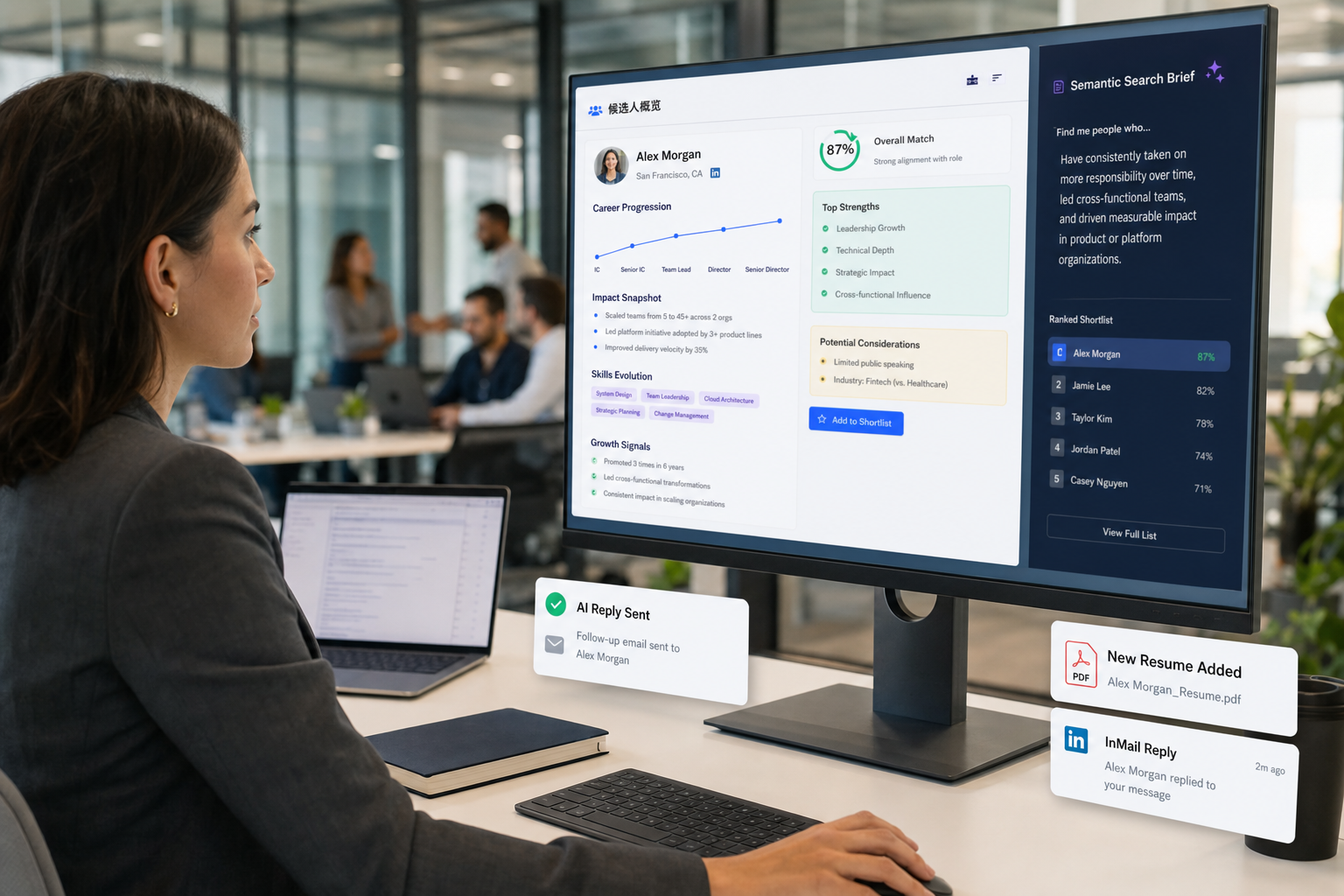
A clearer People GPT brief helps headhunters judge shortlist quality faster, avoid title-only misses, and spot stronger career-fit candidates.
That distinction sounds small, but it is where many sourcing projects go sideways. A vague brief produces a bloated list, a bloated list slows recruiter review, and slow review hurts outreach timing, hiring-manager confidence, and the credibility of the search itself. In smaller agencies, that means wasted desk time and fewer qualified conversations. In internal talent teams, it usually shows up as stalled reqs, poor calibration, and too much dependence on exact-title matching.
One way I have reduced that friction is by pairing semantic search with follow-up automation instead of expecting one step to do everything. In practice, tools such as StrategyBrain AI Recruiter can help with the repetitive communication layer that follows sourcing, especially when recruiters need 24/7 replies, multilingual candidate messaging, and automatic collection of resumes or contact details from interested prospects. The recruiter still owns the final shortlist, resume review, and next decision, but the workflow feels much cleaner when search, candidate response handling, and handoff are not all fighting for the same hour.
The reason this matters becomes obvious in the kind of meeting recruiters and candidates still have every day. A candidate gets one brief window to explain where they have been, what they are doing now, and where they want to go next. In recruiting conversations, that first 30 seconds often determines whether the person sounds focused or generic. The old lesson from recruiter elevator-pitch coaching still holds: people are remembered less for a list of past titles and more for a concise story that connects decisions, strengths, and future direction.
That same pattern shows up on the sourcing side. When a recruiter searches only for titles like controller, accounting manager, or finance lead, the search can miss the candidate whose profile tells a more meaningful progression: strong process grounding, a shift into leadership, and a visible motivation around improving operations and mentoring teams. In other words, the sourcing problem is not just database access. It is whether your search method can understand a career narrative the way a good recruiter does in a live conversation.
That is why AI candidate sourcing deserves to be evaluated through the lens of recruiter judgment, not just search speed. Much of the search intent behind people gpt, ai person finder, and ai people search free comes down to one question: can the system translate a recruiter's understanding of a candidate story into a better shortlist? The sections below break that down in practical terms.
- What people gpt buyers are really looking for
- Why candidate-story search beats title-only search
- A practical ai person finder workflow for recruiters
- Boolean search vs AI sourcing in real recruiting work
- Three common sourcing tool approaches recruiters compare
- What ai people search free usually means
- Best practices for better sourcing results
- Common mistakes in AI candidate sourcing
- FAQ
What people gpt buyers are really looking for
Searchers using people gpt are usually not looking for a buzzword. They are looking for a sourcing experience that feels closer to recruiter reasoning. Instead of forcing every role into exact keyword syntax, they want to describe the shape of the hire in plain English and get back candidates ranked by relevance, not just by word overlap.
In practice, that means three expectations sit behind the keyword:
- Natural-language role entry: recruiters want to write a role brief as they would explain it to a hiring manager.
- Semantic candidate matching: they want the system to recognize adjacent experience, title variation, and likely fit.
- Usable ranking: they want the first page of results to be reviewable enough to support fast calibration and outreach.
That framing also lines up with how experienced recruiters think about first impressions. A strong candidate is rarely reducible to a title string alone. Good recruiting judgment connects the past, present, and likely next move. AI sourcing is useful when it helps mirror that logic rather than flatten it.
Why candidate-story search beats title-only search
The elevator-pitch lesson is useful here because it exposes what sourcing systems often miss. Recruiters remember a concise narrative: where someone started, what they learned, what they changed, and what they are aiming for next. Candidate profiles work the same way. A search that only looks for title repetition may miss the person whose real value sits in progression, scope, and motivation.
Take a finance search. One candidate may literally match the req because the profile repeats every desired title. Another may show a more compelling path: early process depth, later management responsibility, evidence of process improvement, and a visible shift toward leadership. Most recruiters would at least review the second profile. A good ai person finder should, too.
This is where semantic sourcing earns its place. It can connect dots between functions, responsibilities, and career movement in a way exact-match search often cannot. That does not remove recruiter judgment. It simply gives the recruiter a better first draft of the market.
Key insight: The best AI candidate sourcing workflows do not replace recruiter intuition. They capture it earlier, in the search brief itself.
A practical ai person finder workflow for recruiters
The most reliable way to evaluate an ai person finder is to look at the workflow from intake to outreach. Here is the sequence I find most useful in real searches.
- Write the search brief as a career narrative. Include where the ideal candidate has been, what they likely do now, and what next-step logic makes sense.
- Run semantic search first. Start broad enough to let the system interpret adjacent backgrounds and title variation.
- Review the top results for storyline fit. Do the profiles show a coherent progression or only superficial overlap?
- Refine with recruiter filters. Narrow by geography, seniority, industry context, or functional must-haves once the first page is directionally right.
- Move selected prospects into outreach. After shortlist review, transition qualified prospects into a structured contact workflow.
That last step is where I have found support tooling especially useful. When I tested StrategyBrain AI Recruiter in a sourcing-heavy workflow, the immediate value was not in replacing selection. It was in handling repetitive LinkedIn-style follow-up after the shortlist was defined: connecting with candidates, introducing the role, replying after hours, and collecting resumes from people who were actually interested. For lean recruiting teams, that can protect recruiter time without giving away final qualification.
The important boundary is this: sourcing identifies likely people, outreach starts conversation, and screening decides fit. Blurring those stages is one of the fastest ways to create false confidence in automation.
What a strong search brief looks like
A strong brief sounds less like a copied job description and more like a recruiter explaining a candidate to another recruiter. For example, instead of listing ten requirements, you might say you want someone who built accounting discipline in a growing business, improved close or reporting processes, then moved into team leadership because they were effective at developing others and partnering cross-functionally.
That type of input gives a semantic system more usable context than isolated keywords. It also reflects how candidates naturally explain themselves when their elevator pitch is actually good: a connected story, not a random inventory of tasks.
Boolean search vs AI sourcing in real recruiting work
Boolean search still has a place. It is useful when the target is narrow, the title pattern is known, and the recruiter wants direct control over inclusions and exclusions. For many technical and highly standardized searches, it remains effective.
But AI sourcing changes the starting point. Instead of building a long logic string from guessed keywords, the recruiter can describe the role naturally and let the system infer related concepts, functionally similar backgrounds, and different profile language. That is especially helpful when the strongest candidates do not describe themselves in the same words the hiring manager used.
| Method | Best Use Case | Main Strength | Main Limitation |
|---|---|---|---|
| Boolean search | Precise, known-profile targeting | High manual control | Misses relevant candidates with different wording |
| AI candidate sourcing | Broader discovery and ranking | Understands context and progression | Still requires recruiter review |
If your team keeps finding “correct” profiles that still feel wrong in review, that is often a sign that search logic is too literal. The recruiter is thinking in stories; the system is thinking in strings.
Three common sourcing tool approaches recruiters compare
When teams evaluate software around this topic, they are usually comparing approaches rather than identical products. These three patterns come up most often.
1. LinkedIn Recruiter style search workflows
Use experience: familiar to many recruiters and strong for large-scale profile review within established LinkedIn recruiting behavior.
Effectiveness: useful when recruiters already know the target market well and can refine manually.
Cost lens: generally better suited to teams with an established sourcing budget.
Best fit: in-house talent teams, retained search, and firms already working heavily inside LinkedIn.
Working with StrategyBrain AI Recruiter: after prospects are identified, a tool like AI Recruiter can assist by keeping candidate conversations moving, answering common role questions, and gathering resumes or contact information while the recruiter focuses on evaluation.
2. Broad talent data platforms such as SeekOut
Use experience: often valued for filtering depth and wide talent discovery across multiple candidate attributes.
Effectiveness: strong for market mapping and diversity of search inputs when the team needs a larger top-of-funnel.
Cost lens: usually aimed at more mature recruiting functions with ongoing sourcing volume.
Best fit: larger internal TA teams and organizations with specialized sourcing roles.
Working with StrategyBrain AI Recruiter: the data-platform layer can help identify prospects, while StrategyBrain AI Recruiter can help maintain responsive candidate engagement once targets are selected.
3. Recruiter workflow plus AI communication support
Use experience: most helpful for lean teams that already know how to source but lose time in repetitive messaging and follow-up.
Effectiveness: useful when the bottleneck is not finding names but converting shortlist activity into real conversations.
Cost lens: should be evaluated against recruiter time saved and after-hours communication demands, not just seat count.
Best fit: agencies, solo headhunters, and internal teams managing high candidate-response volume.
Working with StrategyBrain AI Recruiter: this is where StrategyBrain is most relevant to the workflow discussed here, because it supports multilingual outreach, around-the-clock response handling, and resume capture, while leaving final qualification to the recruiter.
I am deliberately avoiding hard claims about ROI, pricing, or placement outcomes here because those vary by team, discipline, and implementation quality. The real comparison standard is operational fit: where does your process actually break?
What ai people search free usually means
The keyword ai people search free carries mixed intent. Some recruiters want a genuinely free sourcing tool. Others want a low-risk way to test whether AI search is better than manual keyword hunting. Those are very different needs.
In practice, free usually means one of four things:
- A limited free plan with restricted searches or exports
- A trial period for product evaluation
- A demo experience rather than live production use
- Free search with paid workflow features such as messaging, collaboration, or integrations
For recruiters, the useful question is not “Is it free?” but “What part of the sourcing workflow can I actually validate without budget?” If your goal is to test whether natural-language search improves shortlist quality, limited access may be enough. If your goal is to run an active desk, it usually is not.
The same principle applies to outreach tooling. A trial can help you see whether candidate replies are handled more consistently, whether multilingual communication matters in your market, or whether resume capture improves handoff quality. But no trial removes the need for recruiter review.
Best practices for better sourcing results
The strongest AI candidate sourcing results usually come from better recruiter inputs and better calibration habits, not from clever prompting alone.
1. Build around past, present, and next-step logic
The elevator-pitch structure is genuinely useful in sourcing. Ask what the candidate has done, what they are doing now, and why this role would be a coherent next move. That framework improves both search quality and shortlist review.
2. Look for motivation, not just mechanics
Strong candidate stories often contain a visible reason for progression: leadership, process improvement, customer depth, scale, or industry interest. Those clues matter because they help explain why a profile may fit even when the title is imperfect.
3. Review results before over-filtering
If the initial results are directionally right, resist the urge to add too many filters too quickly. Over-filtering often removes the nonlinear candidates who make the best hires.
4. Keep outreach and qualification separate
Use automation to keep communication moving if that suits your process, but do not confuse candidate interest with candidate fit. The recruiter still needs to evaluate resumes, assess relevance, and decide who advances.
5. Practice your own intake discipline
What candidates need in an elevator pitch, recruiters also need in a search brief: clarity, brevity, and a believable narrative. If the intake conversation is muddy, the sourcing results usually will be too.
Common mistakes in AI candidate sourcing
The first mistake is treating sourcing as a keyword exercise when the hiring decision is actually based on career pattern recognition. If a recruiter would never assess someone that simplistically in conversation, the search brief should not be simplistic either.
The second mistake is assuming the first tool in the workflow must do every job. A semantic search layer, an outreach support layer, and a formal ATS process can each play different roles. Expecting one system to perform all three usually creates weak handoffs.
The third mistake is chasing ai people search free without defining the test. Free access can be useful for validating search behavior or messaging workflow, but not if the team never agrees on what success should look like.
Practical takeaway: Better AI sourcing starts with a recruiter-quality brief, not a bigger pile of filters.
FAQ
What is AI candidate sourcing?
AI candidate sourcing uses natural-language search, semantic matching, and ranking to surface likely candidates before screening and outreach begin. It is most useful when recruiters want broader discovery than exact keyword search can provide.
What does people gpt usually mean in recruiting?
In recruiting search intent, people gpt usually refers to an AI-powered talent search experience where recruiters describe a role in plain English and receive ranked candidate matches based on meaning, not just text overlap.
How is an ai person finder different from Boolean search?
An ai person finder typically understands context, title variation, and related experience through semantic search. Boolean search gives stricter manual control but can miss relevant candidates who describe their experience differently.
Is ai people search free actually free?
Sometimes, but often only partially. Free may mean a trial, limited plan, or restricted access to certain features. Recruiters should confirm what is included before relying on it for live sourcing work.
Can AI replace recruiter judgment in sourcing?
No. AI can help surface and rank candidates faster, but recruiters still need to define the brief, assess nuance, review resumes, and decide who moves forward.
Where does outreach support fit after sourcing?
After a shortlist is selected, outreach support tools can help keep candidate communication moving, especially for after-hours responses, multilingual messaging, and collecting resumes or contact details. Final qualification should still remain with the recruiter.
Conclusion
AI candidate sourcing becomes genuinely useful when it mirrors how experienced recruiters already think. The lesson borrowed from elevator-pitch coaching is simple but important: people are easier to understand when their story is clear. The same is true in talent search. A system that recognizes career progression, motivation, and functional context will usually outperform one that only matches titles.
If you are evaluating people gpt, an ai person finder, or any ai people search free option, judge it by whether it helps you build a better first shortlist from a recruiter-quality brief. Then decide where communication support fits. In my experience, pairing better search logic with structured follow-up support such as StrategyBrain AI Recruiter can make the workflow more manageable, especially when candidate response handling is the bottleneck. Just keep the boundaries clear: AI can assist search and outreach, but strong recruiting decisions still depend on human judgment.