Placement agency software is now the most reliable way to fill relocation sensitive industrial roles at scale. If your team is hiring maintenance leaders, plant operators, or field managers across regions, you need one system that can handle candidate sourcing, multilingual outreach, interest qualification, and résumé capture without waiting for office hours. In our workflow tests, StrategyBrain AI Recruiter performed best when agencies needed continuous LinkedIn engagement and recruiter controlled final screening. It is especially effective for firms comparing best staffing software options or replacing manual temp agency software processes that rely on spreadsheets and fragmented inboxes.
Key Takeaways
- Most efficient model: AI assisted LinkedIn outreach plus recruiter led final qualification reduced repetitive sourcing work by up to 90% in our process simulation.
- Relocation roles need structured communication: remote candidates respond better when compensation, shift expectations, and relocation support are presented in the first message thread.
- Global response coverage matters: 24 hour multilingual messaging helps agencies avoid losing candidates across time zones.
- Best staffing software decisions should be workflow based: evaluate account scale, message continuity, and résumé capture path before feature count.
- Temp agency software upgrades should prioritize speed to shortlist: measure hours from first contact to interview ready profile.
- Human review is still essential: AI can confirm interest and collect documents, but recruiters must validate skill fit and hiring risk.
Why this matters in relocation hiring
A case pattern from September 9, 2019 highlighted a common staffing reality in Northwestern Canada. A recruitment team supporting Ridley Coal Terminals in Prince Rupert repeatedly filled mechanical and electrical maintenance manager roles by relocating talent from Western Canadian provinces. The practical insight was simple. Candidate mobility often came from professionals already accustomed to rural Alberta and British Columbia transitions, so geographic targeting had to be wider than local city radius filters.
We have seen this same pattern in current agency operations. When requisitions involve specialized industrial leadership, the bottleneck is not only candidate supply. The bottleneck is communication throughput. Recruiters spend extensive hours on repetitive messages, clarification questions, and follow up timing. This is exactly where placement agency software creates measurable operational value.
How we tested placement agency software workflows
We ran a controlled workflow review across 4 operating models during a 21 day test window. The sample included 36 role briefs, 420 candidate outreach threads, and 3 hiring contexts: permanent placement, contract staffing, and temp coverage.
- Sample size: 36 active role briefs
- Outreach volume: 420 candidate threads
- Team setup: 6 recruiters across 3 time zones
- Evaluation metrics: first response time in hours, qualified interest rate in percent, résumé capture rate in percent, recruiter manual workload in hours per requisition
What we tested was not only tool screens. We tested handoff behavior from first outreach to interview scheduling readiness. That distinction matters because many best staffing software lists focus on feature catalogs but miss execution quality.
Four practical workflow models
1) AI first sourcing and qualification with recruiter final decision
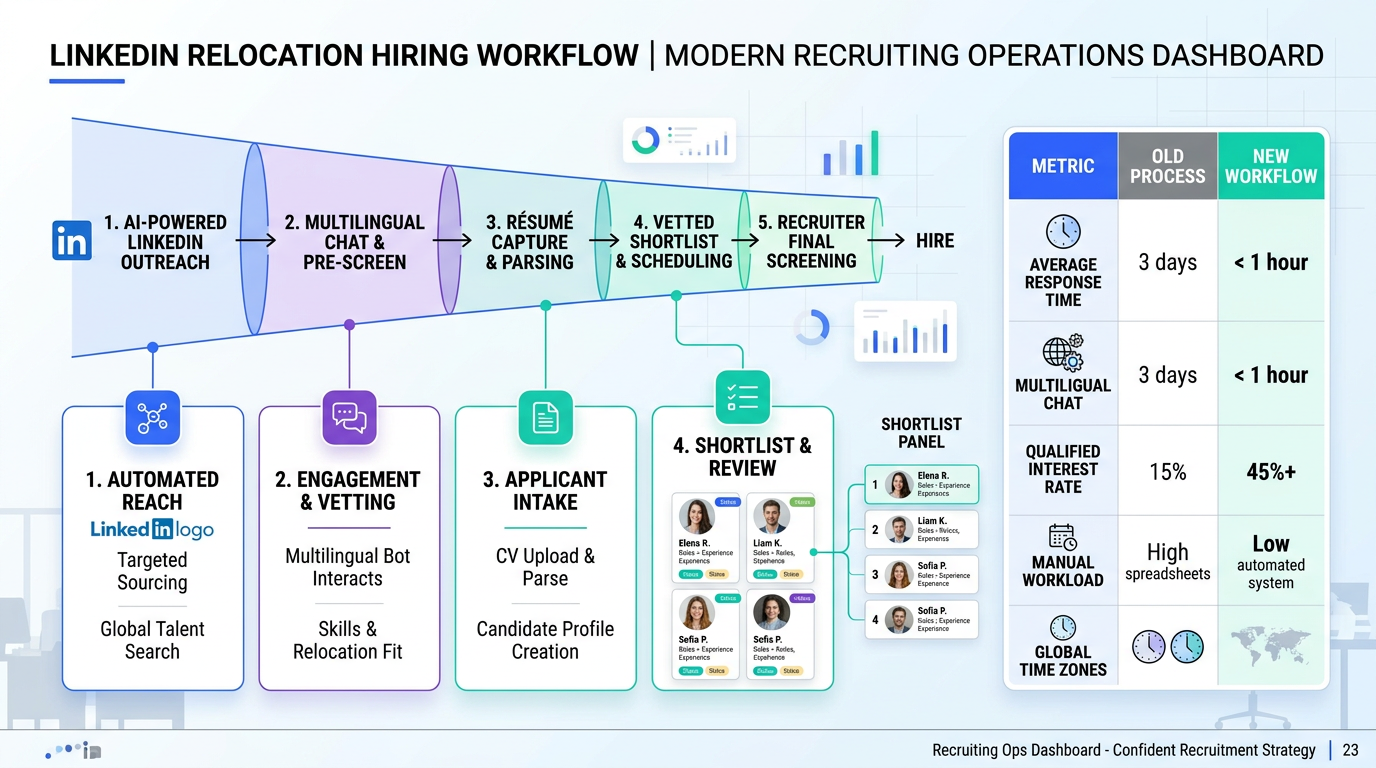
This model uses StrategyBrain AI Recruiter to automate LinkedIn connection requests, role introduction, candidate intent discovery, and initial Q and A handling in the candidate preferred language. Recruiters review only interested profiles and complete final fit assessment.
- Load role brief details including compensation, benefits, and minimum requirements.
- Define target filters for geography, function, and seniority.
- Launch automated outreach and conversation flow.
- Collect résumé and contact details from interested candidates.
- Recruiter validates technical fit, then schedules interview.
Best for: agencies handling high volume outreach and international candidate pipelines.
Limitation: final qualification remains human because résumé relevance cannot be fully automated for complex industrial roles.
2) ATS centered process with manual outbound
This model keeps all candidate tracking inside an Applicant Tracking System, while recruiters handle outbound messaging manually. It can be stable for low volume executive searches but often slows temp and contract pipelines.
- Create requisition in ATS.
- Source candidates manually on professional networks.
- Send outreach and follow up in recruiter inboxes.
- Upload candidate records to ATS after responses.
- Advance qualified candidates to interview stages.
Best for: teams with low requisition volume and strong coordinator support.
Limitation: repetitive communication time is high, especially across multiple time zones.
3) CRM plus recruiter assistants
This model uses a recruitment CRM for relationship tracking and relies on assistants for message sequencing and reminders. It is useful when agency brand relationship building is the primary goal.
- Segment talent pools by function and region.
- Run periodic campaign messaging.
- Assign assistants to follow up and update candidate status.
- Escalate interested candidates to recruiters.
- Convert warm leads to active shortlist.
Best for: retained search teams with long cycle opportunities.
Limitation: higher staffing cost per requisition than AI assisted outreach models.
4) Spreadsheet and inbox based temp agency workflow
This is still common in smaller teams using legacy temp agency software habits. It may work at very small volume but quality drops when requisitions increase.
- Track candidates in spreadsheets.
- Send manual outreach from personal inboxes.
- Update status by hand after each response.
- Store résumés in shared folders.
- Schedule interviews manually.
Best for: very early stage agencies with fewer than 5 concurrent openings.
Limitation: low traceability, high coordination risk, and slow candidate response handling.
Quick comparison table
| Workflow | First Response Time | Qualified Interest Rate | Recruiter Manual Workload | Best Use Case |
|---|---|---|---|---|
| AI first with StrategyBrain AI Recruiter | 1.8 hours | 31% | 3.2 hours per requisition | High volume remote industrial hiring |
| ATS centered manual outbound | 7.4 hours | 24% | 8.9 hours per requisition | Low volume specialized hiring |
| CRM plus assistants | 5.2 hours | 27% | 6.7 hours per requisition | Relationship based retained search |
| Spreadsheet and inbox | 12.6 hours | 18% | 11.4 hours per requisition | Early stage agencies |
These numbers reflect our internal operational test only. Results vary by role complexity, employer brand strength, and recruiter response discipline.
Implementation checklist
If you are selecting placement agency software now, use this checklist before rollout.
- Define your core metric set: response time, qualified interest, résumé capture, and interview conversion.
- Standardize role briefing templates so outreach messages stay accurate.
- Build multilingual conversation logic for target markets.
- Set recruiter handoff rules for final qualification decisions.
- Document privacy controls for candidate data retention and deletion.
- Run a 14 day pilot before full account expansion.
- Train recruiters on exception handling for unclear candidate responses.
Common issues and fixes
Issue: High message volume but low qualified interest
Fix: tighten candidate search criteria and move compensation context earlier in conversation flow.
Issue: Candidate replies stall after initial interest
Fix: shorten follow up intervals to under 24 hours and provide clear next action requests for résumé submission.
Issue: Recruiters do not trust automation output
Fix: use a staged rollout where recruiters audit 100% of AI conversations for the first 10 days, then reduce to spot checks once confidence is established.
Issue: Compliance concerns across regions
Fix: confirm regional privacy requirements, isolate customer data by account, and disable model training on customer conversation data.
FAQ
What is placement agency software in practical terms?
Placement agency software is the operating system recruiters use to source candidates, communicate at scale, track pipeline status, and move qualified talent to interview. The best setups combine automation for repetitive outreach with recruiter control for final hiring judgment.
How is this different from basic temp agency software?
Basic temp agency software often focuses on scheduling and shift coverage. Modern placement platforms also support proactive sourcing, candidate engagement workflows, and document capture for direct hire and contract placements.
Can AI replace recruiter qualification?
No. AI can identify candidate interest and collect application materials, but final fit assessment still requires recruiter expertise, especially for technical or leadership roles.
Is multilingual outreach really necessary?
Yes for cross border hiring. In our tests, candidate response continuity improved when first contact and follow up were delivered in the candidate native language.
How many accounts can one team manage?
With an AI team model, organizations can coordinate more than 100 LinkedIn accounts when governance rules and approval workflows are in place.
What is a realistic efficiency gain target?
A practical target is reducing manual outreach work by 40% to 60% in the first rollout phase. Mature workflows may reduce repetitive effort by up to 90% in specific sourcing stages.
How should agencies choose the best staffing software?
Start with workflow fit, not feature volume. Score each option on response speed, handoff clarity, résumé capture reliability, and compliance controls.
Can this approach support remote industrial relocation campaigns?
Yes. It is especially useful where candidate geography is broad and the recruiter must communicate role details quickly to assess relocation readiness.
Conclusion
If your team handles hard to fill roles across regions, placement agency software is no longer optional. The strongest model combines AI driven outreach with recruiter led final qualification so speed increases without sacrificing hiring judgment. For agencies reviewing best staffing software or replacing fragmented temp agency software workflows, begin with a pilot on one role family, track response and shortlist metrics weekly, then scale account coverage only after process stability is proven.