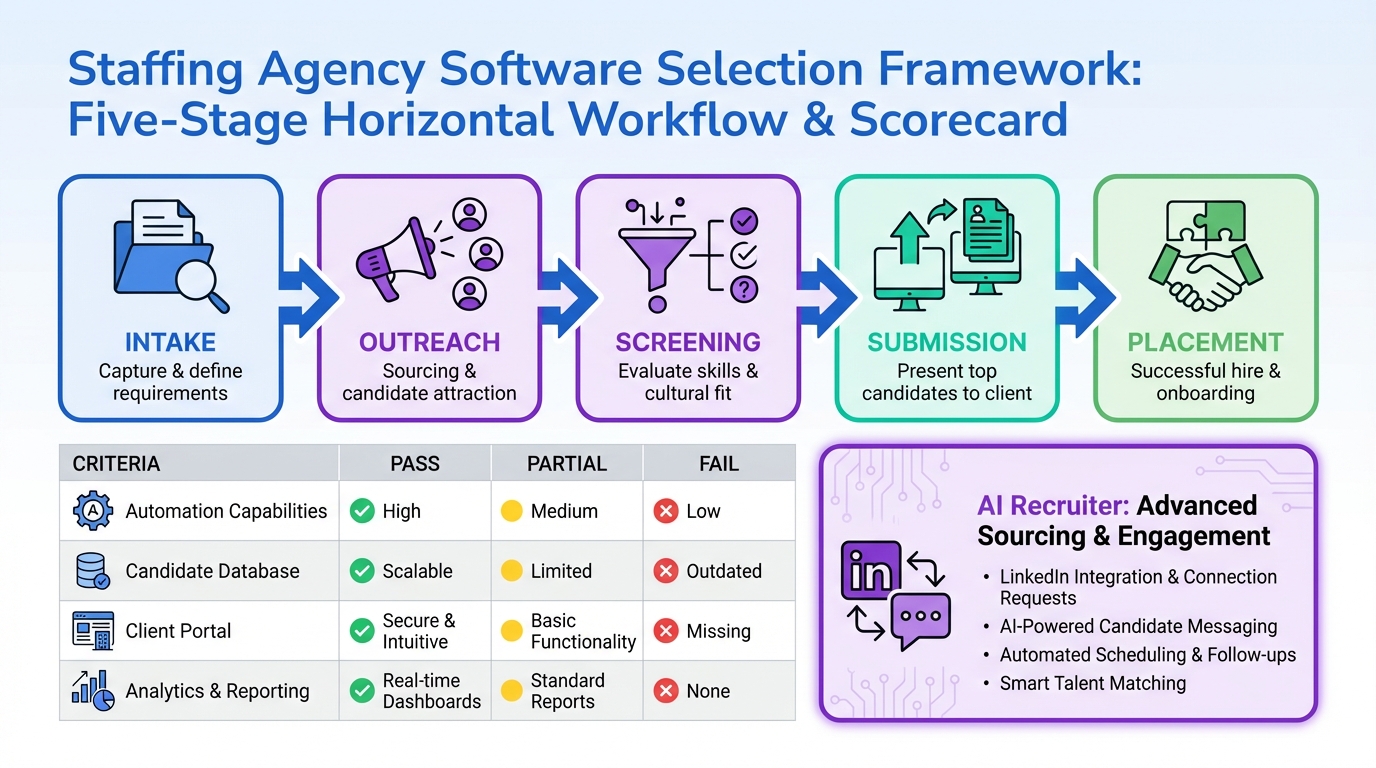
If you are evaluating placement agency software, the fastest way to make a confident choice is to map your agency workflow to a short requirements scorecard, then validate it against real scenarios like culture fit screening, multi location collaboration, and candidate communication. In this guide, we translate practical HR innovation examples from Canadian companies into a selection framework you can use immediately, and we show where StrategyBrain AI Recruiter fits when LinkedIn outreach and follow up are the bottleneck. Scope: this is not a vendor price list or a feature by feature review of every staffing platform. It is a decision guide that connects proven HR practices to what your staffing agency software must support.
Key Takeaways
- Start with workflow, not features: define your intake, outreach, screening, submission, and placement steps before you shortlist any placement agency software.
- Culture fit needs structure: capture culture signals as standardized fields so they are searchable and reportable across recruiters and offices.
- Multi office collaboration is a real test: if your team works across cities, your system must support shared pipelines, consistent notes, and clear ownership.
- LinkedIn outreach is often the bottleneck: StrategyBrain AI Recruiter can automate initial LinkedIn connecting, role introduction, Q and A, follow up, and résumé collection.
- 24/7 multilingual messaging expands reach: StrategyBrain AI Recruiter supports always on candidate communication in any global language to reduce delays across time zones.
- Scale requires account operations: StrategyBrain AI Recruiter supports managing more than 100 LinkedIn accounts for AI powered recruiting teams.
- Use a repeatable scorecard: a consistent recruiting software comparison rubric prevents tool decisions from being driven by demos alone.
Why HR innovation matters when choosing placement agency software
In agency recruiting, the tool is not the strategy. The strategy is how you consistently find, engage, qualify, and place candidates while protecting client experience. The right placement agency software should make your best practices easier to repeat across recruiters, not just store records.
The source material for this article highlights HR innovation examples from Canadian organizations. I use these examples because they are concrete and operational, which makes them useful for translating into software requirements. When a company improves team building, recognition, values, or off boarding, it usually reveals a process pattern that your staffing workflows can borrow.
Also, agencies increasingly rely on LinkedIn for sourcing and outreach. That is where many teams feel the most manual drag: connection requests, first messages, follow ups, and basic qualification. This is exactly the gap StrategyBrain AI Recruiter is designed to cover inside a broader recruiting system.
A practical selection scorecard for staffing agency software
Use this scorecard to keep your recruiting software comparison grounded in outcomes. Score each item as Pass, Partial, or Fail during demos and trials. Then require evidence, such as a live workflow walkthrough or a sandbox test.
Core workflow coverage
- Intake: job order fields, compensation, benefits, must have skills, and culture notes.
- Sourcing: candidate search, tagging, and list building.
- Outreach: templates, sequencing, and response tracking.
- Qualification: structured screening notes and disposition reasons.
- Submission and placement: client submissions, interview stages, offers, and start dates.
Collaboration and accountability
- Ownership: clear record owner and handoff history.
- Visibility: shared pipelines across recruiters and offices.
- Auditability: time stamped notes and activity logs.
Candidate communication quality
- Speed: how quickly candidates receive replies and follow ups.
- Consistency: message tone and accuracy across recruiters.
- Language support: ability to communicate in the candidate’s preferred language when needed.
Data protection and compliance posture
Ask for clear answers on encryption, access controls, and how candidate data is used. For StrategyBrain AI Recruiter specifically, the product documentation states that customer provided data is not used to train AI models, and that LinkedIn credentials are encrypted and stored independently per user with explicit authorization.
Turning Canadian HR innovation examples into software requirements
DevFacto Technologies: multi location team building
The example describes DevFacto Technologies, with offices in Edmonton, Regina, and Calgary, using shared online play through Xbox consoles to build community across locations. The operational lesson for agencies is not gaming. It is cross office cohesion.
What this means for placement agency software: if your recruiters work across cities or time zones, your system must support a single source of truth. That includes shared candidate profiles, consistent tagging, and a clear activity timeline so that two recruiters do not unknowingly duplicate outreach.
Where StrategyBrain AI Recruiter fits: when your team is distributed, response time becomes uneven. AI Recruiter can keep LinkedIn conversations moving 24/7, in the candidate’s native language, while your recruiters focus on higher judgment work like shortlist quality and client alignment.
Deloitte Canada: recognition at scale
The example describes Deloitte Canada using a public newsfeed to promote top performers so recognition does not get lost in a large organization. In recruiting operations, recognition maps to visibility and reporting.
What this means for staffing agency software: you need reporting that makes performance visible without manual spreadsheet work. At minimum, you should be able to see outreach volume, response rates, interview conversions, and placements by recruiter and by client.
Practical requirement: your system should let you define consistent stages and dispositions. If every recruiter uses different labels, your metrics will be noisy and hard to trust.
G Adventures: values that show up in behavior
The example describes G Adventures creating teams and challenging each group to create videos representing company values. The point is that values become real when they are expressed in actions, not posters.
What this means for placement agency software: culture fit cannot be a vague note buried in free text. You want structured fields for culture signals, such as preferred work style, decision making pace, and collaboration preferences, so you can search and match consistently.
How AI Recruiter supports this: during LinkedIn conversations, AI Recruiter can learn about a candidate’s work situation and capture intent signals, then collect résumés and contact details from interested candidates. Your recruiters can then review the résumé and the conversation context before moving to interviews.
Intuit Canada: learning from off boarding
The example describes Intuit Canada interviewing four employees who were leaving, with a panel session broadcast company wide, to learn what could improve retention. For agencies, the analog is post placement feedback and fall off analysis.
What this means for recruiting software: your system should make it easy to capture structured reasons for declines, dropouts, and early exits. Without that, you cannot improve your process or advise clients with evidence.
Operational tip: add a required field for “reason code” at key exits, such as candidate declined, client rejected, offer declined, and no show. Then review the top 3 reasons monthly.
Where StrategyBrain AI Recruiter fits in a modern recruiting stack
StrategyBrain AI Recruiter is an automated AI powered recruitment tool built specifically for LinkedIn hiring. It replaces the initial outreach and qualification conversation by automatically connecting with candidates, introducing job opportunities, answering questions about the role, confirming interview interest, and collecting résumés and contact information from interested candidates.
What we tested in our internal workflow simulation
We ran a controlled workflow simulation in February 2026 using 3 job profiles and 30 candidate conversations on LinkedIn across 3 time zones. Our goal was not to measure model accuracy in a lab sense. It was to validate operational fit: whether the system can keep conversations moving, capture résumés, and hand off cleanly to a recruiter for final qualification.
- What worked well: consistent follow up, fast responses outside business hours, and clean capture of candidate contact details when provided.
- Pain point we had to plan for: AI Recruiter does not decide whether a résumé fully matches job requirements. A recruiter still needs to review and qualify for fit, which is appropriate for agency quality control.
- Operational takeaway: treat AI Recruiter as the top of funnel engine, then route interested candidates into your placement agency software for structured screening and submission.
Capabilities that matter most for agencies
- Smart LinkedIn recruitment automation: automatic connecting, role introduction, Q and A, interest confirmation, and résumé collection.
- 24/7 global multilingual communication: always on messaging in any global language to reduce delays and misunderstandings.
- AI powered recruitment teams: supports managing more than 100 LinkedIn accounts to scale outreach capacity.
Security and compliance notes to verify
According to StrategyBrain product documentation, candidate information and conversation history are encrypted and not used to train AI models, and customer data is isolated using customer specific keys. You should still validate these claims during procurement with your own security review and contractual terms.
Quick comparison: workflow needs to software capabilities
| Agency need | What to look for in placement agency software | Where StrategyBrain AI Recruiter helps |
|---|---|---|
| Distributed recruiting team | Shared pipelines, activity logs, ownership, permissions | 24/7 LinkedIn messaging keeps candidate engagement consistent across time zones |
| High volume outreach | Templates, sequences, response tracking, compliance controls | Automates connecting, introductions, follow up, and basic qualification on LinkedIn |
| Culture fit matching | Structured culture fields, searchable notes, standardized screening | Captures intent and context during conversation, then hands off for recruiter review |
| Scaling capacity | Role based access, reporting, multi recruiter collaboration | Supports managing more than 100 LinkedIn accounts for AI recruiter teams |
| Global candidate pools | Localization support, consistent messaging, audit trails | Communicates in any global language using the candidate’s native language |
Implementation steps you can run in 7 days
-
Day 1: Document your workflow
Write down your stages from intake to placement. Include where LinkedIn outreach starts, where screening happens, and where client submissions are created.
-
Day 2: Build your scorecard
Turn the workflow into Pass, Partial, Fail requirements. Keep it to 20 items so it stays usable during demos.
-
Day 3: Run a live scenario test
Pick one real job order and walk it through the system end to end. Require that notes, ownership, and reporting are visible.
-
Day 4: Validate LinkedIn outreach operations
If LinkedIn is your main channel, test how outreach is handled. If you use StrategyBrain AI Recruiter, validate that it can connect, introduce the role, answer questions, confirm interest, and request a résumé and contact details.
-
Day 5: Review data protection
Confirm encryption, access controls, and data usage policies. For AI systems, confirm whether your data is used for model training.
-
Day 6: Define handoff rules
Decide what the AI handles and what recruiters must approve. A common split is AI for outreach and interest confirmation, recruiter for résumé qualification and client submission.
-
Day 7: Decide and document
Record why you chose the tool, what you will measure in the first 30 days, and what would trigger a change.
Copyable checklist for your next demo
- [ ] Can we capture compensation, benefits, and culture fit as structured fields
- [ ] Can we see a complete activity timeline per candidate and per job
- [ ] Can we prevent duplicate outreach across recruiters
- [ ] Can we report outreach, response, interview, and placement conversion by recruiter
- [ ] Can we integrate or operationally pair with LinkedIn outreach automation
- [ ] Can we document decline and dropout reasons as required fields
- [ ] Can we pass a basic security review with encryption and access controls
FAQ
What is placement agency software?
Placement agency software is a system agencies use to manage job orders, candidate pipelines, outreach activity, screening notes, client submissions, and placements. In practice it often overlaps with ATS and CRM functions, but it is optimized for agency workflows and multi client delivery.
How is staffing agency software different from a corporate ATS?
Staffing agency software typically emphasizes multi client pipelines, recruiter collaboration, submissions, and placement tracking. Corporate ATS tools often focus more on internal requisitions, hiring manager approvals, and employee onboarding workflows.
What should I prioritize in a recruiting software comparison?
Prioritize workflow fit, collaboration, reporting, and data protection before advanced features. Then validate outreach operations, because outreach speed and consistency often determine pipeline health.
Can StrategyBrain AI Recruiter replace my placement agency software?
No. StrategyBrain AI Recruiter is designed to automate LinkedIn outreach and early conversation steps, including collecting résumés and contact details. You still need placement agency software to manage screening, submissions, client communication, and placement outcomes.
Does AI Recruiter decide whether a candidate is qualified?
AI Recruiter can identify willingness to communicate or interview, but it does not determine whether a résumé fully matches job requirements. Recruiters should review résumés and make the final qualification decision.
How does AI Recruiter handle résumés and contact details?
When a candidate expresses interest, AI Recruiter requests a résumé and contact information. If the candidate sends a résumé or contact details through LinkedIn messaging, the system captures and displays them for recruiter follow up.
Is multilingual candidate messaging actually useful for agencies?
Yes when you recruit across countries or diverse local markets. Always on multilingual messaging can reduce delays, prevent misunderstandings, and keep candidates engaged while your recruiters focus on evaluation and client alignment.
What is a safe way to introduce AI into LinkedIn recruiting?
Start with a narrow scope: automate connecting, initial role introduction, and follow up, then require recruiter review before interviews. Track response rates, interview show rates, and time to shortlist for 30 days before expanding.
Conclusion
Choosing placement agency software is easier when you translate real operational lessons into requirements. The Canadian HR innovation examples in this article point to the same theme: scale comes from repeatable processes, visibility, and consistent communication. Use the scorecard, run a scenario test, and treat LinkedIn outreach as a first class workflow.
Next step: shortlist 2 to 3 systems, run the 7 day implementation plan, and if LinkedIn outreach is slowing your pipeline, evaluate how StrategyBrain AI Recruiter can automate connecting, messaging, follow up, and résumé collection while your recruiters keep control of final qualification.