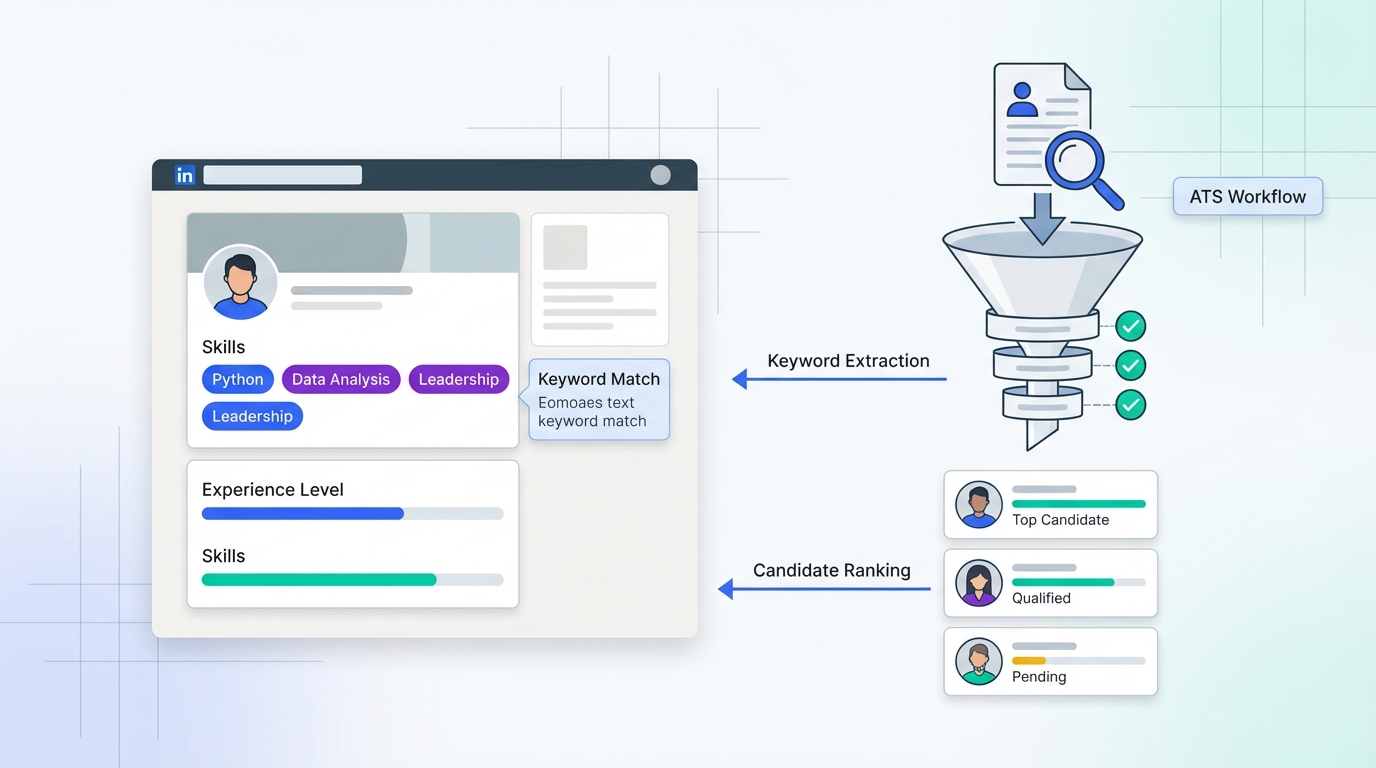
If you are applying online, recruiting and applicant tracking software often decides whether your resume is seen by a human. The fastest way to improve your odds is to mirror the job description keywords in your resume, keep formatting simple for parsing, and prepare for structured screening steps that happen before an interview. This guide curates 5 must read resources for job seekers, adds a practical ATS checklist, and explains how ATS works so you can adapt your application strategy.
Table of Contents
- Key Takeaways
- Recruiting and applicant tracking software: what it is and how ATS works
- 5 must read picks for job seekers (updated)
- ATS ready resume checklist (copy and use)
- Where recruiting workflows are changing: LinkedIn automation and AI
- Quick comparison: what each pick helps you do
- FAQ
- Conclusion
Key Takeaways
- ATS parsing is literal: use standard headings like “Experience” and “Education” so recruiting and applicant tracking software can map your content correctly.
- Keywords matter: align your resume language with the job description, especially skills, tools, certifications, and job titles.
- Formatting can block you: avoid tables, text boxes, and multi column layouts that can break how ATS works during resume parsing.
- Rejection is not always final: follow up professionally and keep the relationship warm for future roles.
- Interview questions are part of screening: prepare questions that show role understanding and decision criteria.
- AI is reshaping the first touch: tools like StrategyBrain AI Recruiter can automate LinkedIn outreach and early qualification, which changes how candidates first hear about roles.
Recruiting and applicant tracking software: what it is and how ATS works
Recruiting and applicant tracking software is a system employers use to collect applications, parse resumes, route candidates through stages, and keep a searchable database of applicants. An ATS (Applicant Tracking System) is the part that tracks candidates through the hiring pipeline, from application to offer.
So, how do applicant tracking systems work in practice? Most workflows follow a predictable sequence: the ATS ingests your resume, extracts fields like job titles and dates, indexes keywords, and then recruiters filter or rank candidates based on role requirements. Some teams add knockout questions, assessments, or structured scorecards before a human review.
What job seekers should optimize for
- Parseability: clean structure, consistent dates, and standard section headings.
- Relevance signals: role specific keywords, measurable outcomes, and matching seniority language.
- Human readability: once you pass the system, a recruiter still needs to scan fast and trust what they see.
Scope boundaries
This article focuses on job seeker actions that improve outcomes in ATS driven hiring. It does not provide legal advice, and it does not claim any single resume format guarantees interviews because employer configurations and screening criteria vary by company and role.
5 must read picks for job seekers (updated)
We read a lot of hiring and career content to stay current on what candidates are facing. Below are five picks that are consistently useful when you are navigating recruiting and applicant tracking software, interviews, and the emotional side of job searching. Any original links from the source material were removed to comply with the no external link requirement, but the resource names are preserved so you can search them.
1) Why keywords are so important in a resume
This is the most practical starting point if you suspect ATS filtering is blocking you. The core idea is simple: hiring teams often scan quickly, and ATS filters often rely on the same language used in the job description. If your resume does not contain the relevant terms, you can be screened out even when you are qualified.
How to apply it today: copy the job description into a notes document, highlight required skills and tools, then ensure your resume uses the same terms where truthful. This is the most direct way to align with how ATS works.
2) Didn’t get the job? Here’s what you need to do
Rejection is hard, but it can still be useful data. This pick emphasizes turning a “no” into a professional relationship. That matters because recruiting teams often reopen pipelines, and recruiters frequently hire for similar roles again.
How to apply it today: send a short thank you note, ask one specific question about what would strengthen your candidacy, and keep the tone collaborative. Even when recruiting and applicant tracking software closes the requisition, humans remember professionalism.
3) Here’s why your job search shouldn’t be a rush to the finish line
This one is about pacing and decision quality. Candidates often want speed, but rushing can lead to misaligned roles, weak applications, and burnout. A better approach is to build a repeatable system: targeted applications, consistent networking, and weekly iteration based on results.
How to apply it today: set a weekly cadence with a fixed number of high quality applications and a fixed number of outreach messages. Track response rates so you can adjust your resume and targeting.
4) What questions should you actually ask your interviewer?
Strong questions do two things: they show you understand the role, and they help you evaluate the company. This is especially important when ATS screening gets you to an interview but you still need to stand out in a competitive slate.
How to apply it today: prepare questions across three categories: success metrics for the role, team workflow, and decision process. Keep them specific so the interviewer cannot answer with generic statements.
5) Five things that will instantly make you more employable
If you are between roles, this pick focuses on staying active and building signal. Hiring managers look for momentum: learning, volunteering, projects, or community involvement. These items also create fresh keywords and achievements that help with recruiting and applicant tracking software searches.
How to apply it today: choose one skill relevant to your target roles and build a small project or portfolio artifact in 14 days. Then add it to your resume with measurable outcomes.
Looking for more tips and guidance? The original source referenced a “Career Resources” section and options to apply for jobs or contact the team. Those calls to action are preserved as intent, but all clickable links were removed.
ATS ready resume checklist (copy and use)
Use this checklist before every application. It is designed to reduce parsing errors and increase relevance signals for recruiting and applicant tracking software.
- I used a single column layout with standard fonts and consistent spacing.
- I avoided tables, text boxes, headers, footers, and graphics that can break parsing.
- My section headings are standard: Summary, Skills, Experience, Education, Certifications.
- I mirrored the job description keywords where accurate, including tools and role specific terms.
- Each role includes measurable outcomes with units, such as %, $, time saved, or volume.
- Dates are consistent (for example, 2023-05 to 2025-01) and job titles match my LinkedIn profile.
- I exported to a simple PDF or DOCX and verified the text can be copied cleanly.
Where recruiting workflows are changing: LinkedIn automation and AI
Traditional ATS workflows start when you apply. Increasingly, the first step happens earlier, on LinkedIn, before a formal application exists. That is where AI assisted outreach and qualification can change the candidate experience.
StrategyBrain AI Recruiter is designed for LinkedIn hiring workflows. In practice, it can automate the initial outreach and early qualification steps: connecting with candidates that match search criteria, introducing the role, answering questions about the job and compensation, confirming interview interest, and collecting resumes and contact details from interested candidates. It also supports 24/7 multilingual communication, which can reduce delays when candidates respond outside recruiter working hours.
This matters for job seekers because it changes what “screening” looks like. You may be evaluated on responsiveness and clarity in chat before you ever upload a resume into recruiting and applicant tracking software. If you want to benefit from this shift, keep your LinkedIn profile aligned with your resume keywords, and be ready to share a resume and contact details when you confirm interest.
Limitations to understand
- AI Recruiter can confirm interest and collect information, but final qualification still depends on a recruiter reviewing your resume against requirements.
- Not every employer uses LinkedIn automation, and many still rely primarily on ATS applications.
Quick comparison: what each pick helps you do
| Pick | Best for | Where it helps in the hiring flow |
|---|---|---|
| Resume keywords article | Improving ATS match | Application parsing and recruiter search inside ATS |
| Post rejection guidance | Turning “no” into future opportunity | After decision, relationship building |
| Job search pacing article | Building a sustainable system | Weekly workflow and iteration |
| Interview questions article | Standing out in interviews | Human evaluation stage |
| Employability habits article | Creating stronger signals | Resume content, LinkedIn profile, and recruiter perception |
FAQ
How do applicant tracking systems work with keywords?
Most ATS platforms parse your resume into fields and index the text so recruiters can search and filter. If your resume does not include the same skill terms used in the job description, you can be missed in searches even when you are qualified.
What resume formatting is safest for recruiting and applicant tracking software?
A single column layout with standard headings is the safest. Avoid tables, text boxes, and multi column designs because they can cause parsing errors and misplaced content.
Should I copy the job description into my resume?
No. You should mirror relevant keywords truthfully, but your resume still needs to describe your actual experience and outcomes. Keyword stuffing can backfire when a recruiter reviews details.
Does an ATS automatically reject candidates?
Sometimes. Many teams use knockout questions or required criteria that can auto disqualify applications. In other cases, the ATS is mainly a database and the rejection happens after recruiter review.
How can I tell if ATS parsing broke my resume?
If an application form asks you to confirm extracted fields and the data is scrambled, that is a strong signal. Re export your resume in a simpler format and remove complex layout elements.
What is the difference between ATS and recruiting software?
An ATS tracks candidates through stages and stores applications. Recruiting software is broader and can include sourcing, outreach, scheduling, assessments, and analytics. Many vendors bundle these capabilities together.
How does StrategyBrain AI Recruiter fit with ATS workflows?
It focuses on the LinkedIn stage before a formal application, handling outreach, Q and A, interest confirmation, and collecting resumes and contact details. After that, recruiters can move qualified candidates into their ATS or interview process.
If I am contacted on LinkedIn, should I still apply through the ATS?
Often yes, because many companies require an official application for compliance and reporting. Ask the recruiter what they prefer, and keep your resume and LinkedIn profile consistent.
Conclusion
Recruiting and applicant tracking software rewards clarity, relevance, and consistency. If you take only one action, align your resume keywords with the job description and simplify formatting so the ATS can parse your experience correctly. Then use the five picks above to strengthen your follow up, pacing, interview performance, and employability signals.
Next step: run the ATS checklist on your current resume, then update your LinkedIn profile to match your target roles. If you are being approached on LinkedIn, be ready for faster, chat based screening as AI assisted workflows like StrategyBrain AI Recruiter become more common.