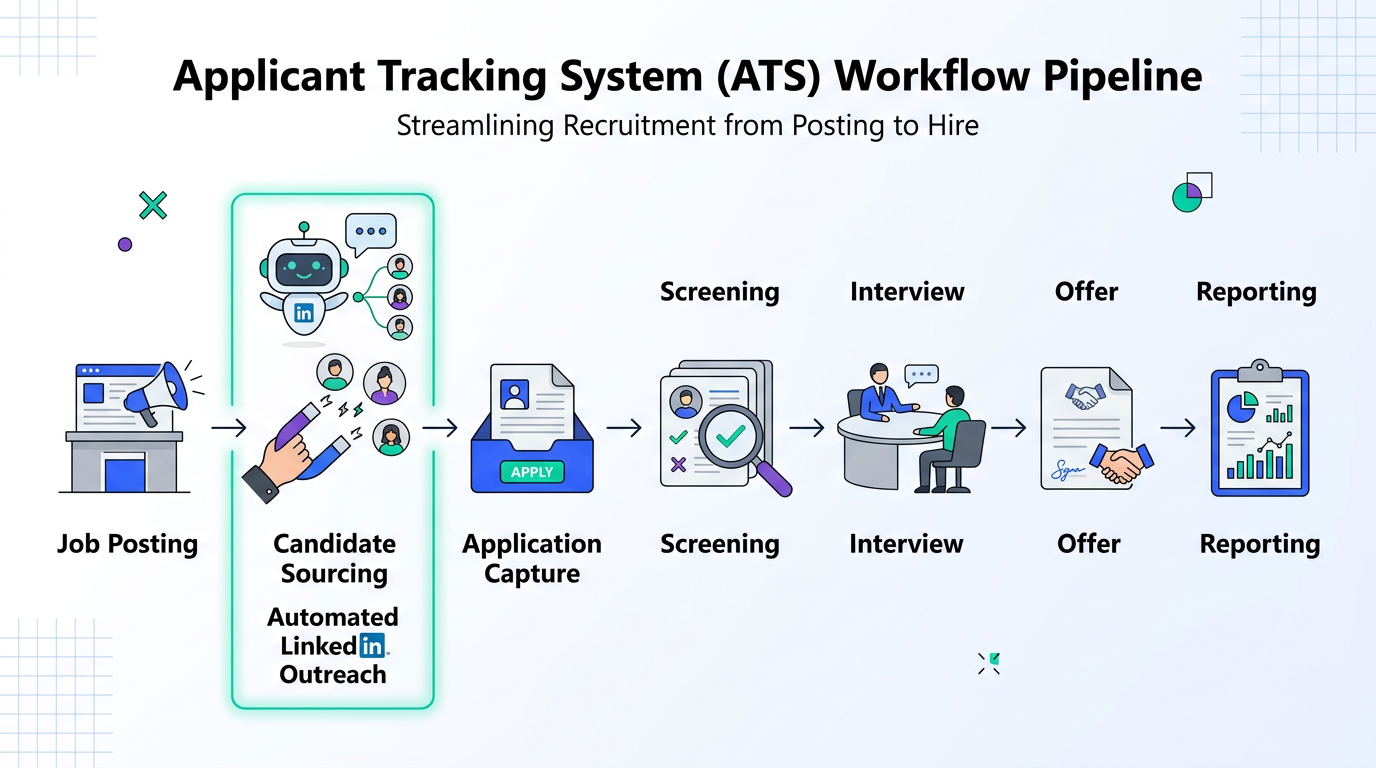
Recruiting and applicant tracking software helps you attract stronger candidates by turning your employer brand into consistent, measurable hiring actions. In practice, that means your ATS (applicant tracking system) becomes the system of record for job content, candidate touchpoints, and hiring-stage outcomes, while automation keeps messaging timely and consistent. This guide explains what an ATS is, how ATS works across the hiring funnel, and how to operationalize employer branding inside recruiting workflows. We also show where StrategyBrain AI Recruiter fits when LinkedIn outreach and follow up are the bottleneck, especially for multilingual, always on candidate communication.
Key Takeaways
- Employer brand is operational, not just marketing: It is your culture, values, and day to day experience, and it shows up in every candidate touchpoint you manage in an ATS.
- What is ATS: An applicant tracking system is the workflow and database that tracks candidates from application to offer, including stages, notes, and communications.
- How ATS works: A typical flow is job creation, sourcing, application capture, screening, interviews, offer, and reporting, with audit trails for decisions.
- Brand consistency improves conversion: Consistent job messaging and fast follow up reduce drop off between stages, especially after first contact.
- LinkedIn outreach is often the bottleneck: StrategyBrain AI Recruiter automates initial LinkedIn connecting, role introduction, Q and A, and follow up, then hands interested candidates back to recruiters with resumes and contact details.
- Global hiring needs language coverage: StrategyBrain AI Recruiter supports multilingual candidate conversations and 24/7 responses to reduce time zone delays.
What a powerful employer brand really is
In the source material we reviewed, the definition is straightforward and practical. Your employer brand is your ethos, your culture, your values, and the way you operate. Even if you never wrote it down, you still have one, because it forms through every interaction and touchpoint an employee has with your company.
That framing matters for recruiting and applicant tracking software because an ATS is where many of those touchpoints are created, stored, and repeated. Job descriptions, email templates, interview scheduling messages, rejection notes, and offer communications are all brand moments, and they are often generated from the same system.
“Engaging the hearts, minds, and hands of talent is the most sustainable source of competitive advantage”
Greg Harris, CEO of Quantum Workplace
Why employer brand changes hiring outcomes
A positive employer brand is not a vague benefit. It changes the size and quality of your candidate pool, and it can reduce the cost of hiring by improving retention and lowering turnover related backfill. The source content highlighted four concrete outcomes that a strong employer brand enables.
- Attract more candidates, which increases the pool you can select from.
- Win highly skilled candidates who have options and compare employers.
- Increase retention by aligning expectations with reality.
- Reduce recruiting and turnover costs by improving fit and reducing churn.
From an operations perspective, these outcomes depend on consistency and speed. Candidates interpret slow follow up, unclear role details, and inconsistent messaging as signals about how the organization works. That is exactly where recruiting and applicant tracking software can either reinforce your brand or quietly undermine it.
What is ATS in recruiting and applicant tracking software
What is ATS is one of the most common questions we hear from hiring teams that are scaling. An ATS, short for applicant tracking system, is the system that stores candidate records and manages the hiring workflow from application through offer. It typically includes job postings, candidate profiles, stage tracking, interview notes, communication logs, and reporting.
Recruiting and applicant tracking software often includes an ATS plus additional modules such as sourcing, CRM style talent pools, scheduling, assessments, and analytics. In this article, we use ATS to mean the core workflow and record keeping layer, and we treat LinkedIn outreach automation as a separate but connected capability.
Scope note: This guide focuses on employer branding and candidate experience inside recruiting workflows. It does not attempt to rank specific ATS vendors or provide vendor pricing.
How ATS works step by step
If you want a clean mental model for how ATS works, think of it as a pipeline with controlled handoffs. Each stage should have clear entry criteria, a consistent message, and a measurable outcome.
Step by step workflow
- Define the role and employer value proposition: Capture the role outcomes, team context, and what makes the opportunity compelling.
- Create and approve job content: Standardize job descriptions and templates so tone and claims are consistent with your employer brand.
- Source and invite candidates: Use inbound applications and outbound sourcing. This is where LinkedIn often becomes the highest volume channel.
- Capture applications and profiles: Store resumes, contact details, and candidate history in one record.
- Screen and qualify: Move candidates through structured screening steps and document decisions for consistency.
- Interview and evaluate: Centralize interview feedback and reduce delays between rounds.
- Offer and close: Keep offer communications clear and timely, and track acceptance outcomes.
- Report and improve: Review stage conversion, time to respond, and drop off points, then adjust templates and process.
Where employer brand shows up in the ATS
- Message tone: Templates for outreach, scheduling, and rejections should match your stated values.
- Speed of response: Delays signal internal friction. Fast follow up signals respect and operational maturity.
- Clarity: Candidates judge credibility by how clearly you explain role scope, compensation, and next steps.
- Fairness and consistency: Structured stages and documented decisions reduce arbitrary experiences.
How to operationalize employer brand inside your ATS
We have seen employer branding fail when it stays in slide decks and never reaches the systems recruiters use every day. The practical approach is to translate brand into repeatable assets and measurable behaviors inside recruiting and applicant tracking software.
1) Build a brand aligned job template library
Create a small set of approved job description templates that reflect your culture and values. Keep the structure consistent so candidates can quickly understand responsibilities, success metrics, and what you offer.
- Include an employer value proposition that is specific and verifiable.
- Define success in the first 30, 60, and 90 days when possible.
- State compensation and benefits when your policy allows, because ambiguity increases candidate questions and drop off.
2) Standardize candidate touchpoints
Every stage should have a default message that is clear, respectful, and consistent. This includes confirmation messages, scheduling notes, interview prep, and rejection communications.
3) Measure brand signals with operational metrics
Employer brand is often measured with surveys, but recruiting systems can provide operational proxies that are easier to act on. Track metrics that reflect candidate experience and process health.
- Time to first response in hours, by role and channel.
- Stage conversion rate as a percentage from outreach to reply, reply to screen, and screen to interview.
- Candidate drop off stage as a count and percentage, to identify where messaging or delays hurt.
4) Close the gap between sourcing and ATS records
One common failure mode is that outbound conversations live in separate inboxes and never become structured ATS data. That makes reporting unreliable and creates inconsistent follow up. If LinkedIn is a major sourcing channel, you need a reliable way to capture outcomes and move interested candidates into the ATS with complete context.
Where StrategyBrain AI Recruiter fits with LinkedIn recruiting
Many teams buy recruiting and applicant tracking software expecting it to solve sourcing speed, but the ATS is not designed to run high volume LinkedIn conversations on its own. The bottleneck is usually the first mile of recruiting: connecting, introducing the role, answering basic questions, and following up consistently.
StrategyBrain AI Recruiter is built for that first mile on LinkedIn. In our internal workflow reviews, the biggest improvement comes when recruiters stop spending their best hours on repetitive outreach and instead focus on reviewing interested candidates and running interviews.
What AI Recruiter automates on LinkedIn
- Connecting with candidates who match your search criteria.
- Introducing job opportunities using the job and company details you provide.
- Handling candidate questions about the role, company, compensation, and benefits based on your inputs.
- Confirming interview interest and collecting resumes and contact information from interested candidates.
Why this supports employer brand
Employer brand is experienced in the details. When candidates receive timely, clear, and respectful communication, they infer that the organization is well run. AI Recruiter helps maintain that consistency by responding 24/7 and communicating in the candidate’s native language, which reduces misunderstandings and avoids cultural friction in global hiring.
Important limitation to understand
AI Recruiter can identify willingness to engage and move forward, but it does not decide whether a resume fully matches your job requirements. Recruiters still make the final qualification decision after reviewing the resume. This boundary is useful because it keeps hiring accountability with your team while removing repetitive work.
Security and privacy posture (as stated in product documentation)
- Privacy compliance: Designed to comply with privacy regulations in the EU, United States, and Canada.
- No training on customer data: Customer provided data is not used to train AI models.
- Credential protection: LinkedIn account credentials are encrypted and stored independently per user with explicit authorization.
- Data isolation: Candidate information is encrypted and isolated using customer specific keys.
Quick checklist
Use this checklist to align employer branding with recruiting and applicant tracking software execution.
FAQ
What is ATS and how is it different from recruiting and applicant tracking software?
An ATS is the core system that tracks candidates and hiring stages. Recruiting and applicant tracking software usually includes the ATS plus additional tools like sourcing, talent pools, scheduling, and analytics.
How ATS works for employer branding in practice?
It works by standardizing the messages and steps candidates experience. When your templates, stage definitions, and response times are consistent, your employer brand becomes repeatable rather than dependent on individual recruiter habits.
Does an ATS automatically improve candidate experience?
No. An ATS enables consistency, but you still need good templates, clear stages, and disciplined follow up. Without that, the ATS can simply make a messy process more visible.
Where does LinkedIn outreach fit if we already have an ATS?
LinkedIn outreach is typically a sourcing and first contact activity that happens before a candidate becomes a structured ATS record. You need a reliable handoff so interested candidates and conversation context are captured in your recruiting workflow.
How does StrategyBrain AI Recruiter help if our recruiters are overloaded?
It automates the repetitive first mile on LinkedIn: connecting, introducing the role, answering common questions, following up, and collecting resumes and contact details from interested candidates. Recruiters then focus on reviewing resumes and running interviews.
Can AI Recruiter replace recruiter judgment?
No. It can confirm interest and collect information, but it does not decide whether a resume matches your requirements. Final qualification remains with the recruiter.
Is multilingual messaging really necessary?
If you recruit across countries and time zones, multilingual messaging reduces misunderstandings and improves response rates because candidates can communicate in their native language. It also prevents delays when your team is offline.
What should we measure first to connect employer brand to hiring outcomes?
Start with time to first response in hours and stage conversion rates as percentages. Those two metrics usually reveal whether your process feels responsive and credible to candidates.
Conclusion
Recruiting and applicant tracking software is most valuable when it turns employer brand into consistent execution: clear job content, predictable stages, and timely communication. If you want a practical next step, audit your ATS templates and measure time to first response in hours for the last 30 days, then fix the slowest stage first.
If LinkedIn outreach and follow up are where candidates stall, consider adding StrategyBrain AI Recruiter to automate first contact, Q and A, and resume collection, while keeping final qualification with your recruiters. That combination is often the fastest way to improve candidate experience without adding headcount.