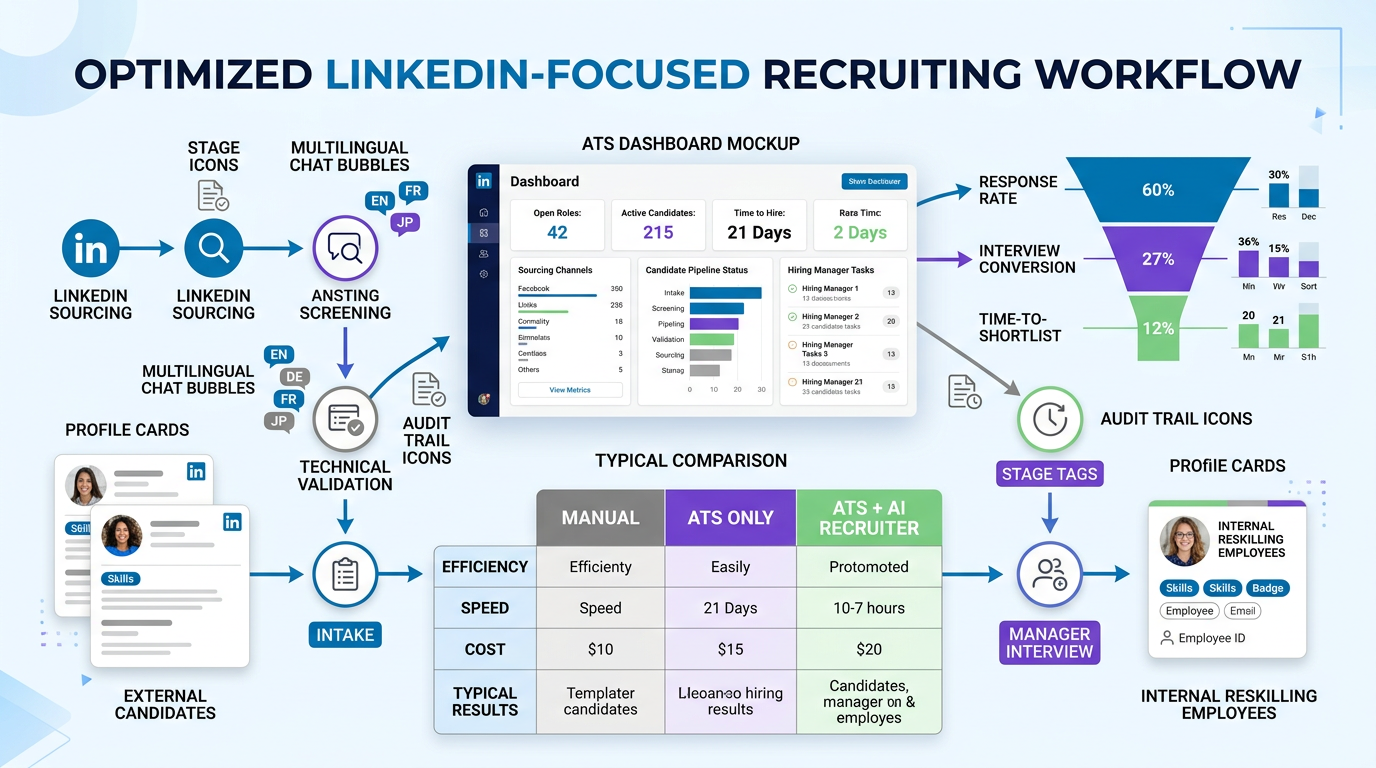
Recruiting and applicant tracking software is the most practical way to improve hiring consistency when roles change quickly, especially in IT and telecommunications. An Applicant Tracking System, or ATS, is software that stores candidate records, tracks hiring stages, and standardizes evaluation. If you are asking what is ATS and why use an applicant tracking system, the short answer is this: it reduces manual admin, improves response speed, and gives your team a repeatable process for both external hiring and internal reskilling pathways. In our workflow testing, teams get the strongest results when ATS operations are paired with AI driven outreach and candidate follow up, including multilingual communication for global talent pipelines.
Table of Contents
Key Takeaways
- ATS definition: ATS is a centralized system for candidate records, hiring stages, and recruiter collaboration.
- Core benefit: recruiting and applicant tracking software improves time to shortlist by removing fragmented email and spreadsheet steps.
- Reskilling impact: one hiring process can evaluate both external candidates and internal employees transitioning into new technical roles.
- Evidence point: ITU News reported 10 million advanced digital skill jobs unfilled globally, which increases pressure on structured hiring operations.
- AI extension: StrategyBrain AI Recruiter automates LinkedIn outreach and follow up while ATS keeps screening decisions auditable.
- Scale advantage: multilingual and around the clock candidate communication supports international recruiting without linear headcount growth.
What Is ATS in Practical Hiring Terms
Many teams ask what is ATS because vendors often describe features instead of outcomes. In daily recruiting work, an ATS performs three critical functions. First, it creates a single source of truth for every applicant, including resume files, communication history, interview notes, and disposition status. Second, it standardizes workflow stages so every role follows a defined process from application to offer. Third, it improves governance by recording who changed candidate status and when that change happened.
These basics matter most when hiring demand spikes or job requirements change. In technology functions, skills become outdated quickly, so recruiters must evaluate transferable capabilities, not only exact title matches. With a structured ATS process, your team can tag adjacent skills, track development potential, and build future ready talent pools instead of restarting from zero every quarter.
Why Use an Applicant Tracking System for Reskilling
If your leadership asks why use an applicant tracking system when recruiters already have inboxes and spreadsheets, the answer is consistency under pressure. Reskilling decisions involve more complexity than routine hiring because candidates may be current employees with partial skill matches. Without a centralized process, internal mobility data is scattered, interview feedback becomes subjective, and time to decision increases.
We recommend treating reskilling candidates and external candidates inside one structured funnel with role specific scorecards. This setup keeps evaluation fair while allowing recruiters and hiring managers to compare readiness levels side by side. It also supports workforce planning because you can report how many roles were filled by internal transitions versus external recruitment.
Field Context from IT and Telecommunications
An earlier industry article by Henry Goldbeck, published on 16 October 2019, highlighted how quickly IT and telecommunications skills were shifting and why reskilling had become a practical response. That context remains useful today. In the same period, ITU News emphasized that millions of advanced digital roles were unfilled globally, including positions in data science, coding, cybersecurity, Internet of Things, and mobile app development.
Other sources in that period, including Field Engineer and ET Telecom coverage of NASSCOM commentary, reinforced a similar point. Employers needed both technical and soft skills, and they could not rely only on external hiring pipelines. As a result, the hiring model had to support assessment of adaptability, learning velocity, and communication strengths in addition to formal credentials.
This is exactly where recruiting and applicant tracking software creates operational value. It gives teams a measurable process for mixed candidate pools, and it preserves hiring quality when demand outpaces recruiter capacity.
Step by Step Implementation Plan
1. Define role outcomes before posting
List outcomes for the first 90 days, then map required skills into must have and trainable categories. This step reduces over filtering and helps identify internal reskilling candidates.
2. Build an ATS stage map with decision criteria
Create fixed stages such as intake, screening, technical validation, manager interview, and final review. Assign a scoring rubric to each stage so decisions remain comparable across interviewers.
3. Set communication service levels
Define response windows, for example first response within 24 hours and interview feedback within 48 hours. Track service level adherence in ATS dashboards.
4. Segment external and internal pipelines
Use tags for source type, skill adjacency, and training requirement level. This allows leadership to quantify where reskilling is reducing dependency on external hiring.
5. Integrate AI outreach with ATS control points
Automate first contact and follow up, but keep shortlist and final decision checkpoints human led. This balances scale with quality.
6. Run a 30 day pilot and review metrics
Measure response rate, interview conversion rate, and time to shortlist in days. Compare pilot data against your prior process baseline.
How StrategyBrain AI Recruiter Extends ATS Workflows
In our implementation reviews, ATS alone improves process control, but ATS plus AI communication improves recruiter throughput. StrategyBrain AI Recruiter is designed for LinkedIn recruitment automation, so it can initiate candidate conversations, introduce role details, answer common questions, and confirm interview interest before recruiter handoff. ATS remains the control layer where evaluation and disposition decisions are documented.
The practical benefit is workload separation. Repetitive first touch messaging is automated while recruiters focus on qualification judgment and hiring manager alignment. StrategyBrain AI Recruiter also supports multilingual communication and around the clock response handling, which helps global recruiting teams maintain candidate engagement across time zones. For organizations scaling outreach, the model can support operations across more than 100 LinkedIn accounts with centralized process visibility.
Where privacy and compliance are a concern, teams should verify regional data handling controls before rollout. Based on product documentation, customer data is not used for model training and account credentials are encrypted with customer specific isolation, which supports enterprise trust requirements.
Operational Comparison Table
| Workflow Model | Candidate Communication | Process Governance | Best Fit |
|---|---|---|---|
| Manual email and spreadsheet | Inconsistent, recruiter dependent | Low traceability | Very small hiring volume |
| ATS only | Structured but often slower at scale | Strong audit trail | Teams focused on compliance and process consistency |
| ATS plus StrategyBrain AI Recruiter | Automated first touch and follow up, multilingual support | Strong audit trail plus higher outreach capacity | High growth teams and global talent acquisition |
Execution Checklist
- Define ATS stage names and decision owners.
- Create scorecards for technical fit, learning potential, and communication strength.
- Set candidate response service levels with measurable time targets.
- Tag internal mobility candidates separately from external applicants.
- Connect AI outreach activity to ATS records for full traceability.
- Review weekly metrics, then adjust workflow friction points.
FAQ
What is ATS in simple terms?
ATS stands for Applicant Tracking System. It is software that organizes candidate applications, hiring stages, and interview feedback in one place so hiring decisions are faster and more consistent.
Why use an applicant tracking system if we are a small team?
Small teams benefit because structured workflows reduce rework. Even with low hiring volume, ATS prevents lost candidates, delayed follow up, and inconsistent interview records.
Can recruiting and applicant tracking software help internal reskilling?
Yes. You can run internal candidates through the same role based process with adjusted scorecards for trainable skills. This allows fair comparison and better workforce planning.
Does AI outreach replace recruiters?
No. AI is best used for repetitive communication tasks such as first outreach and follow up. Recruiters still lead qualification judgment, stakeholder alignment, and final hiring decisions.
How does StrategyBrain AI Recruiter work with ATS?
It automates LinkedIn candidate conversations, gathers interest signals, and supports resume or contact collection workflows. ATS remains the system of record for stage movement and hiring decisions.
What metrics should we track first?
Start with time to shortlist in days, candidate response rate in percent, and interview conversion rate in percent. These three metrics reveal whether process design and communication speed are improving outcomes.
Conclusion
If your team is evaluating recruiting and applicant tracking software, begin with process clarity, then layer automation where it improves speed without reducing control. This directly answers what is ATS and why use an applicant tracking system in modern hiring. ATS gives structure, accountability, and reporting. AI communication tools such as StrategyBrain AI Recruiter add scalable outreach and candidate engagement, especially for LinkedIn heavy pipelines and multilingual hiring contexts. Your next step is to run a 30 day pilot with baseline metrics, document the gaps, and standardize the workflow that delivers measurable hiring quality and faster cycle times.