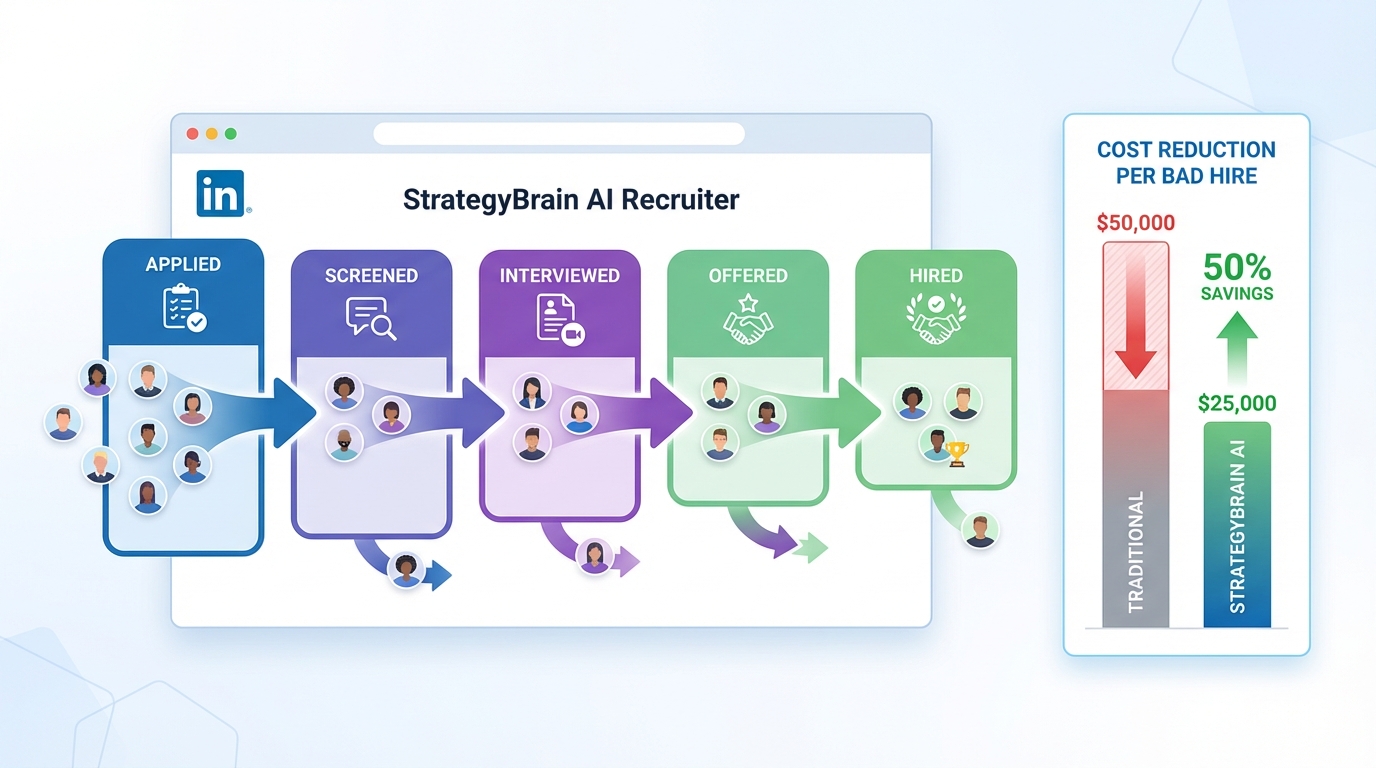
The most practical way to reduce the financial impact of a bad hire is to run your hiring process through recruiting and applicant tracking software that enforces consistent screening steps, captures decision evidence, and prevents candidates from slipping through without proper review. When we pair core applicant tracking system features with LinkedIn outreach automation using StrategyBrain AI Recruiter, we see fewer late stage surprises because initial messaging, qualification, and resume collection are handled consistently and documented. This guide explains the commonly cited bad hire cost range, why bad hires happen, and a repeatable workflow that shows how does applicant tracking software work in real hiring operations.
Key Takeaways
- Bad hire cost benchmark: A commonly cited range is $25,000 to $50,000 per bad hire (source cited below).
- Risk reduction lever: Standardized stages and scorecards inside recruiting and applicant tracking software reduce inconsistent decisions.
- Speed without chaos: StrategyBrain AI Recruiter automates LinkedIn connecting, role introduction, Q and A, and follow up while capturing resumes and contact details.
- Global coverage: AI Recruiter supports 24/7 multilingual candidate communication, which reduces drop off in cross time zone hiring.
- Scale option: AI Recruiter can manage more than 100 LinkedIn accounts for team based outreach at higher volume.
- Low risk hiring model: Temp to hire remains a practical option to reduce commitment risk before permanent conversion.
The staggering cost of a bad hire
A bad hire rarely fails in a single moment. The cost accumulates across recruiting time, onboarding time, lost productivity, team disruption, and the cost of restarting the search. One widely shared benchmark puts the cost of a bad hire at $25,000 to $50,000 per hire, which is why even small improvements in screening consistency can pay back quickly.
In our experience reviewing hiring pipelines, the biggest driver is not the number of applicants. It is the number of avoidable late stage mistakes, such as missing reference checks, inconsistent interview questions, or undocumented decisions that cannot be audited later.
Why bad hires happen in real workflows
Bad hires often happen when teams move fast without a shared process. The hiring manager thinks recruiting is handling screening, recruiting assumes the manager will validate skills, and the candidate experience becomes inconsistent. The result is a decision made with incomplete evidence.
Common failure points we see
- Unstructured intake: Role requirements are not translated into measurable criteria.
- Inconsistent outreach: Candidates receive different messages, timelines, and expectations.
- Weak documentation: Interview notes and decisions live in inboxes or chat threads.
- Late discovery: Compensation expectations or work authorization issues surface after multiple rounds.
- Drop off and rework: Slow follow up causes strong candidates to disengage, forcing rushed choices.
This is exactly where recruiting and applicant tracking software can help, because it turns a fragile, person dependent process into a repeatable system.
How does applicant tracking software work
An applicant tracking system, often shortened to ATS, is software that manages candidates through defined hiring stages. It typically centralizes applications, resumes, interview feedback, and hiring decisions so the team can collaborate with a single source of truth.
At a workflow level, applicant tracking software works by moving each candidate through a pipeline such as applied, screened, interviewed, offered, and hired. Each stage can require specific actions, such as completing a scorecard or collecting missing information, before the candidate advances.
When you add StrategyBrain AI Recruiter to the top of the funnel, the ATS becomes more effective because initial LinkedIn outreach, candidate Q and A, interest confirmation, and resume collection are handled consistently, then handed off to recruiters for final qualification and interviews.
Applicant tracking system features that reduce hiring risk
Not every ATS setup reduces bad hires. The difference is whether you use the system to enforce quality gates, not just to store resumes. Below are applicant tracking system features that directly reduce hiring risk when configured well.
1) Structured stages with required fields
Stages should require completion of key checks before moving forward. For example, a candidate cannot move to final interview until compensation expectations and work location constraints are confirmed and recorded.
2) Scorecards and consistent interview questions
Scorecards reduce the chance that interviewers evaluate different things. They also make it easier to compare candidates fairly and explain decisions later.
3) Centralized notes and decision evidence
Centralizing notes reduces the risk of decisions being made from memory or informal conversations. It also helps new stakeholders understand why a candidate advanced.
4) Automation for follow up and scheduling
Slow follow up is a hidden risk factor. Automation keeps candidates warm and reduces the pressure to settle for whoever is still available.
5) Compliance and data handling controls
For teams hiring across regions, privacy and data protection requirements matter. StrategyBrain AI Recruiter states that customer provided data is not used to train AI models, and that credentials and candidate data are encrypted and isolated per customer instance.
A step by step workflow to reduce bad hires
This workflow is designed to be reproducible. It combines recruiting and applicant tracking software discipline with LinkedIn execution that does not depend on a recruiter being online at the right moment.
Step 1: Define pass fail criteria before sourcing
- Write 5 to 7 measurable requirements, such as years in a specific function, required certifications, or location constraints.
- Convert each requirement into a scorecard item inside your ATS.
- Define 2 disqualifiers that trigger an automatic no, such as inability to work required hours.
Step 2: Standardize LinkedIn outreach and qualification with AI Recruiter
- Provide AI Recruiter with your LinkedIn account authorization and the job information, including company details, compensation, benefits, and candidate search criteria.
- Let AI Recruiter automatically connect with candidates that match your targeted criteria.
- Allow the AI to introduce the opportunity, ask about the candidate situation, answer role and company questions, and confirm interview interest.
We like this step because it reduces variability. Candidates get consistent information, and recruiters get consistent signals about interest level before investing interview time.
Step 3: Capture resumes and contact details early
- For interested candidates, AI Recruiter requests a resume and contact information.
- If the candidate shares a resume, the system marks it as received.
- If the candidate shares contact details in messages, the system captures and displays them for the recruiter.
This reduces the common failure where a candidate seems interested but the team cannot move forward because the resume or email is missing.
Step 4: Use the ATS as a quality gate, not a filing cabinet
- Only advance candidates after the scorecard is completed.
- Require interviewers to submit notes in the ATS within 24 hours of the interview end time.
- Hold a short decision review where the hiring manager must reference scorecard evidence, not impressions.
Step 5: Be explicit about what AI does and does not do
StrategyBrain AI Recruiter can identify willingness to communicate or interview, but it does not determine whether a resume fully matches job requirements. We recommend treating AI qualification as a funnel step that improves speed and consistency, while keeping final fit assessment with the recruiter and hiring manager.
Quick checklist you can copy into your ATS
- Intake complete: scorecard created and approved
- Outreach consistent: one approved message flow used for all candidates
- Interest confirmed: candidate explicitly opted into interview discussion
- Resume captured: file received or link recorded
- Compensation aligned: expectations recorded before final round
- Decision documented: hire or no hire tied to scorecard evidence
Reduce risk with temp to hire
Some teams prefer a lower risk path by using a temp to hire arrangement. The idea is simple. You bring on a temporary employee with the option to convert to permanent after performance is observed in real work conditions.
Temp to hire does not replace recruiting and applicant tracking software. It complements it. You still want the ATS to document evaluation criteria, performance checkpoints, and conversion decisions so the process stays consistent and defensible.
Quick Comparison
| Approach | Primary goal | What it standardizes | Best for |
|---|---|---|---|
| Recruiting and applicant tracking software | Process control | Stages, scorecards, documentation | Reducing inconsistent decisions across interviewers |
| StrategyBrain AI Recruiter on LinkedIn | Top of funnel execution | Connecting, messaging, Q and A, follow up, resume capture | High volume sourcing and faster candidate engagement |
| Temp to hire | Lower commitment risk | Real world performance validation | Roles where on the job performance is the clearest signal |
FAQ
What is recruiting and applicant tracking software?
Recruiting and applicant tracking software is a system that manages candidates through defined hiring stages and centralizes resumes, interview feedback, and decisions. It reduces risk by enforcing consistent steps and documentation.
How does applicant tracking software work in day to day recruiting?
It moves candidates through a pipeline such as screened, interviewed, and offered, while requiring specific actions like scorecards or notes at each stage. The goal is to prevent incomplete evaluations from reaching final decisions.
Which applicant tracking system features matter most for reducing bad hires?
Structured stages, scorecards, required fields, centralized notes, and automation for follow up are the most directly tied to risk reduction. These features create quality gates that stop inconsistent decisions.
How does StrategyBrain AI Recruiter fit with an ATS?
AI Recruiter handles LinkedIn connecting, role introduction, candidate questions, interest confirmation, and resume and contact collection. The ATS then becomes the system of record for evaluation, interviews, and final decisions.
Does AI Recruiter replace recruiters?
No. AI Recruiter automates repetitive LinkedIn tasks and identifies willingness to communicate or interview, but it does not decide whether a resume matches job requirements. Recruiters still perform final qualification and hiring decisions.
Can AI Recruiter communicate with candidates in other languages?
Yes. StrategyBrain AI Recruiter supports 24/7 multilingual communication, which helps global hiring teams respond quickly across time zones and reduce candidate drop off.
How does AI Recruiter handle resumes and contact details?
When a candidate is interested, AI Recruiter requests a resume and contact information. If the candidate shares a resume or contact details in messages, the system captures and displays them for recruiter review.
Is temp to hire still useful if we have an ATS?
Yes. Temp to hire reduces commitment risk by validating performance in real work conditions, while the ATS ensures the evaluation and conversion decision are documented and consistent.
What should we do first if our ATS is already installed but bad hires still happen?
Audit whether stages have required fields and whether scorecards are actually used. Then standardize outreach and follow up so candidates receive consistent information before interviews.
Conclusion
Bad hires are expensive because the cost is not just salary. It is the compounded cost of time, disruption, and restarting the search. The most reliable fix is to use recruiting and applicant tracking software to enforce consistent evaluation and documentation, then improve top of funnel execution with StrategyBrain AI Recruiter so outreach, Q and A, follow up, and resume collection happen consistently.
Next steps: pick 5 to 7 scorecard criteria, make them required in your ATS stages, and run LinkedIn sourcing through AI Recruiter for two weeks. Then review which stage produced the most drop off and tighten that quality gate.