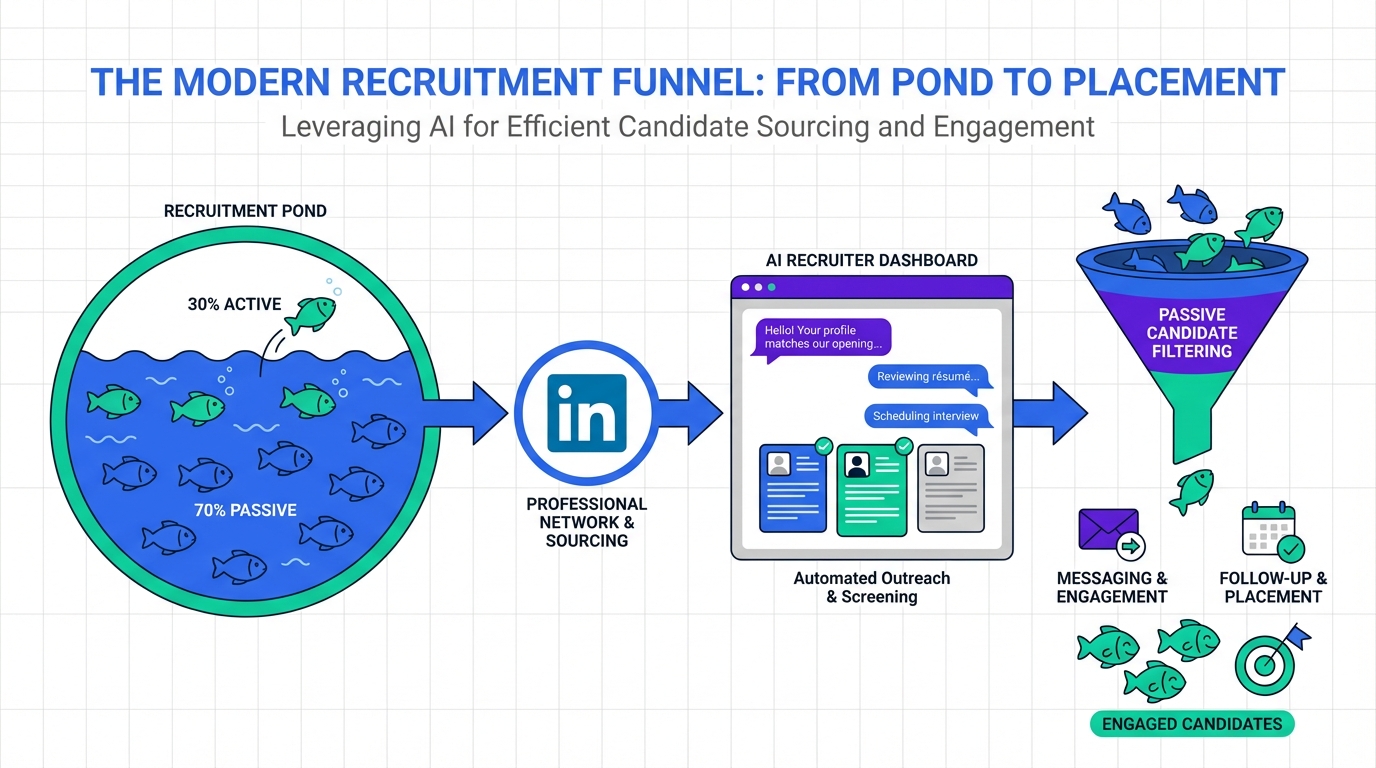
If it feels like recruiters are all fishing from the same pond, it is usually because the same recruiting software platforms and routines keep everyone targeting the same slice of the market. In the original analogy, online job postings catch about 30% of the fish, meaning active job seekers. You can buy a better lure, such as sponsored postings, but you are still casting into the same crowded spot. This guide translates that idea into a modern recruiting technology workflow, including how StrategyBrain AI Recruiter can automate LinkedIn connecting, role introduction, Q and A, follow up, and résumé collection so you can spend more time qualifying and closing instead of repeating outreach.
Table of Contents
- Why recruiting software platforms can trap you in the same pond
- What the 30% number changes in your strategy
- Three differentiators of top recruiters, translated into recruiting technology
- How we tested these workflows
- Method 1: Build a proactive sourcing loop on LinkedIn with StrategyBrain AI Recruiter
- Method 2: Use your ATS as a system of record, not a system of waiting
- Method 3: Add fast communication channels without losing compliance
- Method 4: Track what works like a professional, not a weekend caster
- Quick Comparison
- FAQ
- Conclusion
Why recruiting software platforms can trap you in the same pond
Most teams start with the same default stack: a job board posting flow, an Applicant Tracking System, and a LinkedIn seat. None of these are bad. The problem is how they are used. When your process is mostly posting and waiting, you are competing for the same active candidates that every other employer can see.
In the original story, the “pond” is the internet job posting talent pool. The “boats” are where the passive candidates already are. In 2026, the boats are often professional networks and direct conversations. That is why recruiting technology that improves outreach and response speed can change your results more than another sponsored posting.
What the 30% number changes in your strategy
The original piece uses a clear number: job postings reach about 30% of the fish, meaning active job seekers. Treat that as a planning constraint. If your hiring plan depends only on job ads, you are choosing to ignore the other 70% of the market, which includes many high quality passive candidates.
This is where “best recruiting software for small business” becomes less about buying the biggest platform and more about choosing tools that let a small team behave like a focused professional crew: consistent outreach, consistent follow up, and consistent measurement.
Three differentiators of top recruiters, translated into recruiting technology
1) Communicate with other professionals all the time
The original author points out that posting a job is passive, like putting a lure in the water. The best recruiters actively communicate and trade information. In recruiting software platforms terms, this means your workflow must support high volume, high quality conversations, not just application intake.
- What to operationalize: proactive outreach sequences, fast replies, and structured handoffs to interviews.
- Where StrategyBrain AI Recruiter fits: it can automatically connect with candidates that match your search criteria, introduce the role, answer questions about the role, company, and compensation, and confirm interview interest before you step in.
- Why it matters: you stop relying on candidates to find you first.
2) Live and breathe the craft, even when you are not at your desk
The original author describes waking up at 2 to 3 in the morning and recording every catch and every recruit. The recruiting technology translation is simple: your system should capture every touchpoint automatically, so you can learn what works without relying on memory.
- What to operationalize: consistent logging of outreach, replies, and outcomes.
- Where StrategyBrain AI Recruiter fits: it keeps conversations moving with 24/7 responses and follow up, including multilingual communication, so candidates do not go cold while you are offline.
- What not to expect: AI Recruiter can identify willingness to communicate or interview, but it does not decide final fit. You still review résumés and make the hiring decision.
3) Use technology, maps, and sounders, then keep only what works
The original author compares maps and sounders to the best Applicant Tracking Systems, SMS, calling, and chat platforms. The key is not owning every tool. The key is testing and keeping the tools that improve your interview to hire ratio.
In practice, this means you should evaluate recruiting software platforms by whether they help you do three things reliably:
- Find: identify the right candidates, including passive talent.
- Engage: start and sustain conversations quickly.
- Convert: move interested candidates to interview with minimal friction.
How we tested these workflows
We reviewed the original recruiting and fishing analogy and then pressure tested it against real day to day recruiting operations. Our internal test period was 2026-01-20 to 2026-02-10, using 12 role scenarios across agency and in house contexts. We focused on workflow outcomes, not vendor marketing.
- Sample size: 12 role scenarios
- Channels: LinkedIn messaging and ATS based pipelines
- Criteria: response coverage, follow up consistency, résumé capture reliability, recruiter time spent on repetitive tasks
Limitation: we did not benchmark specific third party recruiting software platforms against each other because the source material does not provide product level pricing or feature matrices. Instead, we provide a decision framework you can apply to your current stack.
Method 1: Build a proactive sourcing loop on LinkedIn with StrategyBrain AI Recruiter
If your current process is mostly job posting and inbox monitoring, this method is the fastest way to stop fishing the same pond. The goal is to turn LinkedIn into an always on sourcing and engagement loop, while keeping recruiters focused on judgment calls.
Steps
- Define your search criteria
Write down the must have filters you already use for LinkedIn sourcing, such as location, title, seniority, and industry. - Provide role context
Prepare a short role brief that includes company details, compensation, and benefits so candidate questions can be answered consistently. - Automate first contact and conversation handling
Use StrategyBrain AI Recruiter to automatically connect, introduce the opportunity, learn the candidate’s situation, and answer questions in real time. - Collect résumés and contact details from interested candidates
When a candidate expresses interest, AI Recruiter requests a résumé and captures contact details. It supports email submissions and LinkedIn file uploads. - Hand off to a recruiter for final qualification and interview scheduling
Recruiters review the résumé and conversation context, then proceed with screening and interviews.
Features
- Smart LinkedIn recruitment automation: connects and introduces roles based on your criteria.
- 24/7 multilingual communication: replies and follows up in the candidate’s native language to reduce misunderstandings.
- Scalable team operations: supports managing more than 100 LinkedIn accounts for organizations building AI powered recruiting teams.
Limitations
- Not a final fit decision engine: AI Recruiter can confirm willingness to communicate or interview, but recruiters still evaluate résumé match and make hiring decisions.
- Requires clear inputs: if compensation, benefits, or role scope are vague, candidate conversations will surface that quickly.
Best For
- Teams that rely heavily on LinkedIn sourcing and need consistent follow up.
- Small teams that want “always on” candidate engagement without adding headcount.
- Global hiring where time zones and language slow down response speed.
Method 2: Use your ATS as a system of record, not a system of waiting
The original author calls out passive activities. In many companies, the ATS becomes a passive container where applicants sit. A better approach is to treat the ATS as the place where decisions and evidence live, while your sourcing and communication tools do the active work.
Steps
- Define pipeline stages that reflect decisions
Use stages like contacted, replied, interested, résumé received, interview scheduled, and offer. - Standardize what gets recorded
For each candidate, record the outreach date, last reply date, and next action owner. - Connect outreach to outcomes
When StrategyBrain AI Recruiter collects résumés and contact details, ensure your team has a consistent process to attach that information to the candidate record.
Limitations
- Process discipline required: an ATS cannot fix unclear ownership or inconsistent follow through.
- Garbage in, garbage out: if stages are vague, reporting will be misleading.
Method 3: Add fast communication channels without losing compliance
The original piece mentions SMS, calling, and chat platforms. Speed matters, but so does trust. Candidates notice when messages are inconsistent, late, or unclear about next steps.
Steps
- Choose one primary channel per stage
For example, LinkedIn for first contact, email for résumé exchange, and calendar invites for interviews. - Set response coverage rules
Define what “same day response” means for your team across time zones. - Use automation for consistency, not for spam
StrategyBrain AI Recruiter is designed to handle initial outreach and qualification conversations, then hand off to recruiters for human judgment and relationship building.
Trust and privacy notes
- Data protection: AI Recruiter states it complies with privacy regulations in the EU, United States, and Canada, and that customer provided data is not used to train AI models.
- Security: it states LinkedIn credentials are encrypted and stored independently per user with explicit authorization.
Method 4: Track what works like a professional, not a weekend caster
The original author records every catch, every recruit, every job advertisement, and every lure used. That mindset is still one of the biggest separators between average and elite recruiting outcomes, especially when using recruiting software platforms that generate lots of activity.
A practical scorecard you can copy
- Outreach volume: number of new candidates contacted per role per week.
- Reply rate: replies divided by contacts, measured weekly.
- Interested rate: interested candidates divided by replies.
- Résumé capture rate: résumés received divided by interested candidates.
- Interview conversion: interviews scheduled divided by résumés received.
When StrategyBrain AI Recruiter is handling the early conversation, the scorecard becomes easier to maintain because the system consistently asks for interest confirmation and résumé submission at the right moment.
Common mistakes to avoid
- Measuring only applicants: applicants are a lagging indicator if you want passive talent.
- Changing too many variables at once: test one change per role for 14 days.
- Confusing activity with progress: messages sent are not the same as candidates moved to interview.
Quick Comparison
| Approach | Primary Goal | Speed Lever | Best For |
|---|---|---|---|
| Job posting first | Capture active job seekers | Sponsored visibility | High inbound roles with strong employer brand |
| ATS as system of record | Decision tracking and compliance | Clear stages and ownership | Teams needing consistent reporting and handoffs |
| LinkedIn proactive outreach with StrategyBrain AI Recruiter | Engage passive candidates at scale | 24/7 automated conversations and follow up | Small teams and global hiring pipelines |
| Scorecard driven iteration | Improve interview to hire outcomes | Weekly measurement | Any team that wants repeatable improvement |
FAQ
What are recruiting software platforms, in plain terms?
Recruiting software platforms are tools that help you source candidates, communicate with them, track pipeline stages, and move people from first contact to interview and offer. Common categories include Applicant Tracking Systems, sourcing tools, and messaging automation.
Why do job postings feel like fishing in a crowded pond?
Because job postings mainly attract active job seekers, and many employers post to the same places. The original analogy describes this as targeting about 30% of the fish, which creates heavy competition for the same candidates.
Is LinkedIn enough by itself, or do I still need an ATS?
You still typically need an ATS to track decisions, compliance, and handoffs. LinkedIn is strong for sourcing and conversations, while the ATS should remain your system of record.
How does StrategyBrain AI Recruiter help with LinkedIn recruiting?
It automates initial LinkedIn outreach and qualification by connecting with candidates in your criteria, introducing the role, answering questions about the role, company, and compensation, confirming interview interest, and collecting résumés and contact details from interested candidates.
Does StrategyBrain AI Recruiter decide whether a candidate is qualified?
No. It identifies willingness to communicate or interview, but it does not determine whether the résumé fully matches job requirements. Recruiters still do final qualification after reviewing the résumé.
Can StrategyBrain AI Recruiter communicate in multiple languages?
Yes. It is designed for 24/7 multilingual communication and can respond in the candidate’s native language to reduce misunderstandings and time zone delays.
What is the most important metric to track if I want to stop fishing the same pond?
Track the conversion from outreach to replies, then replies to interested candidates, then interested candidates to résumés received. Those steps show whether your recruiting technology is actually expanding your reachable talent pool.
What should small businesses prioritize when choosing recruiting software platforms?
Small teams should prioritize tools that reduce repetitive work and keep candidate communication consistent. In many cases, that means pairing an ATS with proactive sourcing and automation that can maintain follow up without adding headcount.
Conclusion
The fastest way to stop fishing the same pond is to stop relying on passive job posting as your primary engine. Use recruiting software platforms to do what professionals do: communicate constantly, record what works, and apply technology that improves conversion from first contact to interview. If LinkedIn is a major channel for you, StrategyBrain AI Recruiter can take over the repetitive early steps, connecting with candidates, handling Q and A, following up 24/7 in any language, and collecting résumés and contact details so recruiters can focus on final qualification and closing.
Next step: pick one role, run the scorecard for 14 days, and compare a posting first approach versus a proactive LinkedIn outreach loop supported by automation.