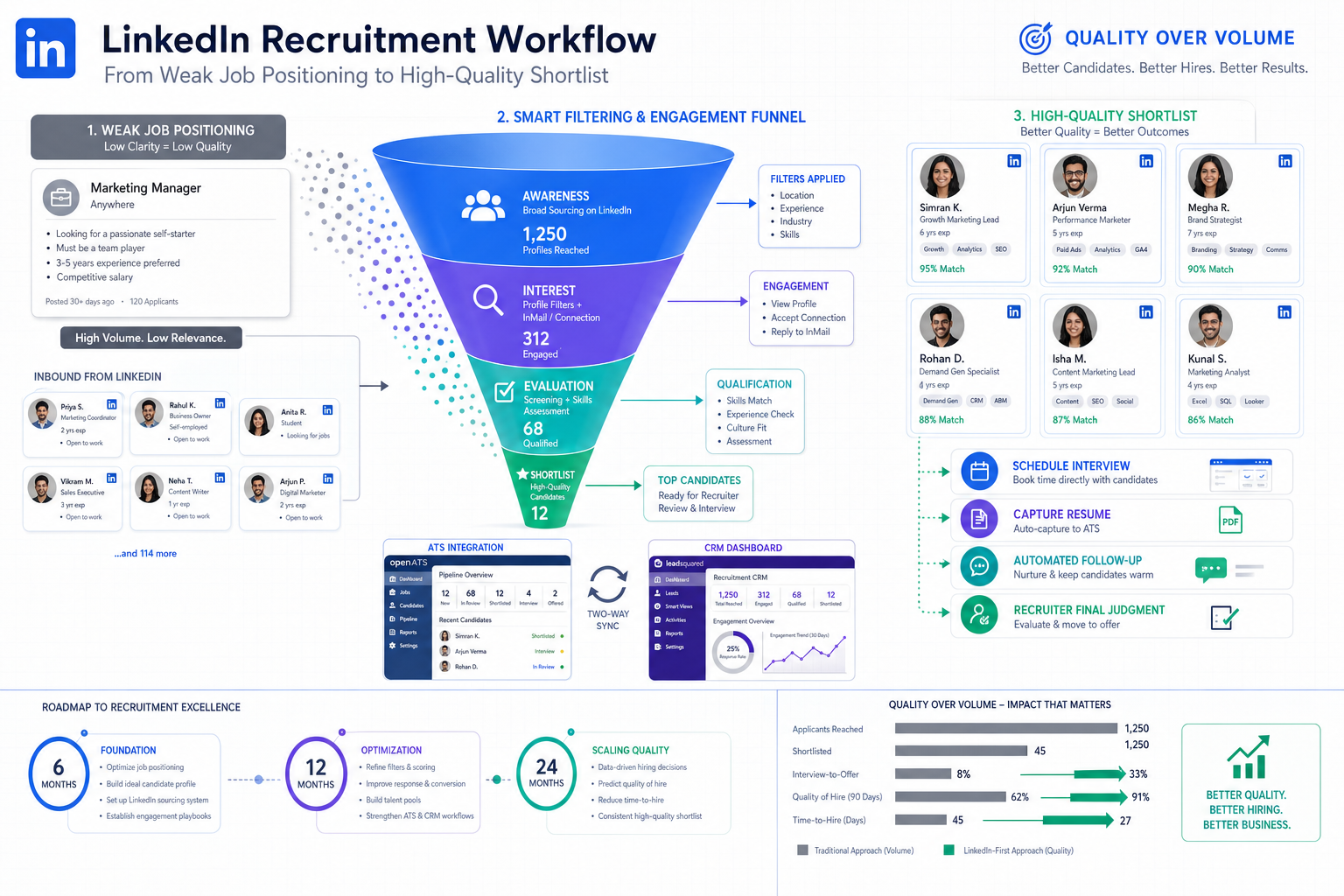
When recruiter funnels are full but shortlist quality is weak, this article shows how to judge recruitment online for recruiters before poor job positioning scales the wrong applicants.
Most recruiters do not lose time because they lack applicants; they lose time because weak role positioning, generic job copy, and disconnected follow-up invite the wrong people into the funnel. For a solo headhunter, that means hours wasted reviewing mismatched resumes and chasing quiet prospects. For a small agency owner, it means consultants spending billable time on admin instead of delivery. For an in-house recruiter, it means hiring managers see volume, not relevance, and start losing confidence in the process.
That is where an AI-supported workflow can help. In my own sourcing and follow-up work, AI Recruiter has been most useful when a role needs fast outreach, after-hours response handling, and early interest capture across markets. It can automate first-touch conversations, answer common candidate questions, and collect resumes or contact details from interested prospects, while the recruiter still makes the final judgment on fit, resume quality, and whether a candidate should move forward.
The deeper issue starts earlier than many teams admit: the job itself is often sold badly. A sloppy, recycled job description acts like bait for hundreds of unwanted resumes, while stronger candidates skim past it because they cannot see the real challenge, the first-year goals, or why the opportunity is different. When recruiters try to hire people for jobs using vague templates, automation simply moves poor inputs through the system faster.
The best recruiters I know treat job descriptions more like market-facing positioning than internal paperwork. They spell out what must be achieved in the first 6, 12, and 24 months, highlight what makes the role genuinely attractive, and check whether their language stands apart from similar openings in the market. Once you see the opening that way, the software question becomes clearer too: you need recruitment automation tools that can distribute strong messaging, manage candidate response at scale, and preserve context from first outreach to final review. That matters for internal teams and even more for agency recruiter jobs, where speed and differentiation decide whether a shortlist gets traction.
- Why Job Positioning Comes Before Automation
- Six Principles Behind Better Automated Recruiting
- ATS vs Recruiting CRM: Where Each One Fits
- Core Features That Actually Help Recruiters
- A Practical Workflow for Recruitment Online for Recruiters
- What Changes for Agency Recruiter Jobs
- How to Implement Automation Without Damaging Candidate Quality
- Common Mistakes Recruiters Make
- FAQ
Why Job Positioning Comes Before Automation
Recruitment automation tools are often discussed as if the main problem is speed. In practice, the first problem is usually targeting. If the role is described poorly, the market hears the wrong message. More traffic then becomes a burden, not an advantage.
That is why experienced recruiters look at automation through an older but still very practical lens: does the process help the right person recognize the opportunity quickly? Good automation supports that outcome by keeping messaging consistent, preserving recruiter context, and reducing delays between outreach, response, and next steps.
For teams doing recruitment online for recruiters, this means software selection should begin with a simple question: can the system carry a well-positioned job into sourcing, screening, scheduling, and follow-up without flattening it into generic communication?
Practical takeaway: If your funnel is full but shortlist quality is weak, improve role positioning before adding more sourcing volume.
Six Principles Behind Better Automated Recruiting
The reference point I keep coming back to is not a software feature list but a recruitment discipline: better jobs attract better attention. Below are six principles that translate that idea into modern automation workflows.
1. Start with goals, not just duties
The strongest role briefs explain what the person must accomplish, not only what tasks they will perform. Outlining expected outcomes in the first 6, 12, and 24 months helps serious candidates self-select. It also gives recruiters stronger material for outreach, screening, and hiring manager calibration.
When I have used AI Recruiter on hard-to-fill searches, the quality of the initial conversation improves when the role brief includes specific goals rather than a recycled responsibility list. Candidates respond more clearly when they understand what success would actually look like.
2. Treat the job preview like candidate-facing marketing
Top candidates are not evaluating your vacancy the way an internal stakeholder does. They are asking what challenge they would solve, what they would gain, and why the move is worth the risk. Strong recruiters build a "why this role" narrative into job ads, outreach messages, and first-call talking points.
This matters because automation can distribute messaging at scale, but it cannot rescue unclear positioning. The more candidate-facing your process becomes, the more important that preview is.
3. Differentiate the opportunity from lookalike roles
Many job ads in the same function read almost identically. If the role sounds interchangeable, top prospects have no reason to engage. Compare your wording against competing job posts and ask what makes your opening distinct: scope, team exposure, growth path, market challenge, leadership access, project complexity, or timing.
For recruiters trying to hire people for jobs in crowded categories, differentiation is often the hidden variable behind response rates.
4. Capture the real employee value proposition
Good recruiters do not invent an EVP in a vacuum. They ask strong performers what makes the work challenging, worthwhile, or career-building. Those phrases often become better outreach language than anything drafted top-down by HR alone.
That insight also improves CRM workflows. A recruiting CRM is not just for storing names; it should help you segment candidates by the kinds of opportunities they care about and re-engage them with relevance later.
5. Align brand promises with lived reality
Your employment brand is not a slogan. It is what candidates and employees believe after interacting with your process. If your messaging says the company is fast, transparent, and ambitious, but feedback is slow and outreach feels robotic, the market will trust the experience, not the claim.
This is one reason I prefer automation that supports timely replies and organized handoff rather than automation that tries to overstate certainty. Candidates notice the difference immediately.
6. Build recruiting partnerships beyond recruiting
Some of the best improvements in hiring come from borrowing methods from marketing, sales, and communications. Recruiters who learn how those teams position offers, qualify interest, and manage follow-up usually produce better funnels. The same is true when choosing software: evaluate whether it supports messaging discipline, not just task completion.
ATS vs Recruiting CRM: Where Each One Fits
Once the role is positioned properly, you still need the right workflow architecture. One common buying mistake is assuming an ATS and a recruiting CRM do the same job. They do not.
An applicant tracking system for recruiters is designed to manage active applicants in a live process. A recruiting CRM is designed to help you build, organize, and re-engage talent before formal application. If you only use an ATS, you may control stages well but remain too reactive. If you only use a CRM, you may source effectively but struggle with process governance.
| Function | ATS Workflow | Recruiting CRM Workflow |
|---|---|---|
| Main purpose | Manage active applicants and interview stages | Build and nurture talent pipelines |
| Typical starting point | Candidate applies or is submitted to a live role | Recruiter identifies a prospect before application |
| Best use case | Stage control, notes, feedback, offers, compliance | Outreach, segmentation, rediscovery, future hiring |
| Main risk if weak | Messy process and poor stakeholder visibility | Starting every search from zero |
For recruitment online for recruiters, the strongest setup usually combines both. The CRM helps shape and deliver the opportunity to the right audience; the ATS takes over once interest becomes active process movement.
Core Features That Actually Help Recruiters
When evaluating recruitment automation tools, ignore bloated feature lists for a moment and focus on the functions that directly affect delivery.
Applicant tracking and stage discipline
A good ATS should make stage changes, notes, feedback capture, and candidate status visible without extra admin. This is one of the most important applicant tracking system benefits because it reduces duplicate outreach and confusion between recruiters and hiring managers.
Candidate search and rediscovery
If you fill repeat roles, candidate rediscovery matters almost as much as new sourcing. Search filters, tags, saved views, and previous engagement history help recruiters move faster without losing context.
Automated outreach and early response handling
This is especially valuable when sourcing through professional networks and dealing with replies outside standard working hours. In my own workflow, tools that can continue the first conversation, answer basic role questions, and capture resume intent are useful because they keep momentum alive while I stay responsible for shortlist quality. That is where AI Recruiter has practical value for recruiters covering multiple searches or time zones.
Scheduling support
Interview scheduling still causes unnecessary delays. Automated coordination, reminders, and self-scheduling options reduce friction and improve candidate experience, especially when several stakeholders are involved.
Messaging consistency without full loss of human judgment
Templates and sequences are useful, but they should support recruiter craft rather than replace it. Sensitive moments such as rejection, compensation discussion, or counteroffer risk still need human handling.
Analytics tied to real recruiting questions
Good software should answer practical questions: which role messaging converts, which source produces qualified interviews, where candidates drop, and which stages stall. Otherwise, the reporting is decorative rather than operational.
A Practical Workflow for Recruitment Online for Recruiters
Below is the workflow I recommend when the goal is not just to create activity, but to create better-fit movement.
- Clarify role outcomes: Define what success looks like in the first 6, 12, and 24 months.
- Build a differentiated job story: Explain why the opportunity matters to the right candidate.
- Launch sourcing and distribution: Push the role into the channels that fit the target market.
- Capture and qualify interest: Use automation to handle early interaction and collect candidate information.
- Review resumes and context: Keep the final quality judgment with the recruiter.
- Move candidates through a clear ATS process: Maintain feedback, visibility, and next-step discipline.
- Preserve near-fit talent: Add silver medalists and passive prospects into future pipelines.
This sequence works because it reflects the same lesson from strong job positioning: a better opening message improves everything that follows. Software then becomes a delivery layer, not a substitute for recruiting judgment.
Key insight: The right automation does not just speed up process steps. It protects the quality of the message from first contact to final decision.
What Changes for Agency Recruiter Jobs
Agency recruiter jobs add another level of difficulty because agencies are balancing multiple clients, changing briefs, and reusable talent pools at the same time. A generic internal hiring workflow is not enough.
What agency teams should prioritize
- Multi-client separation: Recruiters need clean control by account, role, and submission status.
- Candidate reuse: Good consultants remember who may fit future mandates, not just today's live role.
- Fast response handling: Agency work often depends on immediate engagement before competitors get there first.
- Submission visibility: It should be obvious where and when a candidate was introduced.
- Scalable communication: Recruiters need help managing volume without sounding careless.
For that reason, the best setup for agencies usually needs stronger CRM behavior alongside ATS discipline. In practical terms, this is where I have seen value in using AI Recruiter as a support layer for repetitive outreach and initial qualification, especially when consultants are covering several searches at once. It helps keep conversations moving, but it does not replace the consultant's judgment on credibility, relevance, or shortlist strategy.
If you work in agency recruiter jobs, avoid any system that is decent at applicant intake but weak at candidate rediscovery, outreach segmentation, or account-based pipeline management.
How to Implement Automation Without Damaging Candidate Quality
Buying recruiting software is easier than implementing it well. The safest rollout starts with process design, not dashboards.
1. Audit the quality of your role inputs
Before automation, review job descriptions, intake notes, and outreach templates. If they are generic, the tool will scale the wrong message.
2. Decide where automation should stop
Good automation can handle posting, first-touch communication, reminders, and scheduling. Final judgment on fit, motivation, and risk should stay with the recruiter.
3. Train hiring managers on what good input looks like
If managers provide vague requirements and delayed feedback, no platform will fix the process alone. Recruiters need clear goals, not only laundry lists of tasks.
4. Review funnel quality, not just funnel volume
Measure whether better-positioned jobs lead to stronger applicants, cleaner response patterns, and fewer dead-end interviews. This matters more than raw applicant count.
5. Refine messaging based on live market response
If top candidates are not engaging, do not only widen the search. Revisit the opportunity story, the value proposition, and the first outreach language.
Common Mistakes Recruiters Make
- Automating weak job descriptions: More exposure to poor positioning creates more low-fit traffic.
- Confusing ATS control with CRM strength: Process visibility is not the same as pipeline depth.
- Over-trusting automation in qualification: Interest is not the same as suitability.
- Neglecting differentiation: If the role sounds like every competitor's role, response quality will suffer.
- Skipping the 6, 12, and 24-month outcomes: Candidates respond better to clear goals than vague responsibility lists.
- Ignoring recruiter workflow reality: Tools fail when they look polished in demos but create extra handling in live searches.
The strongest mindset is simple: optimize for relevance first, then for speed.
FAQ
What are recruitment automation tools?
Recruitment automation tools help recruiters manage repetitive hiring tasks such as outreach, application handling, screening support, scheduling, messaging, and reporting. The best ones reduce admin without removing recruiter judgment.
Why does job description quality matter in recruitment automation?
Because automation scales whatever message you put into it. If the job description is vague or generic, the funnel fills with the wrong applicants. If it is clear, differentiated, and goals-based, the same system becomes far more productive.
How do recruiters hire people for jobs faster without lowering quality?
Start with better role positioning, then use automation for repetitive tasks like outreach, reminders, and early response handling. Keep final review, shortlist judgment, and hiring decisions with the recruiter.
What matters most in agency recruiter jobs?
Agencies need fast communication, reusable pipelines, clear submission tracking, and strong multi-client workflow management. CRM-style capability is especially important because agencies rarely succeed by working only from inbound applicants.
Can AI handle the whole recruiting process?
No. AI can support sourcing conversations, candidate engagement, scheduling, and administrative speed, but recruiters still need to evaluate resumes, assess relevance, and make final progression decisions.
Conclusion
The real lesson behind effective recruitment online for recruiters is that automation works best when the opportunity itself is positioned well. Clear goals, stronger job previews, visible differentiation, and disciplined follow-up all improve the funnel before software features even come into play.
If you need to hire people for jobs more efficiently, start by tightening the message, then choose tools that preserve that quality through sourcing, response handling, and ATS process control. And if your world includes agency recruiter jobs, put extra weight on CRM strength, candidate reuse, and communication scale. The software should support recruiting craft, not flatten it.