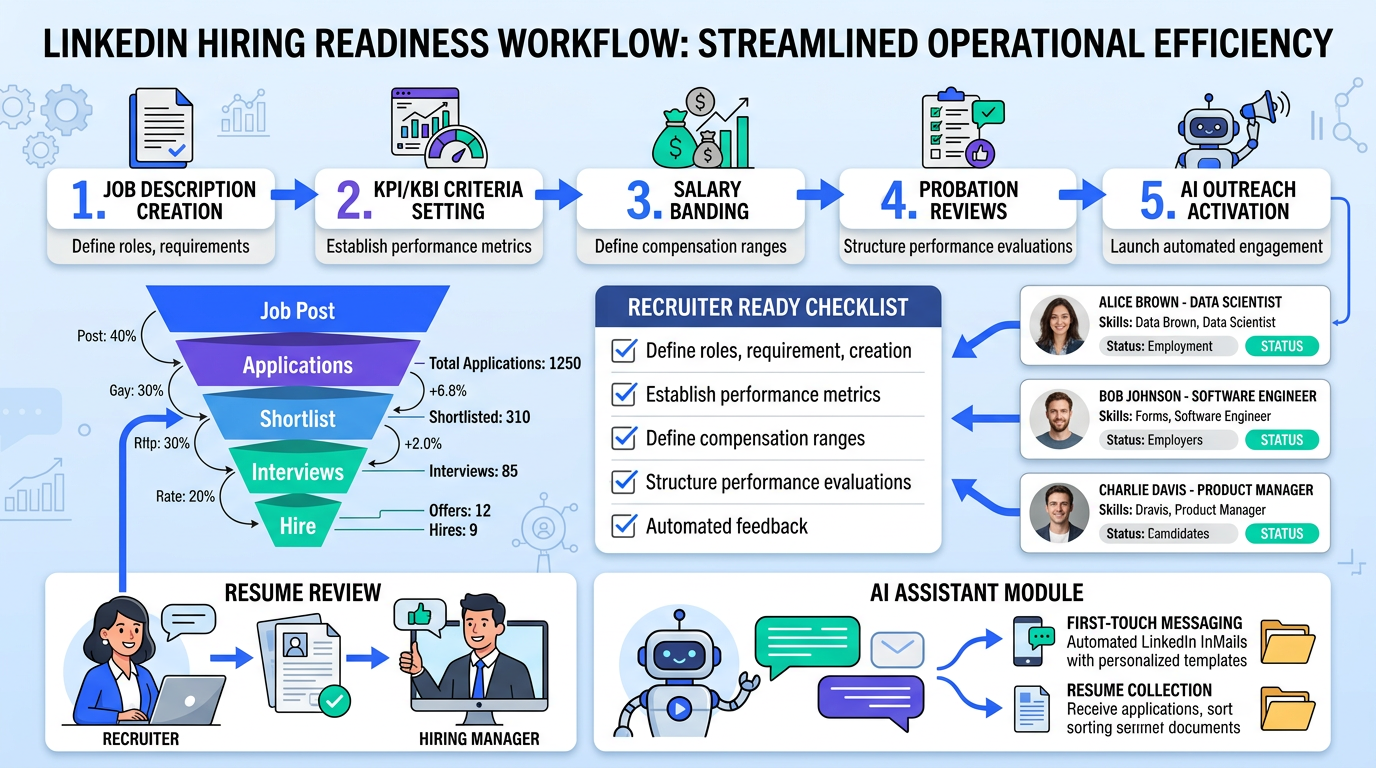
If you are choosing recruitment agency software, start by building hiring readiness before tool setup. In practice, the strongest sequence is clear job descriptions, measurable KPI and KBI criteria, a defined salary range, and a structured probation review plan. Once those foundations are set, enterprise staffing software and StrategyBrain AI Recruiter can automate LinkedIn outreach, candidate conversations, and resume collection without creating process chaos. We use this approach in agency and in house hiring programs because it improves shortlist quality and reduces manual screening time. This guide explains exactly how to prepare, what to automate, and how to keep hiring decisions consistent.
Table of Contents
- Key Takeaways
- Why Readiness Comes Before Tool Configuration
- Step 1: Build a Job Description That Can Be Measured
- Step 2: Turn Role Expectations into Posting Criteria
- Step 3: Set a Defensible Salary Range
- Step 4: Design a Two Stage Probation Review
- Step 5: Activate Recruitment Agency Software and AI Automation
- Hiring Readiness Checklist
- Common Mistakes to Avoid
- FAQ
- Conclusion
Key Takeaways
- Start with process, then platform: Recruitment agency software performs best when role scope, KPI targets, and evaluation criteria are documented first.
- Define KPI and KBI early: KPI means Key Performance Indicators and KBI means Key Behavioural Indicators, and both should be measurable before posting.
- Use salary bands with criteria: High, mid, and low compensation points improve fairness and offer speed.
- Use probation as a decision framework: A heads up review and a final review reduce early turnover risk.
- Automate repetitive LinkedIn work: StrategyBrain AI Recruiter can handle initial outreach, role introduction, and candidate interest checks at scale.
- Keep humans in final qualification: AI can collect resumes and contact details, while recruiters make final fit decisions.
Why Readiness Comes Before Tool Configuration
Many teams buy enterprise staffing software and immediately build pipelines, templates, and automations. That often creates speed without quality. We see better outcomes when hiring leaders complete a readiness pass first, because software then amplifies a strong process instead of amplifying ambiguity.
A practical reference point comes from Judy Slutsky’s recruiting guidance published on 1 October 2019, which emphasizes job definition, performance indicators, salary structure, and probation discipline as the base layer of effective hiring. That logic still applies today, especially when AI workflow tools are added.
In other words, software selection is only one part of the decision. The higher leverage choice is how clearly your team defines success in the role before outreach starts.
Step 1: Build a Job Description That Can Be Measured
A job description is not an administrative document only. It is an operating agreement between the organization and the future employee. It should separate core responsibilities, expected outcomes, and required competencies in language managers can score consistently.
What to include
- Role purpose and reporting line
- Core responsibilities with ownership boundaries
- Key Performance Indicators, which are measurable output targets
- Key Behavioural Indicators, which are measurable behavior expectations
- Training requirements and development milestones
How we apply this in software workflows
When we configure recruitment agency software, we map each KPI and KBI to a screening field or interview rubric. This keeps shortlist decisions tied to evidence. It also gives StrategyBrain AI Recruiter clearer context for candidate outreach messaging, so role conversations stay accurate and aligned.
Step 2: Turn Role Expectations into Posting Criteria
Your job posting should convert the full job description into a candidate facing version with concise priorities. We recommend listing the most important 10 to 12 KPI signals and 12 to 14 KBI signals for professional roles, then mapping those to must have versus nice to have requirements.
Posting structure that improves match quality
- Use a precise title: Match real responsibilities instead of inflated labels.
- State reporting context: Candidates assess seniority by decision rights and team structure.
- Prioritize outcomes first: Put role success metrics before long company narratives.
- Separate skills clearly: Distinguish technical skills from behavioral competencies.
- Include employment terms: Clarify location, contract type, and probation details.
Once this is done, best recruitment software UK teams can automate first touch communication with less candidate confusion and fewer unqualified applications.
Step 3: Set a Defensible Salary Range
Compensation clarity is a conversion factor, not only a finance exercise. A structured range usually includes low, mid, and high points tied to experience and impact. It should also include total compensation elements like bonus logic, benefits, and variable pay where relevant.
Three data inputs to combine
- Internal trend data: Use 3 to 5 years of salary history by role family.
- External benchmark data: Compare by industry, region, and company size.
- Offer strategy rules: Define when off band offers are allowed and who approves them.
In our projects, we attach salary range rules directly inside enterprise staffing software requisition templates. That reduces approval back and forth and speeds up time to offer.
Step 4: Design a Two Stage Probation Review
A probation period is usually 3 months or 6 months, and it should be managed as a formal process. The first review is a heads up check on progress and support needs. The second review confirms whether the employee meets permanent role expectations.
Recommended probation framework
- Define KPI and KBI scoring criteria at onboarding.
- Run independent assessments from manager and employee.
- Use a neutral HR reviewer for calibration when possible.
- Document required improvements with dates.
- Close with a final decision meeting and written outcome.
This structure protects fairness, improves manager consistency, and gives new hires a clear path to success.
Step 5: Activate Recruitment Agency Software and AI Automation
After readiness is complete, implementation becomes simpler. At this stage, recruitment agency software should automate repetitive tasks while preserving human judgment for final selection.
Where StrategyBrain AI Recruiter fits
- Automates LinkedIn candidate connection and first message flow based on target criteria.
- Introduces role details and answers common candidate questions continuously.
- Supports multilingual communication for cross border hiring workflows.
- Collects resume and contact details from interested candidates for recruiter review.
- Supports multi account operations for scalable agency delivery models.
Important boundary: AI Recruiter can automate early stage engagement and interest qualification, while final capability assessment remains a recruiter and hiring manager decision.
Hiring Readiness Checklist
Use this checklist before launching automation in your enterprise staffing software stack.
- [ ] Job description includes measurable KPI and KBI criteria.
- [ ] Job posting reflects role outcomes, not only duties.
- [ ] Salary range includes low, mid, and high points with criteria.
- [ ] Probation review template is finalized for 3 month or 6 month cycle.
- [ ] Outreach messaging is approved for candidate clarity and compliance.
- [ ] AI automation scope is defined with human decision checkpoints.
- [ ] Data handling rules are documented and reviewed by legal or compliance.
Common Mistakes to Avoid
- Buying tools before defining role success: This creates process rework and weak shortlist quality.
- Mixing KPI and strategy language: KPI should measure outcomes, not describe plans.
- Skipping probation structure: Without formal checkpoints, early performance risk rises.
- Over automating final decisions: Automation should support, not replace, human selection judgment.
- Ignoring multilingual candidate communication: Global hiring pipelines need language support to reduce drop off.
FAQ
What is recruitment agency software used for?
Recruitment agency software is used to manage sourcing, outreach, applicant tracking, shortlist collaboration, and hiring workflow reporting. The strongest setups connect process standards with automation so recruiters move faster without lowering candidate quality.
How is enterprise staffing software different from basic ATS tools?
Enterprise staffing software usually adds deeper workflow controls, team permissions, multi client handling, advanced analytics, and integration support. It is designed for larger operations where consistency and scale matter.
Can AI Recruiter replace recruiters completely?
No. StrategyBrain AI Recruiter can automate repetitive LinkedIn tasks, candidate messaging, and resume collection, but final qualification and hiring decisions still require recruiter and manager judgment.
What should be ready before implementing automation?
You should have a defined job description, KPI and KBI criteria, salary range rules, and probation review structure. Without these elements, automation can increase activity while reducing decision quality.
Is this approach relevant for best recruitment software UK evaluations?
Yes. The readiness framework is vendor neutral and works for UK, Canada, and international hiring teams. It helps you evaluate software based on operational fit, not only feature lists.
How often should job descriptions and posting criteria be updated?
At minimum, review annually and also review after major organizational changes, role redesign, or market shifts. Frequent updates keep software automation aligned with current hiring reality.
Conclusion
The core lesson is simple. Recruitment agency software works best when hiring readiness comes first. Define KPI and KBI criteria, set salary range logic, run structured probation reviews, and then automate the repetitive work. This sequence improves hiring quality, recruiter productivity, and candidate experience.
If your team is scaling outreach on LinkedIn or across regions, StrategyBrain AI Recruiter can support continuous engagement and resume collection while your recruiters focus on final assessment and placement decisions. Start with one role family, apply the checklist, and expand once your process metrics are stable.